

Key Takeaways
Recover the author's claim before asking what a passage means for you.
Start with the text. The book distinguishes a passage's meaning, the claim its author communicates, from its significance, the relationship of that claim to later readers and situations. Interpretation should establish the first before responsibly exploring the second. The same truth can speak to circumstances the original audience did not face, but an application should grow from the passage rather than replace it with a reader's preferred message.
One claim, many uses. The authors use Jesus' vineyard-workers parable to show how one principle, God's generosity toward the undeserving, can illuminate questions about Jews and Gentiles, late conversion, and heavenly reward. These are different applications, not proof that the parable has unrelated meanings. The authors agree on the priority of the author's communicated meaning, while differing somewhat on how later readers and New Testament writers extend a text's significance.
The distinction resembles the difference between a rule and its use: a stable claim can govern cases its first audience never encountered. That makes interpretation both disciplined and useful. The difficulty is that meaning is not always as sharply bounded as this model suggests. Metaphor, irony, and deliberate ambiguity can sustain several related readings. The practical safeguard is not to pretend that every passage has only one obvious paraphrase, but to require evidence from wording, context, and genre for each proposed reading.
Treat ancient language and culture as evidence, not decoration.
Cross the historical distance. Biblical readers already interpret language unconsciously in daily life, but ancient Scripture adds distance in language, custom, and time. Grammatico-historical exegesis is careful interpretation that attends to the original language and historical setting. The storm story in Matthew, for instance, is linguistically straightforward, yet its place in the Gospel can highlight discipleship, and its miracle raises questions about the reader's assumptions about history.
Notice your filter. A reader's prior knowledge can clarify an unfamiliar passage, but it can also force new evidence into a mistaken pattern or dismiss it too quickly. The authors therefore urge interpreters to identify what they do not know, consult reliable translations and scholarship, and distinguish the biblical author's situation from modern expectations. The Bible's clarity does not mean every passage is equally easy or that historical learning is unnecessary.
Interpretation depends on background knowledge, much as a conversation depends on shared context. Naming that dependence is a strength because it makes correction possible: a reader can ask which assumption is doing the work. Yet historical reconstruction is also incomplete, and competing reconstructions can overreach. A sound reading should remain anchored in what the text states, while treating cultural explanations as aids whose confidence varies with the evidence.
Let sentences and context overrule seductive word-study shortcuts.
Words need context. Greek and Hebrew can correct mistakes introduced by translation, but neither language is a secret code. In Ephesians 4, the placement of a Greek negative shows that the instruction permits anger while forbidding sin, rather than banning anger altogether. That detail matters because the grammar and the surrounding teaching together clarify the point.
Avoid false precision. A word's origin does not establish its present meaning, and a dictionary's list of possible senses does not mean all senses belong in one verse. The authors warn against building arguments from etymology, loading every use of a word into a passage, or making a doctrine depend on a subtle tense distinction. Word studies are most useful when the proposed sense fits the sentence, paragraph, and book.
This is a strong corrective to the performance of expertise, where technical vocabulary can make a weak argument sound decisive. Context acts as a constraint, not a decorative backdrop. The caution applies beyond biblical languages: specialized terminology in any field can invite readers to mistake complexity for proof. Still, linguistic details sometimes genuinely decide a case. The right lesson is proportion: grammar can support an interpretation, but a claim that collapses without one fine distinction deserves especially careful scrutiny.
Read each passage through its genre, structure, and literary purpose.
Stories make arguments indirectly. Biblical narratives form a large share of Scripture. Their meaning often emerges through scene changes, plot, dialogue, repetition, and a pivotal speech, rather than a narrator stating a lesson outright. In the story of Elijah and the widow, repeated references to the Lord's word culminate in the widow recognizing its reliability. A reader who turns every character into a simple moral example may miss the story's actual point.
Form changes the reading. Poetry uses parallel lines, imagery, and compression; a metaphor should not be expanded into every imaginable comparison. Wisdom sayings are general observations, not guarantees without exceptions. The Gospels are selective theological accounts of historical events, while letters address concrete occasions and should be read as whole documents. Genre does not loosen interpretation; it tells readers what kind of evidence to attend to.
Genre functions like a set of reading instructions. A proverb, a parable, a letter, and a narrative can use similar words but make different kinds of claims. This helps prevent the common mistake of demanding modern precision from ancient storytelling or treating a general saying as an exceptionless law. Genre labels can also become shortcuts of their own. They should guide attention, not predetermine conclusions before the passage's particular structure has been examined.
Trace Scripture's developing promise without flattening its historical stages.
Follow the unfolding story. Biblical theology, as the book defines it, traces how Scripture's themes develop through history while asking how each part contributes to the whole. Kaiser identifies God's continuing promise-plan as a unifying thread, appearing through themes such as blessing, seed, covenant, kingdom, and God's presence. The promise develops from Genesis through Abraham and David toward the New Testament, without every stage saying exactly what later stages say.
Read forward first. The analogy of antecedent Scripture uses earlier biblical passages to illuminate a later text. This respects what was available to the original writer and audience. The later canon still matters, but importing later formulations before interpreting an earlier passage risks making the earlier text say more than it does. The aim is to hold continuity and historical development together, not to erase either one.
The approach offers a useful model for reading a long collection as an unfolding argument rather than a box of detachable quotations. Its insistence on historical sequence also guards against treating later doctrine as a shortcut around close reading. The challenge is deciding how much unity a reader may posit before the textual evidence is assembled. A claimed master theme can illuminate details, but it can also silence them. The strongest synthesis remains answerable to each book's distinctive emphasis.
Read Old Testament echoes as continuity, not interpretive license.
Look backward carefully. The New Testament repeatedly quotes and alludes to the Old, and its arguments often depend on those earlier contexts. The book argues that the Old Testament's message remained relevant to first-century believers, not merely as background but as instruction. To understand a quotation, interpreters should ask what the earlier passage said and why the later writer invokes it.
Distinguish fulfillment from free association. Typology identifies historically grounded patterns, such as an earlier person, institution, or event corresponding to a later one. It is not a license to turn incidental details into coded predictions. Kaiser stresses one underlying sense that can have multiple fulfillments; Silva is more open to the possibility that New Testament writers sometimes use an earlier text in ways that are not ordinary exposition. Their shared concern is that such uses should not be mistaken for permission to impose any desired meaning.
Intertextual reading is most persuasive when it explains why a later writer chose a particular earlier passage, rather than merely noticing a shared word. This resembles tracing a concept's history: earlier uses shape later ones, but do not automatically dictate them. The authors' disagreement usefully exposes a real interpretive tension. If apostolic readings can do more than recover original sense, interpreters need clear limits on what is exemplary and what is unique to the apostles.
Keep history in view without letting apologetics replace interpretation.
Events matter to the message. The book argues that biblical faith rests on claims about events in time, especially Jesus' death and resurrection. Treating a Gospel as a parable when it presents itself as history changes the kind of claim being made. At the same time, the Gospel writers select and arrange material to teach, so they should not be judged by every expectation of modern historical reporting.
Use evidence proportionally. The authors point to manuscript discoveries, archaeological finds, and ancient inscriptions as converging evidence relevant to biblical settings. Such evidence can support historical claims, but it does not by itself establish a passage's theological meaning. Historical study should help readers understand what the text claims, not displace that claim with a debate about evidence. Nor should a modern assumption that miracles cannot occur decide the historical question in advance.
The argument correctly distinguishes the truth of an event from the literary and theological work performed by its narration. That distinction matters in any history writing, since evidence and interpretation are related without being identical. The book's presumption in favor of the text is a confessional starting point, not a neutral historical result. Readers can still value its demand for fair evidence while recognizing that the same artifacts may be assessed differently by people with different prior commitments.
Translate commands across cultures by preserving their governing principle.
Track three horizons. Ethnohermeneutics names interpretation across the culture of the Bible, the interpreter's culture, and the receiving audience's culture. The interpreter must notice all three without letting modern preferences dictate what the ancient text says. A command to wash feet, for example, may express humility even where its original social form is unfamiliar.
Ask what remains binding. The book offers three broad possibilities: keep both principle and practice, keep the principle while changing its expression, or conclude that both are culturally limited. It recommends examining the reason given for a command, whether it reflects God's character, whether it is entangled with pagan practice, and whether circumstances affect its application. Where the evidence remains uncertain, humility is safer than casually dismissing a demanding text.
Cross-cultural interpretation makes visible a problem that is easy to miss within one community: familiar habits can masquerade as universal rules. The three-horizon model is especially useful because it includes the people who will actually receive a translation or teaching. But deriving a timeless principle is not mechanical. Interpreters may disagree about which part of a command is cultural and which is enduring. The proposed criteria help structure that judgment, though they cannot remove the need to argue it publicly.
Read prophecy's timing and genre before forcing predictions into headlines.
Prophecy is more than forecasting. The book cites an estimate that about 27 percent of biblical verses contain predictive material, while emphasizing that prophets also confronted their own societies. Biblical prophecy is not a coded calendar. Its images can use familiar events and terms from Israel's past to describe a future that the first audience had not experienced.
Identify the pattern. Prophecies may be conditional, unconditional, or sequential. Some combine near and distant events in what the book calls inaugurated eschatology: an initial fulfillment is real, yet it participates in a larger fulfillment still ahead. The authors argue that such multiple fulfillments share one coherent sense rather than creating unrelated meanings. Interpreters should attend to clues in the passage, including conditions, shifts in sequence, and recurring prophetic language, before proposing a fulfillment.
The distinction between a prediction's sense and its stages of fulfillment offers a way to avoid two extremes: dismissing prophecy as meaningless or treating every image as a timetable. It also encourages attention to how ancient audiences could understand a message before its final outcome. The danger is that flexible fulfillment can become difficult to falsify if every apparent mismatch is assigned to a later stage. Interpretations therefore need textual indicators, not merely a retrospective fit.
Bring theology, devotion, and community to the text without replacing it.
Synthesis follows close reading. The analogy of faith checks a proposed interpretation against Scripture's broader teaching, especially its major teaching passages, sometimes called chair passages. The book warns against using a theological system to predetermine an individual text, while also arguing that interpreters never approach Scripture without prior commitments. Silva's Calvinistic chapter adds that scholarship from outside a confessional tradition can contribute genuine insight, provided its assumptions are examined.
Understanding should change the reader. Devotional reading involves sustained attention, meditation on Scripture, and responsiveness to its teaching, with the Holy Spirit's illumination understood as more than technical comprehension. The book defends Scripture's basic clarity for ordinary readers while acknowledging difficult passages and the value of teachers. Interpretation is also a shared responsibility: neither private inspiration nor scholarly expertise should become the sole authority.
The chapter's strongest practical insight is that intellectual rigor and spiritual receptivity need not compete. A reader can test an interpretation against the canon, learn from scholarship, and still approach the text as a summons rather than an object. The claim that theological commitments should inform exegesis is plausible because assumptions are unavoidable, but it needs reciprocal discipline: commitments must be exposed to textual correction. Community can supply that check, though communities themselves can reinforce inherited blind spots.
Analysis
This book is both a guide to reading biblical literature and an argument about what counts as faithful interpretation. Its practical sequence moves from language and history, through literary genre and canonical relationships, toward theological judgment and contemporary application. The organizing conviction is that a text has a communicable claim grounded in its author and context, while interpretation remains unfinished until readers ask how that claim bears on their lives.
The collaboration between Walter Kaiser Jr. and Moisés Silva makes the book more than a unified manual. Both authors resist arbitrary readings and value authorial meaning, historical setting, and Scripture's authority. They differ in emphasis on the New Testament's use of the Old Testament and on whether later readers can discover significance not reducible to ordinary historical exegesis. That tension is productive: it shows that even scholars committed to shared theological premises must still explain how application relates to meaning.
The book's strongest contribution is methodological restraint. It warns against proof-texting, etymological speculation, importing later theology too early, flattening literary genres, and treating historical questions as distractions. Its advice repeatedly asks interpreters to show their work. Its most important limitation is also clear: its confidence in biblical unity, divine authorship, and historical trustworthiness is a theological commitment that organizes the method, not a conclusion established by the method alone. Readers outside that commitment can still use its tools, but may contest its conclusions.
A helpful way to understand the whole project is as constrained interpretation. Readers bring assumptions and needs; texts also resist some readings through grammar, structure, historical setting, and genre. Neither total objectivity nor unlimited reader freedom is credible. The book's best practice is to make interpretation accountable in both directions: to the particular passage and to the larger canon, then to distinguish the text's claim from the contemporary judgment drawn from it. That discipline preserves relevance without making the interpreter the author.
Review Summary
Introduction to Biblical Hermeneutics receives mixed reviews, with an average rating of 3.80 out of 5. Readers appreciate its comprehensive approach and historical insights but criticize its dense writing style and occasional theological biases. Some find it helpful for understanding biblical interpretation, while others struggle with its complexity. Positive aspects include chapters on specific genres and the history of interpretation. Criticisms focus on the book's difficulty for beginners and disagreements with certain theological positions. Overall, it's considered a valuable resource for those with prior knowledge of hermeneutics.
People Also Read




Glossary
Grammatico-historical exegesis
Language and context analysisA method of interpreting a text by examining its original language, grammar, literary context, and historical circumstances. It aims to identify what the author communicated in the setting in which the text was written, rather than importing meanings from a later reader's assumptions. The book treats it as foundational, while insisting it does not complete the work of application.
Authorial intention
The author's communicated claimThe meaning an author conveys through the words and structure of a text. In this book, intention does not require guessing the author's private psychology. It refers to the truth or claim expressed in the writing, which provides a standard for evaluating interpretations and distinguishing the text's meaning from its changing significance for later readers.
Significance
Meaning related to new situationsThe relationship between a text's communicated meaning and a person, issue, or later situation. The authors distinguish significance from the original claim of a passage: circumstances change, so a text can have many valid applications while retaining its original meaning. A sound application extends a principle found in the text rather than inventing a separate message.
Syntactical-theological method
Contextual reading toward theologyAn interpretive approach that studies complete units of thought, attending to how phrases, clauses, sentences, and paragraphs work together. It then asks how the passage's purpose relates to the theology of its book and the wider Bible, and how that teaching applies now. The method rejects treating word analysis alone as a finished interpretation.
Biblical theology
Scripture's developing wholeThe study of how biblical teaching develops through its historical periods and literary units, while relating those parts to the Bible's broader message. In Kaiser's account, it traces God's promise-plan through recurring themes such as blessing, seed, covenant, kingdom, and divine presence. It differs from simply collecting verses by topic because it attends to historical development.
Analogy of antecedent Scripture
Earlier texts illuminate later textsKaiser's proposed practice of using the Scripture available before a passage to clarify its language, themes, and allusions. Earlier texts provide the historical and theological backdrop for a later writer. The method aims to avoid reading later formulations backward into an earlier passage before that passage's own meaning has been established.
Principlization
State a text's lasting principleThe process of expressing a passage's central claim or principle in a form that can guide contemporary readers. It begins with the text's subject, structure, and emphasis, then identifies a principle that remains faithful to the original message. Applications may vary across circumstances, but they should not become detached meanings attributed to the passage.
Inaugurated eschatology
Fulfillment begun, not completedA way of describing biblical expectations in which a promised future begins to appear in historical events but awaits its full realization. Prophetic material may therefore connect an initial fulfillment with a later, climactic one. The book treats these stages as related fulfillments of one coherent prophetic sense, not as separate meanings.
Ethnohermeneutics
Cross-cultural biblical interpretationAn approach that considers three cultural settings in interpretation: the culture of the biblical text, the interpreter's culture, and the culture of the audience receiving the message. It highlights how each setting shapes questions and assumptions. Its task is to communicate the text across cultural boundaries without allowing modern preferences to determine the text's original claim.
FAQ
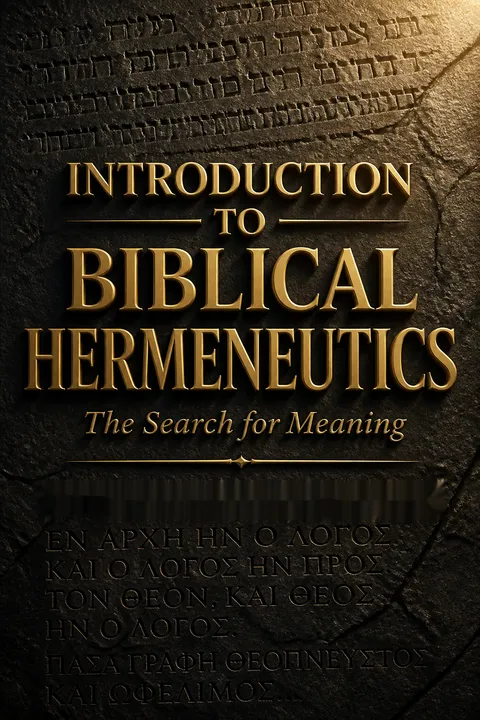
What is Introduction to Biblical Hermeneutics: The Search for Meaning by Walter C. Kaiser Jr. about?
- Comprehensive guide to interpretation: The book is a detailed introduction to biblical hermeneutics, focusing on principles and methods for interpreting the Bible accurately.
- Bridging academic and devotional reading: It aims to serve both lay readers and scholars, addressing the complexity of meaning and the need for careful interpretation.
- Dual authorship and dialogue: Kaiser and Silva present differing views on key issues, encouraging readers to engage thoughtfully rather than accept a single perspective.
- Central concern with meaning: The subtitle, "The Search for Meaning," highlights the book’s focus on understanding what biblical texts mean and how that meaning applies today.
Why should I read Introduction to Biblical Hermeneutics by Walter C. Kaiser Jr.?
- Avoids interpretive errors: The book provides a historical overview of biblical interpretation, helping readers recognize and avoid common mistakes.
- Balances faith and scholarship: It respects both rigorous academic exegesis and the spiritual, theological dimensions of Scripture, making it valuable for a wide audience.
- Practical application guidance: Readers learn how to responsibly apply biblical principles in contemporary contexts, with an emphasis on humility and cultural awareness.
- Engages with major hermeneutical debates: The book’s dual-author format exposes readers to different perspectives, fostering critical thinking.
What are the key takeaways from Introduction to Biblical Hermeneutics by Walter C. Kaiser Jr.?
- Exegetical priority: Exegesis—understanding the grammatical, historical, and literary context—must come before drawing theological conclusions.
- Analogy of faith and Scripture: Interpretation should be coherent with the whole Bible and informed by earlier scriptural texts.
- Cultural and historical sensitivity: Interpreters must bridge the gap between the Bible’s original context and contemporary application, recognizing both continuity and change.
- Role of the Holy Spirit: Spiritual understanding and transformation require the illuminating work of the Holy Spirit, not just intellectual effort.
How does Introduction to Biblical Hermeneutics define and explain biblical hermeneutics?
- Hermeneutics as necessary discipline: The book argues that hermeneutics is essential because the Bible is both a divine and human book, written in ancient languages and cultures.
- Bridging language and history: Specialized principles, such as grammatico-historical exegesis, are needed to understand texts from different times and cultures.
- Formalizing interpretive skills: While people interpret language daily, biblical hermeneutics refines these skills to avoid misinterpretation, especially given the Bible’s unique authority.
- Focus on meaning and application: Hermeneutics seeks to uncover the original meaning and its significance for today’s readers.
What are the main senses of "meaning" in biblical interpretation according to Walter C. Kaiser Jr.?
- Meaning as referent: Identifies what the text is talking about—the object, event, or person addressed.
- Meaning as sense: Focuses on what is being said about the referent, including propositions or arguments.
- Meaning as intention: Emphasizes the author’s intended truth assertions, foundational for validating interpretations.
- Meaning as significance: Relates the original meaning to contemporary readers or situations, guiding application without altering the original sense.
How does Introduction to Biblical Hermeneutics address the relationship between biblical languages and interpretation?
- Value of original languages: Knowledge of Hebrew and Greek is important for accurate interpretation and avoiding invalid readings.
- Context over etymology: The book warns against overemphasizing etymology or reading all possible meanings into a passage, stressing that context determines meaning.
- Everyday language use: Biblical authors used their languages in normal, everyday ways, so interpreters should avoid romanticizing the original languages.
- Translations and clarity: While translations are helpful, they can obscure ambiguities that original languages clarify.
What is biblical theology, and why is it important in Introduction to Biblical Hermeneutics?
- Unified message of Scripture: Biblical theology studies the Bible’s message as a whole, focusing on God’s self-revelation and the unfolding of His promise-plan.
- Emphasis on unity: It seeks to understand how individual parts fit into the overarching narrative, avoiding fragmented interpretations.
- Tool for deeper insight: Biblical theology helps place texts within redemptive history, enabling richer theological understanding and application.
- Prevents thin interpretations: It guards against superficial readings by situating passages within the broader divine plan.
What is the "promise-plan" of God as explained by Walter C. Kaiser Jr.?
- Central unifying theme: The promise-plan refers to God’s unfolding plan of redemption, beginning with creation and culminating in Christ.
- Progressive revelation: The plan is revealed over time, with each biblical era contributing to a fuller understanding of God’s purpose.
- Historical context matters: Interpreters are encouraged to read earlier texts in their own context, avoiding the imposition of later meanings.
- Avoids eisegesis: The approach discourages reading New Testament meanings back into Old Testament texts prematurely.
How does Introduction to Biblical Hermeneutics explain the analogy of faith and analogy of Scripture?
- Analogy of faith: Requires interpreting Scripture so that no passage contradicts the overall teaching of the Bible, ensuring doctrinal coherence.
- Analogy of Scripture: Involves recognizing how earlier biblical passages inform and provide context for later texts through repeated terms, quotations, and themes.
- Post-exegetical check: These analogies are used after exegesis to summarize and check interpretations against the whole canon.
- Prevents doctrinal isolation: They help avoid isolated or contradictory doctrinal conclusions by ensuring interpretations fit within the biblical narrative.
What are the key interpretive principles for different biblical genres in Introduction to Biblical Hermeneutics?
- Narrative: Focuses on indirect communication through scenes, point of view, dialogue, and rhetorical devices, integrating historical and theological messages.
- Poetry and wisdom literature: Marked by parallelism and figures of speech, requiring attention to genre-specific features for accurate interpretation.
- Gospels: Treated as both historical and theological documents, with selective arrangement and use of parables to convey meaning.
- Epistles and prophecy: Emphasize reading letters as wholes, understanding historical context, and distinguishing between types of prophecy (forth-telling, foretelling, conditional, unconditional).
How does Walter C. Kaiser Jr. advise readers to apply biblical principles to contemporary issues?
- Sola Scriptura commitment: Scripture alone is the authoritative source for theology and ethics, but application requires principlization—extracting timeless truths.
- Three horizons model: Application involves considering the Bible’s original context, the interpreter’s context, and the contemporary audience’s context.
- Cultural forms vs. principles: Some commands are culturally bound, so interpreters must discern between unchanging principles and adaptable cultural expressions.
- Cautions against overextension: The book warns against introducing meanings not grounded in the original text, preserving biblical authority.
What role does the Holy Spirit play in understanding and applying Scripture according to Introduction to Biblical Hermeneutics?
- Illumination for understanding: The Holy Spirit enables believers to comprehend spiritual truths that are otherwise inaccessible.
- Conviction and transformation: The Spirit applies biblical truths to readers’ lives, fostering genuine growth and obedience.
- Necessity of humility: Devotional reading requires openness to the Spirit’s work, as intellectual knowledge alone is insufficient for spiritual transformation.
- Clarity and accessibility: The Spirit ensures that essential truths are clear and accessible to all believers, supporting the Bible’s perspicuity.
What are the major historical and contemporary approaches to biblical interpretation discussed in Introduction to Biblical Hermeneutics?
- Jewish and early Christian methods: Covers rabbinic rules, Qumran pesher, Philo’s allegory, and early Christian schools (Alexandrian, Antiochian, Western).
- Reformation and modern developments: Highlights Luther and Calvin’s literal sense, pietism, rationalism, and historical-critical methods.
- Contemporary challenges: Addresses presuppositions, the autonomy of the text, and the reader’s role in meaning-making.
- Balance of objectivity and subjectivity: Kaiser affirms the importance of authorial intent and historical meaning while recognizing interpretive subjectivity.
Download PDF
Download EPUB
.epub digital book format is ideal for reading ebooks on phones, tablets, and e-readers.








