

Plot Summary
Prologue
In 1965, fourteen-year-old Cork O’Connor is still grieving his dead father when he joins Sam Winter Moon, an Ojibwe elder and his father’s friend, to track a bear that has escaped a crushing trap. The hunt takes them into unfamiliar forest.
By nightfall, Sam has decided he would rather see the animal than kill it, and a rattling coffee pot leads him to tell Cork about the Windigo, a cannibal spirit with an icy heart. Sam describes how a man might have to become like the monster to defeat it, and how difficult it is to become human again afterward. The hunt gives Cork a way to carry grief, and the warning will return decades later.
The prologue makes the wilderness a place of both danger and instruction. Cork’s grief initially leaves him unable to welcome anything, but Sam does not try to erase it; he brings the boy into a shared task and allows sorrow to move alongside curiosity. The bear’s survival turns the hunt away from conquest, while the Windigo story plants a harsher possibility: fighting evil may require entering its moral climate. That possibility is not presented as a clean heroic transformation. Sam’s warning about being unable to return from monstrosity foreshadows Cork’s later struggle to distinguish justice from vengeance.
The Paperboy’s Last Stop
Fourteen-year-old Paul LeBeau takes his newspaper route through a blizzard because he treats the work as proof that he is not like his absent, alcoholic father. At the remote North Point estate, Judge Robert Parrant’s front door stands ajar. Paul hears a gunshot inside, follows a trail of blood to the study, and finds the judge’s head destroyed beside a fallen shotgun.
Before he can flee, the study door closes behind him and he sees someone else in the room. His Scout training has prepared him to handle emergencies, but not to face a killing or understand why the scene seems to demand his silence. Paul’s disappearance begins with what he witnesses there.
The opening makes the crime arrive through a child’s routine rather than through official investigation. Paul’s sense of duty brings him into the house, but his preparedness cannot protect him from what he finds. The storm removes ordinary safeguards, isolating the estate from help and witnesses. When the door closes behind him, the scene turns from an apparent suicide into a threat that Paul cannot yet name. His disappearance is therefore not a mystery of careless behavior. It is a response to danger that adults around him have not yet acknowledged.
A Name in the Blizzard
Corcoran O’Connor, known as Cork, is a former sheriff living apart from his wife, Jo, and their children while he carries on an affair with Molly Nurmi. Driving through the blizzard, he gives a lift to Henry Meloux, an elderly Ojibwe medicine man who says a dark presence crossed the sky and called names.
Cork recognizes the old Windigo story from his boyhood hunt with Sam. He later finds his daughter Anne at the brewery’s open water, feeding the stranded geese she worries about, and takes her home. Jo tells him she wants a divorce. That evening, Darla LeBeau reports Paul missing and fears his father, Joe John, has returned to take him.
Cork enters the case from a life already fractured. He has lost the sheriff’s office, lives apart from Jo and the children, and uses his affair with Molly to soften the loneliness without resolving it. Henry’s warning unsettles him because it makes a childhood legend feel present, while Anne’s devotion to the stranded geese exposes the care Cork still shares with his daughter. The storm gathers these pressures into one night: a missing child, a threatened marriage, and a possible force moving through the woods.
The Judge’s False Ending
Cork visits Darla and uses Paul’s receipt book to trace the route, learning that the judge was the last customer and the only one Cork cannot reach by phone. At the estate, he finds Robert Parrant dead in his study. Sheriff Wally Schanno treats the shotgun wound as likely suicide, a conclusion strengthened when Sandy Parrant says his father was dying of cancer.
Cork has no badge, but he knows Paul should have returned and suspects the boy may have seen more than he can explain. Rumors that Joe John is back on the reservation offer a convenient answer to Paul’s absence. Darla later says Paul has contacted her and is safe with his father, but her fear does not ease Cork’s suspicions.
The official explanation is persuasive because it fits what the town already believes: an old, sick judge has died, and a troubled father may have taken his son. Cork’s refusal to accept that neat arrangement is not yet evidence of insight; it is an instinct shaped by years of watching people exploit convenient stories. Without a badge, he must persuade others to take his doubts seriously while also confronting his own record of failure. The case begins to test not only what Cork can discover, but whether he can still trust the methods that once defined him.
The Lake Remembers
Cork’s doubts about his former sheriff’s role reach back to a confrontation over Ojibwe treaty fishing rights. Russell Blackwater urged the Iron Lake band to exercise those rights, while Cork tried to prevent a violent clash between Native fishers and angry white protesters. At Burke’s Landing, Arnold Stanley opened fire. Cork shot Stanley, but Sam Winter Moon was killed beside him.
The fishing stopped, and a negotiated settlement followed. Cork admitted at the inquest that he may have panicked; a recall campaign removed him from office, and Wally Schanno replaced him. The casino later brought jobs and money to the reservation, but its prosperity is inseparable from the deaths that helped make it possible.
Cork’s past gives the present investigation its moral charge. At the fishing-rights protest, he tried to protect the Ojibwe community but could not prevent Sam Winter Moon’s death, then accepted public blame for the shooting. His removal from office left him unsure whether he failed because he acted badly or because the political aftermath needed a scapegoat. The casino’s later prosperity complicates any simple judgment: gains arrived, but the people who paid for them cannot be restored. Cork’s guilt makes him eager to act, while also warning that action can become another form of harm.
The Windigo Calls Again
Cork examines the judge’s body after coroner Sigurd Nelson declines an autopsy. He notices the blood settled on the judge’s back even though the body was found face down, suggesting it had been moved. Henry Meloux names Harlan Lytton as the man the Windigo called, and Cork visits Lytton with Father Tom Griffin because Lytton’s huge attack dog, Jack the Ripper, is dangerous.
When the dog charges Tom, Cork shoots it. Lytton grieves and blames Cork. That night, men break into Sam’s Place, beat Cork, and tear through his belongings. With his furnace broken, Cork returns to the family home, where Jo reluctantly lets him stay, and he resolves to end things with Molly for the children’s sake.
Cork’s private doubts acquire physical consequences. The body’s position contradicts the easy suicide ruling, while the Windigo warning gives him a name to investigate without supplying proof. When Jack the Ripper attacks, Cork shoots to protect Father Tom, but the act leaves Harlan Lytton bereaved and hostile. The beating and vandalism at Sam’s Place make clear that the case is dangerous, yet Cork’s decision to stay with his family also arises from vulnerability: he wants to repair what he helped fracture. His competing loyalties begin to make every choice costly.
Lytton’s Bloodied Folder
Harlan Lytton later calls Cork to his cabin, but a hidden gunman shoots Lytton before Cork can learn what he wanted to show him. As Schanno’s deputies arrive, Cork finds a blood-soaked folder labeled with Jo’s name. Inside are nighttime photographs of Jo and Sandy Parrant, Robert’s son and a newly elected senator, together at Sandy’s hot tub.
Cork confronts Jo, who admits she began seeing Sandy after Cork moved out, while insisting the affair was not the sole reason she wanted a divorce. Cork’s effort to rebuild the marriage collapses under the revelation. He had been carrying guilt for their separation without knowing that Jo had also chosen another life.
The photographs turn private intimacy into an instrument of power. Lytton has not simply watched people; he has collected images that can be used to control their reputations and choices. For Cork, the folder detonates the story he has told himself about Jo’s departure. Her admission does not erase his failures, but it prevents him from treating himself as the sole cause of the marriage’s collapse. The personal revelation also gives the case a new direction: Lytton’s archive may connect the deaths to a wider system of coercion.
Blackwater Beneath the Ice
At the judge’s estate, Cork encounters Schanno searching for evidence that the judge’s body was moved. Someone shoots Schanno, then escapes on a snowmobile. Cork pursues across Iron Lake, where the rider fires at him and crashes through an ice-fishing shack. Near open water, Cork throws a life ring, but the rider clings to the sinking machine and is pulled under.
The dead man is Russell Blackwater. Schanno later finds casino records among Lytton’s belongings that appear to show Russell embezzled money, and he assumes Russell killed the judge and Lytton to silence blackmail. Cork doubts the convenient solution, especially after Schanno burns Lytton’s other files rather than preserve them.
Russell’s death seems to give the case a culprit, but Cork’s attempt to save the man complicates the satisfaction of that answer. Schanno’s explanation arrives quickly, built around casino fraud and blackmail, and its coherence makes it tempting. Yet his choice to destroy the remaining files reveals that an investigation can be compromised by motives that feel protective or practical. Cork has no authority to stop him, only the conviction that the case has not been fully understood. The open water swallows Russell, but it does not close the questions he leaves behind.
Lytton’s Hidden Archive
Cork follows Lytton’s records to a storage unit and then searches the taxidermy shed, where he finds a bag of negatives hidden inside Jack the Ripper’s carcass. An attacker knocks Cork unconscious and escapes, but Cork takes the film to Lytton’s darkroom.
The developed images show Harlan standing over the murdered Joe John LeBeau, Judge Parrant with Helm Hanover at a Minnesota Civilian Brigade gathering, and GameTech documents tied to casino equipment and paid county consultants.
Cork confronts Hanover in GameTech’s Duluth office. Hanover admits the arrangement was meant to finance the militia, but denies killing the judge. The evidence broadens the case from local embezzlement to a political network built on money, blackmail, and armed resentment.
Lytton’s archive reveals surveillance as an economy: he turns private behavior and political meetings into images that can purchase silence or money. The photographs expose the limits of Schanno’s first theory. Russell’s financial misconduct matters, but it cannot account for the entire chain of violence. GameTech’s seemingly ordinary contracts show how corruption can wear a legal face, while Hanover’s militia gathering connects local racial resentment to organized political force. Cork now has a pattern, but not yet a complete account of who arranged the murders or why.
The Mission’s Confession
Cork finds Paul, Darla, Wanda Manydeeds, and Father Tom Griffin hiding at the reservation mission. Wanda explains that her dying father, Vernon Blackwater, confessed he had watched Harlan kill Joe John on Judge Parrant’s orders. Wanda later confronted the judge and struck him with a fireplace poker; Tom staged the shotgun scene as suicide.
Paul had discovered them at the house and was hidden to keep him safe. He also admits that he shot Lytton, avenging his father, and had planned to kill Sandy Parrant. Cork forces Paul to face what killing felt like rather than let him treat vengeance as honorable. The boy breaks down and recognizes he could not live with another death.
The mission gathers people who have concealed the truth for different reasons: grief, fear, protection, and distrust of white institutions. Wanda killed the judge after hearing of Joe John’s murder, while Father Tom altered the scene to shield her from a justice system he believed would fail her. Paul’s revenge nearly extends the violence to Sandy. Cork’s harsh questioning forces him to imagine the victim’s suffering instead of treating retaliation as a moral victory. The scene gives the Windigo myth a psychological shape: becoming monstrous is not simply an enchantment, but a temptation to let pain authorize anything.
Molly on the Ice
Cork returns to Molly’s cabin and finds her dead on the ice beside the sauna, her clothes folded inside. The scene appears to support an accidental fall, but Cork knows the bag of negatives is missing. Jo arrives, and the two go to Sandy’s home. He insists he spent the day there, and Jo supports his account, leaving Cork without proof.
Then Jo discovers a strip of negative in the new Mercedes Sandy gave her. Sandy admits he went to Molly’s cabin to retrieve the evidence and found her dead, but claims he did not kill her. He agrees to hand over the negatives. Jo believes him enough to accept the promise, though the evidence has already unsettled her trust.
Molly’s death strips Cork’s pursuit of its remaining emotional distance. The scene can be read as an accident, yet the disappearance of the negatives keeps suspicion alive. Jo’s response is not simple blindness: she demands evidence, but her bond with Sandy makes his explanation easier to accept than Cork’s accusation. The expensive car and promised political future are part of the same seduction, material signs of a life he claims he can build with her. Trust becomes the last obstacle between Jo and the truth, and the cost of misplacing it is now immediate.
Sandy’s Last Bargain
Sandy binds Jo and drives her toward Molly’s cabin, carrying the negatives and Cork’s revolver. He admits he killed Molly after she resisted surrendering the evidence, then plays a recording from the judge’s office. It captures Sandy, Russell, Vernon, Joe John, and the judge discussing Russell’s casino embezzlement; when Joe John refuses to stay silent, the judge brings in Harlan, who shoots him.
Sandy heard the murder and chose his election over exposing it. He later found the judge’s GameTech and militia records and used them to protect his own future. Now he intends to frame Cork and eliminate witnesses. Jo understands that Sandy’s promise of shared greatness was another form of control.
The tape supplies what rumor and circumstantial evidence could not: a record of Joe John’s murder and Sandy’s presence when it happened. His culpability extends beyond that moment. He chose the election over disclosure, then used the inherited machinery of blackmail and political influence to protect himself. This is ambition converted into an ethical system, one where loyalty lasts only while it advances power. Jo’s captivity makes the betrayal bodily as well as emotional. She must stop treating Sandy’s promises as proof of character and begin acting on what his behavior has shown.
The Windigo Meets the Lake
Sandy takes Jo to Cork’s cabin, where he threatens her and tries to force Cork to accept blame for her death. The lights fail during a struggle, and Jo escapes into the woods. Henry Meloux hides her while Cork draws Sandy away, but Cork’s injuries and exhaustion leave him unable to outrun him.
Remembering Sam’s warning, Cork lets himself become cold enough to meet Sandy without hesitation. Jo finds the Winchester and fires as Sandy drives his Cherokee toward Cork on the lake.
The vehicle veers onto thin ice near Half Mile Spring, overturns, and burns against the cliff. Henry sings Sandy onto the path of the dead. On Christmas morning, Cork leaves a small decorated tree at Molly’s cabin, while the geese return and his daughter reads a different poem.
The final confrontation tests whether Cork can use the Windigo’s coldness without surrendering himself to it. He prepares to meet Sandy with lethal resolve, but Jo’s shot changes the course of the vehicle and prevents Cork from becoming the instrument of the ending he imagined. Henry’s song gives the death a ritual frame rather than a legal one. Christmas offers no restoration of Molly or Cork’s former family life. Instead, the tree, the returning geese, and Jenny’s changed poem mark small acts of attention that make grief livable without making it disappear.
Analysis
Iron Lake builds its mystery around the gap between what can be proved and what a community has learned to accept. The judge’s death first looks like suicide; Paul’s disappearance looks like a domestic matter; Russell’s financial misconduct seems to explain the killings. Each account contains some truth, which makes it more dangerous than a simple lie. Cork’s work consists of resisting explanations that close too neatly, even though his own history has taught him that insisting on certainty can carry a cost. The novel also locates corruption in relationships and institutions rather than in one isolated villain. GameTech’s contracts turn casino prosperity into a channel for private profit and militia funding. The scheme depends on people who can tell themselves they are helping a spouse, protecting a political career, or preventing public scandal. Their motives do not excuse the consequences; they show how moral collapse often proceeds through choices that appear small when made separately.
Cork’s family life mirrors the investigation. He has treated his marriage as a problem he might repair through a decisive gesture, while Jo has concealed a different account of their separation. Molly asks for recognition rather than rescue, and Cork understands that too late. His movement toward the Windigo is therefore both criminal and intimate: he is tempted to turn pain into permission, first with Paul and then with Sandy. He resists that logic not through moral purity, but through other people’s interventions and his own hard-won recognition of what killing does.
The Ojibwe characters are not a cultural backdrop to Cork’s case. Their treaty rights, distrust of white law, spiritual practices, and economic aspirations shape the plot’s stakes and expose the limits of the county’s official institutions. The ending refuses easy repair. The deaths remain, the marriage is not simply restored, and Molly cannot be brought back. Cork’s small Christmas tree is meaningful because it offers no cure. It is an act of attention made after the possibility of rescue has passed.
Review Summary
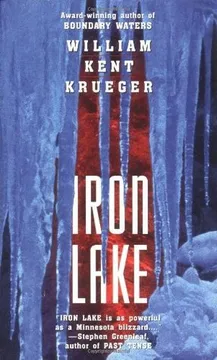
Iron Lake introduces Cork O'Connor, a former sheriff in Minnesota investigating murders and corruption. Readers praise Krueger's atmospheric writing, complex characters, and incorporation of Native American culture. The harsh winter setting and Cork's personal struggles add depth. While some found the plot convoluted, most enjoyed the page-turning mystery and look forward to continuing the series. Krueger's prose and character development receive particular acclaim. The book offers a strong start to a beloved mystery series set in the northern Midwest.
People Also Read





Characters
Corcoran O’Connor
The fallen sheriffKnown as Cork, he is a former Tamarack County sheriff of Irish and Ojibwe heritage, a father of three, and a man whose working life has been shaped by the deaths he could not prevent. Losing his badge has left him resentful and uncertain about the justice system, but he remains observant, persistent, and deeply responsive to people others dismiss. His divided heritage makes him sensitive to the distrust between the reservation and Aurora’s white establishment, though he is never entirely at home in either world. Cork often masks shame with humor and action. His central struggle is to distinguish genuine protection from the urge to control outcomes, especially when grief tempts him to treat vengeance as justice.
Nancy Jo O’Connor
The uncompromising attorneyJo is Cork’s estranged wife, a successful Aurora attorney known for representing clients who cannot afford powerful legal help. She is disciplined, politically astute, and unwilling to soften her principles for the comfort of local leaders. Her confidence was hard won in a town where she began as an outsider and a woman with few clients. At home, that same self-command can become emotional reserve, particularly when she feels Cork has withdrawn from the family. Jo wants security and recognition, but she also wants to believe she can choose a future without sacrificing her independence. Her relationship with Cork is strained by old injuries neither has fully explained to the other.
Molly Nurmi
The self-made neighborMolly is a strong, independent waitress who owns a lakeside cabin and sauna near Cork’s home. She values physical discipline, books, learning, and the quiet life she has built after a difficult youth. Her reputation in Aurora is shaped by gossip, but she does not let the town define her. With Cork, she offers pleasure and companionship while remaining clear-eyed about his unresolved marriage and his divided loyalties. Molly’s warmth does not make her passive: she expects to be treated as a person with her own needs, not as a refuge Cork can enter and leave at will. Her self-reliance is both a hard-earned strength and a way of guarding against disappointment.
Paul LeBeau
The prepared paperboyPaul is fourteen, a capable Scout, and the son of Darla and Joe John LeBeau. He takes his newspaper routes seriously because he wants to prove he can be dependable, unlike the father whose drinking has shaped his childhood. Strong, resourceful, and proud, Paul is also a boy who longs for belonging and for a version of his father he can respect. His practical competence can conceal how frightened and lonely he feels. Cork recognizes something of his own younger self in Paul, especially the way grief and loyalty can narrow a child’s choices. Paul’s story tests whether courage means acting alone or accepting help before pain hardens into certainty.
Henry Meloux
The watchful medicine manHenry is an elderly Ojibwe medicine man and one of the few people Cork trusts to speak frankly about the unseen world. He lives simply on a remote point of Iron Lake and understands the woods through long practice, cultural knowledge, and spiritual attention. White townspeople sometimes mistake his reserve for eccentricity, but he is perceptive about human motives as well as old stories. Henry offers warnings rather than easy answers, and he expects others to accept responsibility for their own choices. His knowledge of the Windigo gives Cork a language for the danger of allowing anger to freeze into a permanent way of being.
Sam Winter Moon
Cork’s Ojibwe mentorSam was Cork’s father’s close friend and a respected Ojibwe hunter who shared food, knowledge, and traditions with the people of the Iron Lake Reservation. He taught Cork to read the land and to approach animals with respect rather than simple possessiveness. Patient without being sentimental, Sam helped the grieving boy reconnect with life through a demanding hunt. His memory remains a moral reference point for Cork, especially when the younger man faces violence and must decide what kind of person survival requires.
Russell Blackwater
The casino’s ambitious managerRussell is an educated Ojibwe leader, a member of the tribal council, and manager of the Chippewa Grand Casino. As a young activist, he challenged white control over Native rights; as a manager, he wears a suit and works inside the economic structures he once opposed. He wants the Iron Lake band to gain lasting independence, jobs, and services, not merely symbolic recognition. His guarded manner and appetite for power make him difficult for Cork to trust, but Russell’s political goals arise from a history of real deprivation. He embodies the tension between self-determination and the compromises required to build institutions.
Sandy Parrant
The rising senatorSandy is the judge’s son, a wealthy developer, and a newly elected senator whose polished manner conceals a powerful appetite for achievement. He is politically liberal in contrast to his father, and his economic projects have brought employment to a region hurt by mine closures. Sandy understands how to make people feel seen and how to present ambition as shared purpose. He is attracted to influence and to people who can help him build a public life. His relationship with Jo draws on both genuine intimacy and the advantages he associates with partnership, leaving others unsure where his affection ends and his calculation begins.
Wally Schanno
The burdened new sheriffWally replaced Cork as Tamarack County sheriff after the recall election. A decent, conscientious Lutheran and a capable local officer, he takes the obligations of his job seriously even when they conflict with his private needs. He is devoted to his wife, Arletta, whose Alzheimer’s disease steadily increases his fear about the future. Wally’s ordinary goodness does not make him immune to compromise: he can be protective, evasive, and too eager for a case to have a manageable answer. His contrast with Cork is not between a good cop and a bad one, but between two men struggling with the cost of duty.
Father Tom Griffin
The activist priestTom is a Catholic priest serving both Aurora and the Iron Lake Reservation. A former missionary in Central America, he carries physical scars and a lively, practical faith that leads him to restore the abandoned mission building himself. He is known affectionately as St. Kawasaki because he travels on an unreliable old motorcycle or snowmobile. Tom works closely with Ojibwe leaders and treats spiritual care as inseparable from material responsibility. He listens without rushing to judgment, but his loyalty to people in danger can place him in conflict with official law.
Wanda Manydeeds
The guarded community leaderWanda is an Ojibwe Midewiwin, tribal council member, and founder of Nokomis House, a shelter for Native women. Tall, direct, and difficult to intimidate, she distrusts systems that have repeatedly failed her community. Her political activism is matched by the daily work of caring for her children and the women who seek refuge at the lodge. Wanda values silence as a form of judgment and control, not merely as fear. Cork respects her commitment even when her refusal to answer his questions frustrates him.
Joe John LeBeau
The fallen basketball starJoe John is Darla’s husband and Paul’s father, a gifted former basketball player whose career ended after a car struck and badly injured him. He later struggled with alcohol and the shame of being seen as a failure by the town that once celebrated him. Cork remembers him as a friend who could be funny, talented, and deeply hurt by prejudice. Joe John’s efforts to regain self-respect matter to his family, especially to Paul, who wants to see his father as someone worth following.
Darla LeBeau
Paul’s protective motherDarla works in public relations at the casino and is Paul’s mother. She has known Cork since high school and has spent years managing the consequences of Joe John’s drinking while trying to give her son a stable life. Darla is practical and guarded, especially when she fears that official attention will make a dangerous situation worse. Her silence can frustrate Cork, but it grows from a mother’s instinct to protect Paul rather than from indifference.
Robert Parrant
The old political patriarchJudge Robert Parrant is a powerful former politician and the father of Sandy. He built influence through business, local alliances, and a belief that government should not interfere with individual ambition. His long career has made him a formidable presence in Tamarack County, even after his political fortunes declined. He regards relationships as part of a larger calculation and has little patience for people who challenge his authority. The distance between his public reputation and private conduct shapes the town around him.
Helmuth Hanover
The militia-minded editorHanover edits the Aurora Sentinel and uses its editorial pages to criticize government and give space to extremist politics. A Vietnam veteran who lost part of a leg, he carries an anger that turns easily toward targets he believes threaten local white workers. He can distinguish local reporting from opinion when it suits him, but his tolerance for inflammatory causes helps make radical ideas seem respectable in town. His influence comes less from formal office than from shaping what Aurora’s residents hear and repeat.
Jenny O’Connor
The searching eldest daughterJenny is Cork and Jo’s fourteen-year-old daughter, small, sharp-minded, and resistant to being told what to think. Her unconventional clothes, interest in Sylvia Plath, and dry humor set her apart from her more conventionally devout younger sister. She is deeply affected by her parents’ separation, though she often protects herself with skepticism. Jenny wants adults to be honest about what they have broken and what cannot simply be restored.
Anne O’Connor
The faithful younger sisterAnne, often called Annie, is Cork and Jo’s younger daughter. She is a devout Catholic with a serious concern for animals, particularly the injured goose and its mate that remain on the brewery’s open water. Her faith gives her a way to express hope for her family, even when the adults cannot promise that her wish will come true. She remains affectionate toward Cork and often brings him back to the small acts of care he is tempted to overlook.
Stevie O’Connor
The youngest childStevie is Cork and Jo’s five-year-old son. Imaginative and easily frightened by darkness, he relies on his father’s presence to make the world feel manageable. His trust reminds Cork that children need comfort even when adults cannot protect them from every danger.
Arletta Schanno
Wally’s beloved wifeArletta is Wally Schanno’s wife and lives with Alzheimer’s disease. Her warmth and moments of confusion reveal the intimate burden behind Wally’s public steadiness. He is determined to keep her at home and preserve the life they have shared.
Harlan Lytton
The reclusive photographerLytton is a loner and taxidermist who grew up under the protection of Judge Parrant, whose household employed his mother. A troubled adolescence and a military career that ended badly left him isolated from the town. He keeps dangerous company and an imposing dog, yet his private interests include photographing the winter landscape. Lytton’s habit of watching people from a distance makes him both feared and difficult to understand.
Plot Devices
The Windigo
A myth of moral coldIn Ojibwe tradition, the Windigo is a giant cannibal with an icy heart, and Sam Winter Moon warns Cork that defeating one may require becoming one. Henry Meloux’s reports of the spirit calling names give the present-day murders an uncanny frame. The story never needs the creature to function as a conventional monster: it also names the human capacity to turn grief, fear, and ambition into permission for cruelty. Cork’s final struggle depends on whether he can borrow the Windigo’s resolve without keeping its heart.
Lytton’s photographic archive
Secrets made into leverageLytton uses specialized cameras and night photography to record private encounters, political meetings, and documents. The images can threaten reputations, conceal criminal links, and send Cork toward people who would prefer the past to remain invisible. They first appear as evidence of Jo’s relationship with Sandy, then expand into a record of the larger network surrounding GameTech and the militia. The archive makes seeing itself dangerous: information is not automatically justice, especially when the person who controls it can use it to blackmail or mislead.
GameTech contracts
Legal cover for corruptionGameTech buys casino equipment and leases it back at inflated long-term cost, creating a steady source of money that appears legitimate on paper. Consultant contracts distribute payments to influential local figures, while the arrangement also supports the Minnesota Civilian Brigade. The scheme exposes how exploitation can operate through contracts, not only through overt theft. Because the casino is a source of genuine prosperity for the Ojibwe community, the fraud is especially difficult to discuss without risking the credibility of the institution and the people it serves.
The open water
A dangerous passageRunoff from the brewery keeps a patch of Iron Lake unfrozen, making it both a refuge for Romeo and Juliet, the geese, and a hazard for anyone crossing the lake in winter. Cork and Anne feed the birds there, and Cork’s concern for their safety becomes a small measure of his tenderness as a father. Later, the lake’s thin ice shapes the pursuit and its outcome. The same landscape that sustains life can become lethal without warning, a concrete reminder that nature is not an accomplice to human intentions.
The bear hunt memory
A model for griefCork’s adolescent hunt with Sam Winter Moon teaches him that a difficult encounter need not end in domination. Sam changes his mind about killing the enormous bear, and the experience gives Cork a path through the grief left by his father’s death. The hunt returns in Cork’s memories and in the bearskin Sam leaves him. It also frames the later Windigo story: courage and violence can look similar in the moment, but the choices made before and after danger determine what kind of person survives it.
Cork O'Connor Series

About the Author
Other books by William Kent Krueger


Download PDF
Download EPUB
.epub digital book format is ideal for reading ebooks on phones, tablets, and e-readers.








