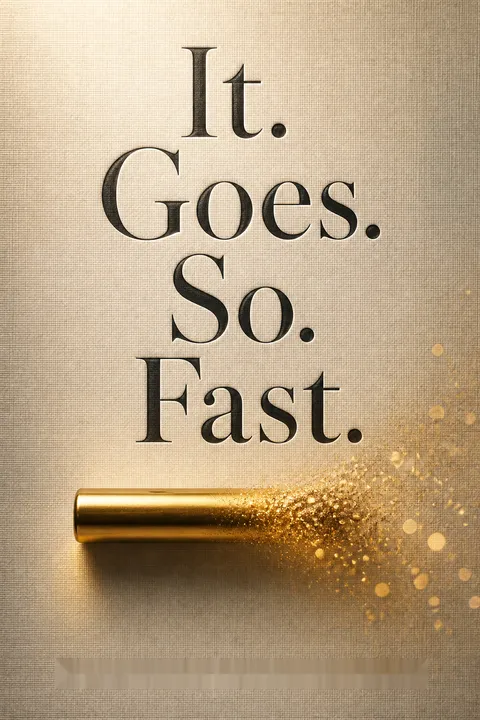


Key Takeaways
Treat ordinary family time as finite before it becomes a memory.
The quiet misses accumulate. Kelly’s weekday broadcast begins at the same hour as her son James’s soccer games. She misses nearly all of them, telling herself there will be another chance. Then ninth grade gives way to senior year, and the ordinary game becomes one of the last chances to watch him play at home. She counts the weeks, then days, until he leaves, realizing that family life does not announce when a routine moment is becoming a last one.
No blame, just a clock. Kelly is not condemning parents who work, or claiming that every family has equal freedom to choose. Her point is that time is limited, and repeated small decisions shape a life as surely as dramatic emergencies do. The question is not how to do everything, but which absences and presences one can live with.
What's powerful here is the distinction between crisis and accumulation. A medical emergency makes priorities obvious; a weekly game does not. Behavioral research on temporal discounting helps explain why: distant losses feel abstract, so people favor immediate obligations until the future suddenly arrives. A practical response is to put recurring, meaningful events on the calendar before work fills every opening. That is not a universal prescription. Some people cannot move their shifts or afford to miss income. The insight is less about perfect choices than noticing when repetition has quietly made the choice for someone.
Compare your private fears with other people's carefully edited lives.
Two mothers, two assumptions. When Kelly takes time off work to arrange speech therapy for her two-year-old son Alexander, she runs into Annie, a successful reporter dressed for a White House interview. Kelly sees Annie’s polished career and feels she has lost her own. She imagines Annie sees a disheveled has-been. Years later, Annie confesses that she had envied Kelly’s morning in the park with her happy child, while Annie was rushing to work and worrying about daycare.
Neither saw the whole picture. Alexander eventually speaks confidently in public, and Kelly finds an old note from the doctor that recalls how frightened she was. The encounter reminds her that people often mistake another person’s visible circumstances for evidence that they made the better choice. A stranger cannot see the fear, cost, or love underneath the scene.
This story gives social comparison a concrete mechanism: each woman evaluates her own internal experience against the other’s public surface. Psychologists distinguish this from a fair comparison, because the observer sees only selected evidence and fills in the rest with assumptions. The correction is not to stop noticing other people’s lives, but to treat first impressions as incomplete data. At the same time, the story should not erase real inequality. Some people do have more money, flexibility, or support. Perspective can soften envy, but it cannot substitute for policies that make care and work more compatible.
Let work and family both matter without pretending trade-offs vanish.
There is no frictionless balance. Kelly loves the newsroom and the urgency of reporting, yet leaves NPR after a call from her son’s school while she is in a military helicopter over Baghdad. She writes novels, misses journalism, and returns to the newsroom when major events make her want to report again. Success brings more invitations and responsibility, not a clean finish line. Meanwhile, she remembers both choices she regrets and assignments she is glad she accepted, even when leaving her children hurt.
Contradictory feelings can coexist. Near James’s graduation, Kelly declines a return assignment to Ukraine because it would keep her away for weeks. The decision matters, but it does not make her career less meaningful or erase her desire to go. The book rejects a single formula for working parents: circumstances differ, and a choice can be right while still carrying grief.
This is a more credible account of work and care than the promise of having everything at once. The emotional skill on display is not perfect balance but tolerating ambivalence without turning it into self-condemnation. That resembles the idea of cognitive complexity: holding competing truths without forcing one to cancel the other. Still, individual choice has limits. Kelly has unusual professional standing and family support, while many workers face rigid schedules and financial necessity. Her reflections are most useful when read as a way to examine trade-offs, not as evidence that everyone can simply choose differently.
Turn intention into protected time, then accept what plans cannot control.
Make presence concrete. After realizing she has missed so many games, Kelly arranges six weeks away from the newsroom during soccer season. She plans to write until mid-afternoon, then drive to the field. Some days deliver exactly what she hoped for: goals, shared excitement, and a fleeting exchange between brothers as James subs off and Alexander takes his place.
Plans cannot command the weather. Kelly retreats to Nantucket to finish the book, expecting to return for James’s final regular-season game. A storm forces the game forward, then blocks her from leaving the island. James scores a decisive goal without her in the stands. She later attends the state championship, where he scores again and the team wins. The distinction matters: planning can increase the odds of showing up, but it cannot guarantee control over every outcome.
The leave is a useful example of implementation intention: a value becomes more actionable when linked to a specific block of protected time. Yet the storm exposes the limits of productivity logic. A plan can reduce avoidable absence, not eliminate uncertainty or guarantee the most meaningful moment. This is a valuable correction to advice that treats intention as control. A resilient plan includes both commitment and flexibility, such as asking others to step in when circumstances change. The deeper test is not whether every event is witnessed, but whether priorities have shaped the pattern of ordinary days.
Raise children to outgrow your protection, even when it stings.
Care changes shape. During a violent storm, Kelly finds Alexander awake beside Shadow, the family dog he had campaigned for and promised to care for. She settles the trembling dog across her lap and comforts both of them, recalling the bedtime reassurance she once gave her small sons. Her instinct to protect remains, but the scene is different now: her teenager is caring for a frightened animal, and he tells her when he no longer needs her help.
Independence is the point. Kelly describes the parental contradiction: adults want children to become capable, then mourn the evidence that they are. The same care that once meant feeding, soothing, and keeping watch must eventually make room for children to act without a parent nearby. Her own mother and grandmothers remain present in the words and habits she passes on, suggesting that protection can continue as an inheritance rather than constant supervision.
The scene captures a central tension in developmental psychology: secure care is meant to support exploration, not prevent separation. A child’s independence can therefore be evidence of successful attachment, even when it feels like rejection to the parent. That emotional cost deserves recognition rather than dismissal. The story also broadens caregiving beyond the parent-child pair: Kelly’s inherited comfort comes from her mother, while her mother later helps care for the family. Independence is not isolation. Healthy separation depends on reliable relationships that remain available without demanding constant dependence.
Listen before the last conversation becomes impossible to recover.
Listening takes effort. Kelly has severe high-frequency hearing loss and uses hearing aids to anchor a national radio broadcast. In a test where she could not see the speaker’s lips, she understood only six of twenty spoken words. At home, she sometimes misses what James says while she is not wearing her aids; he grows frustrated and gives up. Professional interview skills, such as waiting through silence or asking for examples, do not automatically work with teenagers.
Change the conditions, not just the intention. Kelly recognizes that listening requires practical access as well as patience: hearing aids, face-to-face conversation, and the willingness to ask someone to repeat themselves. As her sons approach adulthood, she wants to spend less time correcting and interrogating, and more time listening without an agenda. The regret is not simply that a conversation might be missed, but that she may have filled too many with instructions.
This section makes listening both relational and material. Communication is not just a virtue; it depends on accessible conditions, and Kelly’s hearing loss shows how easily intent can fail when the environment is wrong. Disability scholarship often emphasizes that barriers arise from the interaction between a person and their surroundings, not solely from an individual impairment. The family scenes add another complication: teenagers may choose not to talk, even when access improves. Listening well cannot force disclosure. It can, however, keep the door open and reduce the chance that a preventable misunderstanding becomes a permanent silence.
Ask powerful people again, then own only your response.
Questions are public service. In a short interview with Secretary of State Mike Pompeo, Kelly asks about Iran, then turns to Ukraine and the treatment of Ambassador Marie Yovanovitch. Pompeo ends the interview early and berates her privately, including challenging her knowledge of geography. Kelly reports what she knows and how she knows it, rather than turning the incident into a personal media feud. She also declines television appearances that would shift attention from the journalism to her own reaction.
Courage needs boundaries. Kelly sees persistence as part of a reporter’s responsibility to listeners who cannot question officials themselves. But she distinguishes pressing for an answer from retaliating for an insult. Her young son’s instinct to physically defend his brother adds a useful complication: standing up to a bully can be necessary, though the right response depends on the situation and the available power.
The section links professional ethics with emotional regulation. Repeated, precise questioning can reveal evasion more clearly than an elaborate performance, while restrained reporting protects credibility when the subject attacks the reporter. The institutional setting matters: NPR’s editors and leadership support Kelly, a safeguard unavailable to many freelancers or journalists working under more threatening governments. That does not diminish her judgment; it clarifies its conditions. The passage also resists an easy rule that one should always rise above conflict. Accountability sometimes requires confrontation, but public interest, proportionality, and safety should guide the response.
Find the human stakes inside the geopolitical story.
Policy reaches the kitchen table. Before Russia’s full invasion of Ukraine, Kelly interviews Hanna Hopko, a former parliament member whose daughter wants a guinea pig. Hopko worries that war could force the family to evacuate with the animal. The moment is funny and tender, but it makes the stakes of a possible invasion immediate: a parent is trying to protect a child while also preparing to defend a country.
Small stories can carry large events. After the invasion, Hopko tells Kelly that her daughter is safe elsewhere and keeps asking about the guinea pig, Nafanya. An American butcher later names a sausage after Hopko and directs proceeds toward Ukrainian refugees. The contribution is modest beside government aid, but it signals solidarity and gives listeners a memorable human thread through a vast crisis. Kelly’s reporting shifts from abstract strategy toward the lives that strategy is meant to protect.
Human-scale detail is not decorative relief from serious reporting. It is a way to make abstract stakes legible and to preserve the agency of people often reduced to symbols in coverage. The guinea pig makes displacement imaginable because it introduces the ordinary logistics, attachments, and anxieties that policy language can obscure. There is a risk that a vivid anecdote can crowd out structural analysis or turn suffering into a sentimental hook. The strongest reporting uses such details as a doorway, then connects them back to military, political, and humanitarian realities.
Treat aging invisibility as culture's bias, not your disappearance.
Being seen changes with age. Kelly admits that, despite rejecting harassment, she misses the feeling of being noticed by strangers. A friend describes passing young rowers who look at her teenage child instead, as if she has lost a language she once spoke. Kelly’s own encounters include a shop assistant warning her about showing her arms and a hairdresser steering her away from gray hair.
The message is social, not personal. Older women are often shown in advertising as patients or consumers of anti-aging products, while a senior congresswoman reports being told that gray hair would undermine her credibility. Kelly does not argue that youth should be preserved at any cost. She asks why women’s visibility and attractiveness are treated as though they expire together, and imagines reclaiming attention as proof of presence rather than a promise of romantic possibility.
The chapter names a real asymmetry: aging men can retain authority while women are more often judged through appearance and youth. Its candid admission about missing attention complicates the usual public script, which expects women either to reject beauty standards or confess defeat. Both responses can conceal the desire to remain visible. The nuance is that unwanted attention is not a reliable measure of worth, and many women never experienced it as flattering or safe. The sharper target is the cultural system that makes visibility feel scarce, not the individual who misses a form of recognition.
Keep loved ones present through rituals, skills, and shared effort.
Grief travels through habits. Kelly’s father, Jim, teaches her to run and to make his preferred Manhattan. After his death, she returns to the Peachtree Road Race, a Fourth of July tradition he loved, and hears his encouragement in the rhythm of her run. Her college friends mark his death anniversary with a donation to GirlTrek, which supports walking groups for Black women and girls.
Love changes channels. Kelly sees her father’s humor in James, his connection to nature in Alexander, and his care reflected in friends who support her and her mother. A recipe, a race, a remembered voice, and a friend’s gesture do not undo grief. They make a relationship available in new forms. The family’s rituals carry knowledge forward, much as her mother’s words and her father’s practical advice once became part of her own voice.
This account aligns with the idea of continuing bonds, a model of bereavement in which the deceased remain part of a person’s life through memory, ritual, and inherited practice. It offers an alternative to treating grief as a task of detachment. The race and recipe are especially effective because they make remembrance bodily and repeatable, not merely reflective. Such rituals do not work identically for everyone, and they cannot resolve the loss. Their value is more modest and durable: they create occasions for love to be enacted, shared, and passed on.
Treat an unsettled marriage, empty nest, and career as an open plot.
The next act is uncertain. As James prepares to leave for college, Kelly’s mother falls and needs rehabilitation, and her husband tells her he wants to separate. The family is celebrating graduation while the home feels newly unstable. Kelly does not force the marriage into a neat conclusion or pretend that her professional future is settled. She returns to an old journal and recognizes the young woman she was before marriage and motherhood: anxious, ambitious, and trying to find her way.
Growth can feel like rupture. An old line in the journal describes pain as walls cracking as a room expands. The image reframes transition: the self is not necessarily disappearing when familiar roles change. Kelly’s final scenes hold pride, grief, gratitude, and uncertainty together, as her sons walk toward their adult lives and she considers what work, home, and love might mean next.
The ending refuses the tidy redemption arc often imposed on memoir: no single insight repairs a marriage or makes an empty nest painless. That openness is a strength because transitions are processes, not conclusions delivered on schedule. Narrative identity research suggests that people make sense of change by revising the stories they tell about themselves, but not every difficult event needs an immediate lesson. Kelly’s earlier self remains recognizable beneath the roles she has acquired. The unresolved questions leave room for agency without pretending that the future is fully controllable.
Analysis
This memoir is organized around a countdown, but its real subject is not simply the passage of childhood. It is the gap between a parent’s imagined importance and the child’s growing independence. Kelly begins by treating a senior year as a final opportunity to repair years of missed soccer games. The book then complicates that urgency: her sons may not remember many absences, they do not always notice when she leaves, and her attempts to be present cannot prevent every missed moment. The tension makes the title’s warning more than a sentimental slogan. Time passes, but it does not offer a single, definitive test of whether a parent did enough.
The episodic structure suits this argument. A silent toddler, a teenager and a frightened dog, a difficult interview with a cabinet official, a lost parent, and a war assignment seem at first to belong to separate books. Their connection is the repeated collision of roles: reporter and mother, ambitious worker and grieving daughter, protector and person who must let go. Kelly’s reporting background supplies a second lens. She watches people closely, checks old records against memory, and recognizes that what appears to be a simple story often contains contradictory accounts. The encounter with Annie makes that method personal: each woman misreads the other because each sees only the visible scene.
The memoir’s strongest contribution is its resistance to moral arithmetic. It does not claim that family must always defeat work, or that professional ambition is selfish. Kelly is glad she went to Pakistan and still regrets leaving her baby. She turns down a later Ukraine assignment and remains eager to report. That honesty matters, though her freedom to choose is greater than many parents have. The book’s tenderness also risks idealizing family memory, especially when rituals and inherited voices make loss feel bearable. Its better insight is quieter: love does not erase missed chances, but it can keep changing form. The book ends without solving marriage, career, or grief, leaving its central question open: how to spend a life when every meaningful commitment excludes another.
Review Summary
"It. Goes. So. Fast." receives mixed reviews, with some praising Kelly's honesty about balancing work and family, while others criticize her privilege and lack of focus on parenting. Many readers appreciate her reflections on motherhood and career, but some feel the book strays from its promised premise. Kelly's writing style and storytelling are generally well-received, though some find her perspective difficult to relate to. The book's exploration of work-life balance and the fleeting nature of childhood resonates with many parents, despite its limitations.
People Also Read








Glossary
Act III
Life after active parentingKelly’s metaphor for the stage of life that opens as her sons prepare to leave home. She imagines life as a play in acts: youth forms the first, raising children the second, and the next phase becomes a newly open stage. The term does not name a fixed plan. It frames later adulthood as a chance to ask what comes next while acknowledging uncertainty.
Abu Simbel
A missed-event running jokeKelly and her husband’s private shorthand for an outing one partner misses and the other later describes with intense enthusiasm. The name comes from a trip to the ancient Egyptian temples at Abu Simbel, which Kelly initially chose not to visit, then regretted after her husband returned delighted. In the memoir, the phrase becomes a joking label for the fear of missing an important experience.
FONs
Kelly’s college friend groupAn abbreviation for the Forces of Nature, the affectionate name Kelly and her college friends use for their close-knit group. The eleven women did not all technically share a room or dorm, but they graduated together and sustained their bond through frequent messages and annual gatherings. Their friendship provides support across adulthood, including parenting, bereavement, and major life transitions.
The year of no do-overs
A final year under one roofKelly’s description of the year before her eldest son leaves for college, when she realizes that the family will not have another guaranteed year living together. The phrase focuses her attention on choices she had postponed, especially attending routine events. It is not a claim that every missed moment can be recovered, but a prompt to recognize when an opportunity is finite.
FAQ
What's "It. Goes. So. Fast.: The Year of No Do-Overs" about?
- Author's Journey: The book is a memoir by Mary Louise Kelly, chronicling a pivotal year in her life as she balances her demanding career as a journalist with her role as a mother to two teenage sons.
- Themes of Time and Change: It explores themes of time, change, and the bittersweet nature of watching children grow up, emphasizing the idea of "no do-overs" in parenting.
- Personal and Professional Conflict: Kelly shares her internal conflict between her professional ambitions and her desire to be present for her sons during their final years at home.
- Reflection and Growth: The narrative is a reflection on personal growth, the challenges of work-life balance, and the importance of cherishing fleeting moments with loved ones.
Why should I read "It. Goes. So. Fast.: The Year of No Do-Overs"?
- Relatable Parenting Insights: The book offers relatable insights into the challenges and joys of parenting, especially for working parents trying to balance career and family.
- Emotional and Thought-Provoking: Kelly's candid storytelling evokes a range of emotions, prompting readers to reflect on their own lives and priorities.
- Inspiration for Work-Life Balance: It provides inspiration and practical advice for those struggling to find a balance between professional responsibilities and personal life.
- Engaging Writing Style: Kelly's engaging writing style, combined with her journalistic background, makes for a compelling and thought-provoking read.
What are the key takeaways of "It. Goes. So. Fast.: The Year of No Do-Overs"?
- Cherish the Present: The book emphasizes the importance of cherishing the present moment, especially with family, as time passes quickly and opportunities for connection are fleeting.
- Work-Life Balance: It highlights the ongoing struggle to balance professional ambitions with personal responsibilities, encouraging readers to prioritize what truly matters.
- Embrace Change: Kelly's journey illustrates the inevitability of change and the need to adapt and grow through life's transitions.
- Value of Reflection: The memoir underscores the value of reflection and introspection in understanding one's priorities and making meaningful life choices.
How does Mary Louise Kelly balance her career and family in "It. Goes. So. Fast."?
- Intentional Choices: Kelly makes intentional choices to prioritize her family, such as taking leave from her job to attend her sons' soccer games.
- Struggle and Sacrifice: She candidly shares the struggles and sacrifices involved in balancing her demanding career with her desire to be present for her children.
- Support System: The book highlights the importance of a support system, including friends and family, in managing the demands of work and family life.
- Reflection and Adaptation: Kelly reflects on her experiences and adapts her approach to find a balance that aligns with her values and priorities.
What are the best quotes from "It. Goes. So. Fast." and what do they mean?
- "It. Goes. So. Fast.": This phrase encapsulates the central theme of the book, emphasizing the fleeting nature of time and the importance of savoring moments with loved ones.
- "The year of no do-overs": This quote highlights the urgency Kelly feels to be present for her sons during their final year at home, as there are no second chances in parenting.
- "Love isn’t the absence of struggle. Love is struggle.": This quote reflects the idea that love requires effort and perseverance, especially in relationships and parenting.
- "You own everything that happened to you. Tell your stories.": This quote, inspired by Anne Lamott, encourages embracing one's experiences and sharing them authentically.
How does Mary Louise Kelly's career as a journalist influence her perspective in "It. Goes. So. Fast."?
- Storytelling Skills: Kelly's background as a journalist enhances her storytelling skills, allowing her to convey her experiences with clarity and depth.
- Insight into Work-Life Conflict: Her career provides insight into the work-life conflict many professionals face, as she navigates the demands of journalism alongside family responsibilities.
- Analytical Reflection: Kelly's journalistic training encourages analytical reflection, prompting her to examine her life choices and their impact on her family.
- Public and Private Balance: The book explores the balance between her public role as a journalist and her private role as a mother, highlighting the challenges of managing both.
What role do Kelly's sons play in "It. Goes. So. Fast."?
- Central Figures: Kelly's sons, James and Alexander, are central figures in the memoir, as their growth and milestones drive the narrative.
- Motivation for Change: Their impending departure for college motivates Kelly to reassess her priorities and make changes to be more present in their lives.
- Source of Reflection: Interactions with her sons prompt Kelly to reflect on her parenting choices and the passage of time, leading to personal growth.
- Emotional Connection: The book captures the deep emotional connection between Kelly and her sons, illustrating the joys and challenges of motherhood.
How does "It. Goes. So. Fast." address the theme of change?
- Life Transitions: The book addresses life transitions, such as children growing up and leaving home, and the emotional impact of these changes.
- Adaptation and Growth: Kelly emphasizes the need to adapt and grow through change, finding new ways to connect with loved ones and pursue personal goals.
- Embracing the Unknown: The narrative encourages embracing the unknown and being open to new experiences, even when they are challenging or unexpected.
- Reflection on Past and Future: Kelly reflects on her past choices and considers her future, highlighting the continuous nature of change and the importance of being present.
What challenges does Mary Louise Kelly face in "It. Goes. So. Fast."?
- Balancing Career and Family: Kelly faces the challenge of balancing her demanding career as a journalist with her desire to be present for her sons during their final year at home.
- Navigating Change: She navigates significant life changes, including her sons' impending departure for college and the evolving dynamics of her family.
- Personal Reflection: The memoir involves deep personal reflection, as Kelly examines her life choices and their impact on her relationships and priorities.
- Emotional Struggles: Kelly candidly shares her emotional struggles, including feelings of guilt, regret, and the bittersweet nature of watching her children grow up.
How does "It. Goes. So. Fast." explore the concept of time?
- Fleeting Moments: The book explores the concept of time as fleeting, emphasizing the importance of savoring moments with loved ones before they pass.
- Urgency and Reflection: Kelly feels a sense of urgency to be present for her sons, prompting reflection on how she spends her time and what truly matters.
- Past, Present, Future: The narrative weaves together reflections on the past, experiences in the present, and considerations for the future, highlighting the continuous flow of time.
- No Do-Overs: The concept of "no do-overs" underscores the idea that time cannot be reclaimed, encouraging readers to make the most of each moment.
What lessons does Mary Louise Kelly learn in "It. Goes. So. Fast."?
- Prioritizing Family: Kelly learns the importance of prioritizing family and being present for her sons during their final year at home.
- Embracing Change: She learns to embrace change and adapt to new circumstances, finding growth and meaning in life's transitions.
- Letting Go of Perfection: The memoir highlights the lesson of letting go of perfection and accepting that not everything can be controlled or planned.
- Value of Reflection: Kelly learns the value of reflection and introspection in understanding her priorities and making meaningful life choices.
How does "It. Goes. So. Fast." resonate with readers?
- Relatable Experiences: The book resonates with readers through its relatable experiences of parenting, work-life balance, and the passage of time.
- Emotional Connection: Kelly's candid storytelling creates an emotional connection, prompting readers to reflect on their own lives and relationships.
- Inspiration and Insight: The memoir offers inspiration and insight for those navigating similar challenges, encouraging readers to cherish the present and embrace change.
- Universal Themes: The themes of love, family, and personal growth are universal, making the book relevant and meaningful to a wide audience.
Download PDF
Download EPUB
.epub digital book format is ideal for reading ebooks on phones, tablets, and e-readers.








