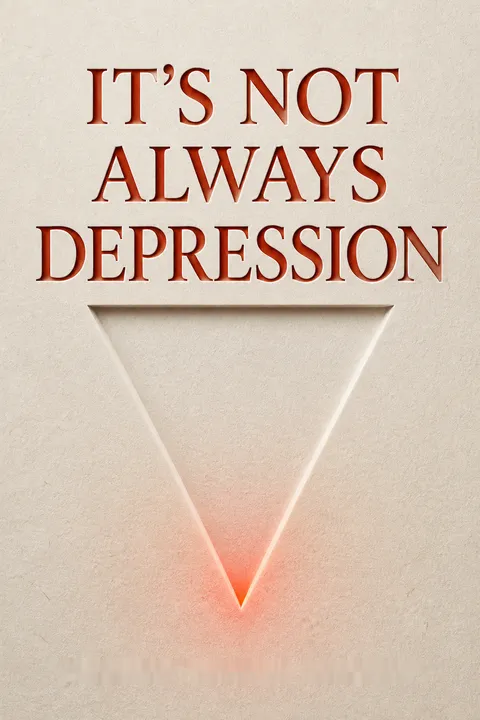


Key Takeaways
Treat depression as a signal to investigate, not a complete explanation
Symptoms can point inward. Hendel argues that depression and anxiety can sometimes protect a person from feelings that once seemed unbearable. After her former husband remarried, she became depressed, then recognized fear and loneliness beneath the shutdown. Medication helped her function, while therapy helped her understand what the distress was connected to and how to respond to her emotions differently.
Keep the explanation open. The book does not claim every depression is hidden grief or trauma. Hendel acknowledges that some mental illnesses have biological causes, and that medication may be important, especially when symptoms make daily life or therapy difficult. The practical lesson is to treat a diagnosis as useful information, not the whole story: symptoms may have several causes, and support can address more than one at a time.
The distinction between a symptom and its possible function encourages curiosity without dismissing suffering. In medicine, a symptom can be both a condition to treat and a clue about what else is happening; those are not competing explanations. The caution matters because framing depression as a defense can become blame if readers conclude they simply need to feel harder. The book itself allows for biological illness and medication. A sound application is therefore additive: seek appropriate clinical care while also exploring emotional, relational, and situational contributors with qualified support.
Map the route from avoidance through feeling toward clarity
A map, not a verdict. The Change Triangle is Hendel’s guide to sorting emotional experience. It asks a person to notice whether they are avoiding feeling through a defense, caught in anxiety, shame, or guilt, or in contact with a core emotion such as fear, anger, sadness, disgust, joy, excitement, or sexual excitement. Processing can lead toward the openhearted state, marked by greater calm and clarity. The map is meant to show what to attend to next, not to label a person as broken.
Use it in ordinary moments. While preparing to write an article, Hendel noticed negative self-talk and phone solitaire pulling her away from anxiety. She slowed down, identified fear of disappointing readers, and could then choose whether to proceed. The shift was from automatic escape to informed choice.
The map's strength is its practical sequence: identify the current state, then select a fitting response instead of reaching immediately for self-criticism. This resembles emotion-regulation approaches that distinguish noticing, interpreting, and acting. It can also interrupt rumination by turning a vague sense of distress into a question with a next step. Still, the categories are a working model, not a medical test. A person may feel several states at once, or find that the labels do not fit. The map is most useful when treated as a prompt for inquiry rather than a rigid classification system.
Let emotions inform your choices without letting impulses drive them
Feel the signal first. In Hendel’s model, core emotions are automatic responses that prepare the body for action. Fear may push someone to escape danger; sadness may slow them down and draw them toward comfort; anger may mobilize protection or change. These responses carry information about what matters, but an impulse is not an instruction. The task is to notice what the emotion wants before deciding what action fits the present situation.
Make room for a choice. When Hendel feared her article would disappoint readers, her fear urged avoidance. Once she named it, she could consider the actual risk and choose to write. The emotion did not disappear by being argued away; it became understandable enough that it no longer had to dictate the outcome.
This distinction between emotion and action is a useful bridge between acceptance-based therapy and practical decision-making. Suppressing anger can obscure a boundary, while acting on anger immediately can damage a relationship. Naming the feeling creates a pause in which values and consequences can also enter the decision. The model is strongest when emotions are treated as evidence, not infallible truth: fear can signal real danger, but it can also echo an old threat. Context, other people's perspectives, and observable facts help determine what the signal means now.
Use the body to find what the mind keeps circling
Slow down to notice. Hendel encourages people to move attention from abstract thoughts to physical sensations: a tight chest, fluttering stomach, heavy limbs, or warmth. These sensations can help identify an emotion that remains vague in words. Naming an emotion may reduce its intensity, and breathing, grounding, or noticing the room can help a person stay present while the feeling changes.
Start with manageable steps. Fran, a client whose parents died when she was a teenager, learned to notice anxiety before approaching grief. When sadness made her heart race, she slowed down, breathed, and pictured a place where she felt safe. This helped her remain present rather than changing the subject or becoming overwhelmed. Hendel advises taking a break if an exercise becomes too distressing.
Attention to bodily sensation can give emotional work a concrete anchor, especially when someone has learned to explain feelings intellectually while remaining disconnected from them. This resembles mindfulness and interoceptive approaches, which train awareness of internal signals without immediate judgment. But bodily cues are not a one-to-one dictionary: a racing heart can accompany fear, excitement, exertion, or illness. Nor does focusing inward calm everyone in every moment. The book's advice to pause when distress rises is important. Grounding in the external environment or seeking a clinician's help may be a better first move.
Respect old defenses, then replace them with safer options
Protection has a history. Hendel uses “defenses” for thoughts or behaviors that help a person avoid emotional discomfort. They can be useful temporarily, but become costly when used automatically. Changing the subject, overworking, joking, worrying, and withdrawing can all function this way. Rather than condemn the behavior, ask what feeling it is trying to keep at a distance and whether the original danger is still present.
Notice before changing. Early in therapy, Fran shifted to talking about knitting just as sadness began to surface. Her therapist did not force her to continue. She helped Fran notice the change and decide whether to stay with the feeling. Over time Fran could recognize the maneuver herself. That growing awareness created more choice, including the choice to take a break when she needed one.
This nonjudgmental approach fits a broader principle in behavior science: avoidance often persists because it provides immediate relief, even when it creates longer-term costs. Asking what a behavior accomplishes is more informative than demanding that it stop. The key is not to treat every distraction as pathological. Rest, humor, and postponing a hard conversation can be sensible responses. A defense becomes limiting when it is the only available response or repeatedly prevents a person from acting on important needs. Curiosity makes change more precise and less shaming.
When the past hijacks the present, bring adult resources into the memory
Old alarms can outlast danger. Hendel describes how a present event can activate a network of earlier emotions, sensations, images, and beliefs. Fran panicked after witnessing a dog struck by a bicycle, which connected with the loss of her parents in an accident. Her reaction made more sense once the earlier grief and fear were recognized. Hendel distinguishes large catastrophic events from repeated or less visible experiences that accumulate into what she calls small t trauma.
Update the emotional learning. Spencer, who had been humiliated by his father, imagined his adult self protecting the boy he had been. The exercise helped him experience anger and care that had been unavailable at the time. Hendel presents this kind of imagery as a way to relate differently to painful memories, not to change the historical facts.
The past-present link offers a compassionate explanation for reactions that seem disproportionate to the immediate event. Memory is not merely a stored narrative; reminders can evoke bodily and emotional responses associated with earlier learning. Imagery can help people approach those responses with more agency. At the same time, strong emotion or vivid imagery does not establish that a memory is historically accurate. The useful aim is to understand current distress and build safety, not to force a forgotten scene into view. Trauma work is best paced carefully, particularly when symptoms are severe.
Borrow safety from trustworthy people until connection feels less dangerous
Emotions need company. The book links emotional development to relationships: children learn what feelings are safe to express partly through how caregivers respond. Repeated dismissal, intimidation, or neglect can teach a child to hide needs or expect rejection. Those expectations may persist in adulthood, even with people who behave differently. Hendel draws on attachment theory to describe patterns that range from comfortable closeness to clinging, withdrawal, or fear of both.
Safety grows through repair. Sara, who had lived with her mother's rages, initially froze when she feared displeasing her therapist. Over time, their predictable relationship gave her room to speak up, disagree, and recover from moments of strain. Hendel calls a shift from insecure expectations toward greater security “earned secure.” In daily life, boundaries, honest conversations, and repairing misunderstandings can help build trust.
The account makes connection part of emotional regulation rather than a reward for already being well. That insight has practical force: a calm, responsive other person can help make difficult feelings more tolerable. The emphasis on repair is especially useful because secure relationships are not conflict-free; they involve making mistakes, addressing them, and restoring trust. Still, not every relationship is safe enough for vulnerability. Readers should not interpret healing as tolerating mistreatment. The capacity to set limits and leave harmful situations is as relevant to security as the capacity to rely on others.
Let anger clarify boundaries, not dictate what you do
Anger can protect. Hendel presents anger as a signal that something may be unfair, hurtful, or in need of change. People who were punished for expressing anger may lose access to it and struggle to say no. Others may confuse feeling anger with acting aggressively. The book separates the internal emotion and its impulse from behavior that harms another person.
Explore before acting. Bonnie had been hit by her father after saying she wanted to quit ballet. As an adult, she explored her anger through an imagined confrontation in therapy. The fantasy let her express the force of the feeling without physically harming anyone. Once the anger eased, she could also feel sadness and think more clearly about her parents' divorce. In real relationships, the goal is assertion and boundaries, not retaliation.
Treating anger as information can help counter the cultural tendency to equate calmness with goodness and anger with danger. The distinction between experiencing an impulse and enacting it supports both emotional honesty and responsibility. Imagery may be a useful clinical tool when guided by a trained therapist, but it is not a universal self-help exercise, especially for people who fear losing control or have a history of violence. Anger also does not prove that another person intended harm. A clear boundary can be warranted even when the interpretation of intent remains uncertain.
Separate guilt for harm from shame about being flawed
Judge the act, not the whole self. Hendel distinguishes guilt, which concerns something a person believes they did wrong, from toxic shame, which turns the judgment into a belief that the person is fundamentally bad. Some shame can help people respect shared rules, but chronic shame can make needs and feelings seem unacceptable. To examine guilt, ask what harm occurred and whether repair is needed. If no wrongdoing occurred, guilt may be blocking anger, fear, or the right to set a limit.
Repair when repair is due. The book recommends an apology that names the action, recognizes its effect, and offers amends. By contrast, a person who feels guilty simply for declining a request may need to tolerate that discomfort rather than reverse a reasonable boundary. These are different situations and call for different responses.
The distinction protects accountability from collapsing into self-condemnation. Shame can make people hide, while specific guilt can focus attention on repair. This aligns with restorative approaches that ask what happened, who was affected, and what can be done now. The framework also guards against the opposite mistake: labeling all guilt as unhealthy. A person may feel uncomfortable because they have hurt someone, and that discomfort can motivate necessary change. The central question is not whether guilt feels bad, but whether it accurately identifies harm and points toward a constructive response.
Practice receiving joy, pride, and care, not only surviving pain
Positive feelings take practice. Hendel argues that people may deflect praise, joy, gratitude, or pride because feeling visible and confident once felt unsafe. She encourages pausing long enough to notice what a good feeling is like in the body, rather than dismissing it as trivial. Her account of the openhearted state describes a condition of greater calm, curiosity, connection, compassion, confidence, courage, and clarity.
Let the good register. After Fran finally experienced grief about her parents, she noticed relief, warmth, and gratitude toward the therapist who stayed with her. The book treats these responses as part of emotional change, not decorative extras. Small practices such as noting things one appreciates or feels proud of can help a person attend to positive experience without pretending that pain is absent.
The focus on positive experience counters a common attention bias: threats and failures often capture more notice than ordinary success or care. Deliberately savoring a positive moment can make it more memorable and can strengthen a person's ability to recognize support. This is not an argument for forced optimism. Some readers face ongoing illness, danger, or grief, and pressure to feel grateful can become another form of shame. The useful distinction is between making room for positive emotion and requiring it. Both pain and pleasure can be true at once.
Analysis
The book's most useful move is to replace the question “What is wrong with me?” with a more specific inquiry: “What is happening in me, and what might this response be protecting?” Its triangle gives that inquiry a repeatable structure. Notice avoidance, identify anxiety, shame, or guilt, approach the underlying emotion at a tolerable pace, and use the information to choose an action. The clinical stories make this process tangible. Fran's abrupt subject change, Bonnie's difficulty speaking directly, and Sara's freeze response are not treated as character flaws. Each behavior is understood in relation to what the person learned about safety, connection, and emotional expression.
The book's strongest ethical stance is that emotions deserve recognition while actions remain a matter of responsibility. Anger can reveal a violated boundary without licensing aggression. Guilt can motivate repair without defining the whole person. A protective habit can once have been necessary and still be costly now. This approach combines self-compassion with agency, rather than treating either as a substitute for the other.
The framework is best used as a map, not a diagnostic instrument. Bodily sensations can be ambiguous, emotional categories overlap, and distress can have biological, social, and material causes that introspection alone cannot resolve. The author's own acknowledgement of medication and biologically based illness helps prevent an overly psychological reading, though the broad claim that symptoms often conceal core emotions should not be generalized to every reader. Likewise, vivid imagery can support therapy, but it should not be mistaken for proof of historical detail or undertaken at any pace regardless of distress.
The most transferable practice is modest: pause, notice the body and the behavior, name a possible feeling, and ask what response would serve the present situation. Sometimes that means staying with emotion. Sometimes it means grounding, seeking another person's help, setting a limit, or consulting a mental health professional. Emotional literacy expands choice; it does not require anyone to endure pain alone or solve every problem from within.
Review Summary
It's Not Always Depression received mixed reviews. Many readers found the Change Triangle concept helpful for understanding emotions and trauma, praising the practical exercises and accessible writing. Some felt it provided valuable insights for self-awareness and healing. However, others criticized the book as repetitive, misleading in its title, and oversimplifying complex mental health issues. Some readers felt it wasn't applicable to severe depression or anxiety. Overall, reviewers appreciated the focus on emotional awareness but had varying opinions on its effectiveness as a self-help tool.
People Also Read




Glossary
Change Triangle
Map for emotional statesA framework for noticing how emotional distress is organized. It directs attention to protective behaviors, anxiety, shame, or guilt, and underlying core emotions, with the aim of reaching a more settled and open state. The triangle is a guide for deciding what to notice or do next, not a diagnostic test.
Core emotions
Inborn emotional signalsThe seven emotions Hendel identifies as basic survival responses: fear, anger, sadness, disgust, joy, excitement, and sexual excitement. In her model, each has bodily sensations and action impulses that help a person respond to a situation. The impulse offers information, but does not determine what action a person should take.
Inhibitory emotions
Feelings that restrain othersAnxiety, shame, and guilt are called inhibitory emotions because they can interrupt or dampen the expression of core emotions. They may help preserve relationships or prevent emotional overwhelm, but can also conceal what a person feels and needs. Their presence is treated as a cue to slow down and investigate what they may be blocking.
Defenses
Protections from emotional painThoughts, actions, or habits that distance a person from uncomfortable feelings. Examples in the book include changing the subject, worrying, joking, working excessively, and withdrawing. Defenses may have helped someone cope with earlier circumstances, but can restrict choices and relationships when they become automatic in situations that are no longer dangerous.
Openhearted state
Settled, connected stateHendel's name for a state in which a person feels more present, emotionally integrated, and able to respond flexibly. It is associated with calm, curiosity, connection, compassion, confidence, courage, and clarity. It does not mean difficult feelings disappear; rather, feelings can be noticed without completely taking over.
Small t trauma
Cumulative emotional injuryA term for the lasting effects of repeated or less visible experiences of hurt, neglect, rejection, or emotional abuse. The experiences may not look catastrophic to an observer, yet can shape a person's beliefs, emotional responses, and sense of safety. The term is used to validate distress without ranking one person's suffering against another's.
Parts
Distinct aspects of experienceA way of describing different feelings, beliefs, memories, or reactions within a person. A person might notice a younger, frightened part alongside an adult part that understands the current situation. Imagining these aspects separately can create perspective and allow the adult self to respond with care rather than being overtaken by the old reaction.
Earned secure
Developed relational securityA description of someone whose early attachment experiences were insecure but who develops greater security in adulthood. Hendel connects this change with learning to set boundaries, ask for needs to be met, tolerate relationship difficulties, and experience trustworthy, responsive connections. The phrase emphasizes that relational patterns can change rather than remaining fixed by childhood.
The 7 C's
Qualities of openheartednessThe qualities Hendel uses to help readers recognize an openhearted state: calm, curious, connected, compassionate, confident, courageous, and clear. They function as points of self-observation, not standards a person must meet continuously. Their absence can indicate that someone is distressed or protective, and can prompt a compassionate check-in.
FAQ
What's It’s Not Always Depression about?
- Focus on Emotions: The book emphasizes understanding and processing core emotions rather than solely focusing on depression.
- Change Triangle Method: It introduces the Change Triangle, a model that helps individuals identify their emotional states and navigate through them.
- Healing Through Awareness: The author, Hilary Jacobs Hendel, discusses how awareness of emotions can lead to healing and personal growth.
Why should I read It’s Not Always Depression?
- Transformative Insights: The book offers valuable insights into the nature of emotions and how they impact mental health.
- Accessible Framework: The Change Triangle framework is easy to understand and apply, suitable for both professionals and laypersons.
- Empowerment: By learning to identify and process emotions, readers can empower themselves to take control of their mental health.
What are the key takeaways of It’s Not Always Depression?
- Core Emotions Matter: Recognizing core emotions such as sadness, anger, joy, and fear is crucial for emotional health.
- Change Triangle Model: The Change Triangle helps individuals identify their emotional states and move towards an openhearted state.
- Healing is Possible: Healing from emotional pain is achievable through awareness, compassion, and the right tools.
What is the Change Triangle, and how does it work?
- Three Corners Explained: The Change Triangle consists of defenses, inhibitory emotions, and core emotions.
- Movement Towards Healing: The goal is to move from defenses and inhibitory emotions to core emotions and ultimately to an openhearted state.
- Practical Application: Readers are encouraged to use the Change Triangle to identify their emotional states and work through them.
What are core emotions, and why are they important?
- Definition of Core Emotions: Core emotions include sadness, anger, fear, joy, excitement, disgust, and sexual excitement.
- Adaptive Functions: Each core emotion has an adaptive impulse that drives behavior, guiding healthier choices.
- Healing Through Experience: Experiencing and processing core emotions is essential for healing and mental health.
How do inhibitory emotions affect our mental health?
- Blocking Core Emotions: Inhibitory emotions like anxiety, shame, and guilt prevent access to core emotions, causing distress.
- Impact on Behavior: These emotions can lead to defensive behaviors that hinder healthy expression and relationships.
- Path to Healing: Recognizing and addressing inhibitory emotions is crucial for reconnecting with core emotions.
How does It’s Not Always Depression address trauma?
- Types of Trauma: The book distinguishes between big T trauma (major events) and small t trauma (emotional neglect).
- Healing from Trauma: Healing involves processing core emotions and understanding past influences on present behavior.
- Role of Connection: Supportive relationships are vital for processing trauma and moving toward healing.
How can I apply the techniques from It’s Not Always Depression in my life?
- Daily Check-Ins: Set reminders to regularly assess your emotional state and encourage self-reflection.
- Labeling Emotions: Practice naming and validating your emotions to reduce anxiety and create calm.
- Using the Change Triangle: Apply the framework to identify emotional states and move towards an openhearted state.
What are some exercises included in It’s Not Always Depression?
- Body Scanning Exercise: Encourages scanning the body for physical sensations associated with emotions.
- Emotion Journaling: Keep a journal of emotions, noting core emotions and their physical manifestations.
- Visualization Techniques: Use visualization to imagine safe spaces or comforting figures during difficult emotions.
What are the best quotes from It’s Not Always Depression and what do they mean?
- “Emotions just are!”: Emphasizes accepting emotions without judgment, recognizing their validity.
- “The power of the Change Triangle is huge.”: Highlights the effectiveness of the Change Triangle for emotional awareness.
- “Healing is possible.”: Reminds readers that emotional healing is achievable through awareness and compassion.
How does It’s Not Always Depression address shame and guilt?
- Understanding Shame: Distinguishes between healthy shame and toxic shame, crucial for emotional healing.
- Guilt as a Signal: Frames guilt as a signal indicating wrongdoing, encouraging exploration of its roots.
- Processing Inhibitory Emotions: Provides strategies like self-compassion to move past shame and guilt.
What role does the body play in emotional processing according to It’s Not Always Depression?
- Mind-Body Connection: Emphasizes tuning into physical sensations associated with emotions for effective processing.
- Physical Manifestations of Emotions: Identifying sensations helps understand emotional states better.
- Releasing Stuck Energy: Engaging with physical sensations allows for the release of emotional energy, promoting healing.
Download PDF
Download EPUB
.epub digital book format is ideal for reading ebooks on phones, tablets, and e-readers.








