

Key Takeaways
Make every sailor responsible for the whole ship
Ownership changes the job. When Abrashoff took command of USS Benfold in 1997, he inherited a talented but discouraged crew. Rather than replace people, he treated them as partners in making the ship better. Sailors could make decisions on their own unless a choice risked injury, damage, or wasted public money. The aim was not to remove authority, but to make responsibility real at every level.
Performance followed participation. In 1998, Benfold used 75 percent of its budget, while mission-degrading equipment failures fell from 75 to 24. Reenlistment among two critical sailor categories rose from 28 percent to 100 percent. Abrashoff credited the crew, not a managerial trick: people who help improve their workplace have reason to protect and excel in it.
What's striking is that ownership here means more than feeling proud of a workplace. It means having actual discretion, information, and consequences to manage. That distinction aligns with self-determination theory, which links motivation to autonomy, competence, and connection to others. Benfold offered all three through meaningful work and shared responsibility. Still, the results come from one ship, and its captain had unusual influence over daily conditions. Other organizations may need to change incentive systems and decision rights before a slogan about ownership can become credible.
Start by seeing the workplace from its lowest deck
Listen where work happens. Military exit surveys put low pay fifth among reasons for leaving. The top complaints were disrespect, having no chance to affect the organization, not being heard, and being denied more responsibility. Abrashoff used those findings to focus on the crew's everyday experience, rather than assuming he already understood it.
Turn complaints into redesign. He interviewed the ship's 310 crew members, often five a day, asking about their lives, goals, and what they would change. One sailor pointed out that rusting fasteners forced young crew members to repaint the ship every other month. The Navy had none of the stainless-steel replacements in stock, so the crew bought them locally. The fix cut the painting burden for nearly a year, and the Navy eventually adopted the fasteners across its ships.
This is a practical version of employee voice: people closest to a process often see friction that managers cannot see from a distance. The interview mattered not because a captain collected personal stories, but because suggestions produced visible changes. That creates evidence that speaking up is worthwhile. A risk remains: asking for feedback and then ignoring it can deepen cynicism. Leaders need a clear way to explain which proposals they adopt, which they decline, and why, especially when safety or law limits the available options.
Replace permission-seeking with bounded, coached decision-making at every level
Set limits, then release control. Abrashoff drew a boundary around decisions that could kill or injure someone, damage the ship, or waste taxpayers' money. Inside those limits, sailors were expected to act without waiting for permission. He backed that freedom with coaching and responsibility for learning from mistakes.
Practice under a watchful eye. During a dangerous at-sea refueling maneuver, junior officer K.C. Marshall admitted he had never handled one. Abrashoff let him take the con, with an experienced officer present to advise and the captain ready to intervene. Marshall initially asked permission for each small adjustment. Once told to make the calls himself, he completed the maneuver successfully. The episode showed the crew that practice was not merely a test of what they already knew. It was a way to build judgment.
The model avoids the false choice between micromanagement and laissez-faire. In high-risk work, autonomy needs guardrails, practice, and access to expertise. This resembles apprenticeship: responsibility expands as skill develops, while a mentor remains close enough to prevent a costly failure. The approach also treats hesitation as a signal about the environment, not simply a personal flaw. Its limits matter: some tasks have little room for learning by trial and error, so leaders must decide in advance which mistakes are recoverable and where rehearsal is essential.
Let useful ideas outrank the rank of whoever offers them
The work contains expertise. In the Persian Gulf, as many as 7,000 operational messages could be delayed or lost in the Navy's communications system. Radioman John Rafalko studied the manuals for a satellite system and saw that it could carry the needed data. After his idea was approved, the backlog disappeared almost overnight, and he trained other ships to use the system.
Make ideas usable. Junior petty officer Derrick Thomas noticed that ship inspections repeatedly asked for information about vessels already inspected. He built a database covering more than 150 ships, so teams could prepare much of their paperwork before boarding. Benfold cleared five delayed tankers in two and a half hours, and the fleet adopted the database. In both cases, the leader's key contribution was giving a lower-ranking expert a hearing and helping remove the obstacles to implementation.
Hierarchies are good at assigning accountability, but they can also filter out information before it reaches decision-makers. Benfold's examples show why authority and expertise should not be treated as the same thing. Research on team cognition similarly emphasizes that complex tasks require access to distributed knowledge, not just the leader's own judgment. Yet a good idea still needs scrutiny: rankless contribution is not the same as rankless approval. Leaders must preserve technical review and accountability while ensuring that status does not disqualify a proposal before it is tested.
Make it safe to report trouble before it becomes catastrophe
Bad news needs a route. Benfold's crew found that an equipment upgrade intended to improve the missile-control system was making it less reliable. Abrashoff reported the problem, and his commodore helped alert the engineers and other ships. In a separate incident, a sailor noticed fuel leaking onto hot equipment. The captain quickly warned senior leaders and recommended checking similar ships, helping reveal a wider hazard.
Review without scapegoating. After major maneuvers, the crew held an After Action Review, a structured discussion of the goal, what happened, the conditions involved, and what to improve. Participants could criticize even the captain without retaliation. The practice made mistakes usable as information instead of occasions for concealment. It also clarified that candid reporting was not an excuse for carelessness: the purpose was to find causes, correct them, and avoid repeating the failure.
Psychological safety, the shared belief that people can raise concerns without punishment, is especially consequential when errors can propagate quickly. The ship's reviews paired openness with analysis, which is stronger than simply telling employees to speak freely. The distinction between blame and accountability is crucial: a system can investigate causes without humiliating the messenger, while still addressing reckless conduct. Leaders also need to respond visibly to reports. If concerns are welcomed in theory but buried in practice, silence will return.
Train for confidence, backups, and recoveries, not just compliance
Develop people beyond the job. Abrashoff found a technically gifted young officer, Elliot, who had been dismissed as incompetent and bullied on his previous ship. With clear expectations and coaching, Elliot regained confidence, qualified for a demanding watch, and became one of Benfold's strongest officers. The captain's message was that a poor performance did not have to define a person's future.
Build depth, not dependence. Benfold cross-trained sailors until critical roles had several backups, rather than one person who could do each job. During a readiness assessment, junior petty officers led teams and earned strong results. In 1998, 86 sailors were promoted, at more than twice the Navy average. Training, responsibility, and regular feedback made capability less dependent on a handful of experienced specialists.
This approach treats competence as something built by opportunity, not merely discovered through selection. Cross-training increases resilience because expertise can survive illness, turnover, and unexpected demands. Coaching also changes the meaning of failure: it becomes diagnostic information rather than a permanent identity. Still, redemption should not mean indefinite tolerance of harmful behavior or inadequate performance. The strongest version combines a genuine chance to improve with explicit standards, training, deadlines, and consequences, so support remains fair to both the individual and the team.
Build unity through fair standards and visible respect
Belonging needs fair treatment. A survey aboard Benfold found concerns about racial prejudice, sexual harassment, and perceived favoritism. Abrashoff replaced the ship's diversity training with sessions focused on common purpose, while insisting that prejudice and harassment would not be tolerated. He also tried to make everyday interactions match that standard, including eating with enlisted sailors and giving them access to visiting senior officers.
Punish, then help people recover. After a racist confrontation led to a fight, Abrashoff investigated the facts and imposed serious discipline on three sailors. He then asked senior crew members to mentor them. All three changed their behavior, and two of the sailors previously involved in the incident became successful members of the crew. When Abrashoff left, 3 percent of minority sailors reported racial prejudice and 3 percent of women reported harassment, a substantial improvement over the earlier survey.
Shared purpose can help people cooperate across difference, while consistent consequences signal that belonging is not conditional on rank or identity. The mentoring response also resists the idea that punishment alone repairs a damaged community. There is an important caution: emphasizing common ground can obscure unequal power or make people feel pressured to set aside real differences. Unity works best when it complements honest investigation, representation, and protection from discrimination, rather than substituting for them. The remaining reports of prejudice and harassment matter because improvement is not the same as resolution.
Treat crew morale as part of operational readiness
Daily life shapes performance. Abrashoff learned that food, rest, and shared enjoyment mattered during long stretches at sea. He replaced some lowest-bid food with better civilian brands that cost less, and sent cooks to culinary school. Sailors also proposed social events, including sunset music, shared meals, and movies on the flight deck. These modest changes made shipboard life more humane without distracting from the mission.
Play can build cohesion. During one Gulf deployment, Benfold spent 35 straight days at sea. When the crew grew tired and quiet, Abrashoff explained that the demanding assignment reflected the fleet's reliance on their skill. The crew's pride and morale recovered. On ordinary days, communal entertainment and better meals helped turn repetitive duties into shared experiences. The point was not that fun erased hardship, but that leaders could reduce avoidable misery and help people recover their energy.
Morale is not a decorative extra when people work under fatigue, isolation, and risk. Better meals and rituals create repeated opportunities for informal connection, which can strengthen coordination beyond the event itself. This resembles the role of recovery in human performance: sustained effort depends on periods of renewal. But morale cannot be purchased with parties while workloads remain unreasonable or basic fairness is absent. Benfold's strongest gestures worked because they were paired with competence, respect, and a credible mission, not used to distract from their absence.
Treat procedure as a hypothesis, then prove the better route
Question inherited routines. In Dubai, Navy rules required sailors to travel on large buses. The buses were inconvenient and, Abrashoff believed, created a greater security risk than smaller vans. He changed the transportation arrangement, explained the reasoning to senior leaders, and asked them to revise the policy. The admiral circulated the approach, and the Navy eventually allowed ships to use vans.
Show the cost of the old way. During a nine-week shipyard overhaul, Jerry Olin and Derrick Thomas created a computer system to coordinate jobs and prevent repeated work. Benfold finished two weeks early and spent about $2.2 million rather than its $3 million budget. Abrashoff often worked through the chain of command, but did not treat established practice as proof that a process was sound. Better results gave his arguments credibility with superiors.
The useful distinction is between challenging a routine and dismissing every rule. Regulations may protect people, coordinate work, or prevent abuse, so changing them requires evidence and an understanding of their purpose. Benfold's strongest cases paired practical observation with measurable results, making innovation easier for others to adopt. Abrashoff also describes occasional rule-bending, which is riskier to generalize than his improvements to workflow. A sound test is whether the alternative preserves the rule's legitimate safeguard while solving the problem the rule has stopped addressing.
Build a ship that still wins after the captain changes
Make the work transferable. At the end of his command, Abrashoff handed Benfold to a successor rather than treating the crew's performance as a personal possession. Six months after Abrashoff left, the ship earned the highest Combat Systems Readiness Review score in the Pacific Fleet's history. In a computer-based battle exercise, two larger cruisers dropped out, and Benfold took over air defense for the group.
Judge what survives you. The successor, initially worried about inheriting a ship unlike any he knew, adopted the crew-centered approach and became a highly rated commander. Abrashoff argued that a leader's real test comes after departure: Can people continue solving problems, developing skill, and delivering results without the original leader present? Benfold's later performance suggests that its practices had become part of how the crew worked, rather than a temporary burst of enthusiasm around one captain.
A durable organization converts good leadership into repeatable routines: training, candid review, clear decision boundaries, and shared standards. That reduces dependence on a charismatic founder and makes succession less fragile. The evidence here is unusually vivid, though not definitive. A successor's success may reflect the crew's capabilities, the ship's circumstances, or the captain's own skill, not only the previous leader's methods. Still, designing for continuity is a valuable criterion: if results collapse when one person leaves, the organization has built a star, not a system.
Analysis
Abrashoff's central move was to treat leadership as the design of conditions in which other people could think, act, and improve. The captain remained accountable, but he stopped equating authority with making every decision. His work joined several mechanisms: listening revealed friction, delegated responsibility created ownership, training made autonomy safer, and reviews turned experience into learning. Recognition, better food, welcome programs, and shared recreation strengthened the social fabric around demanding work. The result was not permissiveness. It was a more informed and capable form of discipline.
The Benfold story is persuasive because it connects human treatment to operational outcomes rather than presenting kindness as an end in itself. The ship's improved retention, readiness, training, and efficiency suggest that respect and performance can reinforce each other. Yet the evidence is a leader's account of a single command, without a controlled comparison. Abrashoff chose what to emphasize, and the ship's success may also reflect crew composition, timing, or unusually supportive superiors. His figures are evidence of achievement, not proof that every result was caused by one leadership style.
The most transferable lesson is therefore not to copy particular rituals or slogans. It is to build a local system that makes it possible for people to contribute: ask what blocks good work, give decisions to those with relevant knowledge, protect the reporting of risk, and make standards explicit. His reliance on instinct as a guide to what is right is less portable than this process. In complex organizations, moral intuition should be tested against law, evidence, and the perspectives of affected people. Likewise, shared purpose should not conceal unequal treatment. Benfold's strongest principles are not blind trust or rule-breaking, but trust with boundaries, initiative with accountability, and unity that still takes fairness seriously.
Review Summary
It's Your Ship received mixed reviews, with many praising Abrashoff's leadership techniques and practical advice, while others found his tone self-congratulatory. Positive reviewers appreciated his focus on empowering crew members, improving morale, and achieving results. Critics felt the book lacked depth in addressing failures and oversimplified complex issues. Some military readers found his claims exaggerated. Overall, the book is widely recommended for its insights on effective leadership, though readers are advised to approach it with a critical eye.
People Also Read








Glossary
Grassroots Leadership
Leadership from the crewAbrashoff's approach to leading by drawing on the knowledge and initiative of people throughout an organization, including those with little formal authority. The leader sets a clear purpose, listens to workers, gives them room to improve processes, and remains accountable for results. On Benfold, the approach meant treating sailors as contributors to the ship's readiness rather than merely as recipients of orders.
After Action Review
Structured learning reviewA discussion held after a major event, decision, or maneuver to examine what the group intended, what happened, what conditions shaped the outcome, and how to improve next time. Abrashoff used the practice to make learning routine and to invite criticism across rank. Its ground rule was that honest analysis should not trigger retaliation.
line in the sand
Boundary for independent decisionsAbrashoff's term for the limits on decisions sailors could make without consulting him. He required involvement when a choice could kill or injure someone, damage the ship, or waste public money. Outside those boundaries, crew members were encouraged to decide and learn from the outcome. The boundary made empowerment concrete without removing the captain's responsibility for serious risks.
Enlisted Surface Warfare Specialist (ESWS)
Whole-ship qualificationA Navy qualification program that teaches enlisted sailors how the ship's systems and departments work together, beyond their individual specialties. Abrashoff simplified requirements that did not apply to Benfold and presented the program as a way to understand and explain the ship. The qualification expanded sailors' knowledge and contributed to broader operational readiness.
Running Mates
Newcomer guidesExperienced sailors assigned to help new arrivals settle into Benfold. They met newcomers, showed them around the ship and base, explained practical details of local life, and stayed with them during their first workdays. The program addressed the disorienting gap between boot camp and arrival at a ship, while giving established crew members a role in welcoming colleagues.
top-down-itis
Excessive top-down controlAbrashoff's informal label for a culture in which decisions and corrections flow only from the top, leaving workers little room to use judgment. He argued that this suppresses initiative and prevents people from learning to make decisions. His alternative was not unrestricted freedom, but delegated responsibility within clear boundaries and appropriate training.
word magic
Words that reinforce beliefAbrashoff's term for language that can shape morale and expectations when leaders support it with action. He used repeated messages about Benfold's potential to build confidence and a shared identity among the crew. The phrase describes words as a way to reinforce a real organizational direction, not as a substitute for improving conditions or performance.
FAQ
What's "It's Your Ship" about?
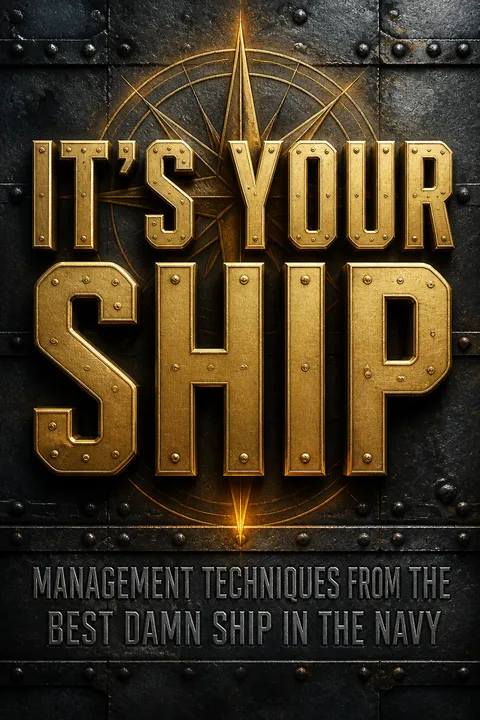
- Leadership transformation: "It's Your Ship" by D. Michael Abrashoff is about the author's journey as a Navy captain transforming the USS Benfold into one of the best ships in the Navy through innovative leadership techniques.
- Empowerment and trust: The book emphasizes empowering crew members, fostering trust, and encouraging initiative to achieve exceptional results.
- Practical leadership lessons: Abrashoff shares practical leadership lessons applicable to both military and civilian organizations, focusing on understanding and leveraging the potential of people.
- Personal growth: The narrative also covers Abrashoff's personal growth as a leader, highlighting the importance of self-awareness and adaptability in leadership roles.
Why should I read "It's Your Ship"?
- Real-world leadership insights: The book provides real-world insights into effective leadership, drawn from Abrashoff's experience commanding a Navy ship.
- Applicable to various fields: The leadership principles discussed are applicable to a wide range of fields, making it valuable for anyone in a leadership position.
- Engaging storytelling: Abrashoff uses engaging storytelling to illustrate his points, making the book both informative and entertaining.
- Proven success: The success of the USS Benfold under Abrashoff's command serves as a testament to the effectiveness of the techniques shared in the book.
What are the key takeaways of "It's Your Ship"?
- Empowerment leads to success: Empowering team members to take ownership of their work can lead to exceptional performance and results.
- Communication is crucial: Open and honest communication fosters trust and collaboration within a team.
- Lead by example: Leaders should model the behavior they expect from their team, setting a standard for others to follow.
- Continuous improvement: Always look for ways to improve processes and encourage innovation, even if it means challenging the status quo.
What are the best quotes from "It's Your Ship" and what do they mean?
- "It's your ship." This phrase encapsulates the idea of empowering team members to take ownership and responsibility for their work, fostering a sense of pride and accountability.
- "Leaders must free their subordinates to fulfill their talents to the utmost." This quote emphasizes the importance of allowing team members to use their skills and creativity to achieve their full potential.
- "The more control I gave up, the more command I got." This highlights the paradox that by relinquishing control, leaders can actually gain more influence and effectiveness.
- "Optimism rules." This simple statement underscores the power of a positive attitude in leadership, encouraging leaders to inspire and motivate their teams through optimism.
How did D. Michael Abrashoff transform the USS Benfold?
- Empowerment: Abrashoff empowered his crew by giving them ownership of their tasks and encouraging them to make decisions.
- Listening and communication: He actively listened to his crew's ideas and concerns, fostering open communication and trust.
- Innovation: Abrashoff encouraged innovation by challenging standard procedures and implementing new ideas that improved efficiency and morale.
- Focus on people: He prioritized the well-being and development of his crew, understanding that their success was key to the ship's success.
What leadership techniques does D. Michael Abrashoff recommend in "It's Your Ship"?
- Lead by example: Demonstrate the behavior and work ethic you expect from your team.
- Listen aggressively: Actively listen to your team members to understand their perspectives and ideas.
- Communicate purpose and meaning: Clearly articulate the goals and vision of the organization to inspire and motivate your team.
- Create a climate of trust: Build trust by being transparent, consistent, and supportive of your team members.
How does "It's Your Ship" address the concept of empowerment?
- Ownership and responsibility: Abrashoff emphasizes giving team members ownership of their work, allowing them to take responsibility for their actions and decisions.
- Encouraging initiative: He encourages team members to take initiative and come up with innovative solutions to problems.
- Trust and support: Empowerment is built on a foundation of trust and support, where leaders provide guidance but allow team members the freedom to act.
- Positive outcomes: The book demonstrates that empowerment leads to increased morale, productivity, and overall success.
What role does communication play in "It's Your Ship"?
- Open dialogue: Abrashoff stresses the importance of maintaining open lines of communication between leaders and team members.
- Feedback and improvement: Regular feedback helps identify areas for improvement and fosters a culture of continuous learning.
- Clarity and transparency: Clear and transparent communication ensures that everyone understands the organization's goals and their role in achieving them.
- Building trust: Effective communication builds trust and strengthens relationships within the team.
How does "It's Your Ship" suggest handling mistakes and failures?
- Learning opportunities: Abrashoff views mistakes as opportunities for learning and growth, rather than reasons for punishment.
- Encouraging risk-taking: He encourages calculated risk-taking, understanding that innovation often involves trial and error.
- Supportive environment: Create a supportive environment where team members feel safe to admit mistakes and learn from them.
- Focus on solutions: Emphasize finding solutions and preventing future errors, rather than dwelling on the mistake itself.
What is the significance of the phrase "Look for results, not salutes" in "It's Your Ship"?
- Focus on outcomes: Prioritize achieving tangible results over adhering to rigid protocols or seeking approval.
- Encouraging initiative: Encourage team members to take initiative and find creative solutions to achieve desired outcomes.
- Breaking down hierarchy: Challenge traditional hierarchical structures that may stifle innovation and progress.
- Empowering team members: Empower team members to focus on delivering results, rather than simply following orders.
How does "It's Your Ship" address the importance of trust in leadership?
- Foundation of success: Trust is the foundation of successful leadership and team dynamics.
- Building relationships: Trust is built through open communication, transparency, and consistency in actions.
- Empowerment and autonomy: Trusting team members with autonomy and responsibility fosters a sense of ownership and accountability.
- Positive impact: A climate of trust leads to increased collaboration, innovation, and overall team performance.
What lessons from "It's Your Ship" can be applied to civilian organizations?
- Empowerment and ownership: Encourage employees to take ownership of their work and empower them to make decisions.
- Open communication: Foster a culture of open communication and active listening to build trust and collaboration.
- Focus on results: Prioritize achieving results over rigid adherence to protocols or hierarchy.
- Continuous improvement: Encourage innovation and continuous improvement by challenging the status quo and seeking new solutions.
About the Author
Other books by D. Michael Abrashoff

Download PDF
Download EPUB
.epub digital book format is ideal for reading ebooks on phones, tablets, and e-readers.








