

Plot Summary
Lan’s Jade in the Grave
On the eve of Kaul Sen’s funeral, Bero6 and his younger accomplice Mudt17 bribe cemetery groundskeeper Nuno to reach the coffin of Kaul Lan, the murdered former Pillar of No Peak. They cut through the coffin and take Lan’s jade beads and cuffs, convinced that wearing green will lift them out of their powerless lives.
When Nuno demands the rest of his payment, Mudt17 strikes him and Bero6 shoots him dead. The boys escape with the jade, leaving a body and a desecrated grave behind. Their theft is not simply a burglary: it makes them targets of the clans and gives the coming black-market trade a face, a motive, and two reckless young recruits.
The theft turns jade from a sacred inheritance into contraband coveted by people excluded from its culture. Bero imagines power as something he can seize, without training, obligation, or community. Mudt’s participation already hints that their partnership is not equal: Bero supplies the plan and believes that makes the jade his. The murdered groundskeeper establishes the cost of their ambition before either boy understands the larger system they have entered.
A Pillar Without Lan
At Kaul Sen’s crowded funeral, Hilo1 stands as No Peak’s new Pillar, facing Mountain leader Ayt Mada5 and the traitorous former Weather Man Yun Doru.14 His grief is sharpened by the knowledge that Lan’s killer remains free. After the service, Hilo1 gives his maimed former Fist Eiten18 a business and a trusted role in the Armpit, turning the man’s wish to rebuild his life into a new clan asset.
Then cousin Teije’s mother reveals that jade smuggler Zapunyo13 has taken Teije hostage in the Uwiwa Islands. Hilo1 promises to retrieve him himself, despite Shae’s2 warning that the invitation is a trap. He also confronts Anden,3 who still refuses jade, and decides the young man must leave Kekon.
Hilo’s new authority is built from competing obligations: he must avenge Lan, protect the clan’s standing, and remain answerable to family members who are not useful in the conventional Green Bone sense. Eiten’s request shows Hilo making room for a life beyond combat, but his response to Teije shows how quickly kinship becomes a public test of strength. His decision about Anden exposes a more painful limit: Hilo can love his cousin and still define belonging through jade.
Anden Sent West
At the funeral reception, Emery Anden3 faces Hilo1 after a year of separation. Hilo1 warns that the Mountain may exploit Anden’s3 isolation and offers him a way back into No Peak, but only if he resumes wearing jade. Anden3 refuses because his brief, violent use of it left him terrified of becoming addicted to power and killing.
Hilo1 sends him to Espenia to study instead, describing the exile as protection and opportunity; Anden3 experiences it as rejection. Shae2 admits she helped arrange the move, hoping foreign education would make him useful in a changing world. Anden3 leaves Janloon hurt and homesick, carrying both his loyalty to the Kauls and the conviction that he must choose what jade will mean in his life.
Anden’s exile makes refusal costly rather than heroic in any uncomplicated way. He is not rejecting his family, but Hilo hears his choice as rejection of the role that makes family legible to him. Shae’s practical reasoning similarly treats Anden as a future resource before she can fully hear his grief. His central conflict is not whether he belongs, but whether belonging requires repeating a form of violence that has already frightened him.
The New Green Market
Bero6 moves into a poor tenement, injects SN1 to tolerate his stolen jade, and sells the drug to other unsanctioned users at the Rat House. A foreign recruiter, Soradiyo, offers him and Mudt17 work as rockfish for Ti Pasuiga, the smuggling network led by Zapunyo,13 promising money, shine, and eventually more jade.
Meanwhile, Maik Tar11 captures Mountain Fist Seko while pursuing the gang behind Lan’s murder. Seko admits involvement but kills himself before revealing the surviving assassin’s identity. The Mountain retaliates against No Peak, killing one man and injuring another. The clans’ unfinished war leaves room for smugglers, addicts, and stolen jade to multiply beyond either clan’s easy control.
The parallel tracks show the same substance producing opposite kinds of power. For the clans, jade is trained capacity bound to service; for Bero, it is an intoxicating shortcut that seems to erase his former insignificance. SN1 supplies the missing bridge, making illegal jade use more accessible while making its users dependent. Seko’s suicide preserves the assassin’s anonymity, so the clans’ violence cannot close the past even as it creates new openings for criminal actors.
Zapunyo’s Island Welcome
Hilo1 reaches the Uwiwa Islands with Tar11 and several No Peak fighters, where Zapunyo13 receives him in a fortified estate guarded by Keko-Shotarian mercenaries. The smuggler13 proposes that No Peak stop disrupting his jade trade in return for a share of its profits. Hilo1 refuses, warns Zapunyo13 to stay off Kekon, and beats Teije for behaving recklessly while held as a guest.
On the way to the airport, corrupt police block the clan party and open fire. Hilo1 deflects the bullets while his fighters overwhelm the officers and escape aboard their plane, leaving wounded men behind. The mission rescues Teije but turns a private dispute into public bloodshed, making Zapunyo13 more dangerous and Hilo’s1 judgment a subject of concern.
Zapunyo offers Hilo a version of clan power stripped of cultural obligation: jade becomes a commodity, and loyalty becomes a negotiated cut. Hilo recognizes the imitation but underestimates how far the smuggler will go to protect his enterprise. His victory at the airport is tactically decisive yet morally costly, because the dead officers are civilians in a foreign jurisdiction. The scene marks a limit Hilo will repeatedly confront: the Green Bone code cannot govern enemies who do not accept it.
Peace, Public and Private
Public pressure, stalled mining, rising smuggling, and the looming conflict in Oortoko push No Peak and the Mountain into secret negotiations. Hilo1 and Ayt5 agree to resume jade production under new oversight, divide disputed districts, cooperate against smugglers, and keep Anden3 safe while he remains jade-free. At a press conference, they present the agreement as a national turning point.
In private, Ayt5 proposes merging the clans under her rule and restoring Hilo1 to a military role. He refuses, naming her betrayal of his family and insisting that their truce cannot erase the feud. Hilo1 then tells his inner circle that No Peak will honor the agreement while secretly searching for the Mountain’s weaknesses.
The truce separates public peace from private intention. Both leaders use the language of national responsibility because the country’s economic and security pressures are real, yet neither mistakes cooperation for trust. Hilo’s willingness to sign is a development in judgment, not forgiveness: he accepts limits on immediate violence to preserve the clan’s strength. His secret plan also reveals the instability of a peace maintained by leaders who regard compromise as preparation rather than resolution.
Doru’s Final Counsel
After the truce, Shae2 travels to Opia to retrieve Yun Doru,14 the former Weather Man who betrayed No Peak and now lives ill and unguarded in the village that once sheltered wartime Green Bones. Doru14 says he offered himself to Ayt5 in hopes of protecting Shae2 and Anden,3 but Ayt5 refused.
He gives Shae2 Kaul Sen’s jade and warns that Ayt’s5 lack of an heir creates an opening among the Mountain’s Koben, Ven, and Iwe families. Shae2 cannot bring herself to kill the dying man. Doru14 takes a pistol from his chair and ends his own life. Shae2 orders his jade returned to the clan and asks the villagers to bury him near the old rebel camp, honoring his service despite his betrayal.
Doru’s death denies Shae the clean moral resolution she expected. His treason remains real, but so do his loyalty to Sen and his attempt to protect the younger Kauls. By refusing to execute him, Shae discovers that judgment does not become justice merely because it is carried out by a leader. His advice also converts personal remorse into political strategy: the Mountain’s succession problem may be the only route to a peace stronger than a temporary truce.
A Clan in Southtrap
In Port Massy, Anden3 discovers that the Kekonese neighborhood has its own Green Bones, led by the modest Pillar Dauk Losun8 and defended by the veteran Rohn Toro.9 Anden’s3 accidental bicycle mix-up ends in a street fight with a Crew foot soldier, teaching him that Espenia’s rules forbid the duels he grew up understanding.
The Dauks explain that civilian jade is now illegal, so their community hides its training and negotiates carefully with local gangs and police. Dauk’s8 son Cory,7 a law student and Green Bone, invites Anden3 into his circle and later into a hesitant, growing intimacy. Anden3 begins to see that his new home is neither jade-free nor safe, but it offers a different way of living with both.
Port Massy unsettles Anden’s assumption that Green Bone identity belongs only to Kekon. The immigrant community preserves jade while adapting its customs to laws that treat its central inheritance as contraband. Dauk’s modest authority contrasts with Hilo’s visible command, revealing that leadership can be neighborhood trust rather than territorial dominance. Cory’s ease and Anden’s hunger for connection complicate exile: the foreign city begins to offer not simply survival, but attachments that make leaving it difficult.
A Nephew Taken Home
While Wen4 sorts Lan’s papers, she finds an old letter from his former wife,16 Eyni,16 revealing that Lan fathered a son named Nikolas.15 Hilo1 travels to Stepenland to meet the child and persuade Eyni16 to return to Janloon. She refuses, saying she wants Niko15 raised outside Green Bone violence, and secretly prepares to leave with her partner.
When Hilo1 discovers the packed bags and Eyni16 threatens to call police, he kills her with a Channeling strike, then takes the toddler home. He tells the clan that Eyni16 died abroad and raises Niko15 beside his own sons. The boy’s arrival gives the Kauls a living link to Lan, but the lie and the killing become another private burden inside the family.
Hilo’s decision is shaped by grief and a sincere belief that Niko belongs with his blood relatives, but he converts that belief into absolute authority. Eyni’s fear of jade culture is not abstract; she has watched it consume her marriage and family. By killing her, Hilo protects the child while repeating the coercive logic she feared. The family gains a son and heir, but its continuity now rests on concealment as well as affection.
Shae’s Foreign Bargain
As Shae2 steers No Peak through mining reforms and foreign negotiations, she begins a relationship with Tau Maro,12 a professor and Royal Council adviser who values debate over Green Bone status. She trades intelligence about Mountain SN1 factories in Ygutan for Espenian support on trade and investment, then refuses the foreigners’ demand for more jade.
When Espenia invades Oortoko, anti-foreign feeling rises, and Ayt5 leaks proof that Shae2 once worked as an Espenian informant. Shae2 privately learns she is pregnant by Maro12 and ends the pregnancy without telling him, fearing scandal would destroy her role and his career. The revelations leave her vulnerable just as Ayt5 turns public opinion against her.
Shae’s expertise makes her indispensable and suspect at the same time. Her foreign dealings are neither simple betrayal nor uncomplicated modernization; they are strategic exchanges made within a political order that insists on judging women’s loyalty through their private lives. The pregnancy exposes the impossible division she maintains between intimacy and office. Her choice protects the clan as she understands it, yet withholding it from Maro repeats the very pattern of secrecy that will later fracture their relationship.
Shae’s Clean Blade
When Ayt5 uses Shae’s2 past to demand her removal as Weather Man, Hilo1 refuses to dismiss his sister.2 Shae2 instead challenges Ayt5 to a public clean-blade duel, gambling her life and position to silence doubts about her loyalty. The fight at the former Shotarian Garrison House proves Shae2 is fast enough to wound Ayt,5 but Ayt5 disarms and cuts her across the abdomen.
Shae2 concedes rather than die; Ayt5 accepts her jade and spares her, protecting her own public image. Shae2 survives surgery and returns to Ship Street with her authority restored but her choker gone. Maro,12 whom she excluded from the decision, cannot accept the secrecy between them, and their relationship breaks into a painful distance.
Shae chooses a tradition that grants her public legitimacy while exposing her to lethal violence. Her victory is not physical: by conceding at the right moment, she forces Ayt to choose between killing a surrendered opponent and preserving her own reputation. Yet the cost is intimate as well as bodily. Shae proves she belongs in leadership by risking herself, but she does so through a code Maro cannot endorse and without allowing him to share the risk.
Southtrap Under Fire
Anden’s3 friendship with Cory7 draws him into the Southtrap grudge hall, where immigrant Green Bones meet to train, gamble, and settle disputes. When Kromner’s men attack the community center with guns and firebombs, Rohn Toro9 organizes an escape while Anden3 delays arriving police by posing as a foreign witness. The doorman Sano dies, and the Crews retaliate against Kekonese businesses.
The Dauks ask Anden3 to appeal to No Peak for help, and Hilo1 comes to Port Massy himself. He negotiates a deal with the Bosses: they will receive low-grade raw jade in exchange for leaving Southtrap alone. Hilo1 also offers Dauk8 a deeper alliance, including good jade and training, making Anden’s3 exile a bridge between two communities.
Anden’s first decisive act without jade is not a duel but a deception that buys neighbors time to escape. The attack reveals the difference between clan violence, constrained by shared rules, and Crew violence aimed at a vulnerable population. Hilo’s response is strategic rather than sentimental: he uses flawed jade as bait, then offers the Dauks a durable partnership. Anden’s divided loyalties begin to become useful, though his closeness to Cory makes the alliance personal rather than merely political.
The Price of the Green
Wen4 quietly builds an informer network inside the Mountain, using women’s spaces and private favors to learn about Ayt’s5 succession problem. Hilo1 and Shae2 court wealthy shipping magnate Ven Sandolan, hoping he will organize a coup against Ayt5 and put his son Haku forward as a successor.
At the same time, No Peak’s foreign strategy expands: Hilo1 arranges jade sales to Kromner’s Crew, while Shae2 develops trade and real-estate ties in Espenia. Bero,6 meanwhile, rejects Soradiyo’s proposed assassination job, but Mudt17 has grown more committed to revenge against Tar.11 Their different choices strain the boys’ partnership and place Lan’s stolen jade at the center of an increasingly crowded struggle.
This section places several kinds of influence beside one another: Wen’s patient intelligence work, Hilo’s personal alliances, Shae’s economic statecraft, and Bero’s impulsive hunger. Each depends on information and trust, but none is morally neutral. No Peak’s attempt to weaken Ayt by cultivating her potential successors mirrors the covert manipulation it condemns in its enemies. Bero’s refusal shows a small growth in caution, while Mudt’s loyalty to revenge prepares the betrayal between them.
Lan’s Jade Recovered
Mudt17 poisons Bero,6 injects him with a fatal dose of shine, and steals the jade before leaving him to die. Bero6 survives because a neighbor calls an ambulance, but he loses the green and sinks into despair. Mudt17 wears the stolen beads and boasts at a bar, drawing attention from a bartender who alerts No Peak.
Hilo’s1 men capture him, and Hilo1 recognizes him as the son of Mudt Jin, the Mountain agent involved in Lan’s murder. He removes Lan’s jade, puts his own studs into Mudt’s17 mouth, and has the boy sealed in a metal box and buried alive. Later, Hilo1 shows Lan’s recovered jade to Niko,15 promising to keep it safe for the child’s future.
The boys’ partnership ends in the logic that began it: jade is treated as proof of worth, so each betrayal seems like a correction of an unfair balance. Mudt invokes his father’s death, but his act reproduces Bero’s selfishness rather than overcoming it. Hilo’s punishment is a horrifying assertion that jade remains bound to family and memory, not merely possession. His gift to Niko turns recovered inheritance into a promise, while its method reveals the price of enforcing that belief.
A Bomb in Green Plain
While Hilo1 and Shae2 meet with visitors, Maik Kehn10 drives the Pillar’s car to collect Wen4 and the children from a park. A bomb destroys the car before they reach it, killing Kehn10 and injuring bystanders; Wen4 gets the children to a nearby No Peak shop and calls for help. A man soon turns himself in: Maro.12
Soradiyo and his barukan associates had threatened Maro’s12 Shotarian relatives and used his request for a meeting with Hilo1 to smuggle fake interns through the estate gates. Maro12 knew a strike was planned but did not expect the bomb. Shae2 kills him before Tar11 can take revenge, then collapses under the grief of killing the man she loved.
The bombing breaks the clan’s assumption that civilian spaces and family routines remain protected by aisho. Kehn’s death is not a defeat in combat but the consequence of an enemy willing to use a family car and a legitimate visitor as tools. Maro’s betrayal is coerced through the very family ties Shae never fully welcomed into her life. By killing him herself, Shae prevents another act of cruelty, but the choice makes her complicit in the violence she had hoped to keep at a distance.
The Hunt Reaches Janloon
Hilo1 turns No Peak’s forces against illegal jade dens, shine dealers, and Soradiyo’s rockfish, with Mountain cooperation allowing raids across disputed territory. Bero,6 destitute and contemplating suicide at the Double Double, is stopped by Eiten,18 who recognizes his despair and calls Hilo.1 Bero6 identifies Soradiyo and maps the smuggling network, giving No Peak the locations of crews, routes, and contacts.
Hilo1 spares him because Bero’s6 information serves the clan and because Lan once argued for giving the boy a chance. Soradiyo is captured while trying to flee and confirms that Ayt’s5 people encouraged Zapunyo’s13 plot. Hilo1 kills him quickly and decides that Zapunyo13 must be punished, but only when No Peak can reach him safely.
Bero’s survival does not redeem his earlier crimes, but it creates a narrow opening for a different use of his knowledge. Hilo’s decision to spare him recalls Lan’s earlier mercy, suggesting that the dead brother’s influence still shapes the living clan. Soradiyo’s confession widens the conflict: the bombing was not only a smuggler’s revenge but part of Ayt’s strategy. Hilo’s restraint is hard-won, because vengeance now has to compete with the need to preserve his people.
The Mountain Purges Its Heirs
Ven Haku and several Mountain fighters plan to assassinate Ayt5 and install Haku as Pillar, trusting that No Peak will support them. Nau Suen detects their conspiracy at the Sin 8 club, kills Haku, and forces the surviving plotters to swear loyalty. Ayt5 then compels Ven Sando to sell K-Star Freight to foreign buyers and tells him that his male heirs will die for treason.
Meanwhile, Nau kills former Chancellor Son Tomarho, removing the councilman likely to oppose the refugee bill. Ayt5 takes Koben Ato under her protection, consolidating support within the Mountain. At the hospital, Hilo1 also learns that his son Ru is a stone-eye after swallowing jade buttons, adding a private family crisis to the political upheaval.
Ayt wins by converting the opposition’s assumptions into vulnerabilities. Ven mistakes wealth and family influence for protection; Ayt uses them to make his defeat public and irreversible. The destruction of the Ven line also demonstrates the cost of Hilo’s covert strategy: it provoked a coup that Ayt was better equipped to detect and defeat. Son’s death helps shift national policy, while Ru’s diagnosis exposes Hilo’s own reliance on jade as a measure of inheritance and future.
Wen Chooses the Mission
When Hilo1 cancels the plan to kill Zapunyo13 because the smuggler insists on meeting in a guarded hotel suite, Wen4 refuses to let the opportunity disappear. She persuades Shae2 to proceed and travels from Adamont Capita to Port Massy, smuggling real jade beneath a case of nephrite samples by exploiting customs officials’ inability to distinguish her stone-eye body from ordinary travelers.
Anden3 and Rohn Toro9 meet her and prepare a false interview with Zapunyo.13 Wen4 knows Hilo1 would forbid her participation, but she believes the man who endangered her children must be stopped. Her decision turns her secret work for No Peak into direct action, placing her marriage and life at risk.
Wen’s stone-eye condition has often placed her outside the clan’s visible hierarchy, but here it becomes the tactical advantage that allows the operation to proceed. Her agency is neither borrowed from Hilo nor simply a rebellion against him; she acts from maternal fear, political judgment, and a long-standing desire to serve. The deception also exposes the family’s unequal distribution of risk: Hilo commands decisions, while Wen quietly supplies capabilities he does not recognize until they are needed.
Wen’s Heart Returns
At the Crestwood Hotel, Zapunyo13 sees through Anden’s3 false identity, but Anden3 admits he intends to kill him. Rohn9 unleashes the jade hidden in Wen’s4 fountain pen and fights the guards; Anden3 pins Zapunyo13 while Wen4 shoots him. The trio escapes the hotel, only to be ambushed by Skinny Reams and his Crew at the hardware store.
Reams’s men kill Rohn9 and strangle Wen,4 then attack Anden.3 Dauk Losun8 and neighborhood Green Bones arrive after Anden’s3 interrupted call. Anden3 puts on Rohn’s9 jade-lined gloves and Channels energy into Wen’s4 heart, restarting it. Wen4 survives with severe brain injury, and Anden’s3 use of jade to heal rather than kill becomes the act that brings him home.
The climax tests each character’s definition of strength. Rohn’s reputation cannot protect him from guns and numbers; Wen acts without jade; Anden’s long-feared power becomes useful only when he directs it toward preservation. The rescue does not erase the deaths or restore Wen unchanged, so it avoids making healing a simple reversal of violence. Anden’s life-changing act gives him a new relationship to jade, grounded not in domination but in responsibility for another person.
The War Changes Shape
After Zapunyo’s13 death, Hilo1 strikes Shae2 for defying his order and endangering Wen,4 but she refuses to leave No Peak, insisting that she and Wen4 acted for the clan. Ayt5 later admits she has made the barukan leaders in the Uwiwas her allies and used their interests to help pass the refugee act; she proposes a private armistice while warning that the clans remain rivals.
Back in Janloon, Anden3 tells Hilo1 that he will return permanently and study bioenergetic medicine, wearing jade only to heal. Hilo1 welcomes him home. He also remains uncertain how to forgive Wen,4 who recovers slowly in Marenia. No Peak survives, but neither grief nor the feud has been settled.
The ending refuses to equate survival with resolution. Hilo and Shae remain bound by family and clan, but their shared loyalty cannot prevent their methods from wounding each other. Ayt’s armistice is less reconciliation than a recognition that their conflict now spans governments, markets, and foreign allies. Anden’s return offers a changed model of Green Bone identity, though it does not repair the family’s losses. The clan’s future depends on adapting without pretending that adaptation is morally clean.
Epilogue
At the Double Double, Bero6 has spent nearly a year working in Eiten’s18 kitchen and saved enough to move out of the recovery home. A leaflet brings him to a meeting led by former barukan who call for a revolution against jade-owning elites.
Their politics still trouble him, but he recognizes that jade and the clans have cost him his friends, his health, and the future he once imagined. He refuses their claim that jade alone can liberate people, yet agrees that the clans should be challenged. For the first time, Bero’s6 next step is not a grab for green but a choice about what kind of change he wants.
Bero’s ending offers neither absolution nor a neat redemption. He has survived because others intervened, and his work under Eiten gives him a life structured by ordinary responsibility rather than jade’s feverish promise. The revolutionary meeting tempts him with a new explanation for his suffering, but he resists simply replacing clan worship with its opposite. His final choice matters because he is no longer chasing status; he is beginning to judge power by what it does to people who cannot wield it.
Analysis
Jade War asks what happens when a local moral code meets a world that does not recognize it. In Janloon, jade is supposed to be earned through training and bound to obligations of kinship, restraint, and protection. Outside Kekon, it becomes a commodity, a military technology, or a symbol that can be imitated. The distinction matters, but it cannot keep foreign markets from reshaping the clans. Hilo1 and Shae2 respond differently: he trusts embodied relationships and decisive action, while she builds leverage through policy, information, and economic ties. Neither approach remains clean. Their victories rely on intimidation, secrecy, and bargains with people whose values they distrust. The book also examines inheritance as both shelter and pressure. Niko’s15 return gives the Kauls a future connected to Lan, yet that future is purchased through Hilo’s1 violence and concealment. Anden’s3 exile initially appears to be the family’s rejection of a cousin who refuses its central practice. In Port Massy, he discovers that he can serve others without making killing the measure of his identity. When he uses jade to revive Wen,4 the act does not prove that his earlier fear was foolish; it shows that the same power can be directed toward care, though it still exacts a bodily and emotional cost.
Wen4 and Shae2 expose how authority is distributed unevenly. Both perform work the clan depends on, yet each must conceal choices from Hilo1 to exercise it. Hilo’s1 protectiveness is loving but also paternalistic, especially when he assumes that keeping others away from danger is the same as respecting them. The ending offers no settled peace: Ayt5 builds foreign alliances, No Peak preserves its own, and the siblings1 remain wounded by decisions made in the name of family. Survival here means adaptation, but adaptation never guarantees innocence.
Review Summary
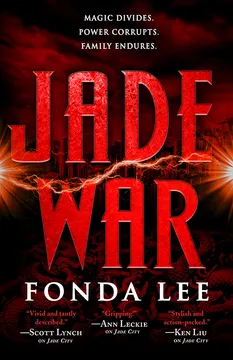
Jade War receives overwhelmingly positive reviews, with readers praising it as a rare sequel that surpasses its predecessor. Highlights include complex, morally grey characters, particularly the Kaul family, and an expanded geopolitical world. Reviewers celebrate the emotionally devastating plot, rich characterization, and blend of action, politics, and family drama. Some criticism notes heavy exposition, slow pacing, and insufficient "war" for a book of that title. Female characters Shae and Wen are frequently singled out for praise. Most readers eagerly anticipate the final installment, Jade Legacy.
People Also Read







Characters
Kaul Hilo
The hard-pressed PillarPillar of No Peak and younger brother of the murdered Lan, Hilo leads through personal presence, forceful loyalty, and an instinct for the human details behind clan strategy. He trusts action more readily than institutional procedure and still feels most at home among fighters, even as business, diplomacy, and parenting demand different skills. His love for Wen4, his sister2 Shae2, and the children is fierce, but he can mistake protection for the right to decide for others. Hilo’s central pressure is to preserve his family without becoming so rigid that the people he loves can no longer act beside him.
Kaul Shae
No Peak’s strategistHilo’s1 sister and Weather Man of No Peak, Shae brings education, political fluency, and an appetite for change to a clan accustomed to judging authority through jade and combat. She reads economic and international pressures with unusual clarity, but her confidence in calculated choices can become secrecy toward the people closest to her. Shae wants to be more than the favored Kaul granddaughter and works relentlessly to prove her capacity. Her restraint and vulnerability coexist with a stubborn willingness to risk herself when her legitimacy or the clan’s survival is threatened.
Emery Anden
The reluctant Green BoneAdopted into the Kaul family and trained at its Academy, Anden is intelligent, conscientious, and deeply sensitive to the damage jade can do when power becomes addictive. His refusal to wear it is not a rejection of family, though it is often understood that way by people who equate service with combat. In Port Massy, he learns a language, builds friendships, and finds work beyond the clan’s familiar hierarchy. Anden’s strongest instinct is to protect others, and his challenge is to discover whether that instinct can shape a Green Bone life on his own terms.
Kaul Maik Wen
The hidden White RatHilo’s1 wife, a stone-eye, and mother to the children in the Kaul household, Wen is observant, practical, and often underestimated because she cannot wear jade. She builds relationships across the clan and notices the everyday vulnerabilities that warriors overlook. Her desire to contribute is partly a response to a lifetime of exclusion, but it is also a form of love: she wants her family to have support before danger arrives. Wen combines maternal attentiveness with strategic nerve, and she understands that care can involve difficult decisions rather than mere comfort.
Ayt Mada
The Mountain’s iron PillarPillar of the Mountain, Ayt is disciplined, politically gifted, and unsentimental about the use of power. Her childhood losses under foreign occupation formed a lasting conviction that survival belongs to those willing to control events rather than trust sentiment. She is an effective public speaker and a formidable Green Bone, but her preference for instrumental loyalty leaves her vulnerable to the very instability she seeks to master. Ayt regards the old clan order as something that must change to survive, even when her reforms threaten the traditions that once made Green Bones distinct.
Bero
The jade-hungry survivorA poor young criminal with a talent for opportunism, Bero believes jade will transform him from a powerless boy into someone others must respect. His confidence masks a deep fear of insignificance, and he often confuses having made a plan with having earned its rewards. He is capable of loyalty when it serves his sense of himself, but his friendships remain strained by possessiveness and self-preservation. Bero’s story asks whether someone formed by exploitation can recognize another path once the prize he worshipped has been taken away.
Dauk Corujon, called Cory
The easygoing Green BoneSon of Dauk Losun8 and a law student, Cory is a Green Bone raised in Port Massy’s immigrant community rather than in Kekon’s clan hierarchy. He is sociable, physically confident, and inclined to treat life as something to be met one day at a time. His warmth helps Anden3 feel less alone, while his relaxed relationship to jade and family duty contrasts with Anden’s3 seriousness. Cory is not careless about his heritage, but he has not been tested by the same demands that shape Green Bones in Janloon.
Dauk Losun
Pillar of SouthtrapAn immigrant Green Bone who leads the Kekonese community in Southtrap, Dauk Losun governs through neighborly trust, practical diplomacy, and his wife’s sharp counsel. His small clan has no territory or wealth comparable to No Peak, so he must weigh every show of force against the safety of civilians. He respects Anden3 and the Kauls, but his loyalties remain rooted in the people who depend on him locally.
Rohn Toro
Southtrap’s veteran defenderA seasoned Green Bone who works an ordinary job while protecting the Dauk8 community, Rohn is reserved, alert, and economical in both speech and violence. He has a complicated past and few illusions about the law or the Crews. His jade is hidden in gloves, a practical adaptation to Espenia’s restrictions. Rohn’s loyalty to Dauk Losun8 comes from shared history and obligation, not rank or ceremony.
Maik Kehn
The steady HornHilo’s1 brother-in-law and Horn of No Peak, Kehn is methodical, dependable, and more comfortable managing people than commanding attention. He grows into a role that once seemed to demand a charisma he did not possess, relying instead on fairness, patience, and attention to his fighters. His partnership with Hilo1 gives the clan a steadier military structure, while his caution is especially valuable as No Peak’s enemies spread beyond Janloon.
Maik Tar
Hilo’s relentless PillarmanKehn’s10 younger brother and Hilo’s1 trusted Pillarman, Tar is fierce, loyal, and more comfortable with direct action than strategic ambiguity. He is capable of tenderness toward people he considers family, but grief and anger can narrow his judgment. Tar’s years beside Hilo1 make him one of the few people who can challenge or support the Pillar without ceremony. His work often takes him into the clan’s most secret and violent business.
Tau Maro
The questioning professorA professor of foreign studies and Royal Council adviser, Maro is thoughtful, articulate, and willing to question the assumptions that Green Bone society treats as sacred. He wears little jade and does not seek status through duels, which allows him to imagine forms of public service outside the clans. His mixed family history gives him a personal understanding of how honor and prejudice can silence people. Maro offers Shae2 a relationship built around conversation, though the pressures of her office make openness difficult.
Zapunyo
The Uwiwan jade smugglerLeader of Ti Pasuiga, Zapunyo is a shrewd businessman who has built a fortified operation by recruiting desperate workers and exploiting corrupt officials. He sees jade as a resource to distribute wherever demand exists, not as a sacred inheritance. His childhood poverty fuels both his ambition and his belief that anyone can be bought. Zapunyo understands the clans well enough to imitate their structures, but he does not share their obligations or limits.
Yun Doru
The fallen Weather ManA longtime adviser to the Kaul family, Doru is clever, experienced, and accustomed to using information as leverage. His years beside Kaul Sen and Lan give him intimate knowledge of No Peak, but his belief that he can manage the clan’s future through private bargains becomes dangerous. He retains affection for the family even when his choices betray it, making him a reminder that loyalty and self-justification can inhabit the same person.
Nikolas, called Niko
Lan’s young sonThe young son of Lan, Niko is observant, affectionate, and still learning how to understand the complicated family that has taken him in. He is especially attached to Shae2 and looks to Hilo1 for structure and protection. His presence connects the living Kauls to the brother they lost, but he is also a small child with needs of his own, not merely a symbol of family continuity.
Eyni
Lan’s former wifeLan’s former wife16 and Niko’s15 mother, Eyni is proud and protective of the life she has built abroad. She distrusts the Green Bone world and wants her child to grow beyond its violence. Her choices place her at odds with the Kaul family, but her fear reflects real costs: marriage, family, and personal safety can all be swallowed by clan duty.
Mudt
Bero’s volatile partnerYounger than Bero6 and the son of a criminal tied to the Mountain, Mudt is driven by grief and a desire to avenge his father. He initially follows Bero’s6 plans, but resentment grows as he recognizes how little of their shared success Bero6 intends to share. His hunger for jade is entangled with a wish to prove that his life and losses matter.
Eiten
The armless distillerA former No Peak Fist maimed by the Mountain, Eiten rebuilds his life through his wife’s family distillery and a new role among the clan’s business community. His dependence on a trained monkey and the support of his family never erase his competence or his desire to contribute. Eiten’s story challenges the assumption that a Green Bone’s worth ends when his fighting body is damaged.
Plot Devices
Jade and SN1
Power with a priceKekonese jade amplifies trained physical and perceptual abilities, but tolerance must be developed over time. SN1 allows people without that training to carry jade, while creating dependence and risking illness or death. The substance enables Bero’s6 rise, fuels black-market demand, and makes the clans’ monopoly increasingly difficult to defend. Jade is both a practical source of power and a marker of kinship, status, and cultural identity, so every attempt to treat it as an ordinary commodity reshapes the political order.
Clean-blade dueling
Violence kept personalA sanctioned duel allows a dispute between Green Bones to be settled through a contest whose rules are meant to prevent clan-wide retaliation. A challenge cannot be casually withdrawn once accepted, and a defeated opponent who concedes is supposed to be spared. The custom gives Shae2 a way to answer public attacks without starting open war, but it also makes her challenge dangerous and politically visible. Its force depends on shared belief; enemies outside the tradition can exploit that trust.
White Rat networks
Information beneath the surfaceNo Peak recruits informers among workers, businesspeople, relatives, and overlooked members of rival institutions. Wen’s4 contacts inside the Mountain and the clan’s agents abroad turn private routines into strategic intelligence. These networks reveal succession tensions, business priorities, and smuggling routes that cannot be learned through public negotiations alone. They are essential because the war increasingly moves through offices, foreign governments, and criminal organizations rather than only through street battles.
The Espenian jade ban
A law that breeds dangerEspenia prohibits ordinary civilians from possessing jade, forcing the immigrant Green Bone community to conceal its abilities and train in private. The law does not remove jade from circulation; instead, it creates a black market that attracts Crews, smugglers, and foreign buyers. It also makes traditional Green Bone practices appear criminal and leaves communities like Southtrap more vulnerable to gangs. The ban repeatedly forces characters to choose between obeying foreign law and protecting their neighbors.
The inherited jade
A family claim made tangibleLan’s beads and cuffs are stolen from his grave by Bero6 and Mudt17, turning a family relic into the object of a criminal struggle. The jade carries more than market value: it represents Lan’s place in No Peak and the Kaul family’s claim to its own history. Hilo’s1 recovery of it and his decision to reserve it for Niko15 make inheritance a central question. Who may wear jade, and what obligations come with it, becomes inseparable from the family’s grief and future.
Download PDF
Download EPUB
.epub digital book format is ideal for reading ebooks on phones, tablets, and e-readers.








