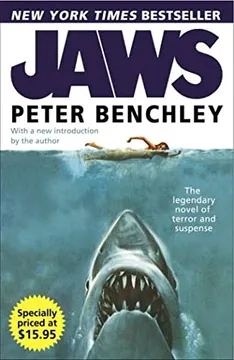


Plot Summary
The First Night Swim
After a night drinking with Tom Cassidy at a rented beach house, Christine Watkins goes swimming alone while Cassidy sleeps on the sand. A great white shark tears her apart, then disappears into the dark water. At dawn, Cassidy finds Christine’s clothes but not Christine, and the house’s owner reports her missing.
Chief Martin Brody searches the shore with Cassidy and young officer Len Hendricks. Hendricks finds what remains of Christine tangled in seaweed, and Brody identifies a shark attack as the likely cause. The coroner agrees. Brody now faces a danger he cannot see, at the start of the summer season on which Amity’s fragile economy depends.
The opening makes the shark’s danger physical before the town can turn it into an argument about probability. Christine’s death is not a duel with a monster. It is a sudden collision between a human body and an animal following instinct. That distinction matters: the shark has no motive that can be negotiated with, while the people on shore immediately begin searching for explanations that might preserve normal life. Brody’s first task is therefore double. He must establish what happened, then persuade a community to act on knowledge that offers no comfort and no visible enemy.
Amity Chooses Business
Brody wants to close the beaches and tell visitors why, but editor Harry Meadows argues that public alarm could empty the rental market. Meadows’s concern is not only his own paper: Amity’s year round residents depend on summer visitors to earn enough to survive winter. Mayor Larry Vaughan makes the pressure explicit, warning that Brody could lose his job if he closes the shore.
Brody gives way, despite believing that warning people is part of his duty. The coroner records a shark attack, but the Amity Leader withholds the story. Vaughan also persuades Christine’s hosts to keep quiet. The decision leaves the beach open and gives Brody a private knowledge he cannot make the town share.
Amity’s silence is not presented as simple cowardice. It is a collective survival strategy that has become dangerous because economic dependence narrows the community’s sense of what counts as responsible action. Brody can imagine lives lost, but Vaughan and Meadows can also imagine livelihoods destroyed. Their conflict exposes an unequal distribution of risk: the town’s leaders protect income by keeping the public uninformed, while bathers bear the physical danger. Brody’s failure is not that he lacks evidence. He has enough to fear. It is that he lets institutional pressure replace his own judgment, and the coming deaths will make that compromise impossible to disguise.
Two More From the Water
On a crowded beach, six year old Alex Kintner paddles his rubber raft beyond his mother’s reach. The shark attacks, taking Alex and most of the raft. Less than half an hour later, it kills Morris Cater as he swims near shore; Hendricks enters the water but cannot reach him. Brody orders the beaches closed.
A New York Times reporter has witnessed the violence, and the deaths become front page news. The Amity Leader finally publishes Christine Watkins’s death as well. Alex’s mother confronts Brody with the fact that he knew a swimmer had already been killed. He cannot deny it, and his guilt hardens into a resolve not to let the town gamble with another life.
The second attack converts private knowledge into public consequence. Alex is especially devastating because his mother gave him permission to play, trusting a beach whose safety had been silently wagered by adults. Brody’s responsibility is real, but it is also entangled with the officials who pressured him to stand down. The novel refuses the comfort of assigning all blame to one person: the decision was shared, yet Brody was the one charged with protection. Mrs. Kintner’s accusation forces him to experience that distinction emotionally. His later vigilance grows from a failure he cannot undo, not from confidence that he can control the sea.
A Tooth in the Boat
Brody and Hendricks find charter fisherman Ben Gardner’s boat anchored offshore, with no sign of Gardner, his harpoon, or a dinghy. Torn screw holes mark a missing cleat, and deep gouges score the transom. Hendricks retrieves a large shark tooth lodged in the wood. Gardner’s wife, Sally, hears that he is missing and immediately fears the worst.
Meanwhile, Meadows brings in Matt Hooper, a marine scientist and shark specialist. Hooper identifies the tooth as belonging to a great white and judges the fish unusually large. He cannot explain why it has stayed near Amity, but the evidence links Gardner’s disappearance to the same predator. Brody accepts that ordinary local fishing boats cannot safely handle it.
The tooth changes the investigation from a sequence of horrific reports into a material case. Its size gives the shark a measure, while the damaged boat suggests that human equipment offers little protection. Yet Hooper’s expertise does not solve the mystery. He can identify the species and describe its capabilities, but cannot predict its movements or explain its presence. This limits the authority of scientific knowledge without dismissing it: Hooper gives Brody better grounds for action, not certainty. Sally’s fear also reveals the cost beyond the public tally. A missing fisherman is not merely evidence of danger; he is the center of a household that must now live with unanswered absence.
Ellen Meets Hooper
Ellen Brody recognizes Matt Hooper at a hardware store as the younger brother of David, a man she dated in her summers as a wealthy young woman. Their conversation revives memories of dancing, travel, and a social world she left behind when she married Martin Brody. She invites Hooper to dinner, hoping he will feel welcome among the summer people she still longs to know.
Martin watches Hooper’s ease with Ellen and feels outclassed by his money, youth, and familiarity with her past. At the dinner party, Martin drinks too much, resents the guests’ assumptions and jokes, and quarrels with Ellen over the meal. Hooper’s presence exposes a strain in the marriage that the shark crisis has not created but intensifies.
Hooper enters the household carrying more than scientific expertise. He embodies a version of Ellen’s life that remains emotionally available in memory, while Martin embodies the life she chose and sometimes resents. The dinner party turns class anxiety into intimate friction: Martin’s discomfort is not merely that Hooper is richer, but that Ellen seems more animated in a social register he cannot share. Ellen’s longing is likewise not reducible to dissatisfaction with her husband. She wants confirmation that her former self still exists. Their conflict shows how social status can persist as an internal audience, judging a marriage long after the original world has been left behind.
The Rainy Day Detour
On a wet Wednesday, Ellen calls Hooper and arranges lunch away from Amity, then lies to the hospital where she volunteers and changes clothes in a gas station restroom. She hopes the encounter will restore her sense of desirability and reconnect her with the confident young woman she remembers. Over lunch, she and Hooper drink wine, trade sexual fantasies, and leave together for a motel.
Their encounter is passionate but leaves Ellen unsettled by Hooper’s intensity and emotional detachment. She returns home, bathes, and hides the trace of the afternoon in the laundry. Brody later asks where Hooper spent the day, but Ellen gives him no reason to suspect her. The affair deepens a private divide beneath their ordinary routines.
Ellen’s deception is driven less by a wish to replace Martin than by a wish to feel legible to herself again. She treats Hooper as a conduit to youth, but the actual encounter cannot restore the past; it produces a new experience, with its own discomfort and moral cost. The secrecy lets her postpone confronting that difference. For Brody, the missing afternoon becomes an unresolved suspicion, made more painful by his existing insecurity around Hooper. The episode binds the domestic and civic plots: while Brody tries to establish what is happening in the sea, he is also losing confidence in what he can know at home.
The Mayor’s Hidden Debt
As the Fourth of July approaches, Vaughan and the selectmen push Brody to reopen the beaches. Meadows uncovers the reason Vaughan is so desperate: the mayor has signed short term property notes for Caskata Estates, a company tied to Tino Russo, a suspected Mafia figure.
Falling prices threaten to ruin Vaughan unless the beaches reopen and Amity’s real estate market recovers. Brody agrees to open the shore under surveillance, unwilling to surrender the police chief’s position to a handpicked replacement.
Soon afterward, a stranger twists the head of Brody’s cat in front of his young son and warns the family to be subtle. Brody confronts Vaughan with the dead animal. Vaughan denies ordering the attack, but the threat makes the town’s corruption unmistakable.
The danger in Amity now has two forms: a predator that cannot be reasoned with and a political network that can. Vaughan’s financial entanglement does not make the shark less real; it makes truthful public action harder to sustain. Brody’s choice to reopen under safeguards is compromised, yet not equivalent to his earlier silence. He is trying to retain the authority needed to protect people while limiting the danger he can. The attack on the cat brings that political calculation into the family home, where a child witnesses violence meant for his father. Public corruption becomes intimate when power uses fear to discipline the people responsible for enforcing rules.
The Camera Sees the Fin
On the Fourth of July weekend, Brody watches the reopened beach while Matt Hooper patrols offshore. A teenager accepts money to swim, despite Brody’s unease. When Hooper spots movement near the boy, he races in; Brody calls the swimmer back and pulls him from the water just before the shark’s fin appears behind him.
A television crew captures the warning and the near miss, making it impossible to pass the incident off as rumor. Brody closes the beaches again. At the station, he contacts Quint, a hard eyed professional shark hunter, who agrees to pursue the great white for four hundred dollars a day. Quint insists on cash in advance and says he will need another man aboard.
The near attack briefly places the town’s competing ways of seeing in the same frame. The television crew wants a story, the teenager treats danger as a wager, and Brody reads the water as a threat whose absence cannot be trusted. Hooper’s sighting and Brody’s intervention prevent another death, but the camera also turns their uncertainty into public evidence. The incident does not restore confidence; it makes the cost of reopening undeniable. Quint’s hiring shifts the response from administration to pursuit. Brody has spent weeks trying to manage the danger with closures and patrols. Now he commits to taking the fight offshore.
The White Shark Appears
Aboard Quint’s boat, the Orca, Brody learns that shark hunting is mostly waiting, bait, and judgment. Quint demonstrates his methods by killing a blue shark and letting smaller sharks feed on its remains, a spectacle Hooper finds cruel. On a later outing, the great white takes bait without being hooked, and Quint’s lines come back neatly severed.
The shark surfaces beside the boat, exposing a huge blunt head and rows of teeth. Hooper is exhilarated by the rare sight, while Brody sees the creature behind the deaths he has been trying to prevent. The shark circles back and strikes at the Orca, then vanishes into the depths. Quint marks the location and prepares to return.
Quint’s fishing methods establish a sharp contrast with Hooper’s scientific attention. Quint treats living creatures as materials within a trade; Hooper sees them as subjects worth understanding. Brody, caught between them, needs the practical knowledge without sharing either man’s certainty or detachment. The great white’s appearance seems to promise a confrontation, but it offers no mastery. It cuts the lines, attacks, and disappears, forcing the hunters to accept that seeing the enemy is not the same as controlling it. The encounter also alters the shark’s meaning for each man: specimen to Hooper, quarry to Quint, and a concentrated image of Brody’s guilt.
The Cage Breaks
Before the next hunt, Hooper insists on bringing a steel cage so he can photograph the shark underwater. Brody objects, but Hooper offers Quint extra money, and the cage goes aboard. After the great white appears and destroys their bait, Hooper suits up and descends with a camera and an underwater power head.
The shark rises toward the cage, then rams through its bars. Hooper loses his mouthpiece and cannot escape. The fish bites him and carries his body out of the cage. Brody fires at the shark but accidentally hits Hooper; Quint’s shots also miss as the fish slips beneath the surface. Back on the boat, Quint refuses to abandon the hunt.
Hooper’s death makes expertise and courage insufficient safeguards against scale. His knowledge has correctly identified the danger, but his confidence in a cage’s limits proves misplaced. The scene also exposes a contradiction in his motives: he wants to understand the shark and to produce images no one else has made, yet he enters the water with a weapon, turning observation into confrontation. Brody’s misdirected shot adds moral injury to physical loss. He tries to save a man and instead contributes to his death. Quint’s refusal to stop is not simple bravado. It is the first clear sign that the hunt has become a private necessity for him.
A Last Return to Sea
After Hooper’s death, Brody tells Ellen he is going back out with Quint. She argues that the hunt is not his duty and that he is trying to atone for the earlier deaths. Brody cannot fully explain why he must continue, but he knows surrender will not restore the town or undo his choices. While he is away, Vaughan visits Ellen, admits that his property scheme has ruined him, and says he intends to leave Amity.
After Brody returns, Meadows gives him an editorial acknowledging that he was right to resist reopening the beaches. Ellen recognizes the value of the life she built with Brody and welcomes him with renewed warmth. At dawn, Brody leaves again, still afraid but no longer pretending fear can decide for him.
The pause between hunts gives the story’s external crisis an intimate reckoning. Brody’s persistence is partly public duty, partly guilt, and partly a need to make an ending where earlier decisions produced none. Ellen sees that her attempt to recover an idealized past has not solved her loneliness; her renewed attention to Brody does not erase the affair, but it redirects her toward the relationship she actually inhabits. Vaughan’s departure offers no grand punishment, only the loss of a life built on leverage and borrowed money. Meadows’s editorial restores Brody’s public standing, but not his innocence. He must act without expecting absolution.
Brody Swims for Shore
Quint baits the shark with a sheep and finally drives a harpoon into it. The fish tears away the barrel, returns to ram the boat, and takes additional harpoons, dragging three barrels through the sea. When Quint tries to haul it closer with a winch, the shark surges upward and lands on the Orca, flooding the stern.
Quint plunges another dart into its belly, but the fish slips away with the rope wrapped around his leg and pulls him under. The boat sinks beneath Brody. Clinging to a seat cushion, he sees the shark approach, then turn downward and disappear with Quint’s body suspended beneath the barrels. Brody kicks toward the distant shore, carrying the town’s survival back in his own exhausted body.
The final struggle breaks the tools of human control one by one: harpoons wound the shark but do not immediately stop it, barrels mark its movement but cannot master its strength, and the winch brings danger closer instead of securing victory. Quint dies inside the logic of his own pursuit, unable to separate skill from the belief that persistence must eventually prevail. Brody survives not by defeating the animal but by staying afloat and moving toward land. That ending refuses the clean satisfaction of a trophy. The threat recedes, but certainty does not arrive with it; what remains is survival, costly knowledge, and a community that must live with what it chose.
Analysis
Jaws builds its horror from a basic mismatch: the people of Amity need causes, forecasts, and remedies, while the shark operates without intention they can interpret. Hooper can identify the animal and describe its behavior, but cannot explain why it remains near town or promise what it will do next. Quint can read the sea through experience, yet even his methods fail to make the shark predictable. Brody is left to govern under uncertainty, where each decision carries a visible cost. Closing the beaches threatens livelihoods; leaving them open risks lives. The novel’s sharpest accusation falls not on the animal, which cannot choose otherwise, but on the human institutions that make uncertainty an excuse for delay.
The threat also exposes the way power distributes danger. Wealthy visitors can leave Amity when it becomes unsafe, while local workers depend on those visitors to survive the winter. Vaughan understands that dependence and uses it to defend a decision that also protects his own finances. Brody’s initial surrender shows how duty can be compromised through ordinary pressures rather than explicit villainy. His later courage does not undo that choice. It comes with guilt attached, and the deaths remain irreparable.
The domestic story gives this public conflict a second register. Ellen’s longing for her old social world and Brody’s insecurity around Hooper are not distractions from the crisis; they show how people seek certainty and validation when life feels unstable. Ellen tries to recover a past self through a secret encounter, while Brody looks for an ending that might absolve him. Neither desire can restore what has been lost. The final survival is therefore deliberately incomplete. Brody reaches shore, but the novel offers no triumphant proof that humans have mastered the sea. It leaves him with responsibility, grief, and the harder task of living after the immediate danger recedes.
Review Summary
Jaws received mixed reviews from readers. Many enjoyed the suspenseful shark scenes and found it a thrilling summer read, but criticized the underdeveloped characters and unnecessary subplots. Several readers preferred Spielberg's film adaptation, finding it more focused on the shark. Some appreciated Benchley's exploration of small-town politics and economic pressures. Common complaints included the abrupt ending and Ellen Brody's character. Despite its flaws, many still consider it a classic thriller that sparked a cultural phenomenon and influenced perceptions of sharks.
People Also Read







Characters
Martin Brody
Reluctant town protectorBrody is Amity’s police chief, a practical man whose authority depends on judgment more than force. He knows the year round residents rely on summer trade, but he also believes public safety cannot be reduced to keeping visitors comfortable. His early willingness to yield to political pressure reveals how much he fears losing the position through which he serves the town. Guilt then sharpens his attention and makes him distrust easy assurances. At home, class insecurity and jealousy complicate his relationship with Ellen, while Hooper’s expertise challenges his self respect. Brody is most convincing when he admits fear without allowing it to make every decision for him.
Ellen Brody
Restless summer outsiderEllen grew up among Amity’s wealthy summer visitors, then married Brody and entered the year round community. She loves her husband and children, yet feels cut off from the ease and social belonging of her earlier life, especially during the summer months when familiar people return. Her longing is not simply for money or status. She misses a version of herself who seemed unburdened and desirable. Hooper revives those memories, making her vulnerable to nostalgia and attention. Ellen’s self awareness is sharp but not always protective: she can recognize her dissatisfaction even while acting in ways that deepen it. Her inner conflict reflects the strain of trying to inhabit two social worlds without feeling fully claimed by either.
Matt Hooper
Ambitious shark scientistHooper is a wealthy marine scientist whose fascination with sharks combines disciplined study with personal daring. He knows more about the great white than anyone in Amity, but his expertise does not make him cautious in every setting. He wants to observe, classify, and photograph what has rarely been seen, and that ambition can blur the line between scientific access and risk taking. His social ease contrasts with Brody’s discomfort, while his connection to Ellen’s youth makes him emotionally disruptive as well as professionally useful. Hooper’s curiosity is genuine, not a disguise for cruelty, but he sometimes mistakes knowledge of danger for control over it.
Quint
Hard edged shark hunterQuint is a solitary professional fisherman who makes his living by catching dangerous fish and treats the work as a test of judgment, equipment, and nerve. He has little patience for abstract moral arguments when a livelihood is at stake, and his bluntness often unsettles Hooper and Brody. Quint trusts practical experience over prediction, yet his confidence is bound to a personal code: he believes a hunter must read the animal and persist until the task is finished. His competence is real, but so is his appetite for confrontation. The great white gives that code an unprecedented test.
Larry Vaughan
Mayor with divided loyaltiesVaughan is Amity’s mayor and a successful real estate broker who moves comfortably between year round residents and wealthy summer visitors. His public concern for the town’s economy is genuine, but his private financial commitments compromise his ability to separate civic duty from self preservation. He understands how quickly a bad season can damage local families and businesses, which gives his arguments a plausible human basis. Yet he uses political authority to pressure Brody rather than accept the danger of public disclosure. Vaughan’s polished manners conceal fear of financial ruin and the loss of the social position he has carefully built.
Harry Meadows
Pressroom conscienceMeadows edits the Amity Leader and has a long working relationship with Brody. He understands both the town’s dependence on tourism and the press’s responsibility to report danger. Those interests pull him in opposing directions, and he initially helps suppress the first attack. He is shrewd, socially connected, and willing to investigate Vaughan’s business ties when the pattern becomes suspicious. Meadows’s appetite and humor soften his manner, but they do not make him indifferent. He often recognizes the stakes before he is ready to act on them.
Len Hendricks
Young local officerHendricks is a young Amity patrolman learning how to make decisions under pressure. His first encounter with Christine Watkins’s remains overwhelms him, but he keeps working and later tries to rescue a shark victim in the surf. He is less seasoned than Brody and sometimes awkward, yet his willingness to act matters more than polish. Hendricks also represents the local officers who must carry out beach closures and face visitors who resent them.
Christine Watkins
The first missing swimmerChristine is a young visitor staying with the Footes, with no close family or established ties in Amity. She goes swimming alone after a night out, and her disappearance begins the town’s crisis. The limited information available about her makes it easier for local leaders to treat her death as something that can be quietly absorbed. Her role in the story exposes how quickly an outsider’s suffering can be discounted when acknowledging it threatens the comfort of people with greater influence.
Tom Cassidy
Sleeping beach companionCassidy is Christine Watkins’s date for the evening. He falls asleep on the beach after drinking and wakes to find her gone, then reports her disappearance to the police. His failure to see what happened makes him an imperfect witness, but his account helps Brody establish when Christine was last seen and where she entered the water.
Alex Kintner
Young beachgoerAlex is a six year old visiting Amity with his mother. Restless on the beach, he asks to take his raft into the water and is allowed to paddle nearby. His ordinary wish to escape boredom becomes central to the town’s reckoning with its choice to keep the beaches open.
Mrs. Kintner
Bereaved truth tellerAlex’s mother is a visitor who expects the beach to be a safe place for her child. When she learns Brody knew about an earlier shark attack, she confronts him directly and demands an explanation. Her grief strips away the official language of calculated risk, forcing Brody to face the human cost of his decision. She is not a symbol of blame alone; she is a mother trying to make sense of a loss that adults in authority could have helped prevent.
Morris Cater
Second beach victimCater is a sixty five year old visitor swimming close to shore when the shark attacks. His death occurs shortly after Alex’s, giving the town a second public witness to the danger and prompting the press to treat the attacks as a major story.
Ben Gardner
Missing charter fishermanGardner is an experienced local fisherman whose boat becomes an important source of physical evidence. He goes offshore while trying to attract the shark, trusting the methods and equipment of his trade. His absence leaves his wife Sally and their children facing uncertainty, and it demonstrates that even a working fisherman can be outmatched by the animal Brody is trying to stop.
Sally Gardner
Fisherman’s anxious wifeSally is Ben Gardner’s wife and the mother of their children. She knows the risks of his work but has lived with them as a fact of family life rather than an immediate threat. When Brody tells her Ben is missing, hope gives way to fear, then anger at the decisions that put him offshore. Her reactions expose the private burden behind the town’s public emergency.
Daisy Wicker
Ellen’s dinner guestDaisy works at an antiques shop and joins the Brodys’ dinner party as a possible companion for Hooper. She is observant, direct, and comfortable speaking about subjects that unsettle Martin. Her questions about police work expose his defensiveness, while her calm manner contrasts with the social performance Ellen is trying to make.
Tino Russo
Hidden business powerRusso is a suspected Mafia figure connected to the real estate company that draws Vaughan into financial trouble. He remains offstage, but his business relationship with the mayor reveals that Amity’s political pressure has interests beyond ordinary civic disagreement.
Plot Devices
Amity’s summer economy
Pressure to stay silentThe town’s year round residents depend on a brief tourist season to earn income for the winter. That dependence gives Vaughan and Meadows a persuasive reason to fear publicity, and it makes every beach closure economically costly. The shark therefore attacks more than individual swimmers: its presence tests whether public safety can take priority over the money that keeps Amity alive. The economy is not merely background. It explains why sensible people conceal evidence, why Brody’s decision has political consequences, and why the town’s recovery cannot be separated from the question of whether visitors will return.
The chum slick
Draw the predator nearQuint uses fish remains and blood to create a trail in the water, hoping the shark will follow it toward the Orca. The slick turns a vast, opaque ocean into a temporary hunting ground and gives the crew a way to test where the shark may be. It also attracts smaller sharks, producing false starts and dangerous distractions. The method makes the hunters wait for the animal rather than pursue it directly, and the shark’s ability to take bait without being caught shows how limited their control remains.
Barrels and harpoons
Track a wounded sharkQuint attaches floating barrels to harpoon lines so the crew can follow a shark after it dives. The barrels make the animal’s underwater movement visible from the surface and can tire it by adding drag. Against the great white, they become both a practical tool and a measure of its strength: it can submerge them, tow them, and pull the boat into danger. Their presence prepares the reader to understand how Quint’s equipment helps the hunters wound the shark without guaranteeing that they can control it.
Hooper’s shark cage
Bring science underwaterHooper brings a steel cage so he can photograph the great white at close range while protected from its jaws. The cage represents his effort to convert danger into observation, allowing him to enter the shark’s environment with specialized equipment and a camera. It also concentrates the conflict between scientific curiosity and practical caution. Hooper trusts the barrier enough to descend, while Brody and Quint doubt that any cage can withstand an animal of this size. The device’s failure turns observation into a fatal encounter.
Caskata Estates
Turn civic policy into leverageCaskata Estates is a property holding company that buys Amity real estate as prices fall. Meadows traces its connection to Vaughan and suspected Mafia figure Tino Russo, revealing that the mayor’s insistence on reopening the beaches is tied to personal financial exposure. The company makes the town’s response to the shark inseparable from a scheme that benefits from a recovered property market. Its role reframes Vaughan’s pressure: he is not simply arguing that the town needs tourists, he is also trying to avoid ruin and preserve his access to power.

Download PDF
Download EPUB
.epub digital book format is ideal for reading ebooks on phones, tablets, and e-readers.








