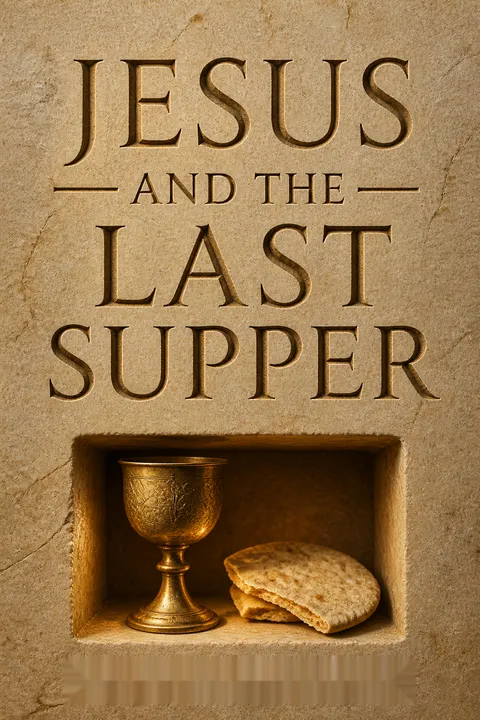


Key Takeaways
Read the Last Supper as the hinge joining Jesus' life to Israel's hopes
A meal with a long backstory. Brant Pitre argues that Jesus' final meal cannot be understood as an isolated Christian ritual. Set beside Jewish Scripture and first-century practice, it gathers threads from Jesus' public life: Moses, the exodus, covenant sacrifice, manna, Passover, and Israel's hope for God's kingdom.
The book's central claim. Jesus acted as a new Moses, initiating a new exodus through his coming death. The Twelve represented a renewed Israel, and the meal became a sign of the community that would continue in his absence. The book uses the Last Supper to revisit four historical questions: how Jesus related to Judaism, how he understood himself, what future he expected, and what kind of movement he intended to leave behind.
What's striking is the book's choice of focal point. Instead of beginning with a doctrine of the Eucharist, it asks what a first-century Jewish audience might have heard in a meal, a covenant, and a command to eat. That approach makes the Last Supper illuminate Jesus' wider ministry, rather than treating it as a detached final episode. Its cost is complexity: the argument depends on readers tracking many biblical echoes, some stronger than others. The payoff is a portrait in which Jesus' identity, death, and community belong to one story.
Judge Gospel traditions by context, coherence, and what they help explain
A three-part historical test. Pitre adapts a method associated with E. P. Sanders. A claim about Jesus gains plausibility when it fits first-century Judaism, connects coherently with other evidence about Jesus, and helps explain the beliefs or practices of the early church. These checks work against a claim as well as for it, but none proves history on its own.
Substance, not stenography. Pitre calls the basic content of Jesus' words the substantia verba Jesu. The Gospels differ in wording and arrangement, so he does not try to reconstruct a perfect transcript. He asks whether the substance of a teaching or action could reasonably come from Jesus. He also insists on interpreting a passage in context before deciding whether it is historical.
This approach avoids two easy shortcuts: accepting a saying simply because it appears in several texts, or rejecting it because early Christians also valued it. It treats history as an explanatory judgment, not a checklist. The key discipline is applying the three tests together. Context can make a startling claim intelligible, while coherence and later effects can show why it mattered. Still, coherence can become circular if an interpreter first chooses a portrait of Jesus, then counts only details that fit it. Pitre's method is strongest when competing explanations remain visible.
See the wilderness meal as Jesus' sign of a new Exodus
Bread in the desert. All four Gospels describe Jesus feeding a crowd of about five thousand with five loaves and two fish. Pitre reads the setting, the miraculous surplus, and the twelve baskets against the story of Moses and the manna. In Mark and Luke, Jesus also organizes the crowd into groups of fifties and hundreds, echoing the structure of Israel's wilderness camp.
A prophetic signal. In John's account, the crowd calls Jesus the prophet expected to come, then tries to make him king. Pitre argues that the meal could evoke both the promised prophet like Moses and the hoped-for messianic feast. He points to other first-century Jewish sign prophets who gathered crowds in the wilderness. This makes the event contextually plausible in his account, though it does not independently establish its miraculous details.
The episode works as more than a report of food appearing. Its geography, numbers, and crowd reaction make the miracle a public claim about what time it is: the old wilderness story is being replayed with Jesus at its center. That reading connects a concrete act of feeding to political hopes about Israel's restoration. It also invites caution. Biblical resemblance can show that an event made sense within its culture, but resemblance alone cannot prove that Jesus deliberately encoded every detail. The case gains force from the pattern across his other reported actions.
Read Jesus' cup as covenant blood and a servant's self-offering
Sinai in the Upper Room. In all four accounts, Jesus links the cup with his blood and a covenant. Pitre hears an echo of Exodus 24, where Moses seals a covenant with Israel using sacrificial blood, then shares a meal with the elders. The Twelve at Jesus' table also evoke Israel's twelve tribes. In Luke and Paul, the covenant is explicitly called new.
A death with purpose. Pitre connects this action with prophetic promises of a new covenant and with Isaiah's servant, whose life is given for many. He argues that Jesus presents his coming death as a sacrifice that inaugurates restoration and forgiveness. The Torah forbids consuming animal blood, but Pitre notes that it does not explicitly address wine identified with human blood. The language remains shocking, but is not simply outside Jewish thought.
The argument's strength lies in its convergence: covenant, blood, a meal, and twelve representatives all appear together, rather than as isolated verbal coincidences. The connection to the suffering servant also gives the cup a forward direction: Jesus' death is not merely a prediction but the means of a hoped-for renewal. Yet the historical claim remains an interpretation of allusions, not a direct quotation from Isaiah. The same evidence can support a powerful theological reading without settling precisely how Jesus formulated it.
Hear the Lord's Prayer as a petition for provisions on Israel's new Exodus
A prayer shaped by the wilderness. Pitre reads the Lord's Prayer as a compact hope for deliverance. Addressing God as Father and asking that his name be hallowed and his kingdom come echo prophetic hopes for Israel's return and renewal. The petition for epiousios bread uses an unusually obscure Greek word, often translated as daily bread. Pitre argues that its daily rhythm evokes the manna God gave Israel in the desert, while acknowledging that the exact meaning of the word remains uncertain.
A journey through need. The request to forgive debts evokes Jubilee, the release of debtors and return of land. The plea about temptation can also mean a request for protection during testing, like Israel's trials in the wilderness. Together, these petitions frame God's provision, forgiveness, and protection as necessities on the way to the kingdom.
This reading turns a familiar prayer from a list of private requests into a shared map of hope. Bread, forgiveness, and protection become signs of a people still traveling toward restoration. It also shows how a single ambiguous word can carry several compatible associations: ordinary sustenance, manna, and future provision. The uncertainty around epiousios matters, though. The larger Exodus interpretation may be persuasive without making every petition a coded reference to one prophetic passage.
Read Capernaum's hard teaching as heavenly manna, not ordinary cannibalism
A shocking promise. In John 6, Jesus compares himself with the manna eaten by Israel's ancestors, then speaks of eating his flesh and drinking his blood to receive life and resurrection. Pitre argues that the manna supplies the context: Jesus is describing food from heaven, not ordinary human flesh. The disciples' disgust and withdrawal make the saying difficult to accept, as the story itself reports.
Spirit-filled life. Pitre reads Jesus' reference to the Son of Man ascending and to the Spirit giving life as a clue to the kind of flesh in view: the heavenly, resurrected life of the Son of Man. This reading treats the passage as more than a metaphor for believing in Jesus. Pitre argues that its Jewish scriptural setting, its coherence with the Last Supper, and its links to early Christian practice make its substance historically plausible.
The interpretation refuses a false choice between literal cannibalism and an empty metaphor. It keeps the passage's emphatic language about food and drink while placing it in a Jewish hope for resurrection and heavenly provision. That makes the disciples' rejection part of the argument, not an awkward detail to explain away. Still, showing that a teaching could make sense in its setting does not settle whether John's long discourse preserves Jesus' own words. Pitre's case rests on plausibility and continuity, not a transcript.
Resolve the calendar clash by checking what ancient Jews meant by Passover
One word, several dates. The Synoptic Gospels call the Last Supper a Passover meal, while John's chronology seems to place it before the Passover. Pitre argues that ancient Jewish pascha could mean the lamb, the meal, peace offerings eaten during the festival, or the whole festival week. Meaning depends on context, not a one-word translation.
Pitre's proposed resolution. He reads John's phrase before the feast as just before the meal, and the leaders' later wish to eat the Passover as a reference to festival offerings. He takes preparation of Passover to mean Friday during Passover week. This Passover hypothesis preserves both Gospel accounts. It is contested, and its force depends on whether John's phrases can bear those contextual meanings. Pitre also argues that ancient observation-based calendars make modern astronomical calculations insufficient to decide the issue.
The useful lesson is methodological: apparent contradictions sometimes begin with a translation that has already chosen one meaning for an ancient word. Pitre's case is unusually attentive to Jewish festival terminology, and it explains details that a simple Synoptic-versus-John choice leaves unresolved. Its vulnerability is equally specific: the proposed readings must each work in their local context, not merely be possible in a lexicon. Readers should distinguish the strong case for taking Jewish usage seriously from the more debatable conclusion that this resolves the chronology.
Use the Bread of the Presence to see the meal's Temple-shaped symbolism
Bread, wine, and covenant. In Exodus and Leviticus, the Temple's golden table holds twelve loaves, with wine libations, as a continuing sign of the covenant between God and Israel. The loaves represent the twelve tribes, and the offering is linked with remembrance. Pitre sees a parallel in Jesus' meal with the Twelve, his bread and wine, and his command to repeat the act in memory of him.
A suggestive, not certain, link. On this reading, Jesus institutes a new bread and wine of divine presence, centered on himself. Pitre notes that Moses could act as a priestly figure in Jewish tradition, which helps explain why Jesus need not be a Levite for the comparison to work. He also admits that the early church's first-century writings do not explicitly identify the Eucharist with the Bread of the Presence, making this argument less secure than his case for a new covenant.
This is one of the book's more inventive connections because it joins imagery that is often studied separately: twelve loaves, wine, covenant, and remembrance. It also shifts attention from private symbolism to the Temple's public ritual world. The author appropriately signals that the evidence is thinner here. Numerical and ritual parallels can illuminate a meal, but they can also accumulate into a pattern that feels more certain than the sources warrant. Its value is strongest as a plausible interpretive backdrop, not a conclusive historical identification.
Make the kingdom banquet the destination of Jesus' final Passover
A feast beyond Jerusalem. Jesus says that he will not drink the Passover wine again until the kingdom comes. Pitre reads this as a death-and-restoration expectation, not a claim that the final feast will happen the next day. In other Gospel sayings, people arrive from every direction to dine with Abraham, Isaac, and Jacob. Pitre argues that this gathering includes both scattered Israelites and Gentiles, while those who reject the kingdom's invitation are excluded.
A community in the interval. The Twelve embody renewed Israel, and the command to repeat the meal gives their fellowship a continuing act of remembrance. The Last Supper thus points beyond Jesus' death to the heavenly banquet and to a community that gathers in anticipation of it. Pitre calls this a Eucharistic restoration: Israel's renewal is centered on the meal and the kingdom, rather than simply on a return to earthly Jerusalem.
The closing vision gives the meal a destination and a social shape. The kingdom is not merely a future political arrangement in this account; it is a banquet where the living, the dead, Israel, and the nations meet. That vision also helps explain why a continuing community matters: the meal rehearses the promised gathering before its completion. The timing and geography remain open in the texts, however. Pitre's heavenly emphasis is a coherent reading, not a timetable or a map that the sayings explicitly supply.
Analysis
Pitre's central achievement is to make the Last Supper historically legible by returning it to the symbolic world of Second Temple Judaism. The book's argument accumulates rather than rests on one decisive proof: Jesus feeds a wilderness crowd, prays for bread, speaks of manna, gathers Twelve, interprets bread and wine, and anticipates a banquet in God's kingdom. Read together, these details support a portrait of Jesus as a new Moses whose death initiates a new Exodus and whose meal binds a renewed community to that hope.
The method is valuable because it refuses to treat resemblance to early Christian belief as automatic evidence against Jesus. Continuity can explain how a movement arose from its founder. It also corrects the opposite error of treating any Jewish parallel as proof that a saying is authentic. Pitre's own three-context test, Jewish plausibility, coherence with Jesus' wider activity, and explanatory power for early Christianity, is best understood as comparative reasoning rather than a mechanical authenticity test. The book is strongest where multiple kinds of evidence converge: the Twelve, covenant language, sacrificial imagery, Passover preparation, and Paul's early identification of Christ with the Passover. Its chronology proposal is more vulnerable. The varied meanings of pascha are real within the sources presented, but the claim that John deploys those meanings in precisely the way required to reconcile the accounts remains contestable. Likewise, intertextual echoes can preserve historical memory, but they can also reflect how Gospel writers shaped remembered events for readers.
That tension does not undo the adaptation's central insight. Pitre shows that the Last Supper is not an inexplicable break from Judaism or a ritual detached from Jesus' public ministry. It is a concentrated act of interpretation: Israel's foundational stories are brought to bear on Jesus' impending death, and the meal becomes a way to understand both that death and the community that follows. Historical plausibility remains distinct from theological truth, but the two questions become harder to separate once the meal is restored to its Jewish setting.
Review Summary
Jesus and the Last Supper receives overwhelmingly positive reviews (4.71/5), praised as a phenomenal scholarly achievement. Readers commend Pitre's exhaustive research examining Jesus' words and deeds at the Last Supper through Jewish historical context, particularly his resolution of dating contradictions between John and the Synoptics. The work explores themes of new Moses, new Passover, and messianic banquet. While dense and technical, reviewers find it accessible and convincing, with thorough engagement of modern scholarship. Minor criticisms note occasional excessive weight on Second Temple literature and one omission regarding the "cup" as divine wrath symbol.
People Also Read




Glossary
substantia verba Jesu
the substance of Jesus' wordsPitre's term for the basic content or sense of a saying attributed to Jesus. It differs from reconstructing his exact wording or trying to reproduce his characteristic voice. The method asks whether the main substance of a teaching or action could plausibly originate with Jesus, while allowing Gospel writers to present it in different forms.
triple-context approach
three tests of historical plausibilityA method Pitre adapts from E. P. Sanders. A claim about Jesus is assessed by whether it fits first-century Judaism, coheres with other evidence about Jesus, and helps explain the beliefs or practices of the early church. The three contexts are used together, both to support and to challenge a historical proposal.
new Moses
the expected prophet like MosesA figure anticipated from Deuteronomy's promise of a prophet like Moses and later Jewish hopes for a deliverer who would renew the Exodus. Pitre argues that Jesus' wilderness feeding, gathering of Twelve, covenant language, and Passover actions evoke this role. In his account, Jesus is not merely repeating Moses, but inaugurating a new Exodus.
new exodus
eschatological deliverance and returnThe prophetic hope that God would deliver Israel again, as in the Exodus from Egypt, gathering the scattered people, forgiving sin, and establishing God's reign. Pitre uses this framework to connect Jesus' ministry, the Last Supper, the new covenant, the manna, and the restoration of Israel. The expected destination may be heavenly as well as historical.
eschatological manna
manna expected in the final ageThe expectation, found in some early Jewish texts, that the miraculous food given to Israel in the wilderness would return in the age of salvation. Pitre connects it with Jesus' feeding of the crowds, the bread petition in the Lord's Prayer, and the teaching in John 6 about heavenly bread that gives life.
messianic banquet
the feast of the coming kingdomA Jewish image of the future age in which God's people share a feast associated with salvation, restoration, and the Messiah. The sources vary on its setting, participants, and meaning. Pitre reads Jesus' sayings about dining with Abraham, Isaac, and Jacob, and his Last Supper vow, as connecting the banquet to the kingdom and the gathering of Israel and the nations.
Bread of the Presence
Temple bread symbolizing God's presenceThe twelve loaves set on a golden table in the Tabernacle and Temple, before God, and eaten by priests. In Leviticus, the bread is associated with the continuing covenant, the twelve tribes, and remembrance. Pitre proposes that Jesus' bread-and-wine meal may evoke and transform this Temple offering, while acknowledging that the historical link is less certain.
Passover hypothesis
a Jewish-context resolution of the datePitre's proposal that the apparent conflict between the Synoptic Gospels and John about the Last Supper arises partly from the multiple meanings of the word Passover. It can refer to the lamb, meal, festival offerings, or weeklong festival. On his reading, John and the Synoptics can both depict a Passover meal, though the proposal remains debated.
About the Author
Download PDF
Download EPUB
.epub digital book format is ideal for reading ebooks on phones, tablets, and e-readers.








