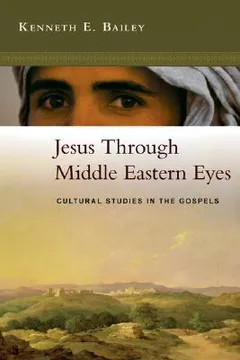


Key Takeaways
Read the Gospels as Middle Eastern stories, not Western abstractions
Culture changes the scene. Kenneth Bailey argues that familiar Gospel stories can look different when read against village life, Jewish customs, Semitic languages, and Eastern Christian interpretation. For example, a manger need not imply a barn, and a parable’s order of ideas may not run in a straight line. Bailey also looks for patterns in which early and late passages echo each other around a central point. He calls one seven-part form the prophetic rhetorical template: paired outer sections frame a central climax.
Form carries meaning. Bailey draws on Hebrew and Aramaic texts, Syriac translations, and centuries of Arabic Christian commentary, traditions often overlooked in Western biblical study. His method asks readers to notice both a story’s social setting and its literary design before deciding what it means.
What's valuable is the shift from treating cultural detail as decorative background to seeing it as part of how a story argues. Narrative structure can guide attention just as strongly as a thesis statement. The method also invites intellectual humility: translations preserve interpretation, not just vocabulary. Still, cultural resemblance is not proof that an ancient event happened exactly as a modern village practice suggests. The strongest readings distinguish evidence from reconstruction, and treat Bailey's vivid cultural accounts as informed interpretive proposals rather than automatic historical certainties.
Read the manger as a sign of humble welcome, not rejection
A home, not an inn. Bailey challenges the familiar picture of Joseph and Mary arriving in Bethlehem moments before the birth and finding every room at a commercial inn occupied. Luke's word for the lodging can mean a guest room, and elsewhere in Luke it refers to a room in a private home. Bailey argues that the guest room was full, so the family stayed in the main room, where village households kept animals at night and used mangers.
The village receives them. Joseph's family connection to Bethlehem, Mary's nearby relatives, and the time Luke allows before the birth all make a last-minute rejection less likely in Bailey's reading. The shepherds, people of low status, find the child in a home like theirs. The scene then signals that ordinary people are welcome near the Messiah.
This reading changes the emotional center of the Christmas story. Instead of a community failing a vulnerable mother, the story may depict ordinary hospitality offered within limited space. That shift matters because it replaces sentimental loneliness with a social ethic: welcome can be real without being luxurious. Yet the interpretation depends on choices about Greek vocabulary, local housing, and narrative timing. Other readings remain possible, so the claim is best presented as a strong cultural reconstruction, not an uncontested correction to the Gospel.
Treat blessing as present grace, not payment for spiritual performance
Blessed already. In the Beatitudes, Bailey distinguishes makarios, a word that recognizes an existing state of spiritual joy, from a request asking God to grant a blessing. The sayings therefore do not simply promise rewards to people who perform the right behaviors. They identify people whose hope rests in God's coming reign, even while they grieve, face persecution, or lack power.
Righteousness is relational. Bailey reads biblical righteousness not as a score for private virtue but as a relationship granted by God and answered through just conduct. God's saving acts set the pattern for human action, especially mercy toward people who are weak or excluded. The meek inherit the land rather than the violent, while those who hunger for righteousness keep striving for justice and peace rather than claiming to have arrived.
This approach resists turning the Beatitudes into a spiritual achievement chart. Its relational account of righteousness also joins inner faith to public treatment of neighbors, a connection that ethical theories often separate. But the phrase poor in spirit can be misused to make material poverty seem spiritually desirable or irrelevant. Bailey's reading should be held alongside the concrete hunger and deprivation named in Luke's version. Spiritual humility and economic hardship are related in the text, but they are not interchangeable.
Pray for God's world, and name bread, forgiveness, and danger
The prayer looks outward. Jesus teaches people to address God as Abba, a familiar Aramaic word for father that also conveys respect. The prayer says our Father, so even a private speaker enters a shared family. Its first requests concern God's holiness, kingdom, and will; the remaining requests ask for food, forgiveness, and protection from trial and evil. Bailey stresses that these are not spiritual concerns detached from ordinary life: the prayer expects people to work for bread, forgive others, and resist wrongdoing.
Scarcity matters. The Greek word traditionally rendered daily in give us this day our daily bread is rare, and early translators disagreed about its meaning. Bailey favors an early Syriac version that suggests bread that lasts or does not run out, linking the petition to fear of future hunger. This is a proposal, not a settled translation.
The prayer's repeated us and our quietly challenge the fantasy that survival is an individual achievement. Its sequence also joins worship to material provision and interpersonal repair, rather than allowing religious devotion to ignore either. Bailey's reading of the bread petition is a useful reminder that translation uncertainty can preserve important questions. It should not be treated as the definitive solution, however. The prayer's force survives the ambiguity: it asks for enough to live, and makes that need communal.
Let Jesus' mission challenge your group's claim to God's favor
A message without vengeance. In Nazareth, Jesus reads from Isaiah and presents a mission Bailey summarizes as proclamation, justice advocacy, and compassion. He emphasizes release for captives and care for the blind, while omitting the passage's line about vengeance. The congregation's anger, in Bailey's account, comes from hearing a familiar promise of national triumph redirected toward mercy and service.
Outsiders become examples. Jesus recalls the foreign widow who trusted Elijah during famine and Naaman, the Syrian general healed by Elisha. Rather than flattering his hometown, he presents Gentiles as models of faith. The episode challenges any community that assumes God's favor belongs exclusively to itself. Faith, in these stories, involves conviction, trust, and action, not merely agreement with religious claims.
The reading is a sharp account of how sacred language can be recruited to bless a group's political interests. By placing foreigners at the center, the story asks whether a community can recognize virtue beyond its own borders. This is a durable challenge wherever religion and national identity overlap. Bailey's detailed reconstruction of Nazareth's political self-understanding is more debatable than the story's broader critique of exclusion. The distinction matters: a strong ethical reading need not depend on every historical detail being certain.
Give women the role of disciples, theologians, and witnesses
Women are part of the movement. Luke names women who travel with Jesus and help fund his work. In another scene, Mary sits at a rabbi's feet, the position of a student, and Jesus defends her right to learn. Bailey sees these as signs that women belong among Jesus' disciples, not merely among the people who serve them.
A witness can teach. At Jacob's well, Jesus discusses worship and theology with a Samaritan woman, who then tells her community about him. In Matthew's story of the Canaanite woman, a mother persistently seeks help for her daughter and is praised for her faith. Bailey also notes that Gospel writers pair stories about women and men, and place women prominently in the resurrection accounts. Women carry the message when male followers have fled.
The argument is strongest when it points to narrative agency: women speak, interpret, finance, learn, and testify. Those roles challenge assumptions about who is qualified to transmit religious knowledge. Bailey's cultural observations help explain the surprise built into these scenes, though broad claims about what women could or could not do in every ancient setting should be handled carefully. The Gospel narratives themselves provide the clearest evidence: whatever the social norms, these women are presented as consequential participants.
Offer mercy without excusing harm, and pursue repair without revenge
Grace has a cost. In the stories of Zacchaeus, the woman accused of adultery, and the woman who honors Jesus in Simon's home, Jesus absorbs hostility that had been aimed at someone else. His welcome does not make wrongdoing harmless. Zacchaeus pledges restitution, and the woman is urged to change her life. In the adultery story, Jesus refuses a double standard that would punish the woman while ignoring the man.
Care crosses boundaries. In the Good Samaritan, the religious insiders pass a wounded man, while a member of a despised community treats his injuries and pays for his care. Together, these stories portray mercy as action that restores a person without denying harm. Bailey describes such acts as costly love, because the giver risks reputation, resources, or safety.
These stories resist two convenient extremes: compassion that asks nothing of the person causing harm, and punishment that treats a person as nothing but the harm committed. That distinction has clear relevance to restorative justice, which centers acknowledgment, repair, and continuing safety rather than revenge alone. Still, forgiveness cannot substitute for protection or accountability, particularly where violence continues. Bailey's emphasis on grace is most persuasive when read alongside the stories' demands for changed conduct and restitution.
Manage wealth as God's loan, not proof of your worth
Possessions create obligations. Bailey reads the rich fool as someone who receives an abundant harvest and treats it as exclusively his own. He plans larger storage, congratulates himself, and never asks who might need the surplus. The story ends with his sudden death, exposing how little control he has over either life or property. In Bailey's account, possessions are entrusted resources, not proof of divine approval.
Neglect is a choice. The rich man in the Lazarus parable feasts while a sick beggar lies at his gate, close enough to hear the banquets. The rich man knows his name, but never helps him. Bailey connects these stories to Jesus' warning that money can become a rival master. Wealth is not condemned simply for existing; the danger is using it only for oneself and ceasing to notice neighbors in need.
The parables make wealth a question of attention as much as ownership. The rich man does not need to hate Lazarus to harm him; indifference is enough. That insight aligns with modern discussions of structural neglect, where institutions can distribute resources unequally without any single actor feeling personally cruel. The stewardship metaphor also raises practical questions the stories do not settle, such as what fair distribution requires. Its strength is not a complete economic policy, but a demand to account for what abundance is doing.
Measure justice by whether the vulnerable can live with dignity
Equal treatment is not always enough. In the vineyard laborers' parable, a landowner hires workers throughout the day and pays each a full day's wage. The first arrivals complain, though they receive exactly what they agreed to. Bailey reads the owner's choice as both fair and compassionate: it lets workers hired late feed their families, while treating them as workers rather than recipients of charity.
Make room at the table. In the Great Banquet, invited guests insult their host by refusing to come. He redirects the meal to poor and disabled people, then sends his servant beyond the town to bring in others. Bailey sees the host turning anger into welcome. The parable challenges religious communities that reserve God's feast for insiders, and it portrays justice as including dignity, provision, and access.
These stories expose a tension between procedural fairness and sufficiency: identical pay may feel unfair to those who measure only hours worked, yet it can meet basic needs for those who had no earlier opportunity. Contemporary debates about wages and social support face the same conflict. The parables do not erase the value of agreements or effort. They ask whether those rules are the whole meaning of justice, or whether a community can also recognize vulnerability and respond generously.
Stay faithful through delay, because the kingdom arrives on God's time
Waiting is active. Jesus' kingdom is already present in his work, yet its completion remains future. In the parable of the pounds, servants receive resources while their master is away. Bailey argues that the key test is not commercial success but whether they act faithfully in public, despite the master's opponents and uncertain return. The servants who act are given greater responsibilities, not private luxury.
The master reverses rank. In the parable of the serving master, servants stay ready through the night, and their returning master serves them a meal. In the two-builders parable, hearing Jesus is not enough: his words must be practiced, like a house built on a foundation that withstands a flood. Together, these scenes make waiting a form of responsibility, not a reason to withdraw from ordinary life.
The book's account of waiting avoids both frantic prediction and passive resignation. A long horizon can support patient work, especially when immediate outcomes are uncertain. The master serving his servants also offers a model of authority that runs against status-based leadership. Yet images of servants and rulers can be misused to sanctify obedience to human power. Bailey's emphasis is on faithfulness to Jesus, whose own authority is shown through service, rather than automatic deference to whoever holds office.
Analysis
Bailey's central achievement is methodological as much as theological. He asks readers to treat the Gospels as Jewish, Semitic narratives shaped by oral memory, translation, community editing, and rhetorical craft, rather than as isolated sayings awaiting modern paraphrase. His attention to Syriac and Arabic Christian interpretation corrects a real imbalance in Western biblical scholarship: Greek and Latin traditions are not the whole history of Christian reading. The payoff is vivid. A manger can signify hospitality, a parable's center can overturn its apparent conclusion, and a woman's action can carry theological authority.
The book's deepest moral pattern is the refusal to let one category monopolize God's concern. The oppressed need liberation, but they are not thereby sinless. The wrongdoer remains accountable, but can still receive mercy. Justice requires both protection from harm and a path toward repair. This is more demanding than a simple opposition between virtuous victims and wicked perpetrators, and it explains why Bailey repeatedly reads stories of welcome alongside calls for restitution and changed conduct.
The method also needs guardrails. Bailey's long experience in the Middle East gives him insight into cultural practices, but present-day customs cannot automatically establish first-century realities. His readings of rhetorical symmetry and some linguistic ambiguities are illuminating, yet patterns can be overdetected, and translations do not always preserve a single recoverable meaning. The book is therefore most persuasive as a rich interpretive lens, not a final verdict on every historical question. Readers gain most by keeping its cultural proposals, textual evidence, and theological conclusions distinct, then testing how well they support one another. That discipline preserves the book's imaginative force without confusing a compelling reconstruction with certainty.
People Also Read







Glossary
prophetic rhetorical template
Seven-part ring structureBailey's name for a seven-section rhetorical pattern found in prophetic and Gospel texts. The opening sections correspond to later sections in reverse order, while the center carries the main emphasis or climax. Bailey uses the pattern to argue that a passage's meaning depends partly on its arrangement, not only on its individual sentences.
inverted parallelism
Ideas return in reverse orderA literary arrangement in which a sequence of ideas appears and then returns in reverse order, often placing the central idea at the point of greatest emphasis. It is also called ring composition or chiasm. Bailey argues that noticing these relationships can clarify a passage's structure and prevent readers from assuming that its conclusion is automatically its climax.
divine passive
God acts without being namedA passive verb form that leaves the actor unstated while implying God as the one who acts. Bailey uses the term for expressions such as a person being forgiven or comforted. In his reading, the grammatical choice can preserve reverence for God's name while still attributing the action to God.
Abba
Aramaic address for FatherAn Aramaic word for father that can convey both personal relationship and respect for an authority. Bailey emphasizes that Jesus' use of Abba in prayer was distinctive and was retained in some Greek New Testament passages. In the Lord's Prayer, its communal form, our Father, makes the relationship shared rather than merely private.
makarios
Recognized state of blessednessThe Greek word Bailey discusses in the Beatitudes. He distinguishes it from a word used to ask God for a blessing, arguing that makarios recognizes a state of joy or good fortune already present. On this reading, the Beatitudes describe people living within God's promised salvation, rather than offering a simple bargain in which behavior earns reward.
righteousness
Right relationship and its responseBailey treats biblical righteousness as more than an abstract standard of personal morality. It includes God's saving action, a person's accepted standing before God, and the conduct that follows from that relationship. Such conduct includes justice and mercy toward vulnerable people, modeled on God's treatment of Israel.
theological cluster
Related meanings within a parableBailey's term for several themes that belong together within a parable, such as repentance, forgiveness, self-righteousness, and joy. Rather than reducing every parable to one point or treating every detail as a separate symbol, he argues that its themes form a connected whole, bounded by what the original audience could plausibly understand.
Download PDF
Download EPUB
.epub digital book format is ideal for reading ebooks on phones, tablets, and e-readers.








