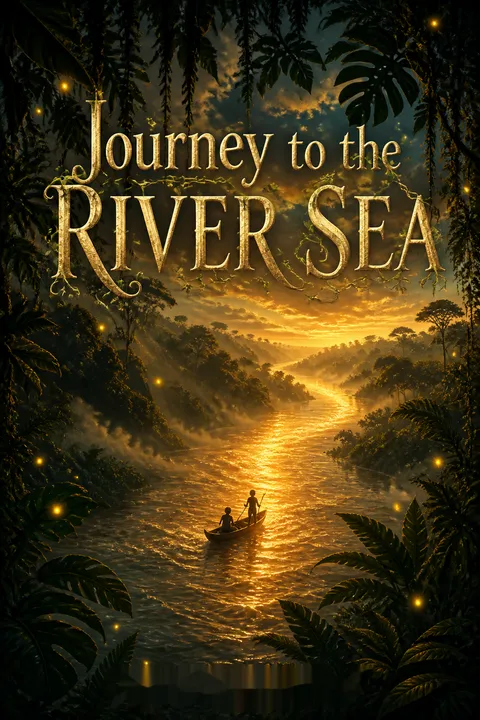


Plot Summary
Maia's Riverward Departure
After her parents die in a train crash, Maia Fielding spends her holidays at a London school, where her guardian, Mr Murray, finally finds relatives willing to house her. The Carters live on the Amazon, and Maia imagines their twin daughters will become the loving family she has missed. She studies the river in the school library until fear gives way to excitement.
Her new governess, Miss Minton, joins her on the voyage, bringing a trunk heavy with books and a fierce sense of justice. At sea, Maia befriends Clovis King, a young actor whose troupe keeps him unpaid and far from his foster mother. He longs for England; Maia is eager for the world waiting upriver.
Maia’s journey begins with a double hunger: she wants family, but she also wants a world large enough to meet her curiosity. Her parents’ death has made belonging feel uncertain, so the twins’ brief welcome carries more emotional weight than the evidence warrants. The books do not simply reassure her about the Amazon; they help her imagine a future she can choose rather than endure. Clovis provides a counterpoint. He has travelled widely but experiences travel as coercion, while Maia approaches it as possibility. Their contrasting responses establish that freedom depends not on distance alone, but on whether a person has agency within it.
A House Sealed Against Life
At Manaus, Maia waits in vain for the Carters, then follows their agent upriver to a dark green bungalow. The parents barely welcome her, while Beatrice and Gwendolyn accept her presents only to complain that they are local goods. Inside, Mrs Carter keeps the windows netted, the rooms disinfected, the garden gravelled, and the meals English and tinned.
She forbids pets and treats the Indian servants as sources of dirt. Maia’s room has a locked door to the servants’ compound, and the twins tell her they never go outside. That night Maia hears a lullaby from the huts and a familiar English melody from the forest. The house feels lifeless, but the world beyond it is calling.
The Carter home turns Maia’s imagined refuge into a controlled enclosure. Mrs Carter’s fixation on germs is more than eccentric housekeeping: it lets her classify local people, food, animals, and customs as threats, then justify excluding them. The twins have inherited this narrowness as routine, moving through lessons and meals without meaningful contact beyond the family. Maia’s window becomes a threshold between imposed safety and lived experience. The songs she hears across it suggest that the people dismissed as servants possess histories and affections the household cannot perceive. Her loneliness is real, but it is also the first force drawing her toward a wider community.
The Crows Seek Taverner
Miss Minton quietly frees Maia from the twins’ dull lessons, teaching her about Brazil from books instead of Dr Bullman’s exercises. On a trip to Manaus, Maia meets two English detectives, Mr Trapwood and Mr Low, who are searching for the son of naturalist Bernard Taverner and insist the boy must return to England.
At the museum, Professor Glastonberry confirms that Bernard was a respected collector, though he denies knowing of a son. Maia also discovers the city’s lively streets and its grand theatre. She hopes to see Clovis perform there, but the twins refuse to include her in their plans. Their casual exclusion sharpens Maia’s resolve to keep her promise to the boy who trusted her on the ship.
This section joins two forms of confinement. Maia is kept from the city by the Carters, while the detectives treat the missing boy’s wishes as irrelevant to his supposed duty. Their certainty exposes the authority of inheritance and law as social claims, not neutral truths. Meanwhile, Maia’s education with Miss Minton counters the Carters’ effort to keep Brazil intellectually distant. The museum offers a different model of knowledge: observation, collections, and respect for a place’s own complexity. Maia’s promise to Clovis matters because it is freely chosen, unlike the obligations imposed on the Taverner heir. Loyalty begins to become a practical act.
A Canoe Through Green
When the Carters leave for Clovis’s performance without Maia, she slips out with a map and tries to reach Manaus alone. The waterways confuse her; she falls, injures her hand, and is found by an Indian boy who paddles her safely to the city. At the theatre, Maia reaches Clovis just in time to watch his voice crack during a crucial scene.
The audience laughs, and he flees the stage in shame, convinced the troupe will abandon him. Maia comforts him backstage and promises to find a way to get him home. She returns to the Carters’ household exhausted, but the river has given her more than a glimpse of danger: her rescuer has shown her that the jungle is navigable with knowledge and trust.
Maia’s first unsupervised journey tests the difference between admiration of nature and competence within it. Her map cannot substitute for local knowledge, and her injury makes that limitation bodily. The rescuer does not validate her fantasy of effortless adventure; he saves her from its consequences. At the theatre, Clovis’s public humiliation reverses the usual stage arrangement: the performer loses control, while Maia becomes the steady witness who can help him imagine a next step. Her promise is not a grand rescue plan yet. It is a commitment made before she knows how difficult keeping it will be.
A Sanctuary Behind Reeds
Mrs Carter punishes Maia for slipping away, but Miss Minton invents a breathing ailment so Maia can spend time outdoors. When Maia returns a runaway baby to Conchita, the servants welcome her into their huts, where Lila teaches her songs and the family shares food, pets, and stories. They know more than they reveal to the Carters and promise to help her.
Meanwhile, Clovis arrives at the bungalow seeking shelter, only to be mocked by the twins and turned away by Mrs Carter. Miss Minton sends him to a disused hut, but Finn secretly moves him to a hidden lagoon. There Maia recognizes her rescuer and learns that the detectives are hunting Finn, Bernard Taverner’s son.
The household’s hierarchy begins to fracture when Maia encounters the servants as people with language, humour, and obligations to one another. Returning Conchita’s baby creates the trust that politeness alone could not earn. The lagoon extends that reversal: what looks like an inaccessible wilderness is a carefully protected home, sustained by knowledge the Carters have refused to learn. Clovis’s rejection makes the difference between these worlds painfully concrete. One household sees a distressed child as an inconvenience; the other shelters him. Maia’s discovery of Finn also changes the story’s scale: her private friendship now sits inside a conflict over inheritance and forced return.
The Heir's Borrowed Face
Finn explains that his father fled Westwood after an abusive childhood, built a life among Amazonian communities, and warned his son never to be forced back. Since Bernard’s elder brother died, their grandfather wants Finn to inherit the English estate. Finn intends to reach his mother’s Xanti people, where he hopes to stay beyond the detectives’ reach.
He proposes that Clovis impersonate him and sail to England in his place. Clovis learns Westwood’s rooms and family history from Finn’s notebook, while Maia arranges a hiding place beneath the museum’s giant sloth skeleton. Professor Glastonberry agrees to help. The plan gives Clovis a route home and Finn a chance to choose his own life.
Finn’s history complicates the idea that inherited privilege is automatically desirable. Westwood represents not comfort but a family system that punished tenderness and treated obedience as masculinity. His father’s escape offers Finn a model of self-definition, yet the plan asks Clovis to borrow precisely the identity Finn rejects. Clovis’s acting skills become a practical resource, but the performance has ethical stakes: the impersonation risks placing him inside another person’s family and fortune. Maia and Glastonberry make the scheme possible through trust and ingenuity, not force. The children are trying to redirect adult power without becoming its instruments.
The Twins Take the Bait
With the detectives preparing to leave Manaus, Finn hides Clovis beneath the museum while Maia attends a party at Sergei and Olga’s home. She acts suspiciously near the windows, asks about the detectives’ ship, and carries food as though she intends to feed a fugitive. Beatrice and Gwendolyn follow her, then corner her and twist her arms until she appears to confess that Finn is hiding in the museum.
Maia hopes the detectives will wait until the ship is ready to sail. Sergei interrupts the twins’ attack, but they escape and take their information to their mother and the detectives. Maia’s deliberate deception has worked, though she cannot control how violently the adults will act on it.
Maia’s performance is an inversion of the children’s usual powerlessness. She uses Clovis’s lessons in stagecraft to make the twins believe they have uncovered a secret, but their physical cruelty shows that the scheme is not harmless play. They turn suspicion into leverage because they want the reward and resent Maia’s independent loyalties. The scene also distinguishes intention from consequence: Maia chooses the information to reveal, yet she cannot determine how the detectives will interpret or use it. Her strategy depends on timing, not moral transformation. The twins’ behaviour makes clear that access to money and social authority can amplify selfishness rather than correct it.
A Boy for Westwood
The detectives break into the museum and search its exhibits, then force Maia to reveal the trapdoor beneath the giant sloth. Finn, dressed as an Indian servant, bursts from the cellar and struggles as they seize him. Miss Minton realizes the captured boy is the real Finn and calls for the hidden heir to emerge.
Clovis climbs out, presents himself as Finn, and gives the detectives Bernard’s watch as proof of his gratitude to his supposed servant. They take Clovis aboard the ship bound for England, while Finn escapes. Afterward, Miss Minton reveals that she once worked at Westwood as Bella, the only childhood friend who encouraged Bernard to leave. Finn’s boat, the Arabella, bears her name.
The substitution succeeds because each child understands a different kind of performance. Finn can convincingly appear foreign to the detectives, while Clovis can inhabit the polished manners they associate with an heir. Yet Miss Minton sees through the scene because she recognizes Bernard’s face and history, not because she trusts appearances. The watch, passed from father to son and then to a friend, becomes a portable record of loyalty that contradicts the detectives’ official account of who deserves what. Miss Minton’s connection to Bernard also reveals that her sternness has always contained a personal allegiance to people who resist abusive authority.
Reward Money Turns to Ash
Finn waits until the ship is safely out of reach, then prepares the Arabella for his journey north. Maia remains behind, while the Carters’ debts worsen and the twins receive the reward for betraying him. They hide the money from their parents and each other, turning their prize into a source of suspicion.
Mr Carter’s creditors close in; his collection of glass eyes absorbs more of his attention, while Mrs Carter clings to the fantasy of her English connection, Lady Parsons. Miss Minton secretly arranges a safer home for Maia with the Keminskys and receives Mr Murray’s approval. Before she can explain, a fire breaks out in the bungalow, trapping Maia in the smoke-filled house.
The reward does not solve the twins’ insecurity; it gives their mistrust a physical object to guard. Their money becomes less a means of pleasure than a private boundary against parents and servants. The adults are also caught in defensive fantasies: Mr Carter retreats into his collection, and Mrs Carter imagines Lady Parsons as a dependable rescue. Miss Minton, by contrast, quietly makes a concrete plan and secures permission before acting. The fire interrupts that rescue at the moment it should have become possible. The contrast reveals how fragile institutional protection is when adults’ schemes and material crises crowd out a child’s immediate safety.
Smoke Above the Negro
The fire consumes the bungalow. Mrs Carter and the twins escape, but Mr Carter goes into his study for his glass eyes instead of rescuing Maia. She climbs through her high window, cuts her leg on broken glass, and hides in the forest until she collapses. Finn has already started upriver, but a growing unease turns him back.
At the ruins, he finds the servants’ huts empty and assumes Maia is lost, until his dog tracks her blood through the leaves. Finn carries her to the Arabella, treats her wound with forest medicine, and takes her away before she can be returned to the Carters. When Maia wakes, she is safe aboard the boat, and Finn continues toward the Xanti with her beside him.
The fire strips away the Carters’ performance of respectable order. Mr Carter’s choice of his collection over Maia exposes the household’s actual priorities at the instant they matter most. Maia survives through her own action, climbing out rather than waiting for rescue, but her injury makes survival precarious. Finn’s return is driven by a feeling he had earlier dismissed as superstition; the novel lets intuition become ethical responsibility when he acts on it. Their departure is not simply an escape from danger. It is a renewed choice to trust one another, made after Maia has seen how little protection the supposedly proper household offered.
Minty Takes the River
When Maia disappears from the hospital after the fire, Miss Minton searches Manaus with Professor Glastonberry and the friends Maia has made. A trader finally reports seeing two children aboard the Arabella. Unable to wait for a hired boat, Miss Minton and the professor take the Carters’ abandoned launch upriver. After days of hard travel, they find Maia and Finn.
Miss Minton first scolds Maia, then learns that the children are bound for the Xanti village. She had planned to move Maia to the welcoming Keminsky household, but Maia cannot bear to leave the river. On the following morning, Miss Minton and the professor abandon their safe return plan, transfer to the Arabella, and agree to continue with the children.
Miss Minton’s search turns care into action rather than possession. She is terrified for Maia, yet her first instinct after the reunion is still to restore the ordinary protections she can understand. Maia’s refusal to return forces her to recognize that safety and flourishing are not identical. The professor’s presence matters because he helps Miss Minton take a risk without pretending it is risk-free. Her discarded corset marks a small, physical surrender of the rules that once defined respectable femininity and professional restraint. The adults do not become careless; they become willing to revise their judgment in response to Maia’s lived experience.
The Corset's False Alarm
The travellers reach the Xanti, where Finn meets his mother’s people and Maia finds friends, songs, and a daily life organized around shared work. Glastonberry searches with them for signs of the giant sloth, while Miss Minton builds an English to Xanti dictionary. At a feast, Maia sings an old song in English.
The sound alerts a river police patrol, which assumes she is a captive and raids the village. The Xanti vanish into the forest to avoid the armed men, leaving the four visitors to be taken back to Manaus. The search began when Miss Minton’s discarded corset was found downstream and mistaken for evidence that the party had been captured. In Manaus, messages arrive from Mr Murray and Clovis.
The rescue is a collision between actual danger and colonial assumptions. The police interpret an English song as proof of captivity because they cannot imagine Maia choosing to live among the Xanti. Their intervention protects the outsiders while disrupting a community that had offered them safety. The Xanti respond by disappearing, an act that reflects strategic self-preservation rather than helplessness. The corset makes the episode more pointed: a symbol of Miss Minton’s personal liberation becomes, in official hands, evidence that she must have been restrained. The scene questions who gets to define rescue, and whether good intentions excuse the refusal to listen.
Westwood's Accidental Heir
Mr Murray orders Miss Minton to bring Maia back to England, and Clovis’s message asks Finn to come to Westwood. In England, Clovis has tried to tell Sir Aubrey that he is not Bernard’s son. The old man suffers a heart attack at the revelation, and Clovis pretends it was a joke so he will recover.
When Finn reaches Westwood, Clovis explains that he has grown fond of Sir Aubrey, the household, and his cousins, but cannot take an inheritance that belongs to Finn. Finn realizes Clovis is not asking to escape the estate; he is trying to return the choice to its rightful owner. Meanwhile, Maia and Miss Minton return to the Mayfair Academy, where Maia finds that her friends cannot understand what she has experienced.
Clovis’s dilemma shifts the inheritance plot from a contest over property to a question of responsibility. He could continue benefiting from a lie, but his affection for Sir Aubrey makes truth emotionally costly rather than merely prudent. The old man’s collapse explains why Clovis retreats from confession, yet the delay also makes his loyalty to Finn more deliberate. Finn, who has treated Westwood as the embodiment of coercion, must now distinguish the estate from the people living within it. Maia’s return to school provides a parallel loss: her experience is real, but ordinary conversation cannot contain it. Both children face the difficulty of translating a changed self into familiar settings.
The Road Back South
At the Academy, Miss Minton meets Mr Murray, expecting to be dismissed for letting Maia travel. She returns the money earned from collecting specimens and explains that Maia was not merely entertained by the Amazon: she became more fully herself there.
Murray initially calls the expedition reckless, but Miss Minton argues that danger exists in London too and that Maia needs room to follow her gifts. At that moment Finn arrives, having chosen to return rather than let Clovis carry the cost of his escape.
Miss Minton tells them they are going home together. The ending restores neither the Carters’ household nor Maia’s former life. Instead, Maia, Finn, Miss Minton, and the professor can return to Brazil with education and exploration both in view.
The resolution refuses a simple choice between adventure and responsibility. Miss Minton does not claim that Maia’s journey was safe or that guardianship is meaningless; she argues that protection must be measured against the child’s capacity to become herself. Murray’s change of mind is therefore a change in what he considers responsible care. Finn’s return also matters: he does not reclaim Westwood through force or deny Clovis’s attachment to it. He chooses a future in Brazil without making friendship depend on sacrifice. The group’s shared return promises a life where learning, exploration, and care can coexist instead of competing.
Analysis
The novel repeatedly asks who has the authority to call a place safe. The Carters use screens, disinfectant, English food, and rigid lessons to shut out the Amazon, yet their house becomes the least protective place in the story. The forest is dangerous when Maia enters it without knowledge, but it becomes navigable through relationships with Finn, Furo, and the communities the Carters dismiss. Safety therefore emerges not from walls but from attentiveness, shared knowledge, and reciprocal trust. Inheritance and guardianship offer parallel forms of control. Sir Aubrey treats Finn’s birth as a claim on his future; the Carters accept Maia for her allowance; the detectives assume that legal authority makes consent irrelevant. Against these arrangements, the children build loyalties through chosen acts. Clovis risks impersonation to help Finn, Maia risks discovery to help Clovis, and Miss Minton revises her duty when she sees what Maia needs. None of these choices is effortless. They carry danger, deception, grief, and the possibility of failure.
The story’s movement is also a movement in how knowledge is valued. Dr Bullman’s fixed lessons and Mrs Carter’s imported habits keep Brazil at a distance. Maia learns instead by drawing, listening to songs, speaking Portuguese, and accepting guidance from people who know the land. Glastonberry’s museum preserves specimens, but fieldwork and the Xanti’s knowledge challenge the idea that nature is fully possessed once it has been labelled. Even the search for the giant sloth matters less as a guaranteed discovery than as a reason to keep looking.
The ending does not claim that childhood should be free of limits. It argues that responsible care must make room for a child’s particular capacities. Maia returns to the Amazon not because danger has vanished, but because the adults who love her have learned that preventing every risk would also prevent her from becoming herself.
Review Summary
Journey to the River Sea is a beloved children's adventure novel set in the Amazon. Readers praise Ibbotson's vivid descriptions, engaging characters, and exciting plot. The story follows orphan Maia as she travels to Brazil to live with relatives, encountering both challenges and friendship. Many reviewers note the book's themes of courage, exploration, and embracing different cultures. While some critique aspects of representation or pacing, most find it a captivating read for both children and adults, with beautiful writing and a sense of nostalgia.
People Also Read
Characters
Maia Fielding
Amazon-bound orphanMaia is an orphan who has learned to manage grief without losing her curiosity. She notices what adults overlook, from the emotional life of a servant’s household to the routes hidden behind a riverbank. Her desire for a loving family initially makes her idealize the Carter twins, but disappointment does not make her cynical. Instead, she responds by observing, learning, and forming loyalties through action. Music, stories, and natural history give her ways to connect with people whose lives differ from hers. Maia’s bravery is not fearlessness; she misjudges danger and needs help. What distinguishes her is her willingness to revise her understanding and keep reaching toward a world larger than the one assigned to her.
Finn Taverner
River-raised naturalistFinn is a capable, self-reliant boy raised among the rivers and forests of Brazil. His knowledge is practical: he can read waterways, handle a launch, and use plants for food and medicine. He values privacy because the life he shares with his father has been a refuge from a family history he does not want repeated. His independence can harden into certainty, especially when he decides that leaving alone is safer than allowing others to share his risks. Friendship with Maia and Clovis tests that habit. Finn is observant and loyal, but not always gentle; his bluntness often conceals fear of losing the life and people he loves.
Miss Minton
Fierce bookish governessMiss Minton is a formidable governess with a scholar’s mind, a formidable sense of justice, and little patience for cruelty. Her severe appearance disguises a generous loyalty to children and animals who are vulnerable to stronger people. She teaches Maia through books, but her best teaching comes from respecting Maia’s questions rather than narrowing them to a syllabus. Miss Minton’s own history has made her cautious about attachment and professional risk. Her bond with Maia gradually unsettles that caution. She remains practical and disciplined, yet she learns that care can require breaking convention, taking a journey, or admitting that a young person’s chosen life may matter more than an adult’s preferred plan.
Clovis King
Homesick child actorClovis is a talented young performer whose life with the Pilgrim Players has left him weary of travel, poor food, and adults who treat him as a source of income. He longs for England and the security of his foster mother’s cottage, though he has learned to perform confidence onstage. His vulnerability is visible in his worries about his changing voice and in how quickly he turns to Maia for reassurance. Acting gives him more than a livelihood: it gives him skills of observation, memory, and self-presentation that prove unexpectedly useful. Beneath his fearfulness, Clovis is loyal, conscientious, and capable of taking a difficult role when a friend needs him.
Beatrice Carter
Reward-hungry twinBeatrice is one of the Carter twins and often speaks first for the pair. She is accustomed to comfort and service, yet her sheltered life has left her with little practice in empathy or independence. She resents Maia’s friendships and treats the reward for finding Finn as a chance to secure possessions and control. Beatrice’s confidence is strongest when Gwendolyn is beside her; away from their shared routines, she is less self-sufficient than she appears.
Gwendolyn Carter
Suspicious twinGwendolyn is Beatrice’s twin, closely bound to her sister’s habits and decisions. She shares Beatrice’s entitlement and cruelty, especially toward Maia and Clovis, but often appears more hesitant about acting alone. The twins’ closeness offers companionship while also reinforcing their suspicion of outsiders. Gwendolyn’s dependence on their paired identity leaves little room for independent judgment.
Mrs Carter
Household's anxious mistressMrs Carter tries to preserve an English social identity in Brazil through rigid housekeeping, imported food, and constant suspicion of local people. Her fear of dirt and disorder gives her a sense of control, but it also narrows her world and alienates the servants whose knowledge the household depends upon. She is preoccupied with status and appearance, and her treatment of Maia reflects calculation more than affection. Her anxieties become harder to conceal as the family’s finances deteriorate.
Mr Carter
Debt-ridden rubber planterMr Carter is a failing rubber planter who keeps largely to his study and speaks little to his family. He mistrusts the local workers whose skill his business requires and avoids confronting the consequences of his debts. His collection of glass eyes is a private obsession, one that reveals his fascination with possession and value. He is not a forceful parent so much as an absent one, leaving much of the household’s emotional life to his wife and twins.
Professor Neville Glastonberry
Curious museum naturalistProfessor Glastonberry runs the Manaus natural history museum and is a patient, generous scholar. His affection for specimens is matched by respect for their integrity; he is troubled by even a harmless false rib in the giant sloth skeleton. His friendship with Bernard Taverner gives him a personal connection to the search for Finn. Though cautious about his age and obligations, he retains a deep appetite for fieldwork and discovery. He treats Maia and Miss Minton as capable partners rather than merely children or dependents.
Bernard Taverner
Runaway naturalist fatherBernard is a naturalist who escaped an abusive English family and built a life studying the Amazon. Gentle and observant, he is more at ease with animals and plants than with the people who once controlled him. His friendship with the young Bella Minton helped him imagine a future beyond Westwood. He teaches his son respect for local knowledge and leaves him both practical skills and a complicated inheritance. His memory continues to shape Finn’s understanding of home.
Sir Aubrey Taverner
Stubborn family patriarchSir Aubrey is the aging owner of Westwood, attached to his family name, estate, and the idea of inherited blood. He values convention and expects his descendants to fit the role he has imagined for them. Grief over his eldest son’s death makes him reconsider who should inherit, though he struggles to understand the younger generation’s choices. His relationship with family history is shaped by pride, nostalgia, and an imperfect capacity for affection.
Furo
Quiet river boatmanFuro is the Carters’ boatman and a member of the Tapuri community. He appears sullen while working for the family, but his reserve hides a strong sense of loyalty to his relatives and to Finn. He knows the river routes and uses that knowledge to move people safely through places outsiders cannot read. His actions show that silence is not the same as passivity.
Lila
Keeper of songsLila is an elderly woman in the servants’ compound and a gifted singer who has cared for children across different communities. She teaches Maia lullabies and other songs, sharing a history that the Carters’ household ignores. Her affection for Finn and her deep connection to the local community make her a quiet source of protection and cultural memory.
Sergei Keminsky
Maia's loyal dance friendSergei is a Russian boy in Maia’s dance class who treats her warmly from their first meeting. He is quick to recognize the Carter twins’ unkindness and steps in when they hurt Maia. His loyalty is straightforward, but he respects her need to keep some matters private. Through Sergei, Maia encounters a welcoming social world beyond the Carter bungalow.
Netta Haltmann
Musical young friendNetta is an Austrian girl whose friendship gives Maia a place among the children of Manaus. She is warm, musical, and comfortable welcoming newcomers. Her kindness contrasts with the Carter twins’ guardedness.
Colonel da Silva
Theatre-loving police chiefColonel da Silva leads the Manaus police and loves theatre as much as he respects his responsibilities. He understands the local communities better than the English detectives do and quietly resists their assumptions. His position lets him influence the search without treating Finn as a mere problem to be solved.
Mrs Bates
Clovis's foster motherMrs Bates raised Clovis in a modest English cottage before the acting troupe took him away. She is practical, affectionate, and proud of the boy she helped bring up. Her steady care gives Clovis a clear measure of what home means to him.
Lady Parsons
The Carter family's English relationLady Parsons is a wealthy relative of Mrs Carter, known to Maia first through a portrait and family stories. She is connected to the Carters’ hopes of returning to respectable English society. Her reputation carries more weight in their imaginations than her actual presence does.
Joan Smith
The formidable auntJoan is Bernard’s older sister, now married and known in the family as a forceful, domineering woman. Her childhood treatment of Bernard helped make Westwood a place he needed to escape. As an adult, she remains bold and socially imposing.
Plot Devices
The Amazon waterways
Routes to chosen freedomThe Amazon, its tributaries, and its hidden channels are more than scenery. They determine who can travel, who can hide, and who possesses the knowledge needed to move safely. Maia first loses her way because she trusts a map more than local expertise; Finn and Furo navigate by intimate knowledge of currents and concealed passages. The waterways also connect sharply different communities, from the sealed Carter bungalow to Manaus and the Xanti village. The changing river routes let the characters make choices that would be impossible in the rigid social worlds represented by Westwood and the Carters’ house.
The Taverner inheritance
A claim mistaken for dutyThe inheritance gives the detectives authority to pursue Finn and forces the children to decide what family obligation means. Sir Aubrey believes that Finn’s birth makes Westwood his rightful future, while Bernard’s history has taught Finn to associate the estate with abuse. Clovis’s impersonation briefly exposes how much the claim depends on appearance, manners, and the adults’ desire for a suitable heir. The inheritance is not simply a prize or threat; it becomes a test of whether a family’s legal claim can outweigh a person’s chosen home.
The museum trapdoor
A hiding place beneath scienceThe trapdoor beneath the giant sloth skeleton provides a hidden route into the museum cellar, where Clovis can wait unseen while the detectives search the building. Professor Glastonberry’s crowded museum makes the space plausible, while the skeleton masks its entrance. The hideout transforms a public institution of classification into a shelter for someone being classified and pursued by outsiders. Its darkness and strange specimens also test Clovis’s ability to perform the role the plan requires.
Clovis's borrowed identity
Acting becomes escapeClovis’s years onstage give him the memory, composure, and command of manners needed to impersonate Finn. Finn supplies the family details, Bernard’s watch supplies a convincing prop, and the detectives’ assumptions about an heir do the rest. The performance offers Clovis passage to England and gives Finn time to flee. It also reveals the double edge of acting: Clovis can use a role to protect a friend, but the false identity places him inside a real family’s expectations and makes truth harder to deliver later.
The discarded corset
Freedom mistaken for distressAfter joining Maia and Finn on the river, Miss Minton throws away her corset, a private gesture of freedom from the rules she has long obeyed. Carried downstream and caught in a fishing net, it is taken as evidence that its owner has been captured. The police launch a rescue mission that interrupts the travellers’ life with the Xanti. This object turns an intimate choice into a public misunderstanding and exposes how easily authorities mistake unfamiliar freedom for danger.
FAQ
Synopsis & Basic Details
What is Journey to the River Sea about?
- Orphan seeks family, finds adventure: The story follows Maia, a young English orphan sent in 1910 to live with distant relatives, the Carters, on the Amazon River in Brazil, hoping for a loving home after her parents' death.
- Dreams meet harsh reality: Instead of warmth, Maia finds the Carters cold, selfish, and obsessed with English customs and cleanliness, fearing the vibrant jungle surrounding them, while their twin daughters are cruel and unwelcoming.
- Unexpected friendships blossom: Despite her disappointment, Maia finds allies in her stern governess, Miss Minton, and a mysterious English boy named Finn, leading her into the heart of the Amazon's wonders and a daring plan for freedom.
Why should I read Journey to the River Sea?
- Rich, evocative setting: The book vividly brings the Amazon rainforest and the city of Manaus to life, contrasting the natural world's beauty and danger with the artificiality of the European settlers.
- Memorable, complex characters: From the resilient Maia and the enigmatic Miss Minton to the fearful Carters and the resourceful Finn, the characters are deeply drawn, exploring themes of identity, belonging, and courage.
- Adventure with emotional depth: Beyond the exciting plot involving hidden identities, escapes, and journeys upriver, the story offers profound insights into loneliness, friendship, and the search for one's true home.
What is the background of Journey to the River Sea?
- Set during rubber boom era: The story takes place around 1910, during the height of the Amazon rubber boom, which brought immense wealth to cities like Manaus, allowing for European-style luxury amidst the jungle.
- Explores cultural clash: It highlights the tension between European colonizers, like the Carters, who try to recreate England and fear the native environment and people, and those, like Bernard Taverner and Finn, who embrace the Amazon and its indigenous cultures.
- Inspired by historical accounts: Author Eva Ibbotson was inspired by the historical reality of Manaus and the accounts of naturalists and explorers who documented the Amazon's unique biodiversity and indigenous tribes.
What are the most memorable quotes in Journey to the River Sea?
- "For whether a place is a hell or a heaven rests in yourself...": This quote from an old book Maia reads in the library defines her initial mindset, suggesting that her experience in the Amazon will depend on her own courage and openness, a central theme of her journey.
- "Courage is the most important thing.": Repeated by Miss Minton, this simple phrase becomes a guiding principle for Maia, encouraging her to face her fears and challenges, from the daunting journey to the cruelty of the Carters and the uncertainty of her future.
- "Children must lead big lives... if it is in them to do so. And it is in Maia.": Spoken by Miss Minton to Mr. Murray at the end, this encapsulates the novel's core message about allowing children the freedom and opportunity to explore their potential and find their true selves, even if it involves risk.
What writing style, narrative choices, and literary techniques does Eva Ibbotson use?
- Omniscient narrator provides insight: Ibbotson employs a third-person omniscient narrator, allowing access to the thoughts and feelings of multiple characters, including the Carters, Miss Minton, and even the crows, providing ironic contrast and deeper understanding of motivations.
- Vivid sensory descriptions: The writing is rich in sensory detail, particularly in describing the Amazon's sights, sounds, and smells ("damp, earthy, slightly rotten smell," "brilliantly coloured birds flashing"), immersing the reader in the setting.
- Juxtaposition and contrast: Ibbotson frequently uses juxtaposition, contrasting the vibrant, wild jungle with the sterile, fearful interior of the Carters' house, or the genuine warmth of the indigenous people and other Europeans with the Carters' coldness, highlighting thematic conflicts.
Hidden Details & Subtle Connections
What are some minor details that add significant meaning?
- Lysol smell symbolizes fear: Mrs. Carter's pervasive use of Lysol and disinfectant, noted by Maia upon arrival, is more than just a quirk; it symbolizes her deep-seated fear of the natural world and her desperate attempt to impose artificial control and cleanliness on the untamed environment.
- Mr. Carter's eye collection reveals detachment: Mr. Carter's morbid hobby of collecting glass eyes, initially presented as merely strange, underscores his emotional detachment from living people and his focus on inanimate, often macabre, objects, reflecting his inability to connect with Maia or even his own family.
- Tapi's "As Pestinhas" comment foreshadows: The maid Tapi's quiet comment "As Pestinhas" ("Nasty little pigs") about the twins as the boat leaves, overheard by Maia, is a subtle detail revealing the servants' true feelings and foreshadowing the twins' greedy and unpleasant nature, confirming Maia's initial instincts.
What are some subtle foreshadowing and callbacks?
- Miss Minton's initial 'A' hints at identity: The embroidered 'A' on Miss Minton's handkerchief, given to Maia on their first carriage ride, subtly foreshadows her true first name, Arabella, and her hidden connection to Bernard Taverner and Westwood, a detail Finn later uses to confirm her identity.
- Bernard Taverner's museum collection: The mention and display of Bernard Taverner's collection of medicinal plants in the Manaus museum foreshadows Finn's existence and his father's life as a naturalist, providing the first concrete link to his hidden world and purpose.
- Whistled tune connects Finn and Maia: The North Country air "Blow The Wind Southerly," whistled by Finn on Maia's first night and later by him as he leaves, serves as a recurring motif and callback, symbolizing their initial connection and the longing for return or connection across distance.
What are some unexpected character connections?
- Miss Minton's past links to Westwood: The revelation that Miss Minton (as Bella the housemaid) knew Bernard Taverner at Westwood creates an unexpected and crucial link between her seemingly separate life and Finn's hidden history, explaining her understanding and support of his situation.
- Professor Glastonberry's friendship with Bernard: Professor Glastonberry's deep respect and friendship with Bernard Taverner provide Finn with a vital ally in Manaus, demonstrating how connections forged in the past can offer support in the present, particularly regarding the museum hiding place.
- Indian servants' loyalty to Finn: The seemingly sullen Carter servants (Furo, Tapi, Lila) have a hidden loyalty to Finn, rooted in Old Lila's past as his nurse and the tribe's connection to his mother, revealing a network of support unknown to the Carters and crucial to the children's plans.
Who are the most significant supporting characters?
- Miss Minton, the unexpected guardian: Far from a mere governess, Miss Minton becomes Maia's true protector and confidante, using her intelligence and hidden past to navigate the Carters' household and facilitate Maia's connection to the Amazon and Finn.
- Finn, the catalyst for adventure: Finn's existence and his need to evade the crows drive much of the plot, pulling Maia out of her confined life with the Carters and offering her a glimpse into a world of freedom, authenticity, and adventure on the river.
- Professor Glastonberry, the benevolent scholar: The professor provides crucial assistance, knowledge, and a safe haven (the museum cellar) for the children's plan, embodying kindness and intellectual curiosity in contrast to the Carters' ignorance and fear.
Psychological, Emotional, & Relational Analysis
What are some unspoken motivations of the characters?
- Carters' greed drives hospitality: The Carters' primary, unspoken motivation for taking Maia in is purely financial; they desperately need her allowance to pay debts and maintain their lifestyle, rather than any genuine familial affection, which Miss Minton quickly discerns.
- Twins' cruelty stems from insecurity: Beatrice and Gwendolyn's nastiness towards Maia is fueled by deep insecurity and jealousy; they resent her perceived independence, her connection with others (Clovis, Sergei), and later, her wealth, seeing her as a threat to their limited world and their parents' attention.
- Miss Minton's past trauma informs protectiveness: Miss Minton's fierce protectiveness of Maia and her willingness to defy the Carters are subtly motivated by her own difficult past, including being dismissed for defending a puppy and her friend Bernard's suffering at Westwood, making her determined to prevent similar injustices for Maia.
What psychological complexities do the characters exhibit?
- Maia's resilience amidst grief: Maia exhibits remarkable resilience, transforming her initial fear and grief over her parents' death and the Carters' coldness into a courageous embrace of the Amazon, demonstrating the psychological capacity to find hope and purpose in challenging circumstances.
- Clovis's performance anxiety and homesickness: Clovis's character explores the psychological toll of performance pressure and profound homesickness, manifesting in physical symptoms (spots, voice cracking) and a deep longing for the simple comforts of his past life with his foster mother.
- Carters' denial and fear: The Carters display psychological denial, attempting to recreate an English life in the Amazon while living in constant fear of the environment and its people, highlighting the destructive nature of refusing to adapt and confront reality.
What are the major emotional turning points?
- Maia's library revelation: A major emotional turning point for Maia is reading the old book in the school library, which shifts her perspective from fear of the Amazon as a "Green Hell" to seeing it as a potential "Paradise," fueled by courage and an open mind.
- Clovis's voice cracking on stage: Clovis's voice breaking during the play is a devastating emotional turning point for him, shattering his confidence and career hopes, and driving his desperate need to return to England, setting the stage for the plan with Finn and Maia.
- Miss Minton's discovery of Maia's safety: Miss Minton's emotional arc culminates in her frantic search for Maia after the fire and the overwhelming relief and subsequent tears upon learning she is alive, revealing the depth of her hidden affection and transforming her stern demeanor.
How do relationship dynamics evolve?
- Maia and Miss Minton's bond deepens: The relationship between Maia and Miss Minton evolves from formal governess-charge to a deep, trusting bond akin to family, built on shared secrets, mutual respect, and Miss Minton's increasing willingness to protect and nurture Maia's adventurous spirit.
- Maia and Finn's partnership forms: Maia and Finn's relationship quickly develops from a chance encounter into a partnership based on shared vulnerability, mutual trust, and a joint desire for freedom and adventure, culminating in their journey together on the Arabella.
- Carters' family dysfunction escalates: The Carters' internal family dynamics deteriorate under financial pressure and external threats, revealing their selfishness and lack of genuine connection, culminating in their panicked, self-serving actions during the fire and subsequent separation.
Interpretation & Debate
Which parts of the story remain ambiguous or open-ended?
- The Xanti's long-term fate: While Maia and Finn find temporary refuge and acceptance with the Xanti, the story leaves their long-term future and the tribe's ability to remain isolated and safe in a changing world open to interpretation.
- Finn's ultimate destiny: Although Finn decides to go to Westwood to help Clovis, his true destiny remains somewhat ambiguous; the ending suggests he might return to the Amazon, but his path as heir or naturalist is not definitively settled.
- Maia's future adventures: The ending strongly implies Maia will return to the Amazon with Miss Minton, but the specifics of their life there, their relationship with Finn, and the nature of their future explorations are left for the reader to imagine.
What are some debatable, controversial scenes or moments in Journey to the River Sea?
- Miss Minton's decision to let Maia go with Finn: A debatable point is whether Miss Minton was right to allow Maia, a young girl, to embark on a potentially dangerous journey upriver with Finn, essentially facilitating her "kidnapping" from the Carters, even if the Carters were unsuitable guardians.
- The twins' betrayal of Maia: The twins' decision to betray Maia to the crows for the reward money is a morally controversial moment, highlighting their extreme greed and cruelty, and prompting debate about the extent of their culpability given their upbringing.
- Mr. Carter's actions during the fire: Mr. Carter's choice to prioritize saving his eye collection over attempting to save Maia during the fire is a shocking and highly debatable moment, revealing the depth of his self-absorption and moral failure.
Journey to the River Sea Ending Explained: How It Ends & What It Means
- Clovis embraces Westwood identity: The Journey to the River Sea ending explained: Clovis, having successfully impersonated Finn, finds unexpected comfort and acceptance at Westwood, deciding to embrace the role of heir, partly out of kindness to Sir Aubrey and a surprising preference for English life over the jungle.
- Finn accepts his destiny, returns to England: Finn, prompted by Clovis's distress call and influenced by the Xanti philosophy of flowing with the river of life, accepts that his path leads back to England to resolve the Westwood situation, demonstrating growth and responsibility.
- Maia and Miss Minton plan Amazon return: Maia and Miss Minton are reunited and, with Mr. Murray's surprising approval (influenced by Miss Minton's passionate defense of Maia's need for a "big life"), plan to return to the Amazon together, signifying Maia's freedom from the Carters and the promise of future adventures and self-discovery in her chosen home.
Download PDF
Download EPUB
.epub digital book format is ideal for reading ebooks on phones, tablets, and e-readers.








