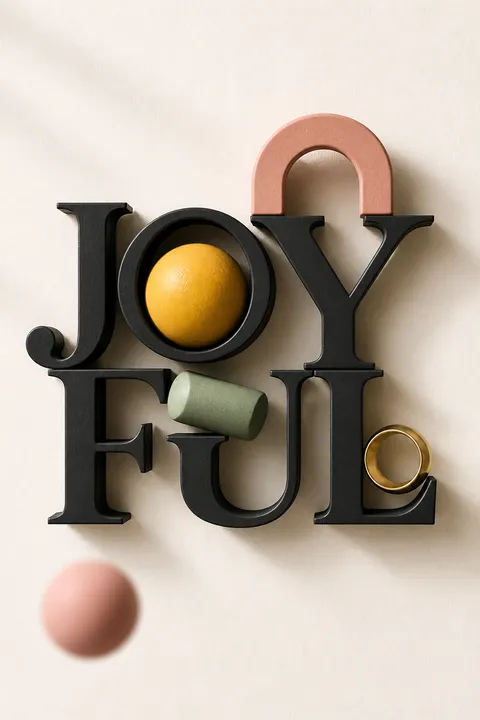


Key Takeaways
Treat sensory pleasure as infrastructure, not decoration.
Joy has a physical address. Ingrid Fetell Lee argues that joy is not only an inward state to cultivate. The colors, light, shapes, and textures around us can affect how alive, safe, and engaged we feel. Her investigation began with a question: how could ordinary objects such as a cup or lamp create an emotion? The answer became a set of ten physical patterns, from vivid color and lush variety to curves, sparkle, and seasonal growth.
Small changes can matter. In Tirana, Albania, mayor Edi Rama painted gray buildings in vivid colors. Residents began using public spaces more, and within five years the number of businesses tripled while tax revenue increased sixfold. The paint was one part of a wider civic change, not proof that color alone fixed the city. Still, it shows how surroundings can signal that a place is worth caring for.
What's useful here is the shift from treating design as an aesthetic extra to treating it as part of the conditions under which people act. That idea resembles choice architecture: spaces make some behaviors feel inviting and others difficult. Yet the Tirana story should not be reduced to a paint recipe. Public trust, institutions, and economic conditions also shape civic life. The stronger lesson is that visible care can help people imagine a different relationship with a place, while design works best alongside material improvements.
Build richness with sensation, not piles of possessions.
More feeling, not more stuff. The abundance aesthetic means layered sensory variety: color, texture, pattern, sound, and smell. It is not simply owning more. The author encountered an apartment by artists Shusaku Arakawa and Madeline Gins with vivid colors and uneven floors that forced movement and attention. Their extreme design expressed reversible destiny, their theory that challenging surroundings could keep the body engaged. Its claim to prolong life is speculative, but the experience made the author notice how ordinary environments can dull perception.
Notice sense hunger. The author describes returning from lush Hawaii to a bland office and immediately craving snacks. She calls this unmet appetite for sensory stimulation sense hunger. A few plants, varied materials, colorful food, or natural sounds can offer alternatives to buying things or grazing. Decluttering can help too: clearing visual noise makes room for a few stimulating objects to register.
This distinction helps reconcile two impulses that are often framed as enemies: simplifying possessions and wanting a lively home. A space can be sparse in clutter yet rich in sensory information. The important qualification is that stimulation is not universally soothing. People differ in sensory sensitivity, and a busy room can exhaust someone who needs quiet. The most practical approach is not maximalism by default, but deliberate choice: add the kinds of textures and signals that make a particular person feel more present.
Bring nature close enough to loosen the body's guard.
Nature opens space. The freedom aesthetic comes from open views, natural materials, wildness, and room to move. The book connects this response to prospect and refuge, a preference for places offering both a broad view and nearby shelter. A meadow can feel liberating because it offers visibility, space, and somewhere to pause. Even a window onto trees can provide a small mental break from work.
Green has real stakes. Studies described in the book link nature access with lower stress and improved recovery. In one Chicago housing study, buildings surrounded by more vegetation had 50 percent fewer reported crimes than buildings with little greenery. That association does not prove plants alone prevent crime, but it highlights how nature can be part of humane public design. At home, a few well-chosen plants, a nature view, or a walk outdoors can bring some of this quality into daily life.
The case for nature is especially strong because it joins pleasure with access and public health. Green space is not merely a personal lifestyle accessory; its distribution is shaped by housing, income, and urban planning. That makes the design question political as well as personal. At the same time, greenery cannot substitute for safety, services, or fair investment. The most persuasive version of the argument is additive: accessible nature can support people, and communities still need the social and material conditions that let them thrive.
Use patterns and order to make complexity feel safe.
Order lets the eye travel. Harmony in this book means balance, repetition, symmetry, and flow. Grouping similar objects helps the brain read a collection as one composition rather than scattered pieces. Repeating a color across rooms or arranging a collection by shape can make a varied space feel coherent. The author also emphasizes that harmony need not mean perfect geometry: the improvisational quilts of Gee's Bend create visual rhythm through irregular pieces and intuitive balance.
Disorder sends signals. Color specialist Hilary Dalke added two bands of warm tile to a women's prison shower room. Staff later reported that, unlike previous rooms, none of its tiles had been broken. Research cited in the book also found that people exposed to visually disorderly scenes cheated more on a subsequent task. These examples suggest that surroundings can affect behavior, though neither establishes a universal rule.
Harmony offers a useful alternative to the false choice between sterile order and overwhelming variety. Structure can make complexity easier to explore, much as rhythm makes a complicated piece of music followable. But orderly appearance should not be confused with moral worth or good conduct. The book itself notes the risks of using disorder as a justification for punitive policing. The more humane application is to ask whether a space supports orientation, dignity, and ease, not whether it conforms to a single visual standard.
Put rounded forms and open-ended objects where play can happen.
Make play feel possible. The play aesthetic favors circles, spheres, soft curves, and objects that invite more than one use. A ball can roll, bounce, or become the center of a made-up game. A round table encourages gathering, while sharp corners can make movement feel cautious. The author connects this to affordances, the actions an object seems to invite. Snow, sticks, and rocks are playful partly because they can become many things.
Adults need invitations too. Psychiatrist Stuart Brown found that many violent offenders he studied had histories marked by little or unusual play, though this does not establish that lack of play causes violence. Play can help people practice flexibility, social give-and-take, and problem-solving. Curved motion has also been linked in studies to more flexible thinking. Rather than install a workplace slide, a small playful object or an open-ended activity may feel less forced.
The idea of affordances connects design to behavior in a precise way: objects do not merely decorate a room, they imply what can happen there. A space that permits improvisation gives people more than entertainment; it gives them room to test ideas without a predetermined answer. Still, play cannot be imposed through childish décor. Adults may experience such gestures as patronizing, especially at work. The key is invitation rather than performance, with choices that allow people to join, adapt, or decline.
Plant small surprises where routine has made you stop noticing.
Contrast wakes attention. Surprise arises when something breaks a pattern: knitted covers on gray parking meters, a bright plate among white dishes, or an unexpected note tucked into a book. Artist Magda Sayeg's yarn-covered street fixtures made passersby pause and touch ordinary infrastructure. The contrast made a small intervention feel larger than its size. A related design principle is the unexpected welcome: keep enough familiar structure for people to feel oriented, then add one unusual detail.
Make novelty renewable. The author also recommends hide-and-reveal: a note in a coat pocket, a colorful cabinet interior, or a small keepsake rediscovered months later. These discoveries can refresh familiar objects instead of replacing them. This counters hedonic adaptation, the fading of pleasure as things become familiar. Surprise should be gentle, however. A startling or unwelcome change can create stress rather than delight.
Small surprises are valuable because they change attention before they change the object itself. That makes them a low-cost way to interrupt autopilot and renew curiosity. They can also foster a sense of authorship: a familiar setting becomes a place someone has actively shaped. The limit is important. Surprise depends on trust and context. A playful mismatch in a café may delight, while unpredictability in a medical or safety-critical setting may unsettle. Good surprise is not random disruption; it is a welcome deviation.
Add height and lightness to give the mind more room.
Look up and out. The transcendence aesthetic uses elevation, sky-like light, and visually light materials to shift perspective. Hot-air balloons offer a literal escape from the ground, but a treehouse, balcony, staircase, or view of clouds can create a milder version. The author describes research in which people who had moved upstairs were more likely to think about a task's broader purpose, while those moving downstairs focused more on its immediate steps.
Elevation need not be grand. Treehouses combine height with shelter and a sense of separation from everyday demands. Cloud watching offers another accessible route: it gives the mind a brief chance to wander. Pale colors, sheer fabrics, and slender furniture can also make a room feel lighter. These techniques do not replace actual open space, but they can alter how enclosed a setting feels.
Changing physical perspective can help loosen the grip of immediate concerns. The connection between elevation and broader thinking is a compelling example of the body's role in cognition: abstract thought is not entirely detached from physical experience. Yet transcendence should not be confused with escape as a permanent solution. A view or a moment of daydreaming may create breathing room, but it cannot resolve the practical pressures someone returns to. Its value is in making reflection possible, not pretending constraints have disappeared.
Make invisible forces visible, and ordinary life turns wondrous.
Give mystery a form. The magic aesthetic makes unseen forces tangible through light, wind, reflection, and illusion. A prism reveals colors hidden in sunlight; a pinwheel shows the movement of air; a rain chain turns runoff into a visible cascade. In Iceland, people preserve stories of elves and hidden people partly because the country's volatile landscape can seem alive with forces that are difficult to explain. The book's point is not that these beings are real, but that mystery can deepen attention to place.
Wonder invites inquiry. Stage magic works by appearing to violate familiar physical rules, while artists such as Olafur Eliasson use simple materials to make light, water, and fog feel extraordinary. The effect can be playful rather than supernatural. A small optical illusion or changing reflection can prompt a person to look again, ask how it works, and notice the world more carefully.
Wonder can be understood as curiosity with emotional force. A phenomenon that feels strange invites investigation, and that impulse can lead from fascination toward learning. This is a valuable bridge between imagination and scientific thinking: mystery need not be defended as fact in order to matter. The necessary boundary is epistemic. Aesthetic enchantment can coexist with evidence-based explanations, but it should not turn uncertainty into proof of supernatural claims. The world can remain astonishing even after its mechanisms become clearer.
Celebrate good news together, with bodies in the same room.
Joy grows in company. Celebration is more than marking an achievement. It gathers people into shared attention through music, dance, food, sparkle, and a focal point such as a large cake or balloon. At the Academy Awards, designer David Rockwell changed the seating so presenters and audience were closer together, making the ceremony feel more like a gathering than a distant performance.
Move in shared rhythm. The book describes synchrony, coordinated movement or sound, as a source of social connection. Studies of people singing or moving together found greater cooperation in later tasks. The author's experience at Paris's Fête de la Musique, when musicians filled the streets and strangers danced together, illustrates how participation can turn a crowd into a community. Even an ordinary success is worth sharing in a way that lets others respond, rather than limiting the ritual to a quick message.
Celebration is a social technology: it gives positive events a public form, allowing others to recognize and reinforce them. Its design matters. Seating, lighting, shared music, and a focal object can help people feel included rather than positioned as spectators. Digital messages remain meaningful, especially across distance, but they often compress the time and attention that a shared ritual provides. The challenge is not to romanticize crowds, which can exclude or overwhelm, but to create celebrations where participation is accessible and joy is not reserved for a few.
Use seasonal cycles to remember that joy can return.
Let nature mark time. Renewal appears in blossoms, expanding curves, and recurring seasonal changes. In Japan, cherry blossoms open in a brief, closely watched season, prompting picnics and public gatherings. After the 2011 earthquake and tsunami, blossoms appeared amid devastated communities, offering survivors a visible sign that spring had returned. The book connects these cycles to mono no aware, a Japanese sensibility that holds pleasure together with awareness of its impermanence.
Build anticipation into ordinary life. Seasonal foods, gardening, holiday rituals, and small recurring pleasures create events to look forward to. Flowers matter not only for beauty: foraging ancestors could read them as signs of future fruit. The author suggests mapping personal sources of joy, noticing what drains it, then choosing two or three qualities to bring into a home, workday, or gathering. The aim is not constant happiness, but a reliable path back toward aliveness.
Renewal gives the book's design argument a temporal dimension. A joyful environment is not only a collection of attractive objects; it can also help people notice change and anticipate return. Seasonal rituals offer continuity without requiring every year to be identical. This is especially valuable when circumstances remain difficult, because recurrence can support hope without promising a quick fix. The distinction matters: a blossom cannot repair a damaged community, but it can become a shared sign that life continues and that the future is not entirely closed.
Analysis
Joyful makes a distinctive case for the emotional consequences of ordinary design. Its central move is to treat aesthetic experience as information the body reads: brightness can suggest vitality, open views can ease constraint, repeated patterns can make complexity legible, and playful shapes can invite movement. That gives readers an unusually concrete vocabulary for diagnosing why a room, street, or routine feels draining, and for changing it without waiting for a major life event.
The narrative method is effective because each abstract claim is tested against places and people: Tirana's painted buildings, Arakawa and Gins's disorienting apartment, Piet Oudolf's gardens, and the communal energy of festivals. The book is strongest when it turns such encounters into adaptable design principles rather than prescriptions. A few colored objects, a plant, a clear entryway, or a recurring seasonal ritual can matter more than expensive renovation.
Its evidence deserves a measured reading. The text brings together laboratory studies, observational associations, historical interpretations, and personal testimony, but these do not all support equally strong causal claims. A greener neighborhood correlating with fewer crimes does not show that planting alone reduces violence, and a single transformed city cannot isolate paint from broader civic change. Likewise, evolutionary explanations for preferences can be suggestive without explaining every cultural or individual response.
The book's practical value therefore lies less in proving a universal science of taste than in offering a disciplined way to notice. It asks readers to observe their own joyful moments, identify the sensory qualities involved, and alter their surroundings accordingly. That method is flexible, inexpensive, and testable in daily life. Its most important implication is also its most modest: design cannot solve every source of unhappiness, but the physical world is not emotionally neutral, and small acts of care can make better states of attention and connection easier to reach.
Review Summary
Joyful explores how physical environments and objects can influence emotions and well-being. The book presents ten aesthetics of joy, including energy, abundance, and harmony. Readers appreciated the author's research and accessible writing style, finding the content thought-provoking and inspiring. Some felt the examples were privileged or impractical, while others found the book refreshing and applicable to daily life. Critics noted a lack of spiritual perspective and questioned the depth of scientific backing. Overall, many readers found value in the book's exploration of finding joy in ordinary surroundings.
People Also Read






Glossary
Aesthetics of joy
Ten physical routes to joyThe book's framework for understanding how tangible qualities in the environment can prompt joy. Its ten aesthetics are Energy, Abundance, Freedom, Harmony, Play, Surprise, Transcendence, Magic, Celebration, and Renewal. They describe recurring sensory patterns, such as vivid light, natural openness, rounded forms, shared rhythm, and seasonal growth, that can be noticed and deliberately used in everyday settings.
Prospect and refuge
View plus nearby shelterA term introduced by geographer Jay Appleton for the attraction of environments that offer both a broad view and accessible protection. A meadow with long sight lines and nearby trees is a common example. The book applies the idea to buildings too, suggesting that windows, balconies, and open interiors can combine visibility with a feeling of shelter.
Biophilia
Human affinity for living thingsBiologist E. O. Wilson's term for humans' innate attraction to other living things. In the book, it helps explain why contact with plants, animals, and natural settings can feel restorative. The idea includes small everyday encounters, such as houseplants or birdsong, as well as immersion in wild landscapes, rather than only trips to remote wilderness.
Reversible destiny
Architecture that challenges the bodyArtists Shusaku Arakawa and Madeline Gins's theory that stimulating environments can keep people physically and mentally engaged, resisting the passivity they associated with conventional buildings. Their apartments used uneven floors, vivid colors, and unusual layouts. The book presents the theory as an extreme design experiment, not as established evidence that architecture can prevent aging or death.
Sense hunger
Unmet need for stimulationThe author's name for a craving that may arise when an environment offers too little sensory variety. It can resemble a desire to snack or shop, even when the underlying need is for color, texture, sound, scent, or movement. The idea encourages readers to consider whether a small environmental change might meet that need more directly.
Chi
Flow through a spaceIn feng shui, chi is an invisible energy believed to animate people and surroundings. The book also uses the term in a practical sense for the movement of air, attention, and inhabitants through a room. Clear pathways and a usable entryway support flow; cluttered or awkward arrangements can create friction, regardless of whether one accepts chi as a literal force.
Patternicity
Seeing patterns in noiseThe tendency to perceive meaningful patterns in random or ambiguous information. The book uses the term to explain why people enjoy finding faces in clouds, shapes in stars, or melodies in street noise. This sensitivity can support discovery, since patterns often carry information, but it can also produce mistaken interpretations when randomness is treated as evidence.
Baby schema
Features that signal infant vulnerabilityEthologist Konrad Lorenz's term for physical traits common in young animals, such as relatively large eyes, rounded faces, and small noses. These features tend to evoke caretaking and playful responses. The book applies the concept beyond infants, explaining why toys, cartoons, and some products use exaggerated round features to seem approachable.
Hedonic adaptation
Pleasure fading with familiarityThe tendency for a positive experience to become less emotionally powerful as it grows familiar. The book argues that changing environments can intensify this effect, encouraging people to replace objects simply to recover novelty. Small surprises and rediscoveries can refresh attention to existing possessions and reduce the impulse to seek constant replacement.
Collective effervescence
Shared energy in a groupSociologist Émile Durkheim's term for the heightened feeling of unity that can arise when people participate together in a ritual or gathering. The book connects it to singing, dancing, and coordinated celebration, where shared rhythm can make individual participants feel part of a larger group.
Mono no aware
Tenderness toward passing thingsA Japanese sensibility described in the book as a gentle sadness intertwined with pleasure in things that do not last. Cherry blossoms express it vividly: their brief flowering makes the season more precious, not less. The concept offers a way to value fleeting beauty without demanding that it be made permanent.
FAQ
1. What is Joyful: The Surprising Power of Ordinary Things to Create Extraordinary Happiness by Ingrid Fetell Lee about?
- Exploring joy in the physical world: The book investigates how everyday objects, spaces, and environments can be intentionally designed or appreciated to evoke joy, challenging the idea that happiness is only found within.
- Ten aesthetics of joy: Ingrid Fetell Lee identifies ten key aesthetics—such as Energy, Abundance, Freedom, Harmony, Play, Surprise, Transcendence, Magic, Celebration, and Renewal—that link tangible qualities to joyful emotions.
- Interdisciplinary and practical: Drawing from psychology, neuroscience, design, and personal stories, the book offers both scientific insights and actionable advice for infusing joy into daily life.
- Toolkit for readers: Readers are provided with exercises, worksheets, and a “Joyful Toolkit” to help them identify and cultivate joy in their own environments.
2. Why should I read Joyful by Ingrid Fetell Lee?
- Reframes the source of joy: The book overturns the belief that joy is elusive and purely internal, showing that it can be accessed through our surroundings.
- Science-backed and credible: Lee integrates research from psychology, neuroscience, and design, making her insights both practical and evidence-based.
- Actionable and inspiring: Readers receive concrete steps, inspiring stories, and creative ideas to transform their homes, workplaces, and communities.
- Empowers personal happiness: By understanding and applying the aesthetics of joy, readers can make small changes that have a big impact on their well-being.
3. What are the key takeaways from Joyful by Ingrid Fetell Lee?
- Joy is tangible and designable: Ordinary things and environments can be intentionally shaped to evoke joy, making happiness more accessible.
- Ten aesthetics as a framework: The book’s ten aesthetics provide a practical guide for identifying and creating joyful experiences.
- Small changes matter: Simple adjustments—like adding color, plants, or playful shapes—can significantly uplift mood and foster well-being.
- Joy is communal and personal: Both individual and shared experiences of joy are important, and the book offers tools for cultivating both.
4. What are the ten aesthetics of joy in Joyful by Ingrid Fetell Lee and what do they mean?
- Energy: Vibrant colors and light that signal life and vitality, energizing our mood and spaces.
- Abundance: Lushness, variety, and multiplicity that evoke feelings of plenty and richness.
- Freedom: Open spaces, nature, and wildness that alleviate constraints and foster liberation.
- Harmony: Symmetry, balance, and flow that create order, ease, and comfort.
- Play: Circles, spheres, and playful forms that invite fun, spontaneity, and childlike joy.
- Surprise: Unexpected contrasts and whimsical elements that delight and redirect attention.
- Transcendence: Elevation, lightness, and vastness that lift the spirit and expand perspective.
- Magic: Illusions, invisible forces, and mystery that spark wonder and curiosity.
- Celebration: Sparkle, synchrony, and communal rituals that amplify shared happiness.
- Renewal: Blossoming, curves, and seasonal changes that symbolize growth and new beginnings.
5. How does color contribute to joy according to Joyful by Ingrid Fetell Lee?
- Color as energy: Bright, saturated colors like yellow, orange, and blue activate neural circuits linked to vitality and thriving.
- Evolutionary and cultural roots: Humans evolved to associate certain colors with nourishment and safety, making color perception deeply pleasurable.
- Transformative power: Projects like colorful murals and school makeovers show how color can uplift entire communities.
- Overcoming chromophobia: The book encourages embracing joyful hues, challenging cultural biases against color in design.
6. What is the role of abundance in creating joy in Joyful by Ingrid Fetell Lee?
- Evolutionary preference: Humans are drawn to abundance due to ancestral experiences of scarcity, making lush environments inherently joyful.
- Sensorial richness: Abundance is about layered textures, colors, and patterns that stimulate the senses, not just material excess.
- Balance is key: The book warns against clutter, suggesting that sensorial richness—not overindulgence—creates sustainable joy.
- Examples in life: Candy stores, gardens, and textured quilts are cited as sources of overflowing delight.
7. How does the aesthetic of freedom foster joy in Joyful by Ingrid Fetell Lee?
- Relief from constraints: Joy flourishes when we experience open spaces, nature, and the ability to move freely.
- Nature’s importance: Landscapes offering both prospect and refuge are universally preferred, balancing safety and exploration.
- Biophilia effect: Our innate attraction to living things and natural environments supports well-being and reduces stress.
- Practical tips: Adding plants, natural light, and views of nature to spaces can restore a sense of freedom and vitality.
8. What does Joyful by Ingrid Fetell Lee say about harmony and its impact on joy?
- Order and balance: Harmony involves symmetry, proportion, and flow, which the brain rewards with feelings of stability and peace.
- Psychological benefits: Harmonious spaces reduce anxiety and promote trust, safety, and positive social interactions.
- Design systems: The book explores feng shui and other systems for enhancing energy flow and balance in environments.
- Imperfect harmony: Joy can also arise from “perfectly imperfect” patterns, such as improvisational quilts, showing harmony is as much felt as measured.
9. How does play manifest as an aesthetic of joy in Joyful by Ingrid Fetell Lee?
- Play as pure joy: Play is an activity done solely for joy, with deep roots in social bonding and creativity.
- Round shapes and safety: Circles and spheres are universal cues for play, being safe and approachable.
- Adult playfulness: Incorporating playful forms into adult environments boosts creativity and reduces stress.
- Design examples: Playful offices, curvy furniture, and whimsical objects invite playfulness into daily life.
10. How does Joyful by Ingrid Fetell Lee explain the aesthetics of surprise, celebration, and magic in creating joy?
- Surprise: Unexpected elements, hide-and-reveal techniques, and playful contrasts jolt us out of routine and refresh our mood.
- Celebration: Communal rituals, music, dance, and sparkling decorations amplify happiness and foster social connection.
- Magic: Illusions, mystery, and enchantment—whether in stage tricks or natural phenomena—spark wonder and curiosity, enriching daily life.
11. What is the renewal aesthetic in Joyful by Ingrid Fetell Lee and how does it contribute to happiness?
- Symbol of growth: Renewal is associated with dynamic, expanding shapes like flowers and spirals, evoking life’s ongoing processes.
- Connection to nature’s cycles: Seasonal changes and natural rhythms provide reliable moments of anticipation and joy.
- Design implications: Incorporating organic curves, blossoming forms, and natural textures into spaces brings a sense of vitality and hope.
- Embracing impermanence: The book highlights how renewal reminds us of the cyclical and resilient nature of joy.
12. What practical advice and tools does Joyful by Ingrid Fetell Lee offer for cultivating joy in daily life?
- Joy Journal and Joyfinding: Keeping a journal and using worksheets helps identify personal sources of joy and patterns in joyful experiences.
- Joyful Project Worksheet: Structured guides help readers plan and implement joyful changes in spaces, events, or experiences.
- Mix and match aesthetics: Combining different aesthetics—like energy with harmony or surprise with abundance—tailors joyful experiences to individual needs.
- Small changes, big impact: Simple acts like adding color, arranging objects harmoniously, or introducing playful elements can significantly uplift mood and well-being.
Download PDF
Download EPUB
.epub digital book format is ideal for reading ebooks on phones, tablets, and e-readers.








