

Key Takeaways
Repeated inner practice can train the brain toward steadier well-being
Practice changes patterns. The book’s central idea is that mental activity and brain activity influence each other: repeated attention, feelings, and actions strengthen some neural patterns while leaving others less practiced. Hanson calls the gradual brain change experience-dependent neuroplasticity. A “Buddha brain” is his broad, nonsectarian term for a mind and brain increasingly shaped by compassion, mindfulness, virtue, and wisdom. The point is not that one good thought transforms a person, but that repeated small practices accumulate.
Start with one thing. London taxi drivers who learned complex routes showed changes in a brain region involved in spatial memory, an example the book uses to illustrate learning-related change. Hanson recommends choosing one practice for a situation or a longer stretch, rather than trying to overhaul everything at once.
The book’s most useful move is turning neuroplasticity into a reason to practice, not a promise of instant self-reinvention. The taxi-driver example makes adaptation tangible, while the one-practice approach respects the limits of attention and habit formation. Still, brain change is not automatically improvement: repetition can reinforce fear or rumination as readily as calm. The practical test is therefore not whether a practice sounds neuroscientific, but whether sustained use improves functioning, relationships, or well-being without becoming another demand for perfection.
Give positive moments enough attention to compete with the brain’s threat bias
Negativity comes easily. The book describes a negativity bias: the tendency for threatening or painful events to capture attention and stick in memory more readily than equally strong positive ones. A criticism can occupy the mind long after several ordinary things have gone well. Hanson calls his counter-practice “taking in the good”: notice a genuinely positive fact, let yourself feel it, and stay with the experience for roughly 10 to 30 seconds instead of immediately moving on.
Make the good memorable. A completed task, a kind exchange, or a pleasant sensation can become more than a fact you registered and forgot. Return attention to it, enjoy it, and sense its effect. The book suggests doing this several times daily. This is not a demand to deny pain; it is a way to stop pain from monopolizing the mental record.
This practice addresses a real asymmetry: people often need deliberate attention to register benefits that negative events advertise loudly. It also resembles savoring practices used in positive psychology, where lingering over an experience can make it more emotionally available. The important safeguard is honesty. A forced search for silver linings can invalidate grief or injustice. The practice works best when positive facts are real, small, and allowed to coexist with difficulty, rather than recruited to prove that everything is fine.
Treat yourself as someone worth protecting, not a problem to punish
Care before correction. Self-compassion means recognizing that something hurts and wishing for that suffering to ease, much as one would for a friend. It is not self-pity or permission to avoid responsibility. Hanson recommends first acknowledging what happened, then drawing on the felt sense of being cared for, and offering that same concern to oneself. The book cites research associating self-compassion with less self-criticism and rumination, and greater resilience.
Separate guilt from learning. When reviewing a mistake, distinguish a genuine moral wrong from unskillful behavior that needs correction, and from factors outside one’s responsibility. A lie that harmed someone may call for remorse and repair; a clumsy choice may call for a better plan, not endless self-attack. Once responsibility and amends are addressed, self-forgiveness lets useful learning remain without keeping punishment on repeat.
This distinction gives self-kindness a backbone. In restorative approaches to conflict, accountability is paired with repairing harm rather than maximizing shame, which is a useful parallel: remorse can orient action, while chronic self-condemnation often narrows attention to the self. The boundary matters, however. A person cannot declare a wrong repaired merely because self-forgiveness feels relieving. Taking another person’s perspective and making proportionate amends help keep compassion from turning into self-exoneration.
Train attention to notice what matters before habit or fear takes over
Attention is trainable. Hanson defines mindfulness as stable awareness of something, whether an external detail or an inner feeling. Attention both reveals experience and helps determine what gets reinforced in the brain. Mindfulness can make it easier to notice hurt beneath anger, recognize when worry is taking over, or remember what someone actually said rather than what fear predicts.
Practice in small intervals. Set aside a minute to follow the sensations of breathing, or use recurring moments, such as a phone ringing or walking through a doorway, as reminders to return to the present. The book cites studies linking meditation practice with changes in brain regions involved in attention and body awareness. These findings support the idea that attention can be trained, though they do not mean every brief exercise produces a measurable brain change.
Mindfulness is presented here less as a special state than as a basic capacity to direct and recover attention. That connects it to skill learning: improvement often comes not from never getting distracted, but from noticing distraction and returning to the task. This is a practical, non-mystical account. Its limit is that attention alone cannot resolve every source of distress, especially external danger or severe illness. Awareness is most valuable when it informs a response, not when it substitutes for one.
Accept facts, then act where your influence actually reaches
Acceptance is not approval. The book separates facing reality from liking it or surrendering to it. If traffic is stopped, a loved one is ill, or a project has failed, arguing internally with the fact may add distress without changing it. Acceptance makes room to see what can still be done. Hanson’s image of tending an apple tree captures the distinction: someone can care for the tree, but cannot command it to produce fruit.
Work on causes. Identify the conditions that are within reach, then act on them and learn from the results. A job search can be organized; another person’s feelings cannot be controlled. The same approach supports persistence: take the next available step at a sustainable pace, while checking that the goal is worth its costs. Effort matters, but outcomes also depend on factors beyond personal control.
This is a strong antidote to two common errors: helplessness, where no action seems possible, and overcontrol, where every result is treated as a personal obligation. The distinction resembles problem-focused coping: change the manageable conditions and adapt to those that cannot be changed. It also protects against turning persistence into stubbornness. A useful review asks not only whether effort continues, but whether new evidence suggests the chosen cause is actually connected to the desired result.
Risk honest self-expression without making approval the price of trying
Fear can shrink a life. The book calls an anticipated painful consequence of expression a “dreaded experience.” A person wants closeness, recognition, or a new challenge, expects rejection or humiliation, then suppresses the wish to avoid that risk. Some caution is sensible, such as not insulting a boss in anger. But old expectations may come from childhood conditions that no longer apply.
Try calibrated risks. Hanson recommends starting with manageable acts of expression, preparing for possible outcomes, and noticing when feared consequences do not happen or prove survivable. He also distinguishes aspiration from attachment: pursue a goal energetically without treating success as proof of worth. His climbing story illustrates this. He began far below his ambitious target, improved step by step, and reached it on the final day, while treating the effort as worthwhile even if he fell short.
The approach combines exposure with agency: small, planned encounters with feared situations can test predictions more effectively than abstract reassurance. It also respects context. A feared response may be realistic where power is unequal or a relationship is unsafe, so “speak up” is not a universal prescription. Calibrating risk means considering both the probability and the cost of harm, then choosing a step that expands freedom without confusing bravery with recklessness.
Treat many alarms as signals to examine, not orders to obey
Pain is not the whole story. Hanson distinguishes unavoidable “first darts,” such as illness, rejection, or loss, from “second darts,” the extra suffering added through rumination, harsh self-judgment, or imagined catastrophe. The canoe story makes the point: being knocked into a river hurts, but believing someone deliberately targeted you can add anger that a drifting log would not provoke. Many events have causes unrelated to personal worth or intent.
Pause before reacting. Notice the body’s alarm, relax if possible, and ask what else could explain the situation. A frown may signal a colleague’s stress, not contempt. Real threats still deserve action; exaggerated alarms do not need to dictate behavior. The book also suggests checking the present moment for immediate safety, rather than letting worries about the past or future fill the whole field of awareness.
This framework helps separate an event from the story attached to it. That separation is central to cognitive approaches to emotion: interpretations shape reactions, and interpretations can be tested. The canoe example is memorable because it preserves the injury while questioning the assumption of personal targeting. A caution is necessary: people who face ongoing discrimination or abuse may be accurately identifying a pattern, not merely personalizing. Context should be examined before an alarm is dismissed.
Match daily life to your temperament, and supply what old wounds lacked
Fit matters. Hanson describes temperaments ranging from cautious to adventurous, introverted to extroverted, and emotionally steady to more reactive. These tendencies are not moral defects, though a poor fit between a person and an environment can create chronic friction. An energetic child may struggle in a tightly controlled classroom; an introvert may need quiet after a socially demanding day. The useful question is not only “What is wrong with me?” but also “What conditions help me function well?”
Find the missing experience. Hanson calls a needed emotional experience a “psychological vitamin.” Someone who lacked inclusion may benefit from seeking welcoming groups and taking in signs of respect; someone who feels unsafe may need reliable support. The experience matters more than a single event. Repeated, relevant experiences can gradually counter old expectations, while professional support may be appropriate for deep or persistent pain.
The emphasis on person-environment fit offers a more humane alternative to treating every mismatch as an individual flaw. It also links self-understanding to practical design: schedules, relationships, and work settings can be adjusted where possible. The “vitamin” metaphor conveys specificity, though it should not imply that emotional injuries can always be repaired by collecting positive moments. Trauma, entrenched symptoms, and harmful environments may require sustained relational or clinical support.
Make room for pleasure, rest, and beauty in ordinary minutes
Enjoyment is nourishment. The book argues that pleasure need not wait for a holiday or achievement. Notice a satisfying taste, sunlight on a wall, a pleasant sound, or the comfort of clean sheets, and allow the experience to register. Gratitude and beauty are not instructions to ignore hardship; they widen attention to what is also present. Hanson also recommends brief breaks, since a life filled only with work and obligations leaves little space for friendship, creativity, or recovery.
Use a refuge. A refuge is something that reliably offers comfort, steadiness, or support, such as a trusted person, a familiar place, a meaningful practice, or a calming routine. The book’s advice is modest: pause, unplug briefly, breathe, or recall a safe setting. These small rests can help restore perspective and keep ordinary stress from occupying the entire day.
This cluster of practices treats well-being as something supported by daily conditions, not only by major life events. Sensory attention can interrupt automatic task mode, while breaks protect time for forms of life that productivity metrics overlook. The nuance is that rest and pleasure are not equally accessible to everyone, especially under poverty, caregiving demands, or unsafe conditions. Such practices can support coping, but they should not obscure the need for structural changes when the strain is structural.
Give love actively, while letting go of control over its return
Love is something to practice. The book treats care, generosity, patience, and attention as expressions of a deeply social human nature. Offering a full hearing, helping with a shared burden, or wishing someone well can improve a relationship and strengthen one’s own sense of agency. Love here is not limited to romance, and it does not require pretending that harmful behavior is acceptable.
Keep boundaries intact. Giving love differs from demanding that another person return it in a chosen form. The book acknowledges the helplessness of wanting love from someone who cannot or will not offer it. A person can still act with warmth, seek relationships that are reciprocal, and protect against harm. Its closing emphasis is practical: make room for love in thought, word, and action, without making another person’s response the measure of one’s worth.
This ending shifts the reader from managing private feelings toward participating in relationships. Prosocial behavior can create reciprocal trust, but its value does not depend on a guaranteed return. That distinction prevents generosity from becoming a covert transaction. The strongest version of the argument includes boundaries: care can coexist with refusal, distance, and accountability. Love is most sustainable when it is freely offered, not extracted from oneself at the expense of safety or dignity.
Analysis
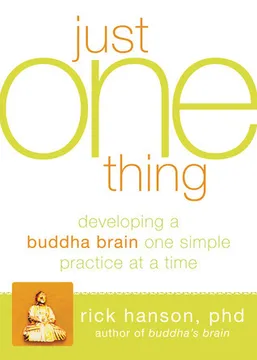
Just One Thing is a practice manual organized around a deceptively simple thesis: repeated mental habits help shape the brain, and therefore small deliberate actions can alter how a person meets life. Its 52 brief practices move from self-care and pleasure through attention, agency, relationships, and peace. The structure is less a linear argument than a menu, which makes it unusually easy to adapt, but also means the reader must supply a sequence and choose a starting point.
The book’s most durable contribution is not any single technique. It is the combination of three moves: notice what is happening, stop adding avoidable suffering, and strengthen a more helpful response through repetition. “Taking in the good” gives positive attention a concrete method. The distinction between acceptance and passivity preserves room for action. The idea of tending causes while releasing control of results makes effort compatible with uncertainty. Together, these ideas create a coherent ethic of practice rather than a collection of cheerful slogans.
The neuroscience offers motivation and memorable examples, but should be read as a bridge, not as proof that each exercise produces a particular brain outcome. Brain structure findings and correlations do not by themselves establish the size, durability, or universality of a practice’s effect. The practical case can stand without overstating them: attention and repetition influence learning, while people differ in temperament, circumstances, and access to support.
That qualification matters because the book sometimes places self-directed practices beside problems that also have social or medical causes. Relaxation cannot remedy an unsafe workplace, and positive attention cannot replace treatment for serious distress. The strongest reading is therefore neither “change your thoughts and everything improves” nor “nothing inside can change.” It is that inner practices are genuine tools, best used alongside realistic action, relationships, and professional care when needed. The one-practice-at-a-time format captures that humility: start small, observe what changes, and keep what helps.
Review Summary
People Also Read









Glossary
experience-dependent neuroplasticity
Experience-driven brain changeThe capacity of the brain to change in response to experience and repeated mental activity. In the book, it explains why recurring attention, thoughts, feelings, and actions can strengthen some neural patterns over time. The concept supports the practical claim that mental practice can influence the brain, while not implying that every practice causes a guaranteed or identical outcome.
Buddha brain
Brain shaped by practiceHanson’s broad, nonsectarian phrase for a mind and brain increasingly oriented toward compassion, mindfulness, virtue, and wisdom. It refers to psychological or spiritual development, not to a particular anatomy or religious identity. The phrase draws on the idea of awakening to the causes of suffering and ways of reducing it.
negativity bias
Greater attention to threatsThe tendency for negative or threatening experiences to receive more attention, evoke stronger reactions, and remain more memorable than comparable positive experiences. The book presents this as an evolved survival advantage that can skew mood and memory in everyday life. Deliberately noticing positive experiences is offered as a way to counterbalance, not deny, the bias.
taking in the good
Savoring positive experienceA practice of noticing a genuinely positive fact, allowing the associated good feeling to arise, staying with it for several seconds, and sensing that the experience is being absorbed. The aim is to give positive moments more influence on memory and mood, rather than letting them pass unnoticed. It is not intended to erase or excuse painful realities.
implicit memory
Unconscious learned expectationsThe accumulated influence of past experience on feelings, expectations, beliefs, and inclinations, often without deliberate recall of the original events. The book uses the term to explain why repeated experiences can shape a person’s background sense of safety, worth, or threat. Positive experiences, it argues, can gradually contribute to more supportive expectations.
dreaded experience
Anticipated emotional painA feared painful consequence that a person expects if a feeling, desire, or wish is expressed. The expectation may inhibit action, such as asking for closeness or pursuing a goal. Hanson argues that some expectations were learned under earlier conditions and may no longer accurately predict present risks, so they can be tested through carefully chosen acts of expression.
second darts
Added suffering after painHanson’s term for avoidable distress added to an unavoidable painful event. A first dart might be illness, loss, or rejection; second darts include rumination, catastrophic prediction, harsh self-judgment, or assuming every setback is personal. The distinction does not deny the original pain. It highlights how interpretation and reaction can intensify suffering.
psychological vitamins
Needed emotional experiencesHanson’s metaphor for positive experiences that address a particular emotional lack or wound. Someone who feels excluded may especially need experiences of inclusion and respect; someone who feels unsafe may need support and security. The metaphor emphasizes matching the experience to the need, rather than assuming any pleasant event will address every difficulty.
About the Author
Other books by Rick Hanson





Download PDF
Download EPUB
.epub digital book format is ideal for reading ebooks on phones, tablets, and e-readers.








