

Key Takeaways
Read John as a failed ruler, not a villain scripted by fate
A man before the legend. In 1199, Bishop Hugh of Lincoln warned the newly crowned John that ruling others put his soul at risk. John answered by pointing to images of crowned kings being led toward salvation. The exchange captures the book’s starting point: John expected to rule well, and his later disaster was not inevitable. The youngest son of Henry II and Eleanor of Aquitaine, he was educated at Fontevraud and became a literate, intellectually curious ruler, not simply a neglected child or a natural monster.
Records complicate reputation. Royal documents show John handling everything from household purchases to military orders. They cannot reveal his private feelings, but they make his choices visible in a way that later chronicles cannot. Those chronicles, written after his defeat, helped turn him into a stock tyrant and even attached him to the Robin Hood legend without historical basis.
What's striking is the distinction between explaining a ruler and excusing him. The surviving administrative record makes John unusually legible, but a record of decisions is not a window into motive. Modern historians face a familiar problem: official data can reveal what an institution did while concealing what its participants believed. Church therefore avoids both the moral shortcut of treating John as evil from birth and the opposite shortcut of treating context as absolution. His failures become more intelligible, not less serious.
A sprawling inheritance made Angevin power immense, but dangerously brittle
One dynasty, several legal worlds. Henry II and his sons controlled England, Normandy, Anjou, Aquitaine, and other territories, but these lands did not form a single modern state. A ruler could be king in England, duke in Normandy, and count in Anjou, with different rights and obligations in each place. On the continent, the French king claimed overlordship over the Angevin rulers, even when his practical power was limited.
Great wealth carried liabilities. English kings had more land and revenue than any single baron, and could interfere in how their tenants inherited property. Yet the continental territories required constant travel, military spending, and negotiation with local elites. When John inherited Richard’s lands in 1199, he inherited both extraordinary reach and a patchwork of rival claims. In 1204 he lost Normandy, Anjou, and northern Aquitaine, leaving England to bear more of the costs of his ambitions.
The Angevin inheritance resembles a network more than a unified state: each territory had its own rules, local power brokers, and routes to legitimacy. Networked power can spread influence quickly, but it also creates many points of failure. A ruler may possess several titles yet lack the authority to make them behave as one system. The comparison clarifies why John's wealth did not guarantee security. It also cautions against measuring medieval power by acreage alone. Control depended on relationships that had to be renewed in each region.
John's Irish failure began when he treated a living society as spoils
Ireland was no blank map. When eighteen-year-old John arrived in 1185, Ireland was divided among regional rulers, trading towns, and powerful settlers. Its geography made control difficult, and local leaders had their own armies, alliances, and claims. John’s entourage mocked Irish leaders by pulling their beards. He then granted large tracts of land to his followers, despite the fact that other people already lived there and claimed them.
Good advice went unused. Henry II had placed experienced administrators around John, including men who knew Irish politics. Instead, John favored younger companions who shared his appetite for rapid expansion. He left Ireland in the autumn rather than stay to consolidate his position. His expedition failed not simply because he was young, but because he treated patronage as a substitute for understanding the society he meant to govern.
This episode reads as a clash between a ruler's map and the lived landscape of the people he hopes to command. The book's account of Ireland also relies partly on English and church writers who described the Irish through a prejudiced lens, so their labels cannot be taken as neutral observations. That limitation does not erase the documented insults or land grants. It does sharpen the lesson: political knowledge is not just information about territory. It includes recognizing whose authority already exists, and whose consent a new ruler needs.
Win succession by building a coalition, not by citing bloodline alone
Inheritance required political support. When Richard left on crusade, he named his young nephew Arthur as heir, leaving John uncertain of his future. After Richard was captured in 1192, John tried to claim the Angevin lands and allied with Philip Augustus. In a January 1194 agreement, John offered Philip major territories, including eastern Normandy, in exchange for recognition as Richard’s successor. It was a staggering gamble that risked the family’s continental power.
A claim had to be made real. Richard returned, forgave John, and gradually restored him to favor. John rebuilt relationships through military service and dealings with powerful nobles. By 1197, he had become Richard’s preferred successor. Even then, Richard’s death in 1199 did not automatically settle the matter: different territories could choose among competing heirs. John gained the throne by securing the support of key figures such as William Marshal and Hubert Walter, not by relying on inheritance alone.
The succession story illustrates a political distinction that appears in many systems: a right on paper is not the same as the capacity to exercise it. John’s legal claim mattered, but so did the cooperation of officials, nobles, and local communities. This resembles a commitment problem in political science: powerful actors must believe that a new ruler can protect their interests, not merely assert authority over them. John’s fortunes rose when he rebuilt those relationships. His earlier gamble shows how a narrow pursuit of personal advantage can weaken the very coalition that makes authority possible.
At Mirebeau, John's victory became a political defeat
A battlefield win needs allies. In 1202, John surprised his enemies at Mirebeau, rescuing his mother, Eleanor, and capturing Arthur of Brittany, the nephew whose claim threatened John’s rule. His victory could have strengthened his position. Instead, John took the prisoners and spoils for himself and treated important captives harshly. William des Roches, a leading ally whose military service had helped secure the win, felt excluded and turned to Philip Augustus.
Arthur's fate deepened the crisis. In 1203, Arthur was killed while in John’s custody. The surviving accounts disagree about the circumstances, but Church finds the story of a drunken killing unreliable and considers a deliberate execution authorized within John’s circle more plausible. The death removed a rival, but also made Arthur a rallying figure for opponents. It damaged John’s standing and gave Philip a potent political grievance, though it was not the sole cause of Normandy’s collapse.
Mirebeau shows why victory and legitimacy are separate currencies. A military success can remove an immediate threat, but if allies believe the victor will deny them credit, reward, or security, the coalition may dissolve before the next campaign. The episode also shows the limits of moral storytelling: Arthur’s killing is central to John’s reputation, yet the evidence does not support every dramatic detail repeated by later chroniclers. The strongest interpretation holds both points together. John’s conduct was politically reckless, while the precise mechanics of the killing remain uncertain.
Philip took Normandy by turning geography, feudal law, and defections into weapons
The Vexin was the gateway. The region between Paris and Rouen mattered because it controlled access along the Seine and protected both capitals. French kings had pressed claims there for generations. Philip Augustus also had a legal advantage: John had acknowledged him as overlord of his continental lands. When John failed to answer charges in the French king’s court, Philip could present the seizure of Normandy as lawful punishment of a disobedient vassal, not simply an invasion.
Local choices decided the war. Philip supported Arthur and exploited revolts among John’s Poitevin subjects. John’s harsh treatment after Mirebeau helped drive William des Roches into the French camp. In 1203, John left Normandy for England and did not return while the duchy was still at stake. After the fortress of Château Gaillard fell in March 1204, Norman resistance weakened, and Rouen surrendered that June. Philip’s strategy succeeded because geography, legal claims, and local loyalties reinforced one another.
The conquest is a useful corrective to histories that assign territorial loss to one bad decision or one villain. Philip’s advantage came from combining several kinds of power: military pressure, a plausible legal claim, and the ability to attract local actors who judged John’s position unsafe. This is a form of institutional leverage: a rule matters most when someone has the force and alliances to enforce it. John’s departure from Normandy remains consequential, but the account resists pretending that staying would certainly have saved the duchy. The outcome was shaped by a system of pressures, not a single switch.
John's recovery campaign drained the kingdom he needed to mobilize
Lost territory meant lost income. After 1204, John tried to rebuild the resources needed to regain his continental lands. In 1207 he demanded a tax on a thirteenth of movable wealth and revenues, which raised more than £57,000. The demand was exceptional, and leading churchmen initially refused to support it. John pushed ahead through a narrower circle of advisers. He also used forest fines, taxation of Jewish communities, and revenues from confiscated Church lands to finance his government and military plans.
A war chest had a public cost. John stored large amounts of coin in castles and sent money overseas. With less currency available for ordinary exchange and tax payments, people faced difficulty meeting debts. His subjects were not simply resisting a king who wanted money; they were being asked to fund a prolonged attempt to recover lost lands. The campaign weakened the cooperation and economic capacity on which any successful return depended.
John’s finances illustrate a feedback loop familiar in modern public finance: extraction can increase a ruler’s immediate capacity while reducing the cooperation that makes future revenue possible. The book’s evidence suggests that hoarding coin intensified scarcity, although precise estimates of the monetary contraction remain uncertain. This nuance matters. A royal treasury is not the same thing as a healthy economy, and a tax yield does not measure consent. John could collect substantial sums, yet each collection also revealed how little agreement he had secured for the purpose.
Compelled allegiance widened royal reach while making trust more brittle
John reached beyond the barons. After returning to England, John asked all free men to swear loyalty to him and his heir, rather than relying only on the traditional chain of allegiance through great landholders. In 1209, he staged mass oaths and homage, then used military force to bring Scotland into line. His campaigns in Ireland and Wales likewise extended royal administration and compelled local rulers to acknowledge his authority.
Compliance was not confidence. A public oath could make it easier to mobilize people and identify resistance, but it could not guarantee affection or trust. When John heard of a plot against his life in 1212, he detained suspected opponents and took hostages, including the sons of prominent lords. He also began easing some demands and reconciling with the Church. The change suggests that even a powerful king understood he needed more than the ability to punish disloyalty.
The oath campaigns reveal both state capacity and its limits. John could communicate commands across a broad realm, gather large forces, and make allegiance visible in public ritual. Those are substantial administrative achievements. Yet political science distinguishes compliance from legitimacy: people may obey because defiance is dangerous, while continuing to regard the ruler as unjust. The book makes that distinction vivid without denying John’s military competence. The caution is that mass oaths should not be mistaken for a modern popular mandate. They were compulsory acts within a hierarchy, even as they drew a wider political community into the king’s orbit.
Magna Carta turned inherited grievances into written terms with armed enforcement
The charter had roots. In 1215, barons demanded that John confirm liberties associated with Henry I’s coronation charter. Their complaints included royal interference in inheritance and the treatment of heirs. Magna Carta also addressed justice, taxation, and the Church’s rights. Its creation was a negotiation, not a sudden invention: an earlier draft and the Articles of the Barons show demands changing as the parties tried to reach terms.
Promises needed a backstop. The charter’s most radical feature was a group of twenty-five barons empowered to respond if John failed to correct violations, including by making war against him. This security mechanism addressed the central problem of mistrust: how to bind a ruler known for outmaneuvering opponents. The document was framed as a grant from the king to his faithful subjects, not as a declaration of popular sovereignty. Pope Innocent III rejected it and annulled it, and the peace it produced was brief.
Magna Carta is most revealing when read as a practical technology of commitment. Written terms make grievances easier to name, circulate, and compare against a ruler’s conduct. The enforcement clause recognized that promises alone may not constrain a powerful actor. But its protections were shaped by the interests of barons and other free men, not by a universal idea of equal rights. Its later symbolic importance should not be projected backward onto its first moment. In 1215, the charter was a contested instrument for ending a political crisis, not a finished democratic constitution.
John's 1215 settlement collapsed, but his son's reissue kept its claims alive
Peace gave way to war. The agreement at Runnymede did not restore trust. The rebels and John soon accused one another of bad faith, and the barons invited Louis, son of the French king, to claim England’s throne. John fought on, but died of dysentery in October 1216 while the kingdom was divided and Louis controlled London and Westminster. His final concern was whether his young sons could inherit what remained of his realm.
A failed agreement became useful. John’s nine-year-old son Henry was crowned quickly at Gloucester, and William Marshal became his guardian. The new government reissued Magna Carta in 1216 with controversial provisions removed, then issued it again in 1217 alongside a Forest Charter. These versions helped draw support away from Louis and form part of the settlement ending the civil war. The charter’s survival was therefore not inevitable: it depended on political actors who found it useful after John’s death.
The document’s afterlife illustrates how political texts gain authority through reuse, not merely through the intentions of their first authors. In 1215, Magna Carta failed to secure peace and was condemned by the pope. Under a child king presented as blameless, a revised version could serve a different purpose: reconciliation and the restoration of royal government. The contrast resembles constitutional development elsewhere, where compromise documents become durable through repeated interpretation. That legacy should not obscure the charter’s narrow origins, but it does explain why a short-lived settlement became much larger than the crisis that produced it.
Analysis
Church’s central achievement is to shift the question from whether John was a bad king to how his choices became disastrous within a particular political architecture. The Angevin ruler was not sovereign in the same way everywhere. He governed England as king, but held continental lands within a hierarchy headed by the French crown, while local elites retained enough leverage to make allegiance a practical choice. John’s failures therefore emerged at the intersection of personal judgment and institutional constraint. His ambition was not itself unusual; the problem was that he repeatedly treated resources, allies, and inherited rights as if they were instruments he could command without negotiation.
The book’s evidence makes that argument unusually persuasive. Chancery records expose the routine decisions of government, from provisioning the household to mobilizing troops. They correct the distorting effects of chronicles written after John’s defeat, while still leaving motive partly inaccessible. This asymmetry matters: a king’s orders are visible, but the calculations behind them are not. Church’s restraint about that gap makes his portrait stronger than a psychological diagnosis built from hostile anecdotes.
The deepest tension is between administrative capacity and political legitimacy. John could levy taxes, coordinate campaigns across the British Isles, and bind subjects through oaths. These are signs of a capable government. Yet using those capacities without dependable consent made the kingdom more expensive to govern and less willing to support his aims. His pursuit of Normandy intensified the pressure: England financed a continental project whose benefits were uncertain and whose costs fell broadly on subjects and elites alike. The resulting resistance was not simply a reaction to cruelty. It was a conflict over who could authorize extraordinary demands, and what obligations a ruler owed in return.
Magna Carta crystallizes this conflict without resolving it. The 1215 document was neither a democratic blueprint nor a timeless settlement. It was an elite bargain, backed by a coercive enforcement mechanism, that failed almost immediately. Its later importance arose because a new government could use a revised charter to rebuild agreement. The book’s most durable insight is therefore institutional: written limits matter, but their force depends on coalitions willing to uphold them and rulers willing to live within them.
Review Summary
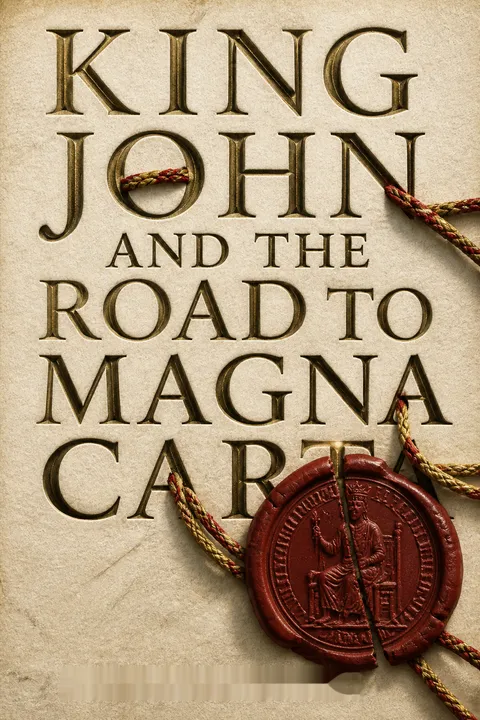
King John: And the Road to the Magna Carta receives mostly positive reviews, with an average rating of 3.61/5. Readers appreciate Church's balanced approach, thorough research, and readable prose. The book is praised for its detailed exploration of events leading to the Magna Carta and John's reign. Some criticize the abrupt ending and occasional tangents. Readers find the historical context valuable but note the book can be dense at times. Overall, it's recommended for those interested in English medieval history, though some feel it lacks deep analysis of John's character.
People Also Read


Glossary
Angevin lands
Angevin family territoriesThe territories ruled by the Angevin dynasty, including England and extensive lands in France such as Normandy, Anjou, and Aquitaine. They were not one unified kingdom: each territory had distinct legal arrangements, local elites, and obligations. Their wide reach made the dynasty powerful, but also required rulers to manage separate political relationships and defend distant frontiers.
community of the realm
The kingdom's political communityA medieval idea that the realm was more than the king and his household. It included the leading clergy and lay magnates, and could also encompass a wider body of free subjects. In John’s reign, appeals to the community of the realm expressed the claim that government should serve the common good and that a king should take counsel.
wardship
Royal control of minor heirsA lord’s right to control the lands and upbringing of an underage heir whose property was held from him. Because the king was regarded as lord of the kingdom, royal wardship could include control over an heir’s estate and, in many cases, influence over marriage. These rights were lucrative for kings and a major concern for landholders.
scutage
Payment instead of knight serviceA levy assessed on a knight’s fee, often used when the king sought money for military campaigns. A tenant could pay rather than provide the expected service, although the king could set the rate and terms. John’s high scutage demands, especially for the 1214 Poitou campaign, became a source of resistance among his barons.
interdict
Suspension of public church ritesA papal penalty that restricted religious services across a territory. Under the interdict imposed on England during John’s conflict with Pope Innocent III, most public rites were suspended, though some services, including baptism of infants and confession of the dying, remained permitted. The measure put pressure on the king by affecting religious life throughout the kingdom.
Magna Carta
A charter limiting royal practicesThe charter agreed between King John and rebel barons in 1215 after a crisis over royal government. It addressed matters including inheritance, justice, taxation, and Church liberties, and included a mechanism for barons to enforce compliance. The pope annulled the 1215 settlement, and civil war followed. Revised versions issued under Henry III helped give the charter a lasting political role.
FAQ
What is King John and the Road to Magna Carta by Stephen Church about?
- Comprehensive biography and analysis: The book offers a detailed account of King John’s life, reign, and the political turmoil that led to the creation of Magna Carta in 1215.
- Context of Angevin dynasty: It situates John within the powerful Angevin family, exploring the legacies of the Norman Conquest and the complexities of ruling vast territories in England and France.
- Focus on constitutional origins: The narrative culminates in the crisis of English kingship, showing how John’s rule directly contributed to the emergence of Magna Carta and the beginnings of constitutional monarchy.
Why should I read King John and the Road to Magna Carta by Stephen Church?
- Balanced portrayal of King John: Stephen Church moves beyond the traditional villainous image, offering a nuanced and humanized view of John’s character and reign.
- Rich use of primary sources: The book draws on contemporary documents, letters, and chronicles, providing a vivid and well-sourced narrative.
- Insight into medieval governance: Readers gain a deep understanding of medieval politics, law, and the origins of English constitutional principles.
What are the key takeaways from King John and the Road to Magna Carta by Stephen Church?
- Complexity of medieval kingship: The book reveals the challenges and intricacies of ruling a diverse and expansive realm in the 12th and 13th centuries.
- Magna Carta’s historical roots: It demonstrates how John’s failures and the barons’ resistance led to the creation of Magna Carta, a foundational document for constitutional government.
- Enduring legacy: The work highlights the long-term impact of John’s reign on English law, governance, and the relationship between ruler and ruled.
Who was King John, and what is his historical significance according to Stephen Church?
- Youngest son of Henry II: John was initially sidelined in inheritance plans, earning the nickname “Lackland,” and was less martial than his brothers.
- Last Angevin ruler: He inherited England and parts of France but lost key territories, marking the end of Angevin dominance in northern France.
- Central to Magna Carta: John’s arbitrary rule and conflicts with the barons directly led to the sealing of Magna Carta, shaping the future of English monarchy.
How does Stephen Church in King John and the Road to Magna Carta explain the origins and development of Magna Carta?
- Baronial opposition: The book traces growing discontent among the barons over John’s heavy taxation, arbitrary justice, and military failures.
- Legal and political negotiations: It details the use of earlier charters and the drafting of precursor documents, leading to the sealing of Magna Carta in 1215.
- Security clause and aftermath: The inclusion of a baronial enforcement clause and the papal annulment of Magna Carta set the stage for civil war and further constitutional developments.
What were the main causes of conflict between King John and the Church, as described by Stephen Church?
- Archbishopric dispute: John’s refusal to accept Stephen Langton as Archbishop of Canterbury led to a prolonged interdict and his excommunication by Pope Innocent III.
- Sequestration of Church property: John confiscated Church lands and revenues, using them to fund his military campaigns and royal household.
- Struggle over authority: The conflict highlighted the broader tension between royal sovereignty and papal power, culminating in John’s submission and England becoming a papal fief.
How did King John’s loss of Normandy and other continental lands unfold, according to King John and the Road to Magna Carta?
- Philip Augustus’s campaign: The French king launched a systematic invasion, capturing key fortresses and cities, and undermining John’s continental control.
- John’s retreat and demoralization: John’s withdrawal to England left his supporters vulnerable and encouraged defections to the French side.
- Legal and political justifications: Philip used John’s refusal to appear at court and accusations of misrule to legitimize the confiscation of his lands.
What role did King John’s campaigns in Ireland and Wales play in his reign, according to Stephen Church?
- Irish administrative expansion: John’s 1210 expedition aimed to impose English structures and curb the power of Anglo-Irish magnates.
- Military and political control: He subdued rebellious lords, redistributed lands, and reinforced royal authority, using Ireland as a resource for his continental ambitions.
- Welsh conflict: John’s campaign against Llywelyn ap Iorwerth consolidated English dominance in Wales and linked Irish and Welsh affairs.
How did King John’s relationship with his brother Richard I influence his early reign, as detailed by Stephen Church?
- Initial favor and grants: John received lands and titles from Richard and was expected to help govern England during Richard’s absence.
- Conflict with William de Longchamp: Power struggles with Richard’s justiciar led to John’s opposition and eventual deposition of Longchamp.
- Rebellion and reconciliation: John’s conspiracies during Richard’s captivity strained their relationship, but he was later restored as Richard’s preferred successor.
What was the significance of the assemblies and oaths of fealty during King John’s reign, according to King John and the Road to Magna Carta?
- Mass oath ceremonies: John organized unprecedented assemblies where thousands swore loyalty to him and his heir, Henry.
- Political strategy: These oaths were designed to secure loyalty amid threats of excommunication and rebellion.
- Early parliamentary development: The gatherings, including the 1213 assembly of knights of the shire, foreshadowed the emergence of representative governance in England.
How does Stephen Church portray King John’s legacy and final years in King John and the Road to Magna Carta?
- Complex and tragic figure: John is depicted as ambitious and politically astute, yet ultimately responsible for bringing England to the brink of disaster.
- Death and testament: His final days were marked by penitence for his treatment of the Church and a unique burial at Worcester Cathedral.
- Contested posthumous image: The effigy on his tomb, showing him with a drawn sword, symbolizes the enduring debate over his reign and legacy.
What are the best quotes from King John and the Road to Magna Carta by Stephen Church, and what do they mean?
- On John’s character: “John was a man ill-suited to power, but not deliberately evil,” reflecting the book’s nuanced approach to his personality.
- On Magna Carta’s significance: “Magna Carta was not a sudden revolution, but the product of years of conflict and negotiation,” emphasizing the gradual evolution of constitutional principles.
- On the Angevin legacy: “The English king was richer in lands than any baron, making him a dominant figure with little individual opposition,” highlighting the roots of royal authority and baronial resistance.
Download PDF
Download EPUB
.epub digital book format is ideal for reading ebooks on phones, tablets, and e-readers.








