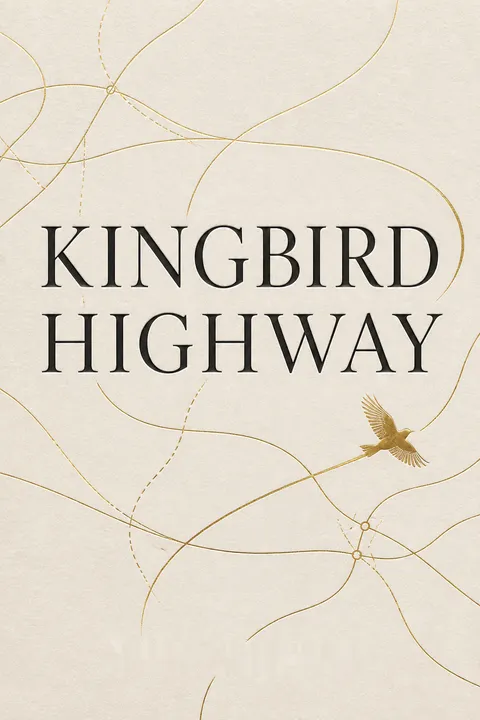


Key Takeaways
Let an obsession set you moving, then stay open to its surprises.
A pursuit can change shape. Kaufman’s birding began as a child’s way of making the world larger. A move from Indiana to Kansas meant unfamiliar birds, and field guides turned geography into a map of possible discoveries. By sixteen, he had left school and was traveling to find species he could not see at home. Years later, his continent-wide Big Year began as a record attempt but became a way to reach remote landscapes, meet other birders, and learn what his tally could not capture.
The destination is not everything. The book’s central tension is that counting birds can motivate the journey, yet the most valuable discoveries may be places, people, or new ways of seeing. The list gives the trip a shape; it does not have to dictate what the trip means.
What's striking is how a narrow interest becomes a broad education without being planned as one. The bird list supplies direction, while travel exposes the observer to unfamiliar communities, weather, and landscapes. This resembles experiential learning: a goal draws attention into the world, where reality adds lessons the goal could not specify in advance. The account does not make every obsession wise or every sacrifice worthwhile. Its more durable point is that a pursuit can be a starting structure, not a life sentence. Curiosity stays productive when the person remains able to revise what counts as success.
Study nearby life deeply before chasing what lies beyond it.
Attention came first. Before crossing the continent, Kaufman watched Western Kingbirds nesting on telephone poles near his Wichita home. He took notes on their behavior, learned the calls of local birds, and gradually predicted where different species would appear. His one-day tally rose from fifty species to one hundred during spring migration, but the count rested on years of close observation.
Knowledge made distance meaningful. Field guides had taught him that birds occupy different ranges, so finding new species required visiting new places. At sixteen, after teaching nature at summer camp, he began traveling. His early birding was not only a hunt for additions to a list: it grew from learning to recognize ordinary birds and understand their habits.
The contrast between a neighborhood kingbird and a distant rarity matters. Expertise is not merely the ability to name more things; it is the ability to notice patterns, anticipate behavior, and recognize what is unusual against a well-known background. Repeated attention to a familiar place can build that foundation more reliably than hurried exposure to many locations. The story also needs a practical caveat: Kaufman’s early travels involved hunger, legal trouble, and dangerous rides. His parents’ support and his unusual circumstances make the adventure a memoir, not a safe template for young readers.
Shared information can transform a solitary pastime into a continent-wide pursuit.
Finding birds became easier. Roger Tory Peterson’s 1934 field guide helped ordinary observers identify species in the field. Later guides answered a different question: where to find them. In 1965, Jim Lane began publishing precise directions to specific birding sites. Birders also shared news of rare visitors through calls, newsletters, and informal networks.
A community took shape. In 1969, Jim Tucker’s newsletter grew into the American Birding Association, which connected active birders across North America. Its magazine, Birding, circulated reports, directions, and list totals. By the time Kaufman began traveling, a teenager with a backpack could use information gathered by experts to find birds that had once seemed nearly impossible to locate.
This is a vivid case of distributed knowledge: no single observer needs to hold every fact when a community records sightings, tests directions, and passes along discoveries. Better information changes not only individual performance but the activity’s scale and culture. The same process appears in citizen science, where many local observations can reveal patterns no isolated researcher could track. Yet access to information is not the same as access to travel. A network can lower the cost of knowing where to go, while money, time, transportation, and safety still determine who can get there.
Birding becomes richer when skilled rivals also become generous teachers.
Competition shared the field. Kaufman’s travels brought him into contact with sharp, ambitious birders, including Ted Parker, who had set a North American year-list record of 626 species in 1971. But the defining relationships were not simply rivalries. The Tucson Five, a group of young birders in Arizona, argued, joked, and searched together. In northern California, Rich Stallcup and his friends were known for sharing expertise and treating time outdoors as a communal adventure.
Knowledge circulated person to person. Harold Morrin helped young birders reach difficult sites, and experienced observers explained how to identify birds by behavior, voice, and shape. The birds created the meeting place; friendship and instruction made the hobby a community.
The book distinguishes competitive intensity from social hostility. That distinction is useful in any skilled pursuit: people can push one another to higher standards while still sharing methods and credit. Learning in the field is especially social because experienced observers can direct attention to details a novice has not yet learned to notice. The community also offers belonging to people whose interests do not fit the usual script. Still, openness is not automatic. Communities can develop insider language and status hierarchies, so generous teaching matters precisely because expertise can otherwise become a gate.
Use a record attempt to create effort, not to define your worth.
A score supplied momentum. After learning that Parker had already beaten the old Big Year record, Kaufman abandoned his own attempt in 1972. A strong Christmas Bird Count in Arizona renewed his confidence, and he tried again in 1973. He traveled against Floyd Murdoch, a rival with more money but less time. On one exhausting Texas Big Day, their team recorded 229 species, a new North American record at the time.
The result depends on the rules. In the year-list contest, Murdoch finished with 669 species in the area later used by the ABA. Kaufman’s total was 671 under the broader AOU boundary that included Baja California. He spent under $1,000 for the year. The book treats the tally as a powerful incentive, not a final verdict on skill or value.
A measurable challenge can convert vague enthusiasm into concrete effort. In behavioral terms, the record gives repeated decisions a visible target: travel now, search longer, or accept a difficult detour. But measurement also narrows attention. When the score becomes a proxy for excellence, it can hide differences in resources, expertise, and rules. Kaufman and Murdoch’s totals are a useful reminder that outcomes are partly constructed by the boundary of the contest. A score can help organize action; it cannot, by itself, settle what the activity is worth.
Know familiar birds deeply before naming the extraordinary one.
A famous rarity was misidentified. In 1973, birders at New Jersey’s Brigantine refuge believed they had found a Spotted Redshank, an exceptionally rare Eurasian shorebird. Kaufman crossed thousands of miles hoping to see it. By the time he arrived, the careful observer Harold Axtell had concluded that the bird was actually a Greater Yellowlegs with oil-stained feathers.
Expertise lives in fine distinctions. Axtell questioned the bill color, leg color, molt, shape, and flight. Other observers knew Greater Yellowlegs well enough to recognize the species in ordinary circumstances, but had not examined it closely enough to rule out a confusing look-alike. The episode changed Kaufman’s sense of what identification demands: not just a checklist of obvious marks, but intimate knowledge of the familiar bird.
This episode captures a classic problem in perception: expectations can turn ambiguous evidence into a desired answer. The more exciting the possibility, the easier it is to interpret each uncertain feature in its favor. Axtell’s approach resembles careful diagnosis in medicine: compare alternatives, attend to disconfirming details, and delay certainty when the evidence is incomplete. The lesson is not that experts are infallible, but that disciplined familiarity can protect against collective overconfidence. Rare discoveries deserve excitement, and the excitement is more trustworthy when observers can explain why competing identifications fail.
Taxonomic labels shift, but conservation cannot depend on checklist status.
Classification changed the game. In 1973, an American Ornithologists’ Union review combined several birds once treated as separate species. The Cape Sable Sparrow became a form of the Seaside Sparrow; the Eurasian Green-winged Teal was merged with the American Green-winged Teal; and other familiar names also disappeared from lists. Some birds were split instead. These decisions reflected new scientific judgments about how populations were related.
The bird remained real. The Cape Sable Sparrow still occupied vulnerable Florida marshes, where developers were filling habitat. Birders feared that losing its species label would also weaken interest in protecting it. The Dusky Seaside Sparrow, another localized Florida form, was extinct by the early 1990s. The book warns against letting a bookkeeping category decide whether a distinct population deserves attention.
Taxonomy is a scientific model, not a set of permanent boxes handed down by nature. Revising classifications can improve biological understanding, but it can also have social consequences when public concern follows memorable species names. Conservation decisions are stronger when they consider population size, habitat, ecological role, and vulnerability, rather than relying on a single label. The account does not establish that a taxonomic change caused a species’ extinction. It does show why scientific precision and practical protection must be kept in conversation: uncertainty about rank is not a reason to ignore a population at risk.
Treat extreme weather as an ecological event, not as scenery.
A storm exposed hidden costs. On North Carolina’s Outer Banks, Kaufman and a friend first admired the large numbers of Myrtle Warblers in the thickets. Then a severe winter storm brought snow, freezing rain, and powerful winds. The birds struggled to find food, collided with cars, and were swept into waves or against bridge supports. The observers guessed they were seeing about 3,000 warblers per mile of road, though the estimate was rough.
Migration has no perfect solution. The warblers’ shorter coastal migration usually spared them a long flight over open water. But those that had traveled farther south were beyond the storm’s reach. The following winter, Christmas Bird Count totals for Myrtle Warblers were lower across the middle Atlantic states, and observers suspected the storm had killed many.
The episode shifts weather from backdrop to causal force. A familiar landscape can become dangerous within hours, and the birds’ adaptations that usually help them can become liabilities under unusual conditions. It also shows the value and limits of naturalists’ field observations: the observers saw distress directly, while the later count offered a broader but still imperfect signal. A single storm and a decline do not prove a precise death toll or establish a general trend. They do make a strong case for long-term monitoring that connects weather events with population data.
Let rare birds make distant places vivid, not merely countable.
The journey became the discovery. In Alaska, Kaufman changed his plans after learning that a birding tour had found Asian strays on St. Lawrence Island. At Gambell, a remote village near Siberia, he saw rare buntings and gulls among enormous numbers of seabirds. Local resident Winnie James took him by boat past eiders, puffins, and murrelets. In the evening, alcids streamed along the shore in immense flocks, estimated by Kaufman at thousands per minute.
One bird made the place personal. A Ross’s Gull appeared, then an Ivory Gull emerged from fog along the beach. Kaufman was so absorbed by Gambell that his year list passed 600 without him noticing. The tally had brought him to a place whose people, weather, and wildlife mattered beyond its value as a stop on a route.
The scene makes a useful distinction between seeing a species and knowing a place. A checklist can motivate travel, but attention to local scale, seasonal rhythms, and residents’ knowledge turns a destination into more than a collection of sightings. The account also invites care in how visitors describe Indigenous communities. The people of Gambell are not scenery for an outsider’s revelation; they are knowledgeable participants in a changing world, with their own priorities and practices. Good nature writing benefits when wonder expands respect rather than reducing a community to atmosphere.
Never let a final checkmark outrank your life.
The last count turned dangerous. Near the end of the year, Kaufman took a position on the Freeport jetty to watch for seabirds during a Christmas Bird Count. In rough weather, he spotted a Black-legged Kittiwake and kept scanning for more. A wave knocked him into the water; he lost the borrowed telescope, cut his hands on barnacles, and struggled back to shore. After receiving help at a nearby restaurant, he returned to the jetty, reasoning that he still had a job to do.
Commitment needs judgment. The incident crystallizes the book’s unresolved affection for listing. The count had brought Kaufman outdoors and into a remarkable year, but no bird or record justified risking his life. What endured was not the equipment or the number, but a sharpened awareness of what the pursuit could open up.
The ending is powerful partly because its behavior is not a model to imitate. Persistence can be admirable, but danger changes the decision problem: once the likely cost includes drowning, continuing for a bird count is not evidence of superior commitment. In risk analysis, the value of additional information has to be weighed against the cost of obtaining it. A birding tradition can demand effort without demanding recklessness. The deeper achievement is the capacity to recognize that a list is a tool for attention, not an authority entitled to overrule basic safety.
Analysis
Kingbird Highway is a memoir, a coming-of-age story, and a history of a hobby changing in real time. Its engine is a young man’s attempt to see as many North American birds as possible in one year, but the narrative keeps testing what that number can mean. The road supplies a physical plot, while shifting taxonomic rules and the rise of birding networks supply a second plot: the game itself is being remade as Kaufman plays it.
The book’s most interesting tension is not simply between competition and appreciation. It is between two kinds of attention. Listing rewards rapid recognition, strategic travel, and the ability to seize temporary opportunities. Field knowledge requires slowing down, studying common species, and tolerating uncertainty. The false Spotted Redshank shows how a competitive desire for a rare bird can overwhelm evidence; the final jetty scene shows how a useful incentive can become a dangerous command. Neither experience makes listing worthless. Both reveal why its value depends on the observer’s judgment.
The memoir also resists a neat triumph narrative. Kaufman’s journey is enabled by unusual freedom, parental support, a generous birding community, and extraordinary luck. It includes hunger and danger, and its low budget is not proof that hardship is inherently virtuous. The book is most persuasive when it treats these conditions as part of the story rather than as a recipe for adventure.
Its environmental insight is similarly grounded in encounters, not abstraction. A storm can turn an ordinary wintering strategy into a trap; a local population can remain vulnerable even when classification changes; a rare bird can draw visitors to a place without making the place theirs. The result is a memoir about learning to see, but also about the limits of seeing through a tally. The count opens the door. Care, humility, and attention determine what happens once the observer is outside.
Review Summary
Kingbird Highway receives strong praise, averaging 4.3/5 stars. Readers celebrate Kaufman's remarkable 1973 Big Year adventure, hitchhiking across North America on under $1,000 to set a bird-sighting record. Many appreciate the coming-of-age narrative arc alongside the birding, particularly valuing Kaufman's gradual shift from competitive listing to deeper naturalist appreciation. Birders and non-birders alike find it compelling, though some critics note repetitive structure and occasional emotional detachment. The book is widely considered a classic, with standout praise for its philosophical reflections on journey versus destination.
People Also Read


Glossary
Big Year
a year-long bird tallyA Big Year is a challenge to identify as many bird species as possible within a calendar year and a defined geographic area. Birders travel widely, keep a year list, and often compare totals. In Kaufman’s 1973 attempt, the challenge sent him across North America, from Florida to Alaska, in pursuit of both regularly occurring birds and rare visitors.
Big Day
a one-day species tallyA Big Day is an attempt to find as many bird species as possible in a single day, usually by following a planned route and making repeated stops. Because a bird heard counts as well as one seen, participants rely on sharp identification skills and careful timing. Kaufman joined a Texas team that recorded 229 species in one day, then a North American record.
American Birding Association
a birders’ networkThe American Birding Association, or ABA, formed in 1969 from a newsletter created by Jim Tucker. It connected active birders across North America through its magazine, shared field information, and published list totals. In Kaufman’s account, the organization helped transform birding from a largely local pastime into a connected culture of travel, rare-bird reports, and friendly competition.
Patagonia Picnic Table Effect
rarities attract more discoveriesThe Patagonia Picnic Table Effect describes a feedback loop in which a rare bird draws birders to a location, whose increased attention then leads to additional rare-bird discoveries. The name comes from a roadside stop near Patagonia, Arizona, where birders repeatedly found significant species. The effect illustrates how observer activity can make a site seem increasingly productive.
AOU Check-list Area
a defined listing regionThe AOU Check-list Area was the geographic boundary used by the American Ornithologists’ Union for its North American bird list. In Kaufman’s era, it included Canada, the United States, Greenland, Bermuda, and Baja California. Because year-list totals depend on where the boundary falls, changing the defined area can change which birds count toward a record.
lumping
combining named speciesIn bird classification, lumping is the decision to combine forms previously treated as separate species into one species. An AOU review in 1973 lumped several birds, including the Cape Sable Sparrow with the Seaside Sparrow. Lumping can reflect new scientific judgments about relationships among populations, while also changing birders’ list totals and the public visibility of local forms.
hard weather movement
weather-driven bird displacementA hard weather movement is a temporary shift in where birds are found when severe conditions push them away from their usual areas. It is not the same as regular seasonal migration. On North Carolina’s Outer Banks, Kaufman and his companion considered whether large numbers of Myrtle Warblers had been driven toward the coast by a winter storm, though they lacked enough data to establish the cause.
Download PDF
Download EPUB
.epub digital book format is ideal for reading ebooks on phones, tablets, and e-readers.








