

Plot Summary
The Roadside Ambush
Willa Russo is on her way to tell her mother that Roberto, Celeste’s new husband, may be involved in her sister Emma’s disappearance. Before she can reach Celeste, Roberto’s men attack the cars carrying Willa, Rock, Neo, and Oscar. Willa and Rock’s car rolls down an embankment; a stranger’s arrival makes the gunmen flee, but Rock is pulled from the wreck unconscious.
At the hospital, Willa wakes bruised and confused, then spots Neo fighting his way past security to reach her. Neo has survived a bullet wound to the chest, and Oscar is also injured. The men she loves are alive, but Rock’s head injury leaves the others waiting for signs that he will wake.
The attack turns Willa’s search for Emma from a private investigation into a direct contest over survival. Her first instinct is not self-preservation but to account for each of the Kings, revealing how far their antagonistic arrangement has shifted toward mutual attachment. Rock’s unconsciousness also makes guilt an immediate hazard: Willa will later blame herself for giving Roberto information, while Rock blames himself for failing to protect her. The ambush has no mystery about its emotional consequence, even as its larger conspiracy remains unresolved. Violence narrows the group’s choices and makes their closeness both a source of strength and a vulnerability Roberto can exploit.
A Mother Chooses Denial
Once Neo helps her reach Rock’s room, Willa admits that telling Celeste about the lighthouse may have exposed their location. The Kings reject her self-blame and point to Roberto as the person responsible for the attack. Rock remains unconscious, but his doctors see no paralysis and say the next day will be critical.
When Celeste arrives, Willa draws her aside and explains that Emma sought the Kings’ help, that Dean Giordana tried to kill her, and that the cabin belonged to Roberto. She asks her mother to leave him. Celeste is alarmed by the danger but dismisses Willa’s evidence as speculation, defending the life and marriage she has built with Roberto. Willa watches her mother walk away without choosing her.
Celeste’s refusal is more than a mistaken judgment about evidence. She protects her current identity by rejecting the facts that would force her to abandon it, while Willa asks for something painfully simple: to be believed by her mother. The failed appeal removes the family refuge Willa hoped to find and strengthens the improvised family she has formed with the Kings. Her guilt about mentioning the lighthouse echoes the way victims often absorb responsibility for an aggressor’s choices. The Kings’ insistence that Roberto alone is to blame offers a corrective, but not a cure. Willa must proceed without the emotional alliance she expected from home.
The Hospital Turns Hostile
Rock wakes, remembers the crash, and agrees that the hospital is too exposed to remain in. The Kings reveal the seriousness of their injuries, then push Willa to leave with them before Roberto can send more men. Their escape is interrupted by four armed attackers entering the corridor. Neo holds the stairwell long enough for Willa, Oscar, and Rock to reach the parking lot, where Oscar hot-wires an old Impala.
Neo runs through the lot under fire and dives into the car as bullets shatter its rear window. They flee by back roads, later switching cars and gathering food, medicine, clothes, and burner phones at a truck stop. Their injuries have not healed, but staying put has become more dangerous than moving.
This escape marks the point at which the group stops treating danger as an interruption and begins organizing around it. Each King contributes a distinct survival skill: Neo creates a diversion, Oscar gets the car running, and Rock helps direct their route despite his head injury and broken arm. Willa is not merely carried along; she recognizes the threat and helps them move. Their secrecy can look like criminality, but in context it is a response to a compromised environment and a powerful pursuer. The scene also makes their protective instincts costly. Neo separates from the group to buy time, turning love into a willingness to become the decoy.
Daisy’s Abandoned Refuge
The group reaches Daisy’s neglected family mansion, tucked into the woods near Blackwell Falls. Daisy welcomes them, supplies blankets and household necessities, and directs them to the third floor, where servants’ rooms, a small kitchen, and fire escapes offer shelter and a way out. She warns them not to light the house at night, since locals know the area, and to stay clear of the cliff behind it.
As the Kings recover, Willa tends their wounds and keeps watch over Rock’s concussion. The house gives them a rare stretch of quiet, although they remain dependent on Daisy’s generosity and cannot safely contact their usual world. Neo seeks weapons and help from the Blades while Willa returns to Dean Giordana’s widow for answers.
Daisy’s house functions as shelter without becoming safety. Its broken windows, hidden location, and dangerous cliff make refuge conditional, mirroring the group’s temporary relief after the hospital. Daisy’s practical kindness contrasts with Celeste’s refusal: she is not Willa’s family, yet she provides the care Willa needed from her mother. Recovery also allows the Kings’ bond with Willa to become more intimate, though their protectiveness remains entangled with control. They can offer warmth and tenderness, but their instinct is still to manage risk by deciding where Willa may go. The hideout gives them time to heal, not permission to stop investigating.
The Widow Opens the Records
Willa returns to Mrs. Giordana’s house and admits that she lied during her earlier visit while searching Dean’s study. She explains that Dean helped lure her to a cabin, where he planned to bury her, and connects that attack to Emma and other missing Bellepoint girls.
Mrs. Giordana, grieving and wary, listens rather than sending Willa away. She describes Dean’s need to impress his wealthy Aventine classmates and lets Willa search his study again.
This time Willa leaves with binders containing maps, land records, and financial documents for cabins in the woods. Meanwhile, Neo meets Hawk of the Blackwell Blades, explains the threat from Roberto, and arranges weapons. The binders provide a lead, but their company names and transfers still need decoding.
Willa earns the widow’s cooperation by replacing a protective disguise with a difficult truth. Her earlier deception got her into the study, but honest disclosure creates the possibility of collaboration. Mrs. Giordana’s account of Dean’s social insecurity complicates the idea that cruelty belongs only to obvious monsters: the need for status can make a person useful to powerful people and willing to imitate them. Yet motive is not absolution. The binders turn private grief into a material investigation, but they do not immediately explain the disappearances. The evidence is frustratingly bureaucratic, requiring Willa and the Kings to interpret financial structures designed to make ownership difficult to see.
Four Houses, One Conspiracy
The Kings eventually leave Daisy’s house and return to their fortified home, where Rafe stations armed guards around the property and installs a backup generator and cameras. Willa tells Claire what she knows about Roberto, then negotiates her return to Aventine rather than accepting indefinite confinement.
At lunch, Claire explains that RAA is a holding company used by her Irish family. Willa recognizes the name from the binders and realizes the other cabins are held through companies tied to Aventine’s crime families.
The Kings present their evidence at the quarry and turn the annual house competition into a mandatory investigation: each house must identify the alumni involved in the girls’ disappearances. They warn students not to alert their families, making the hunt a test of loyalty as well as a search for evidence.
The discovery changes the scale of the story. Roberto is no longer an isolated predator whose defeat would close the case; the cabin records implicate a network distributed across the families that fund Aventine. Claire’s ordinary explanation of how her family manages property becomes the key that makes the binders legible. The Kings respond by using an institution built to train criminal heirs against the criminal hierarchy itself. Their compulsory game repurposes competition as collective inquiry, but the demand also creates a dangerous moral bind: students must betray relatives to uncover crimes committed by those relatives. Willa’s return to school gives her agency, while the security system at home shows how little freedom that agency can yet guarantee.
Freedom With an Escort
Willa resumes classes and tries to reclaim ordinary routines, but the Kings arrange constant escorts and require her to wear a tracker. After Rock argues that keeping her inside indefinitely would only turn protection into imprisonment, the Kings negotiate limited access to Blackwell Falls, backed by Rafe’s guards and promises of protection from local gangs.
Willa uses the small freedom for a day out with Claire, where she notices Alexa Petrov, a usually hostile Queen, appearing shaken and reluctant to speak.
Later, at the Orpheum, Willa sees Alexa arguing with a Knight and leaving in distress. Neo also returns to underground fighting, and Willa sees how quickly his anger can become physical. The fragments do not yet explain Alexa’s fear, but they make her silence impossible to ignore.
The bargain over Willa’s movements exposes a central tension in the Kings’ care: keeping her alive is not identical to letting her live. Rock recognizes that prolonged confinement would reproduce a different kind of harm, and the compromise offers Willa limited self-direction without pretending the threat has vanished. Her observations of Alexa matter because they are small, ambiguous acts of attention rather than revelations. Willa has learned to take emotional signals seriously, even when they come from someone who has treated her cruelly. Neo’s return to fighting shows the parallel cost of restriction for him: violence is both a danger and an outlet. The plot’s suspense grows through behaviors that do not yet have an explanation.
Alexa Breaks the Silence
Alexa comes to the Kings’ house alone and says she has traced several missing girls to men in the Knights’ alumni network, including her own father. She found escrow documents linking Global Limited, another family shell company, to a cabin.
Other names on her list point to powerful fathers who appear to have selected or taken individual girls. The current Knights have refused to expose their relatives, so Alexa delivers the names herself. She also identifies Laszlo Nagy, the owner of St. Andrew’s, as an outsider connected to the operation.
The Kings offer her protection, but Alexa refuses to hide. Willa understands at last why Alexa seemed frightened at the restaurant and during the confrontation at the Orpheum. Now the evidence points beyond Aventine’s students to men who control businesses in town.
Alexa’s decision makes the cost of disclosure personal. She is not merely naming distant criminals; she is identifying her own father and the inherited power that shapes her place at Aventine. Her earlier hostility toward Willa can now be read as defensive distancing, though that explanation does not erase the harm she caused. The refusal of the Knights to come forward reveals that the younger generation is not automatically more ethical than its elders. Willa and the Kings have evidence of a cross-family system, but no assurance that the institution around them will help dismantle it. Nagy’s name widens the inquiry from family property to a public venue, setting the next investigation in a place designed for secrecy and spectacle.
A Gift Without Strings
For Valentine’s Day, Willa gives each King a small tattoo chosen for him: a chef’s hat for Rock, boxing gloves for Neo, and a camera for Oscar. They arrange a lavish dinner and overnight celebration, then give her a separate gift: five hundred thousand dollars placed in an account only she can control.
The money is meant to let her choose her future rather than remain with them out of financial dependence. The tenderness of the gesture is interrupted the next day, when the Kings learn that Alexa has been found dead below a cliff.
Her death is presented as an apparent fall, but the timing and the threats surrounding the investigation make murder far more likely. The group now has names, but speaking out has already cost one person her life.
The Valentine’s gift reframes the Kings’ possessiveness. Their money and protection have allowed them to shape Willa’s options, but the account is an attempt to make love compatible with her independence. Her tattoos answer their generosity with something chosen and enduring, not something purchased. This exchange prepares an emotional contrast with Alexa’s death: Willa is being offered a future she can freely accept, while Alexa is punished for refusing silence. The juxtaposition also sharpens the investigation’s moral stakes. Evidence is no longer just a path toward a past crime; it is a present danger to anyone who carries it. The Kings’ promise of choice cannot protect everyone who makes the same choice.
Smoke at St. Andrew’s
The Kings take Willa to St. Andrew’s masquerade, where they intend to watch Laszlo Nagy and search his office for records. While Oscar stays with Willa, she spots Mara, her childhood best friend, drunk and angry after traveling to Blackwell Falls despite Willa’s warnings. Their argument leaves Willa trying to keep Mara from wandering deeper into the club.
Nagy slips away as a fire alarm begins and smoke fills the room. In the crush toward the exits, Willa loses sight of both Mara and Oscar. She escapes outside and searches the crowd, but a stranger grabs her from behind, drags her to a van, covers her head, and injects her with a sedative. The fire was not merely chaos; it creates the opening for Willa’s abduction.
The fire exploits the conflict between friendship and protection. Willa is trying to rescue Mara from a dangerous situation, while Oscar must choose between tracking Nagy and reaching Willa. The smoke makes every choice partial and every familiar face disappear. Mara’s resentment has roots in Willa’s secrecy, so the abduction follows not from a simple failure of caution but from strained communication between people who still care about each other. The masquerade’s masks and sexualized performance provide cover for the attackers, turning a venue built around chosen play into the scene of real coercion. Willa’s isolation recreates the central crime of the book: a girl disappears while a crowd is looking elsewhere.
The Cabin’s Cruel Game
Willa wakes near the burned cabin where Dean Giordana once tried to kill her. Roberto stands with three men representing other crime families, including the Russian, Irish, and cartel interests. He confirms that Emma’s search for the missing girls led to her death, and describes the other girls as entertainment for powerful men.
Then he lays out a map of the cabins and tells Willa that the group will hunt her through the woods after giving her a short head start. Willa realizes the arrangement is an organized ritual, not a series of unrelated disappearances. Roberto tears away the choker the Kings gave her and orders her to run. Barefoot and nearly naked in winter, she starts toward the forest with the men and their dogs closing in.
Roberto’s confession turns the binder maps into a geography of deliberate violence. The cabins are not simply suspicious properties; they are staging points for a system in which elite men treat human beings as disposable entertainment. His language attempts to normalize the crime by placing it inside the families’ existing culture of violence. Willa’s response refuses that equivalence: criminal power does not make every act morally interchangeable. The chase is designed to restore the hunters’ control, but it also exposes their method to Willa before she runs. Removing her choker is an attempt to sever her from the Kings; the object’s symbolic force comes from the attachment it cannot erase. Her survival depends on memory and movement.
The Kings Enter the Hunt
Neo, Oscar, and Rock race toward the cabin after discovering that Willa’s tracker is still broadcasting. At the clearing, they find a fire but no Willa; the tracker has been left behind, so they follow a feather torn from her angel wings instead.
Knowing the men are approaching from several directions, the Kings split up to search the woods and intercept them. Willa leaves the trail when she hears hunters closing in, but Roberto catches her among the trees and holds a knife to her throat.
Neo reaches them first with a gun, then Oscar and Rock move into position. Rock charges Roberto, giving Willa room to escape, but takes a knife wound in the struggle. Neo shoots Roberto as he lunges again. Police arrive by helicopter, and armed officers take control of the clearing.
The rescue is built from earlier objects and habits: the tracker, Willa’s feathered costume, the Kings’ practiced coordination, and Rock’s willingness to act despite injury. Yet none of these guarantees an easy solution. The tracker misleads them after it is removed, so they must interpret a physical trace rather than rely on technology. Neo’s confrontation with his father forces him to use violence in the very moment he fears becoming like Roberto. Rock’s intervention changes the geometry of the threat and gives Willa an opening, but costs him blood. The scene rejects the fantasy that protection is clean or unilateral. Survival comes from coordinated risk, not from one invulnerable rescuer.
The Case Opens at Last
At the trailhead, Willa learns that Interim Dean Garcia is actually Detective Rodriguez, an undercover officer who has spent years investigating the disappearances. Rodriguez promises a search around the cabins and through the woods.
The Kings are questioned, and reports soon announce Roberto’s death and the arrests of several prominent figures from the Italian, Irish, Russian, and cartel families. Willa remains hospitalized for exposure and nearly loses toes to the cold, while Rock’s stab wound proves less severe than it first appeared.
The search for Emma and the other girls is still underway, so the truth does not restore what Willa has lost. It does give the families a chance at answers, and gives Willa the first real prospect of repairing her relationship with Celeste.
The detective’s reveal changes the meaning of Aventine’s institutional atmosphere. Garcia’s attentiveness had felt potentially manipulative because Willa could not know whether the dean was an ally or another channel of family power. Rodriguez’s identity shows how thoroughly the investigation has had to operate under concealment, though it does not erase the harm caused by the authorities’ earlier failure to find the girls. The arrests offer accountability, but the unresolved search prevents a false sense of closure. Willa’s grief remains embodied in the absent people the woods may still hold. The ending’s hope is therefore conditional: justice can expose perpetrators and support families, but it cannot convert the missing into the recovered.
Epilogue
In the hospital, Willa wakes to find the Kings still keeping watch. Roberto’s death and the arrests have become public, while police continue searching the woods for Emma and the other girls. Neo, Rock, and Oscar each present Willa with a ring and a proposal, admitting that they want her to stay but insisting that her freedom matters more than their fear of losing her.
Willa accepts the three proposals together. The answer does not undo her grief or settle what comes next, but it turns the Kings’ promise of choice into a shared commitment rather than a condition imposed on her.
The proposals complete a conflict that has run beneath the thriller plot: whether protection can coexist with autonomy. The Kings have repeatedly tried to secure Willa by controlling her movement, while Willa has fought to retain the right to investigate, study, and choose. Their gift of money first established that she could leave without financial dependence; the proposals now make staying meaningful because leaving remains possible. Willa’s acceptance is not a retreat into safety but an active decision about the kind of life she wants. The collective engagement also formalizes the book’s why-choose romance without making the men interchangeable. Each offers a different form of recognition, and Willa chooses the relationship as a whole.
Analysis
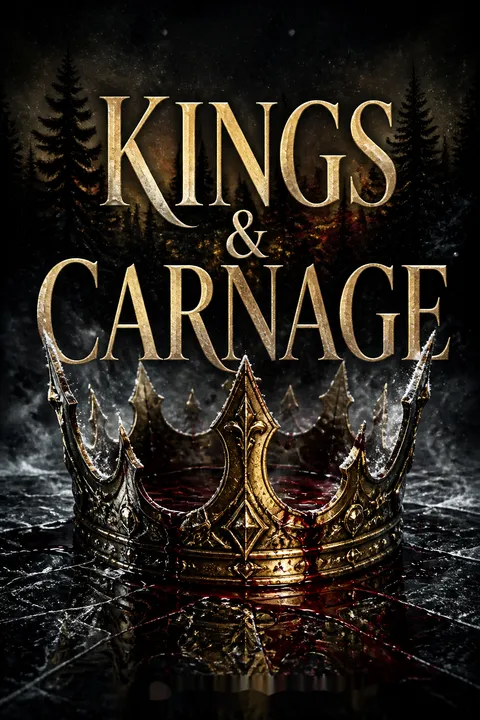
Kings & Carnage joins a missing-person investigation to a romance about the difference between protection and possession. Willa begins by seeking Emma’s fate, but the search exposes a system in which powerful men use family businesses, campus status, and private spaces to conceal violence. The cabin records matter because they make an abstract conspiracy concrete: names on maps, shell companies on deeds, and paths through the woods. Yet evidence alone does not produce justice. Students must decide whether loyalty to their families outweighs the lives of girls their families have treated as disposable.
The book’s most persistent psychological conflict is the inheritance of harm. Neo fears that his father’s cruelty has defined him; Roberto insists that violence is simply what their world requires. Willa’s refusal to accept that equivalence gives Neo another model of strength, one in which tenderness does not cancel danger and vulnerability need not become domination. Rock and Oscar provide different forms of care, but the relationship’s ethical test is whether the Kings can let Willa choose rather than merely keep her safe.
That question is dramatized through concrete decisions. Willa insists on returning to school, investigates without her mother’s approval, and accepts the Kings’ money only because it preserves her freedom to leave. Their eventual proposals have emotional force because the option to leave has been made real. The romance therefore does not resolve the thriller by substituting private love for public justice. Police search for the missing girls, arrests follow, and the losses remain unresolved. Love offers Willa a chosen future, not a way to erase Emma or the other victims. The ending’s hope is strongest precisely because it does not mistake survival for restoration.
People Also Read


Characters
Willa Russo
The relentless sisterWilla arrives at Aventine intent on discovering what happened to Emma, her missing sister. Her curiosity is practical rather than detached: she follows leads, lies when she must to gain access, and risks asking dangerous people direct questions. She is also quick to blame herself when others are harmed, especially when her choices may have exposed them. The Kings’ attention initially frustrates her, but she gradually learns to accept affection without surrendering her independence. Willa’s strongest quality is her ability to keep acting while frightened, not because fear disappears but because the unanswered loss of Emma matters more. Her dry humor and willingness to challenge powerful men keep her from being defined by the danger surrounding her.
Neo
The guarded heirNeo is the most volatile of the Kings, a physically imposing heir shaped by years of abuse and a brutal relationship with his father. Anger is his most familiar language, especially when someone threatens Willa or his chosen family. Beneath his control and aggression is a deep fear that he may become the kind of man who hurt him. Willa unsettles that certainty because she sees his tenderness even when he tries to hide it. Neo protects through action, planning security and confronting threats, but he must learn that care cannot mean deciding everything for someone else. His bond with Willa draws out a softer, more vulnerable self without making him harmless or uncomplicated.
Oscar Drago
The observant artistOscar is one of Neo and Rock’s closest friends and a member of their chosen family. He is perceptive, controlled under pressure, and often notices what others miss, from practical escape routes to shifts in Willa’s mood. His camera offers a private creative life inside a world where family expectations narrow everyone’s choices. With Willa, Oscar combines gentleness and desire, attending closely to her needs while taking pleasure in their physical intimacy. His loyalty is not passive: he acts decisively when danger arrives and shares responsibility rather than leaving protection to Neo. Oscar’s central tension is between the life his family has prepared for him and the artistic self he keeps alive through photographs.
Rock
The steady caretakerRock is the warmest and most openly nurturing of the Kings, known for cooking, humor, and making the people around him feel attended to. His easygoing manner can conceal a serious sense of responsibility, particularly toward Willa, whom he wants to protect without diminishing her. When danger leaves her injured, he turns the event into evidence against himself, even though the Kings share the same risks. His willingness to discuss that guilt with Oscar shows a capacity for vulnerability that his cheerful persona might otherwise obscure. Rock’s relationship with Willa is affectionate and sensual, but care is its foundation: he notices what she needs and takes pleasure in providing it.
Roberto Alinari
The powerful stepfatherRoberto is Celeste’s husband and the head of the Alinari crime family, a man accustomed to using wealth, influence, and violence to make resistance seem futile. His relationship with Neo is marked by cruelty and domination, while his marriage to Celeste gives him access to Willa’s family life. He treats loyalty as obedience and presents brutality as an ordinary feature of power. That worldview makes him dangerous, but it also reveals his need to control the story others tell about him. Willa’s investigation threatens not only his freedom but the authority he has built by keeping his actions hidden.
Celeste Russo Alinari
Willa’s conflicted motherCeleste is Willa’s mother, drawn to beauty, comfort, and the security her marriage provides. She loves Willa, but she is inclined to protect herself from painful truths by dismissing what she cannot bear to accept. Her polished social manner contrasts with Willa’s directness, and their relationship carries a history of Willa feeling secondary to her mother’s choices. Celeste’s dependence on Roberto complicates her ability to respond as a parent when Willa asks for help.
Daisy
The generous recluseDaisy owns the abandoned mansion near Blackwell Falls and lends it to the Kings when they need to disappear. Warm, attentive, and practical, she provides supplies while giving the injured group room to recover. Her history in town is shadowed by an infamous murder case, and her generosity toward the Kings suggests a debt or loyalty deeper than casual friendship. She does not demand explanations before offering help.
Mrs. Giordana
The grieving widowMrs. Giordana is Dean Stephen Giordana’s widow, an elegant woman whose manners remain intact even as grief has unsettled her. She is initially wary of Willa’s intrusion into her home, but she can listen carefully when Willa replaces deception with the truth. Her account of her husband’s insecurity at Aventine helps Willa understand how social ambition may have drawn him toward powerful classmates. She is neither an investigator nor a simple obstacle; she is a person trying to reconcile affection with disturbing evidence.
Claire
Willa’s campus confidanteClaire is Willa’s closest friend at Aventine, quick-witted, socially confident, and familiar with the criminal families’ systems of business and loyalty. Her casual knowledge of shell companies gives Willa the crucial insight that turns the binders into evidence of a wider conspiracy. Claire is affectionate but not meek; she challenges Willa when secrecy strains their friendship. Her brother Liam’s work in town connects her to the social world around St. Andrew’s.
Mara
Willa’s oldest friendMara has known Willa since childhood and carries the emotional history that predates Aventine. She is struggling at Columbia and feels increasingly excluded as Willa becomes absorbed in the Kings and the investigation. Her hurt comes out as resentment, but beneath it is a genuine wish to remain close. Mara’s insistence on visiting Blackwell Falls reflects both courage and a failure to grasp the danger Willa has been trying to hide from her.
Alexa Petrov
The wary QueenAlexa is a formidable Queen at Aventine, known for her sharp tongue and polished confidence. She is the daughter of a powerful Russian crime-family leader and understands the expectations that come with her name. Her relationship with Willa begins in rivalry, but moments of visible unease suggest that her hostility may conceal pressures she cannot safely discuss. Alexa is observant and proud, and she resists being treated as helpless even when she is afraid.
Hawk
The Blades’ wary allyHawk is the vice president of the Blackwell Blades motorcycle club and a contact Neo approaches for help. He is direct about the risks of involving his organization and treats favors as business rather than sentiment. His connection to the Kings gives them access to weapons and local support, but he is careful not to become entangled without understanding the threat.
Rafe
The security commanderRafe runs a professional security operation and previously provided protection to the Kings. He takes the loss of his men seriously and responds to the new threat by securing the Kings’ home with guards, cameras, and backup power. A former Army Ranger, he is methodical and alert to the difference between defending a house and protecting people everywhere they go.
Reva
The house’s loyal caretakerReva cooks for the Kings and treats them, and later Willa, with the affection of family. Her warmth is paired with a hard-earned pragmatism shaped by an abusive marriage and the choices she made to escape it. She values the Kings because they helped her rebuild her life, not merely because she works in their home.
Detective Rodriguez
The undercover investigatorRodriguez works undercover at Aventine as an interim dean while investigating the missing girls. Her careful attention to Willa can seem ambiguous because she must hide her real role. She represents the possibility of lawful investigation within an institution shaped by organized crime, though the years required to gather evidence show how difficult that work has been.
Laszlo Nagy
The club ownerNagy owns St. Andrew’s, the town’s private sex club, and is named by Alexa as a person connected to the men under investigation. His presence gives the Kings a lead beyond Aventine’s student houses and into Blackwell Falls’ adult power structure.
Stephen Giordana
The compromised deanStephen Giordana was the dean of Aventine and Mrs. Giordana’s husband. A scholarship student among wealthy heirs, he wanted acceptance from the classmates who held influence over the school. His papers and associations become important to Willa’s investigation into the missing girls.
Plot Devices
The Giordana binders
A paper trail through the woodsThe binders contain maps, surveys, and financial records for cabins around Aventine. At first, the paperwork seems too technical to explain Emma’s disappearance. Willa’s familiarity with the names and Claire’s knowledge of family businesses reveal that shell companies connected to several crime families own the properties. The records turn a suspicious cabin into evidence of a network, while their gaps keep the investigation from resolving itself too easily.
Shell companies
Hidden ownership links the familiesCompanies such as RAA and Global Limited conceal the real owners of the cabins. Their names appear in the binders and later connect properties to the Irish and Russian families as well as the Alinaris. The device makes the conspiracy legible through financial records rather than a single confession. It also reflects the families’ broader method of separating respectable public institutions from the people who control them.
The house games
Competition becomes an investigationAventine’s annual games usually test the students’ nerve and loyalty. Neo repurposes the fourth game into a demand that every house identify alumni involved in the disappearances. The rule forces students to investigate their own families, putting inherited loyalty against the group’s stated sense of honor. Its secrecy requirement makes cooperation possible but also creates a new danger: any student who warns the alumni may expose the others.
Willa’s tracker
A signal through the darkThe Kings require Willa to wear a tracker while she is out in town, extending their security measures beyond the guarded house. During the final hunt, Neo uses its signal to find the cabin where Willa was taken. The device does not solve the rescue: Willa’s captors remove it and leave it behind, forcing the Kings to follow feathers from her costume instead. Its failure shifts the search from digital certainty to physical observation.
The angel costume
A trail of feathers marks escapeThe Kings dress Willa as an angel for the Spring Fever masquerade, echoing the image Neo has carried of her since childhood. When Roberto’s men take her into the woods, the wings that made her costume striking become cumbersome during the chase. They also shed feathers, leaving a visible trail that helps Neo, Oscar, and Rock track her after the tracker is removed. The costume joins romance, memory, and practical evidence in the same object.
Download PDF
Download EPUB
.epub digital book format is ideal for reading ebooks on phones, tablets, and e-readers.








