

Key Takeaways
Treat statehouses as laboratories where democracy can be quietly dismantled
The warning starts locally. In 2020, voters in Hamilton County, Ohio, faced long car lines and lengthy bus trips to reach the county’s sole ballot drop box. Secretary of State Frank LaRose refused to add locations even after courts found he had the authority to do so. In 2021, state lawmakers proposed making the restriction permanent. The episode shows how small administrative decisions can make voting harder, then become lasting rules.
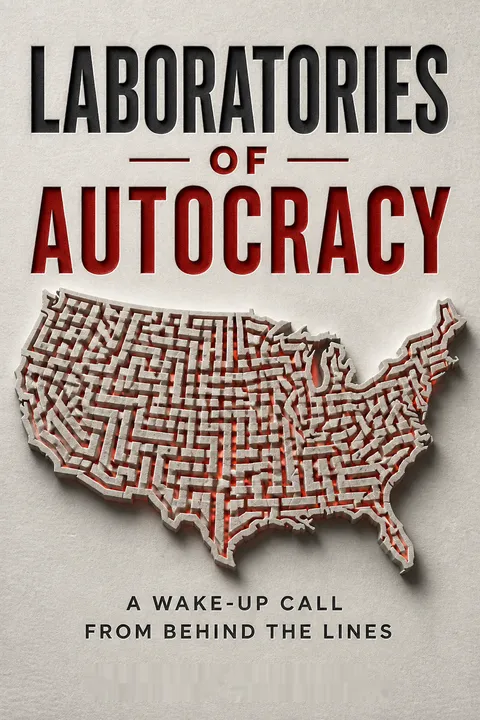
Power hides in plain sight. State legislatures control budgets, broad areas of law, election rules, and often district maps. Yet many voters cannot name their state representative, and local news coverage is thin. David Pepper calls these bodies “Laboratories of Autocracy”: legislatures that test and spread measures weakening democratic accountability. The term describes a dangerous direction, not a claim that every legislator intends to create autocracy.
What's striking is the gap between institutional power and public attention. Political science calls this a problem of low-salience governance: decisions with large consequences receive little scrutiny because they are made far from everyday visibility. That creates room for administrative choices to accumulate into structural barriers. The drop-box dispute makes the point concrete: access is not only about whether voting is formally legal, but whether the process is practically reachable. The metaphor of a laboratory is useful because it highlights experimentation and diffusion, though it should not obscure the difference between deliberate coordination and many actors responding to similar incentives.
Make accountability real before private interests write the public agenda
The incentives point the wrong way. Ohio’s online charter operation ECOT received public education funding while claiming thousands of students for whom it could not document attendance. Its founder, William Lager, became a major political donor. The case illustrates how public money can be redirected toward private gain while schools and taxpayers bear the cost. In Manchester, Ohio, residents asked their state senator how to address a town’s decline. His advice was to move. The exchange captured a system in which officials could ignore failing outcomes without fearing electoral consequences.
Failure can be profitable. The book describes legislators as having stronger incentives to satisfy donors, party leaders, and lobbyists than to improve services for constituents. Term limits and short legislative careers can deepen lawmakers’ reliance on permanent interest groups for expertise, campaign money, and future opportunities.
This is a recognizable problem of agency: elected officials are supposed to act for constituents, but the people with the most continuous access, information, and resources may be organized interests. The ECOT example is especially revealing because the policy did not merely fail to deliver; it shifted public resources toward a connected private operator. Still, lobbying is not inherently corrupt. Advocacy groups can represent schools, workers, patients, or businesses. The useful test is whether decision-making is transparent, performance is independently measured, and the public can identify who benefits when a policy fails.
Fair maps decide whether elections can punish failed government
The bunker changed the contest. In 2011, Ohio political insiders secretly drew legislative and congressional maps in a Columbus hotel suite. The League of Women Voters later reported that, across 655 state legislative elections over the decade, only eight outcomes went against the mapmakers’ intended result. Public meetings were rushed, while private requests from politicians shaped the lines.
Votes stopped translating into seats. In 2018, voters in Michigan, Pennsylvania, and Wisconsin collectively favored Democratic statehouse candidates, yet Republicans kept legislative majorities because of district boundaries. Gerrymandering, the manipulation of electoral districts to advantage a party or group, can make general elections nearly meaningless and leave incumbents vulnerable mainly to more extreme primary challengers. The result is less incentive to appeal to the broader electorate and less chance for voters to remove officials after poor performance.
District design is a form of institutional engineering: it shapes who must persuade whom, and which voters can credibly threaten an incumbent with defeat. That is why competition matters even when election results are not perfectly proportional. A fair map does not guarantee wise policy, but it keeps a basic feedback channel open between public judgment and political power. Independent commissions and clear mapping criteria can help, but no map is wholly neutral. Transparency, public access to data, and meaningful review are as important as the identity of the mapmaker.
Track the bill mills, not just the politicians who introduce bills
Policy can travel in templates. The American Legislative Exchange Council, or ALEC, brings corporate representatives and state legislators together to develop model legislation. Its members can take those proposals back to their legislatures, where similar bills may appear with little explanation of their origins. One example is a model law designed to restrict municipal broadband, which Ohio lawmakers considered as communities lacked reliable internet access.
A failed bill can still teach. The book describes hundreds of model proposals moving through statehouses, with some adopted and others abandoned. The author calls this an 80/20 strategy: advance many measures across many states, accept that some will fail, and learn from the ones that pass or survive court challenges. The approach spreads ideas across borders and gradually expands what lawmakers consider politically or legally possible.
Policy diffusion is common in federal systems: governments borrow from one another because copying reduces the cost of drafting and makes legal outcomes easier to anticipate. Organized networks can turn that ordinary process into a powerful advantage by supplying ready-made language, research, and political support. The concern is not simply that legislators use templates, but that private participants may help shape laws without comparable public visibility or accountability. Similar wording alone does not prove a hidden national command structure. Disclosure of authorship, funding, and stakeholder roles helps distinguish useful policy learning from policymaking that excludes the public.
Treat repeated voting obstacles as a system, not isolated paperwork
Small burdens accumulate. Ohio changed rules so that minor errors on ballot paperwork could invalidate a vote. An elderly legally blind voter, an immigrant who wrote his birth date in a different order, and other voters lost ballots over mistakes that did not call their eligibility into question. Ohio also used a “use it or lose it” process to remove voters who missed elections and did not respond to a mailed notice. More than two million voters were purged over the decade. In 2019, activists found that about one fifth of 235,000 voters slated for removal appeared on the list in error.
The effects were uneven. The book describes restrictions on early voting, same-day registration, and student voting alongside purges. These measures disproportionately burdened young, Black, low-income, and urban voters, groups that had supported Barack Obama in Ohio.
Administrative burdens are often mistaken for neutral because they look like ordinary forms, deadlines, or identification rules. In practice, repeated requirements can impose greater costs on people with less time, stable housing, transportation, or access to assistance. The cumulative effect matters more than any single rule. At the same time, maintaining accurate voter rolls is a legitimate administrative task. The democratic standard should therefore be both accuracy and access: use reliable updates, provide notice and a meaningful chance to correct errors, and assess whether a rule solves a demonstrated problem without needlessly excluding eligible voters.
When voters break through, watch legislatures target the referees
The contest can shift after election day. After Democrats won governorships in North Carolina and Wisconsin, Republican legislatures moved to limit the new executives’ authority. In 2021, Georgia lawmakers removed the secretary of state from chairing the State Elections Board and gave the legislature a role in choosing the replacement. Ohio lawmakers made judicial elections more openly partisan after Democratic-endorsed candidates gained ground on the state Supreme Court.
The target is oversight. The book also describes legislatures resisting voter-approved initiatives, restricting protests, and seeking greater control over election officials and courts. These moves matter because judges, secretaries of state, local election boards, and governors can serve as checks on legislative power. A system becomes more vulnerable when officials who count votes, resolve disputes, or review laws are made dependent on the lawmakers whose actions they oversee.
Institutional checks work only when oversight bodies have enough independence to disagree with those in power. The key question is not whether a legislature may define the authority of other offices. It is whether the timing and design of a change appear to protect a general principle or advantage the current majority against a newly elected opponent. A useful safeguard is reciprocity: would the same rule seem acceptable if the opposing party controlled the legislature? That test does not settle every dispute, but it exposes rules written for immediate partisan convenience rather than stable governance.
Do not confuse elections with democracy when rules preselect the winners
An election can look real yet offer little choice. Political scientists use “competitive authoritarianism” for systems that retain formal elections while incumbents tilt rules and institutions so opponents compete at a persistent disadvantage. Pepper warns that state politics can move in this direction without abolishing elections outright. Gerrymandered districts, barriers to voting, weakened courts, and partisan control of election administration can preserve a democratic appearance while narrowing the public’s ability to change who governs.
History sharpens the warning. After Reconstruction, Black voter registration in several Southern states collapsed, and Black representation disappeared from Southern legislatures. The book argues that democracy’s erosion can be gradual, then become entrenched for generations. It links contemporary attacks on voting and protest to racial backlash, while emphasizing that the danger lies in accumulated institutional changes, not only in one prominent politician.
The distinction between formal procedures and effective competition is essential. Elections are evidence of democracy only when opposition can organize, voters can participate, results can be trusted, and winners can be held accountable. Yet the category of authoritarianism should be applied carefully. A restrictive law, a lopsided district, or an unpopular policy does not by itself make a state an autocracy. The stronger diagnosis comes from a pattern: rules repeatedly insulating incumbents, suppressing meaningful competition, and weakening independent review. Historical comparison is most useful when it identifies mechanisms, not when it implies that present conditions are identical to past atrocities.
Use federal power to protect the conditions for real elections
The author calls for a national floor. The Constitution’s Guarantee Clause says the United States must guarantee every state a republican form of government. Pepper reads this as a federal responsibility to defend popular self-government when state institutions cease to represent the people. He urges Congress to restore voting protections, set minimum standards for access, limit extreme partisan mapmaking, and enforce anti-corruption laws.
Federalism needs a democratic baseline. The book argues that leaving each state entirely to its own devices can let weakened legislatures control the rules that determine their own survival. The proposed response includes stronger voting-rights legislation and preclearance, which requires certain jurisdictions to obtain approval before changing election rules. The author also argues for reforming the Senate filibuster when it blocks measures protecting democratic participation.
Federalism has two legitimate aims: local experimentation and protection against local abuses. A national floor can preserve both by setting minimum rights while allowing states to improve on them. The Guarantee Clause is a striking constitutional argument, but its political-question history means it is not a simple judicial remedy. That makes congressional enforcement central to the author’s proposal. Any national standard should be carefully designed, publicly justified, and applied consistently, so protection of democracy does not become a pretext for one party to centralize power for its own advantage.
Build permanent local pro-democracy infrastructure, not a campaign-season surge
Make participation continuous. Pepper’s practical response is to contest legislative seats even in districts that seem unwinnable, register voters year-round, support local journalism, and make statehouse decisions visible. He points to Ohio’s 2018 map-reform campaign, which gathered enough signatures to put redistricting reform before voters, and to Virginia Democrats, who contested more legislative districts before winning control. Losing candidates can still build volunteer networks, register voters, and help other candidates on the same ballot.
Organize beyond election day. The book urges citizens, local governments, nonprofits, and businesses to make voter registration part of ordinary community life. It also recommends supporting ballot initiatives where available, challenging unlawful restrictions in court, and treating local, school-board, and judicial races as consequential rather than “off-year” distractions. The goal is a durable civic presence that makes silence and uncontested elections harder to sustain.
The strongest feature of this strategy is its emphasis on capacity rather than campaign spectacle. Relationships, local reporting, candidate experience, and registration systems compound over time; they cannot be improvised in the final weeks of a close race. This also reframes a campaign loss as one step in building future participation, without pretending that structural barriers are easy to overcome. The practical challenge is coordination: a broad network needs shared priorities, reliable funding, and safeguards against burnout. Permanent civic work should strengthen pluralism, not require every community organization to become an extension of a political party.
Analysis
The book’s central contribution is to move the reader’s attention from national personalities to the state institutions that shape budgets, election rules, district boundaries, and the authority of local government. Its strongest explanatory chain links low public visibility to weak accountability, weak accountability to dependence on organized interests, and gerrymandering to incentives that reward ideological purity over broad appeal. The Ohio cases make this abstract structure legible: a single drop box becomes a voting barrier, a secret mapmaking process helps insulate legislators, and a publicly funded school scheme shows how policy capture can damage ordinary services.
The account is most persuasive when it identifies mechanisms and documents repeated patterns across states. Its discussion of policy networks also helps explain why similar laws appear in distant capitals: model legislation, shared legal strategies, and repeated experimentation lower the cost of coordinated action. The historical comparison to Reconstruction emphasizes that democratic erosion can proceed through institutions that retain the appearance of normality.
The argument also requires distinctions. Political capture, partisan advantage, administrative incompetence, and autocracy are related but not identical. Evidence that a law harms certain voters does not alone prove a unified intent among every legislator who supports it. Nor can poor state outcomes be attributed solely to statehouse design; economic change, demographics, and local conditions also matter. The book is strongest when its alarm rests on documented rules and consequences, and less conclusive when it moves from those facts to predictions about the ultimate regime. Its durable test is institutional: can voters participate, replace leaders, obtain independent review, and see who benefits from policy? If those channels are systematically narrowed, elections alone are not enough to establish democratic accountability.
People Also Read





Glossary
Laboratories of Autocracy
States testing anti-democratic rulesPepper’s term for state legislatures that use their policy and election powers in ways that weaken public accountability and democratic checks. The metaphor reverses Justice Louis Brandeis’s description of states as laboratories of democracy. It refers to a pattern of experimenting with restrictive laws, learning from other states, and entrenching political power, not necessarily to a declared intention to create an autocracy.
Guarantee Clause
Federal promise of republican governmentThe constitutional provision stating that the United States shall guarantee each state a republican form of government. Pepper interprets this as a federal duty to protect popular self-government when state institutions become detached from the people. The Supreme Court has generally treated Guarantee Clause disputes as matters for the political branches, especially Congress, rather than as ordinary claims for courts to decide.
competitive authoritarianism
Elections without fair competitionA political system that retains formal elections and opposition parties but gives incumbents persistent advantages through control of rules, institutions, or public processes. Elections occur, but the playing field is tilted enough that the public’s ability to replace those in power is substantially weakened. Pepper uses the concept to describe a possible direction of democratic erosion, not to claim that every state has reached that endpoint.
American Legislative Exchange Council
Legislator and corporate policy networkALEC is a membership organization that brings state legislators together with corporate and other private-sector representatives to develop model legislation. Members may take proposals back to state legislatures, where similar bills can be introduced. In the book’s account, private-sector members participate directly in task forces and can influence or block proposals, making transparency about the process and its participants a central concern.
Supplemental Process
Ohio inactive-voter removal processOhio’s voter-roll maintenance procedure, described in the book as a “use it or lose it” system. A voter who does not participate over a specified period may be marked inactive, sent a confirmation notice, and eventually removed from the rolls if there is no response and no later voting activity. The book argues that using missed elections as a proxy for a move can remove eligible voters, particularly when notices or government records contain errors.
80/20 strategy
Advance many measures, learnPepper’s description of groups pursuing numerous policy proposals across multiple states, expecting that some will fail while others become law. Failures can reveal political or legal limits, while successes provide models and precedents for future efforts. The strategy makes persistence and cross-state learning central: abandoning one proposal does not end the campaign if related measures continue elsewhere.
Download PDF
Download EPUB
.epub digital book format is ideal for reading ebooks on phones, tablets, and e-readers.








