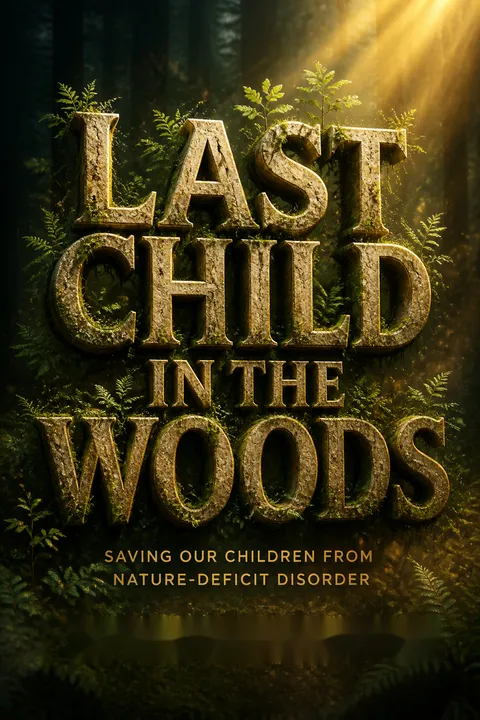


Key Takeaways
Treat direct contact with nature as a developmental need, not a luxury.
A changed childhood. Louv opens with a boy who prefers indoor play because that is where the electrical outlets are. The joke lands because it points to a genuine shift: children may know about distant environmental crises while rarely exploring nearby woods, fields, or streams. Louv calls the human costs of this separation nature-deficit disorder. It is a framing term, not a recognized medical diagnosis, for losses that may include reduced sensory engagement, attention difficulties, and poorer physical or emotional health.
Evidence, with gaps. One study cited in the book found a 50 percent decline from 1997 to 2003 in the share of nine-to-twelve-year-olds doing outdoor activities such as hiking, fishing, and gardening. In another survey, 71 percent of mothers recalled playing outdoors daily as children, compared with 26 percent who said their own children did so. Long-term comparisons remain limited.
The most useful move is to shift the question from whether children are entertained to what kinds of experience their development requires. That reframing makes outdoor access relevant to health, learning, and family life, rather than merely a nostalgic preference. It also demands precision: a view of trees, a supervised sports field, and a child's chosen exploration are not interchangeable doses of nature. The book's own evidence is suggestive rather than diagnostic, so the term works best as a cultural lens, not a label to apply to an individual child.
Give children real permission to explore, not just green scenery.
Nature behind the rules. In Scripps Ranch, a San Diego neighborhood designed with open space, children built forts, made bike ramps, and played beside a pond. Then community rules and enforcement began removing these activities, citing hazards, property standards, or possible damage. Some parents responded by supporting a skate park ten miles away. The children had not lost all access to greenery; they had lost permission to use it in self-directed ways.
Access means agency. Louv describes a broader pattern in which covenants, park rules, liability worries, and development leave nature visible but effectively untouchable. Organized sports may provide outdoor exercise, but they do not replace the freedom to invent a game, follow a stream, or build a hideout. Rules that protect fragile habitats matter. The challenge is to create places where children's play can be welcomed without sacrificing important ecological protections.
This distinction between scenery and agency is central to how public space functions. A green landscape can still be socially closed if children are treated as risks to be managed rather than legitimate users. The answer is not unrestricted access everywhere: sensitive habitat and heavily used parks have real constraints. It is a better distribution of spaces, including designated areas where digging, building, and messy play are acceptable. That approach makes safety and conservation design problems to solve, rather than automatic reasons to say no.
Use green time to restore attention, while keeping clinical claims modest.
Attention needs a break. Attention-restoration theory distinguishes effortful, directed attention from attention drawn effortlessly by interesting surroundings. Continuous concentration can leave people mentally fatigued; nature's sights and sounds may hold attention gently enough to let that effort recover. In one study described by Louv, adults completed demanding tasks, then spent 40 minutes walking in a nature preserve, an urban area, or resting indoors. The nature walkers later performed better on a proofreading task and reported more positive emotions.
Children show a similar pattern. Studies cited in the book link greener play settings with improved concentration and fewer reported attention-deficit symptoms, including among children diagnosed with ADHD. A Swedish comparison also found better motor coordination and concentration among preschoolers playing in natural surroundings. These findings suggest that outdoor time can complement care and support well-being. They do not establish nature as a cure or a replacement for clinical treatment.
The proposed mechanism is plausible because natural settings can engage attention without demanding the same sustained control as a worksheet or screen. This makes outdoor time a low-cost support worth building into ordinary routines, especially around school and homework. The distinction between support and treatment is crucial, however. ADHD has multiple causes and requires individualized care, while some cited studies rely on parent reports or limited samples. The practical case for green breaks remains strong even without turning them into a universal prescription.
Put open-ended materials and sensory freedom back into children's play.
A landscape invites invention. Simon Nicholson's loose-parts theory holds that children are more inventive when an environment contains varied materials they can combine and use in many ways. In a natural setting, those materials might include water, branches, stones, plants, and places to hide or climb. Research reviewed by Louv found that play on asphalt was more often interrupted, while children in greener settings invented stories and games that could continue across days.
Building teaches by doing. Louv recalls constructing a multi-level treehouse with neighborhood children. The project involved measuring, sawing, bracing, lifting materials, and learning from failures. A friend later itemized the practical skills the children had picked up, from geometry to pulleys and structural support. Nature's value here is not that every child must build a treehouse. It is that varied, physical surroundings let children experiment with consequences and create their own purposes.
Open-ended environments matter because they transfer authorship to the child. A fixed playground structure tells a child what action to perform; loose materials leave room for negotiation, imagination, and collaboration. This resembles hands-on learning in engineering, where understanding emerges through testing and revision rather than memorizing a finished answer. Such play should not be romanticized as risk-free or assumed to suit every child. Adults can set sensible boundaries while resisting the urge to script every minute or correct every imaginative mistake.
Teach children to assess risk instead of treating every outdoor space as perilous.
Fear can shrink a world. In a survey cited by Louv, 56 percent of parents said they had been allowed to walk or bike to school by age ten, but only 36 percent thought their own children should be allowed the same freedom. Louv argues that fear of strangers is often amplified by vivid media coverage. A study he cites estimated 200 to 300 stranger abductions annually in the United States, far below common public perceptions, though every case matters and the estimate is from the period discussed in the book.
Replace blanket warnings with judgment. Children need practical guidance about real dangers, trusted adults, and how to respond when something feels wrong. They also need chances to learn boundaries through manageable challenges, such as reading terrain or deciding whether ice is safe. Louv does not claim nature eliminates risk. He argues that appropriate freedom can help children develop confidence, awareness, and the ability to distinguish ordinary uncertainty from genuine danger.
Safety is better understood as a skill developed within relationships than as the complete removal of exposure. A child who knows neighbors, has trusted adults to approach, and can make age-appropriate decisions may be better prepared than one who has only absorbed generalized alarm. Still, independent mobility cannot be prescribed equally in every neighborhood. Traffic, violence, disability, and unequal access to safe public space change the calculation. The useful question is not whether parents are too fearful, but what community conditions would make reasonable freedom possible.
Start with nearby nature, and let children's curiosity set the itinerary.
Small places count. Louv argues that a child's important natural world need not be a national park. A ditch, vacant lot, backyard, or patch of weeds can become a place to revisit and understand. One parent in the book made regular short walks with her daughter, collecting small discoveries and letting the child become familiar with nearby woods. The point was not to stage an impressive educational outing, but to make nature part of ordinary life.
Follow the child's attention. On a hike, Louv's young sons cared more about rocks and animal droppings than the adult's talk about astronomy. That is not a failed lesson. It is a reminder to let curiosity lead. Adults can return to the same place, notice what changes, and offer names or stories when welcomed. Enthusiasm matters more than expertise, and a child who sees an adult enjoying the outdoors receives a stronger invitation than one handed another assignment.
Repeated contact with a modest place can build familiarity more effectively than occasional spectacular trips. Returning gives children a chance to notice seasonal change, remember earlier discoveries, and develop their own questions. The parent's role is partly logistical, making time and access possible, and partly emotional, signaling that the experience is worthwhile. This also makes the advice more realistic for families with limited money or transportation. It should not become one more performance standard: a short, imperfect outing is better than waiting for an ideal expedition.
Teach through the local landscape, not only through environmental crisis.
Begin where children live. Place-based education uses the surrounding community, including its natural features, as a setting for learning across subjects. Students can study fractions with stream measurements, write about local habitats, or investigate plants on school grounds. One review of programs cited by Louv reported gains in academic performance. In one California program, students' measured mastery of science concepts increased by 27 percent after outdoor education. Another school program reported substantially fewer suspensions among participating ninth-graders.
Build attachment before abstraction. Educator David Sobel warns that teaching young children mainly about rainforest destruction and planetary catastrophe can produce ecophobia, fear of ecological damage and helplessness about it. Learning about a nearby meadow, stream, or tree gives children something concrete to observe and care for. Local study does not replace global environmental education. It gives distant problems a foundation in direct knowledge rather than presenting children with crisis before they have experienced nature's appeal.
The strongest curriculum connects emotional investment to intellectual reach. A child who can observe a local stream has a concrete basis for understanding watersheds, pollution, and ecological change. That sequence does not require hiding environmental harm; it makes difficult information more actionable by connecting it to something known. Reported academic gains are encouraging, but they do not prove that every outdoor program causes improvement. Program quality, teacher support, and student selection can matter. Schools should assess outcomes while protecting time for experience that tests cannot easily measure.
Build nature into neighborhoods, not just distant parks.
A city can be habitat. The book imagines a zoopolis, an urban region designed to support human life alongside other species. That means more than preserving isolated parks: it includes connected natural corridors, native plants, restored streams, and places where children can encounter living systems close to home. In Milwaukee's Riverside Park, removal of a dam helped restore the river, and an Urban Ecology Center grew into a program serving students from area schools. Its director reported that serious violent crime had not occurred in the park for five years, though the account does not establish a single cause.
Design changes daily experience. Louv points to green school grounds, walkable routes, gardens, and natural play spaces as ways to make contact ordinary rather than a special trip. Such design can serve wildlife and people at once. It also requires planning for safety, maintenance, and public access, rather than assuming that a landscaped patch or a distant preserve will meet every neighborhood's needs.
Urban nature is not a lesser substitute for wilderness. For most families, accessible green space is the nature they can actually use, so its location and quality shape who benefits. Connected habitats also challenge the false division between a city and the natural world. Yet greening should not be treated as a cure-all for urban problems, nor should new amenities exclude existing residents. Effective projects invite neighborhood participation, protect affordable access, and make room for both ecological priorities and the everyday ways people use public space.
Let firsthand affection become the soil for environmental stewardship.
Care often starts with a place. Research discussed by Louv found that many environmental leaders remembered freely exploring natural settings as children. A study of adults also linked childhood activities such as independent play in woods, hiking, fishing, and hunting with later environmental concern. Another recurring influence was an adult who modeled close, respectful attention to plants and animals. Knowledge mattered, but simply being taught facts was not the only route to commitment.
Attention is contagious. A parent fishing with a child might notice insects, water, and surrounding plants instead of focusing only on the catch. That kind of shared observation helps a child see nature as a living community, not a backdrop or a set of resources. Louv also acknowledges moral complexity: fishing and hunting involve taking life, while wildlife viewing can be less invasive. The central point is direct, thoughtful engagement, not a single approved outdoor pastime.
Stewardship is more durable when it grows from attachment than when it begins as guilt. Repeated encounters create specific things to value, while a mentor shows how to pay attention without either exploiting or idealizing them. This helps explain why conservation messages alone may not produce lasting care. But early nature experience is not a guarantee of environmental action, and people can become stewards through many routes. The idea is best treated as an important pathway, not a test of whether a child has had the right childhood.
Make room for awe, which children may experience before they can explain it.
Wonder can be private. A teenager described finding a quiet place among pines, a creek, and a mountain view, then losing track of time there. He later struggled to explain why the experience felt religious. Louv uses such accounts to argue that nature can support spiritual development through amazement, humility, and a sense of belonging to something larger than the self. This need not depend on a particular faith. A child may experience it through a starry sky, a tide pool, or a familiar tree.
Adults need not overinterpret. The book presents religious leaders who connect care for nature with care for creation, alongside people who understand the experience in secular terms. Both perspectives recognize that children can find meaning in direct contact with the living world. Parents and teachers can make room for quiet and attention without demanding that a child explain what the moment means or adopt an adult's interpretation.
The spiritual argument broadens the case for nature beyond measurable outcomes. Not every valuable experience improves a test score or reduces a symptom; some enlarge a child's sense of scale, belonging, and mystery. That openness can create common ground among religious and secular families, provided neither side claims exclusive ownership of the meaning. The limitation is that spiritual experience is deeply individual and difficult to study. Its value should not depend on proving a universal response or prescribing a single interpretation.
Treat children's access to nature as shared infrastructure, not a parent's side project.
Families cannot solve this alone. Parents can make time, visit nearby nature, and help children explore, but schools, park agencies, developers, health professionals, and local governments shape what is possible. Louv calls for natural schoolyards, outdoor education, child-friendly parks, liability rules that do not automatically suppress play, and community design that makes nature accessible. As of the 2008 edition, the author reported more than forty regional campaigns focused on reconnecting children with nature.
Build a coalition around joy and health. The book compares this effort with earlier social campaigns that combined research, public advocacy, and changes in everyday norms. Its proposals range from small family practices to legislation and regional partnerships. The aim is not simply to send children outdoors for a day. It is to make nearby nature a routine part of childhood, including for families who lack private yards, transportation, flexible schedules, or safe local parks.
The movement's most important implication is that access is a public design choice, not a private virtue. Telling parents to go outside accomplishes little when neighborhoods lack safe routes, schools eliminate recess, or parks are distant. Shared responsibility also creates a chance to connect health, education, conservation, and civic planning without reducing the issue to any one of them. Campaigns should measure who gains access, not just how many programs exist. Otherwise, the language of universal nature benefits can conceal persistent disparities in who gets to enjoy them.
Analysis
Louv's argument moves from a memorable generational contrast to a broad social diagnosis. A child who knows about global environmental problems but rarely explores a nearby wild place represents more than a change in recreation. The shift touches how children move, learn, handle uncertainty, form attachments, and come to value the living world. The book's most consequential reframing is that diminished nature contact is not simply a failure of parental effort. Housing rules, school schedules, traffic, fear, development, and institutional priorities all help construct the childhood being criticized.
The argument is strongest when it joins experience to evidence without pretending that the evidence is complete. Research on attention, stress, physical activity, creative play, and environmental commitment points in a consistent direction, while the author acknowledges missing longitudinal data and limitations in study design. That restraint matters. Nature-deficit disorder is a useful public phrase, but it should not be mistaken for a clinical explanation of ADHD, depression, or any child's difficulties. The evidence supports making nature more available, not promising a cure.
The book also avoids reducing nature to untouched wilderness. A vacant lot, schoolyard, urban river, or backyard can matter. This is both a practical strength and a democratic one: nearby nature is more reachable than a distant national park. Still, access is not evenly distributed. Safety, transportation, disability, time, and neighborhood investment shape who can explore, so a family-centered prescription must be paired with public design and policy.
Some proposals, especially large-scale rural redesign, are more speculative than the near-term recommendations to restore recess, naturalize school grounds, and permit child-led play. The book is most persuasive when its ambition is paired with those concrete steps. Its lasting challenge is not to recreate one remembered childhood, but to ensure that children can encounter nature in many forms, safely and repeatedly, before it becomes only an image on a screen or an abstraction in a lesson.
Review Summary
Last Child in the Woods explores the importance of nature in children's development, arguing that modern society suffers from "nature-deficit disorder." Reviewers appreciate Louv's message but criticize his anecdotal approach and lack of empirical evidence. Many find the book inspiring, urging parents to encourage outdoor play and unstructured time in nature. However, some readers note the book's repetitive nature and occasional lack of focus. Despite mixed opinions on its execution, most agree that the book raises important questions about children's disconnection from the natural world.
People Also Read








Glossary
nature-deficit disorder
costs of disconnection from natureLouv's phrase for the human costs associated with reduced contact with the natural world. He links the condition broadly to diminished sensory use, attention difficulties, and physical or emotional problems. It is not a medical diagnosis, and the book presents it as a way to describe a cultural and developmental concern, not a clinical disorder.
The Third Frontier
childhood shaped by technological distanceLouv's name for the contemporary stage in the American relationship with nature. He contrasts it with earlier periods of direct use of the land and later romantic attachment to it. This frontier is marked by greater technological mediation, fewer family ties to farming, and a weaker everyday relationship between children and natural places.
biophilia
innate affinity for living thingsEdward O. Wilson's hypothesis that humans possess an inherent tendency to affiliate with other forms of life. Louv uses the idea to help explain why contact with plants, animals, and natural settings may support human development and well-being. He notes that not every claim made in biophilia's name is settled science.
attention-restoration theory
nature helps attention recoverA theory developed by environmental psychologists Rachel and Stephen Kaplan. It distinguishes effortful directed attention from attention captured more spontaneously by interesting surroundings. The theory proposes that natural settings can give directed attention a chance to recover, easing mental fatigue and supporting concentration.
loose-parts theory
varied materials invite inventionSimon Nicholson's theory that creativity and discovery increase when an environment offers many variables that people can rearrange and use in different ways. In children's play, loose parts can include natural materials such as water, branches, stones, plants, and spaces for hiding or climbing. The concept favors open-ended environments over play with only one intended use.
naturalist intelligence
skill in noticing natural patternsHoward Gardner's proposed intelligence involving the ability to recognize and distinguish plants, animals, and other features of the natural world. Louv presents it as one way educators can recognize nature-related strengths in children. He cautions against treating it as a narrow label for only children who collect specimens or excel at naming species.
ecophobia
fear of ecological damageEducator David Sobel's term for fear or distress associated with ecological deterioration. He warns that teaching young children mainly about distant environmental destruction can disconnect them from nature rather than motivate care. His alternative is to begin with direct, local experiences and build understanding from familiar plants, animals, and places.
place-based education
learning through the local communityAn educational approach that uses a student's surrounding community, including its natural environment, as a central setting for learning. Students might study a local stream through science and mathematics or write about a nearby landscape. Louv presents it as a way to connect academic subjects with direct experience, local knowledge, and a sense of place.
zoopolis
city designed for people and wildlifeA term used by urban theorist Jennifer Wolch for a city that incorporates other species and natural systems into urban planning. The vision includes wildlife habitat, connected natural corridors, native vegetation, and public awareness that cities are part of the environment. Louv uses it to imagine urban places where children encounter nature in everyday life.
ecopsychology
study of psyche and ecologyAn interdisciplinary perspective, associated in the book with Theodore Roszak, that considers how human inner life relates to the natural world. It challenges the assumption that psychological well-being can be understood only through social relationships and individual experience. In Louv's account, the field also informs questions about nature's restorative and therapeutic effects.
Download PDF
Download EPUB
.epub digital book format is ideal for reading ebooks on phones, tablets, and e-readers.








