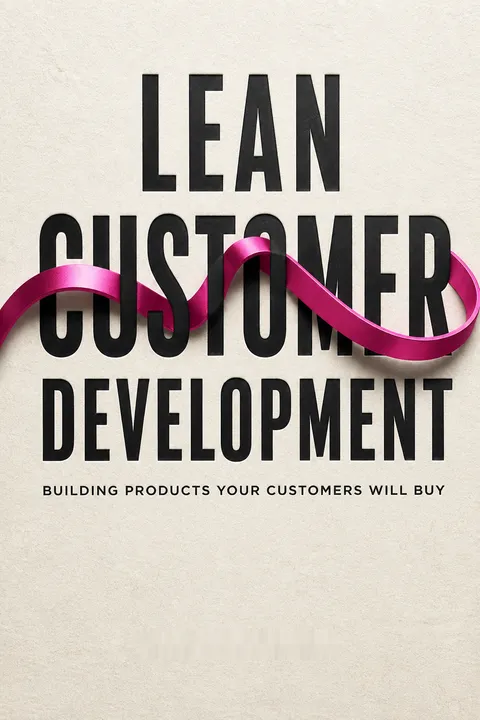


Key Takeaways
Build for a costly customer problem, not for applause
Customer evidence beats confidence. Product teams routinely overestimate their ideas: Microsoft found that only about one-third improved the measures they were meant to improve. Customer development is a disciplined way to test assumptions about who has a problem, how they handle it now, and what solution they will pay for. It complements product development rather than replacing it, and can save substantial time by revealing bad assumptions before they become code, designs, or manufacturing commitments.
A useful win can still fail. Alvarez once asked a business customer what would make its product more valuable. The answer led the company to change its product and triple its price, boosting revenue and attracting customers. Yet the company ultimately failed because it had not understood a crucial dependency in its business model. Learning whether customers value a product is essential, but it does not validate every part of a business.
The book’s strongest move is to treat customer understanding as risk management, not as a ritual of customer friendliness. That framing makes research legible to engineers and executives: the question is not whether an interview feels insightful, but whether it changes a consequential decision. The opening story also prevents a common overclaim. A real customer need can validate one link in a business, while distribution, partners, costs, or purchasing still break the whole chain. A useful research program therefore maps each important assumption, rather than mistaking one enthusiastic customer for proof of a sustainable company.
Write down one narrow customer problem before sketching a solution
Make guesses visible. A problem hypothesis is a concise, testable statement about which kind of person encounters which problem during a particular task or because of a particular constraint. Teams can spend ten minutes separately listing assumptions about customers, product, partners, cost, and distribution, then compare notes. Even experienced colleagues often discover that they are imagining different customers or business models.
Narrowness speeds learning. A broad claim such as “people struggle with technology” contains too much variation to test efficiently. A focused claim, such as a particular work group struggling to complete a defined task, is easier to challenge through interviews. Build a target profile around traits that affect decisions, such as autonomy, risk tolerance, or available time, rather than relying on demographic labels. The initial profile is a working guess, not a permanent market boundary.
Writing assumptions down serves a cognitive purpose: it turns private conviction into an object that a team can inspect, compare, and revise. This resembles preregistration in research, where stating expectations before seeing results makes it harder to retrofit a story afterward. Narrow targeting also improves signal by reducing irrelevant variation. Its danger is premature exclusion: a narrow first segment is a learning instrument, not proof that adjacent groups do not matter. The best practice is to keep the hypothesis precise while remaining willing to change the segment when evidence points elsewhere.
Recruit people already spending effort to escape the problem
Pain creates useful participation. Earlyvangelists are people who experience a specific problem intensely enough to try an unfinished solution and invest effort in explaining what they need. They are not simply technology enthusiasts who sample every new product. Look for evidence of urgency: workarounds, money already spent, repeated attempts, or strong frustration.
Go where the problem lives. KRAVE’s founders tested premium beef jerky among food-conscious consumers at Whole Foods and a Sonoma wine event, rather than asking a generic audience whether jerky sounded appealing. Customers described what “premium” meant to them, including avoiding artificial ingredients and nitrates. That evidence helped the company make its product and persuade Safeway to place a first order worth $500,000. The interviews mattered because they connected a specific audience, a real product standard, and a path to distribution.
This is a sharper form of customer selection than recruiting people who merely enjoy giving opinions. Existing effort acts as evidence of motivation, and motivation is necessary when a new product asks users to change routines. The idea also aligns with diffusion research: initial users often differ from the mainstream, so their feedback is informative about urgent needs but not automatically representative of the eventual market. A team should learn from intense users without assuming that their preferences, willingness to experiment, or language will transfer unchanged to less motivated buyers.
Ask what happened last time, not what someone might do
Past behavior is firmer ground. People can sincerely say they would use a product, spend more, or change a habit, yet fail to act when effort, money, or social pressure appears. Ask about a recent, specific event: what the person did, what tools were involved, who else participated, and what happened next. This reveals routines and constraints that broad opinions leave hidden.
Look for the job beneath the product. A fast-food chain tried to increase milkshake sales by asking customers what kind of milkshake they wanted. A different inquiry found that many morning buyers used one to occupy a hand during a long commute and stave off hunger. The opportunity was not merely a better flavor. Likewise, bank customers readily claimed to care about financial privacy, but one customer reached for a pen when offered a $50 reward for sensitive information. Answers become more credible when tested against real choices.
The distinction between intention and action is central to behavioral science. People forecast their future selves as more disciplined and less constrained than the people they are in practice. Questions about recent events reduce that forecasting error and reveal context, not just preference. Still, recollection is imperfect, and one remembered episode can be atypical. For consequential decisions, interviews are strongest when paired with observation, transaction evidence, or a small experiment. The milkshake example is especially useful because it shows how reframing the task can uncover competitors beyond the product’s usual category.
Let customers narrate their work, then probe the friction
Invite stories, not ratings. Start with open prompts about how someone completes a task, what tools they use, and what happened the last time. Ask follow-ups about timing, other people involved, and consequences. Avoid showing a product too early, since its features can steer the customer’s account toward your assumptions. When someone proposes a feature, ask what problem it would solve rather than treating the suggestion as a specification.
Silence and emotion carry information. Alvarez recommends allowing a full minute after the first broad question so the interviewee has room to move beyond a short, polite answer. Then listen actively, capture surprises and emotional reactions, and explore apparent tangents. KISSmetrics interviews about web analytics repeatedly drifted toward frustration with customer surveys. That recurring complaint led to KISSinsights, whose targeted surveys reportedly drew 10% to 40% response rates, compared with the 1% to 2% customers often saw elsewhere.
Good interviewing is less like administering a questionnaire and more like careful fieldwork: the interviewer follows the person’s sequence of actions, then probes where the account becomes vague, emotional, or surprising. Emotion can reveal priority, but it is not a reliable measure of market size or willingness to pay. A vivid complaint may belong to one unusual user. The discipline is to preserve such anomalies in the notes, then compare them across interviews. The recurring tangent that became KISSinsights illustrates why strict adherence to a script can discard valuable evidence.
Treat enthusiasm as a clue; require costly evidence to validate
Separate wanting from doing. A validated hypothesis means there is enough evidence to justify the next investment, not a guarantee of success. Strong evidence includes a customer confirming a problem, believing it can be addressed, having already tried to address it, and facing no overwhelming barrier to acting. Specific actions and sacrifices are more informative than politeness, vague enthusiasm, or future plans.
Use interviews as a sequence of checks. Alvarez suggests that two interviews should reveal whether the questions are useful, that five should usually produce at least one notably motivated person, and that patterns often begin appearing around ten. Her own projects commonly used 15 to 20 interviews, continuing until significant surprises became rare. These are working guides, not statistical laws. A preorder, pilot commitment, or investment of time can provide a stronger signal than praise alone.
This standard resembles revealed preference: choices that involve a real cost generally tell more than cost-free declarations. Yet a financial commitment is not a pure measure of need. A person may lack budget authority, face procurement rules, or be unable to take a risk even when the problem is serious. Conversely, a small payment can reflect curiosity rather than durable value. The most defensible conclusion combines several signals: recurring behavior, urgency, a credible path to purchase, and a commitment proportionate to the product’s context.
Make the MVP answer the riskiest question with least investment
An MVP is an experiment. A minimum viable product is the smallest test that can provide real value while helping a team learn whether a key assumption holds. It need not be a coded version of the imagined final product. A pre-order tests commitment; an audience-building test measures participation; a concierge test delivers the service manually; a Wizard of Oz test looks automated while people perform the work behind the scenes. A single-use-case test focuses on one task, while using another company’s product can test demand before building infrastructure.
Choose evidence, not spectacle. Finale Fireworks sold 60 discounted copies of software before writing it, giving the founders evidence that buyers would commit. Before building, ask which uncertainty matters most: customer access, value, pricing, delivery, or functionality. A click may show curiosity; payment, a purchase order, or a pilot agreement provides a more demanding signal.
The experimental view of an MVP prevents teams from equating progress with software volume. It also makes the test design more rigorous: decide what observation would change the investment decision before building the prototype. Manual delivery can expose operational costs that automation would conceal, while a purchase commitment can reveal demand more credibly than a survey. These tests still have ethical boundaries. A concealed human process or unfulfilled preorder can damage trust, so expectations, privacy, and refund terms matter as much as speed.
For existing customers, observe usage and protect trust with clarity
A mature product needs a different test. Existing customers already expect reliability and may mistake exploratory ideas for promised features. Explain plainly that research is exploratory, and use rough but coherent prototypes rather than broken experiences that undermine credibility. A storytelling demo walks through a fictional user completing a realistic task, allowing customers to correct the workflow without assuming the concept is finished.
Watch what people actually do. Select customers who are open to change, and ask them to demonstrate their work in context. At Hotwire, a limited test of map-centered hotel results revealed that customers could not judge where opaque-booking hotels were located. The first version lacked useful sorting and filtering, yet customers still booked, giving the team evidence to improve it. With existing products, an incomplete feature should still support a coherent core task, not leave users stranded.
The central challenge in established companies is not simply building smaller features. It is preserving the trust that gives customers a reason to participate in experiments. Clear framing reduces the risk that research becomes an accidental roadmap promise, while direct observation can expose workarounds that customers no longer think to mention. There is a tradeoff: a polished prototype can bias feedback toward approval, while a crude one can trigger reactions to its roughness. A coherent, clearly labeled concept helps separate workflow feedback from judgments about unfinished craft.
Turn support, sales, and usage into a continuous learning system
Customer contact already exists. Support teams, account managers, and salespeople hear about problems every day. When someone requests a feature, ask what they are trying to accomplish and what they cannot do today. Several customers may request the same feature for different reasons, or propose different features to solve one shared problem. The request is a starting point, not a requirement.
Make learning easy to share. Mindbody found that customers called frequently about a complicated pricing screen. Its average customer used only four of the screen’s fifteen options, so the company moved the other eleven behind an advanced-settings link, and call volume dropped dramatically. Capture customer observations in a shared, lightweight format, summarize what they change, and explain the result to the organization. That feedback loop turns individual conversations into evidence for product choices.
This approach treats customer support as organizational sensing rather than a cost center. Its greatest benefit may be connective: product teams gain access to observations that frontline workers already possess, and frontline workers gain a credible way to influence product decisions. The caveat is sampling bias. People who contact support are often unusually confused, engaged, or technically capable, so their experiences should be checked against broader usage patterns. A shared learning system works best when it records both the customer’s account and how common the behavior appears to be.
Analysis
Alvarez’s practical contribution is to move customer development from a slogan to a repeatable habit of inference. The central object is not the interview itself, but the assumption being tested: who experiences a problem, under what conditions, what they already do about it, and what they will risk to change it. This gives a team a useful alternative to the familiar but weak evidence of internal consensus, feature requests, or market-size estimates detached from lived behavior.
The method is strongest when it moves between levels. Specific recent actions show what customers do; broader questions reveal the task those actions serve; prototypes and commitments test whether a proposed response changes behavior. The examples demonstrate that discovery can reshape not only features but positioning, distribution, pricing, and even the product category. A customer’s complaint about surveys becoming KISSinsights is a particularly revealing case: listening beyond the original agenda uncovered an adjacent need with its own commercial potential.
The approach should not be mistaken for a substitute for quantitative validation or business-model analysis. Interviews are selective, memory is fallible, and enthusiastic early users can differ from mainstream buyers. Small samples are excellent for finding mechanisms and contradictions, but weak for estimating prevalence. Likewise, willingness to pay must be interpreted in context: a purchasing decision may depend on budgets, regulation, procurement, or another stakeholder’s approval. The book’s own opening story makes this point sharply: customer value improved, but an unexamined partner dependency still doomed the company.
The most durable operating principle is therefore epistemic humility paired with operational speed. Write assumptions down, seek disconfirming evidence, and choose the cheapest experiment capable of changing a decision. Then share what was learned so that customer knowledge alters the organization’s work, rather than remaining an interesting collection of anecdotes. The discipline is not to ask customers to design the product. It is to understand their world well enough to make better bets than intuition alone allows.
Review Summary
Lean Customer Development receives mostly positive reviews, with readers praising its practical approach to customer research and product development. Many find it valuable for startups and established companies alike. The book offers actionable advice on conducting customer interviews, validating hypotheses, and developing minimum viable products. Some readers note that the content may be familiar to those well-versed in lean methodologies. Overall, it's considered a useful resource for understanding customer needs and improving product development processes.
People Also Read







Glossary
Customer development
Testing customer and business assumptionsA hypothesis-led practice for learning who customers are, what problems they face, how they currently behave, and what solutions they will buy. It runs alongside product development and uses customer conversations and experiments to reduce the risk of building something unwanted.
Lean customer development
Pragmatic, fast customer learningAlvarez’s practical adaptation of customer development for both startups and established organizations. It emphasizes quick, manageable tests of assumptions, direct conversations with current or prospective customers, and using what is learned to guide product and business decisions.
earlyvangelists
People with urgent unmet needsPotential customers who feel a particular problem acutely and are motivated to help shape or try an imperfect solution. They differ from people who merely enjoy adopting new technology: their interest comes from the problem itself, and their actions can reveal urgency and practical constraints.
problem hypothesis
A testable customer problem claimA concise statement describing a type of person, a problem they experience, and the task or constraint surrounding it. It provides a focused starting point for recruiting interviewees and checking whether the assumed customer and problem actually exist.
validated hypothesis
Evidence supporting further investmentA hypothesis supported well enough to justify the next investment of time or resources, not a guarantee that a product or company will succeed. Useful evidence includes a real problem, motivation to solve it, prior attempts to do so, and no insurmountable barrier to action.
Minimum Viable Product (MVP)
A minimal learning experimentThe smallest product or experiment that provides enough value to customers while answering an important business or product question. It may be manual, partial, or built from existing tools. Its purpose is to maximize learning while minimizing investment and risk, not to deliver a miniature version of an imagined final product.
Pre-Order MVP
A test of purchase commitmentA demand test that asks prospective customers to commit before the solution is available. Evidence can include a preorder, pledge, credit-card authorization, letter of intent, or pilot agreement. Its purpose is to test commitment, not just curiosity or willingness to provide contact information.
Audience Building MVP
A test through audience participationAn experiment that gathers prospective customers around relevant content, discussion, or shared activity before a full product exists. Participation and continued engagement can indicate whether a community or service may be valuable, although audience activity alone does not establish willingness to pay.
Concierge MVP
Manual delivery of the proposed valueA test in which the team personally performs the service for customers, who know that the work is being done manually. Close interaction helps uncover customer needs, delivery constraints, and whether the service is valuable enough to pursue before automation is built.
Wizard of Oz MVP
A manual service presented as automatedA prototype that appears to work through software or automation while people perform the underlying tasks manually. It can test how customers behave with an apparently complete service before major engineering investment. Because users are unaware of the manual process, careful attention to trust and potential harm is important.
Single Use Case MVP
A focused product for one taskA working product that solves one specific customer problem or supports one central task, rather than attempting a broad feature set. It should provide a coherent, useful experience for that task while testing whether customers value the proposed solution.
Other People's Product MVP
A test built on existing servicesAn experiment that relies on existing products, APIs, competitors, or infrastructure to deliver a proposed service. Borrowing what already exists can reduce engineering and operational effort while helping a team learn about customer behavior, logistics, and possible differentiation.
storytelling demo
A prototype shown through a user storyA guided demonstration that follows a fictional but realistic user through a task using a proposed product. By presenting a coherent sequence instead of a list of features, it invites customers to correct assumptions about their workflow while making clear that the concept is exploratory.
FAQ
What is Lean Customer Development: Building Products Your Customers Will Buy by Cindy Alvarez about?
- Customer learning focus: The book teaches a hypothesis-driven approach to deeply understanding customers, validating assumptions, and building products people will actually buy.
- Practical, actionable guidance: It provides step-by-step exercises, interview techniques, and social psychology insights for engaging with customers effectively.
- Applicable to all organizations: Alvarez’s method bridges startups and large enterprises, including those in conservative or regulated industries.
- Emphasis on real-world learning: The book stresses learning from actual customer behaviors and needs, not just internal opinions or assumptions.
Why should I read Lean Customer Development by Cindy Alvarez?
- Reduce product failure risk: The book helps you avoid building products nobody wants by validating assumptions early and continuously with customers.
- Actionable techniques for teams: It offers concrete methods for interviewing customers, analyzing feedback, and making informed product decisions.
- Adaptable to any company size: Whether you’re in a startup or a large enterprise, the book shows how to tailor customer development practices to your context.
- Build a customer-centric culture: Alvarez emphasizes sharing learnings across teams and closing the feedback loop to foster continuous learning.
What are the key takeaways from Lean Customer Development by Cindy Alvarez?
- Validate, don’t assume: Always confirm that customers have a real problem, have tried to solve it, and are motivated to buy before investing heavily.
- Customer development saves time: Every hour spent talking to customers can save 5 to 10 hours of wasted design and coding.
- Works for all companies: The approach is essential for startups and large, conservative, or regulated organizations alike.
- Close the feedback loop: Share what you learn internally and externally to build trust, alignment, and better product decisions.
What is customer development according to Cindy Alvarez’s Lean Customer Development?
- Hypothesis-driven learning: Customer development is about forming and testing hypotheses regarding who your customers are, their problems, and what solutions they’ll pay for.
- Parallel to product development: It complements product development by focusing on “Will they buy it?” rather than just “Can we build it?”
- Continuous and iterative: The process involves ongoing conversations and experiments with customers to validate or invalidate assumptions.
- Enables course correction: Early learning allows teams to pivot or refine ideas before heavy investment.
How does Cindy Alvarez define “lean” in Lean Customer Development?
- Pragmatic and efficient: “Lean” means practicing customer development quickly and without unnecessary overhead or bureaucracy.
- Eliminating waste: Inspired by lean manufacturing, the approach focuses on reducing wasted effort by building only what customers truly want.
- Rapid learning cycles: Emphasizes fast, iterative hypothesis testing and learning.
- Adaptable across contexts: The lean approach works for both startups and mature companies.
What are the five steps of the Lean Customer Development method by Cindy Alvarez?
- Forming hypotheses: Explicitly write down assumptions about customers, problems, and solutions to test.
- Finding customers: Identify and reach out to potential customers or “earlyvangelists” who have the problem and are motivated to solve it.
- Asking the right questions: Conduct interviews using open-ended, objective questions to uncover real behaviors and constraints.
- Making sense of answers: Analyze interview data to validate or invalidate hypotheses, looking for emotion, surprises, and contradictions.
- Figuring out what to build: Use validated learning to design minimum viable products (MVPs) that address real customer needs efficiently.
How do you identify and write hypotheses in Lean Customer Development by Cindy Alvarez?
- List assumptions explicitly: Use prompts like “Customers have ___ problem” or “Customers are willing to invest ___ to solve this problem” to surface hidden beliefs.
- Write a problem hypothesis: Format it as “I believe [type of people] experience [type of problem] when doing [type of task],” focusing on specific, testable claims.
- Narrow your focus: Start with a specific customer segment and problem to accelerate learning and avoid vague, broad hypotheses.
- Test and refine: Use interviews and MVPs to validate or invalidate these hypotheses quickly.
Who are “earlyvangelists” in Lean Customer Development and why are they important?
- Passionate problem solvers: Earlyvangelists are customers who have a severe problem and are motivated to find a solution, willing to take risks on unfinished products.
- Rich feedback sources: They provide detailed feedback, try beta versions, and help refine the product through their enthusiasm and engagement.
- Critical for validation: Earlyvangelists are essential for validating hypotheses because their urgent needs drive honest, actionable insights.
- Different from early adopters: Unlike early adopters who try new tech for novelty, earlyvangelists are driven by real pain points.
What are the best practices for conducting customer development interviews in Lean Customer Development by Cindy Alvarez?
- Prepare and practice: Do a dry run with a colleague to refine your questions and interview style before talking to real customers.
- Set clear expectations: Thank the interviewee, emphasize that you want to hear their personal experiences, and position them as the expert.
- Use silence and open-ended questions: Wait after asking questions to encourage detailed responses, avoid leading questions, and gently guide tangents.
- Take detailed notes: Capture verbatim quotes, emotions, and surprises; consider pair interviewing for better note quality.
How many customer interviews do you need according to Lean Customer Development by Cindy Alvarez?
- 15–20 interviews typical: Usually, 15 to 20 interviews provide enough insight to stop hearing surprises and see clear patterns.
- Milestones in learning: After 2 interviews, assess if you’re learning; after 5, you should meet an excited customer; after 10, patterns should emerge.
- Invalidation is valuable: If after 5 interviews no one is excited, your hypothesis is likely invalid and should be refined or pivoted.
- Quality over quantity: The goal is to learn and validate, not just to hit a number.
What are the components of a validated hypothesis in Lean Customer Development by Cindy Alvarez?
- Real problem acknowledgment: The customer clearly recognizes a definite pain point or problem that affects them.
- Belief in solvability: The customer believes the problem can and should be resolved, showing motivation to seek a solution.
- Active investment: The customer has already tried to solve the problem through effort, time, money, or learning.
- No external blockers: There are no regulatory or social constraints preventing the customer from trying to fix the problem.
What types of Minimum Viable Products (MVPs) does Cindy Alvarez describe in Lean Customer Development?
- Pre-Order MVP: Validates customer commitment by collecting pre-orders or financial pledges before building the product.
- Audience Building MVP: Builds a community or audience before product launch to validate demand and ease distribution.
- Concierge and Wizard of Oz MVPs: Deliver the product manually or with hidden human effort to test customer interest without full automation.
- Single Use Case MVP: Focuses on solving one specific problem or feature well to validate value before expanding.
- Other People’s Product MVP: Leverages existing products or competitors’ infrastructure to test ideas quickly and cheaply.
Download PDF
Download EPUB
.epub digital book format is ideal for reading ebooks on phones, tablets, and e-readers.








