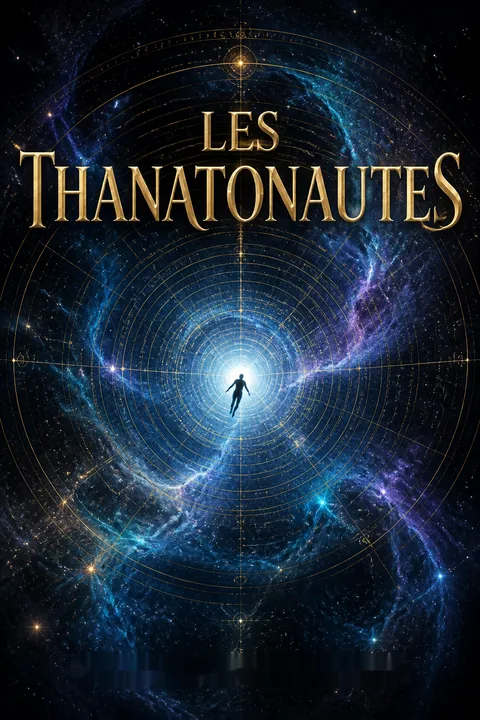


Plot Summary
A Child Meets Death
As a boy, Michael Pinson learns that adults treat death as a forbidden subject. When a car strikes him while he chases a ball, he loses consciousness for three hours and remembers nothing of the interval. The blankness deepens his curiosity rather than settling it. At his uncle's funeral, he meets Raoul Razorbak, a tall, solitary boy who sits beside his father's grave hoping for a message.
Their shared fascination with the unknown begins an unlikely friendship. Raoul feeds Michael books and ancient stories; Michael answers his friend's solemn theories with jokes. The cemetery becomes their meeting place, where death is not a taboo but a question they can examine together.
Michael's childhood turns an ordinary accident into an epistemological wound: he has experienced the border of death, but it yielded no testimony. His family's insistence that grief must look a certain way teaches him to perform emotion rather than understand it. Raoul offers an alternative education, grounded in books and speculation. Their complementary temperaments matter: Raoul supplies conviction and direction, while Michael's uncertainty keeps their ideas open to revision. Their friendship begins as shared curiosity, but its imbalance is already visible. Michael is drawn to Raoul's certainty partly because he does not yet trust his own judgment.
The Father in the Grave
Raoul reveals why he studies death: he found his father, philosophy professor Francis Razorbak, dead by suicide, beside the remains of a burned thesis on death and ancient afterlives. Raoul becomes convinced that his father pursued a discovery, not simply an escape, and treats the surviving pages as clues.
He shares Egyptian accounts of the dead's trials, while Michael's dreams of a veiled woman wearing a skull mask give the subject a private, unnerving shape. Raoul also teaches Michael to use a coin toss when fear makes a choice impossible. The trick helps them drive off graveyard cultists preparing an animal sacrifice, and Raoul gives Michael the coin as a portable source of borrowed courage.
Raoul's inquiry is inseparable from unresolved grief. By construing his father's suicide as research, he turns an unbearable absence into a solvable problem and protects himself from the possibility that no explanation will restore what was lost. His coin ritual shows a related defense: chance relieves him of the burden of choosing, while allowing him to act with theatrical certainty. Michael adopts the method because he has been trained to defer to stronger personalities. The skull-masked woman, meanwhile, makes death both frightening and alluring, a recurring image that links childhood terror to the adult wish to look beyond the body.
Coma, Then Reunion
At fourteen, Michael and Raoul sneak into Saint-Louis Hospital to question comatose patients about near-death experiences. The dying wards and morgue horrify Michael, while Raoul finds no useful account among the patients. Soon afterward, Raoul's mother moves away, separating the boys for years.
Michael's father dies of lung cancer, and his mother humiliates him by reading his private journal aloud. He studies medicine, eventually becoming an anesthesiologist and resuscitation specialist, a career rooted in the hospital that once frightened him.
At thirty-two, Raoul returns as a biologist researching artificial hibernation in marmots. Their old conversations resume, and Raoul asks Michael to help test whether a human can be taken close enough to death to report what lies beyond.
The hospital visit supplies an early empirical test of Raoul's theories, and its failure does not deter him. Michael, however, sees the physical costs of dying and carries that knowledge into medicine. His profession gives him technical authority, but not emotional confidence; he remains vulnerable to Raoul's force of purpose. The long separation preserves their friendship in idealized form, so their reunion can revive both genuine affection and childhood dependency. Their roles have changed, yet the old pattern remains: Raoul imagines the frontier, while Michael is asked to make the dangerous crossing medically possible.
Lucinder Funds the Afterlife
President Jean Lucinder survives an assassination attempt after doctors restart his heart. During the interval when he was clinically dead, he experiences leaving his body and approaching a brilliant otherworld before resuscitation pulls him back.
He asks Research Minister Benoît Mercassier to investigate, despite the minister's skepticism. Mercassier's wife, Jill, persuades him to treat the claim as an unexplored territory and recruit volunteers considered expendable by society. Raoul is selected to lead the work, and he brings Michael to a hidden laboratory beneath Fleury-Mérogis prison.
There, volunteer lifers will act as pilots, while nurse Amandine Ballus monitors them. Michael initially refuses to participate, but his isolation, professional frustration, and attraction to Amandine weaken his resolve.
Lucinder's experience converts private testimony into state-sponsored science, but political motives complicate the project from its start. The president wants to secure his place in history; Mercassier wants to preserve his position; Raoul wants an answer to his father's death. Jill's exploration metaphor makes an ethically fraught experiment sound like a national expedition. The prisoners' consent does not erase the power imbalance: they are offered a chance to escape life sentences, while the researchers hold the instruments that may end their lives. Michael's reluctance is morally perceptive, but his loneliness and desire for belonging make refusal harder than he admits.
Three Pilots Lost
Michael designs a timed infusion system using saline, thiopental, and potassium chloride, intending to reduce a volunteer's heart activity gradually. The first pilot, Marcellin, dies despite an hour of resuscitation.
Michael leaves in horror, but returns the next day after calculating how the dosage might be improved. Hugues survives the next launch only to emerge with severe, lasting brain damage, unable to speak or move. A third volunteer, Marc, wakes violently convinced that devils are attacking him, injures Michael and Amandine, and is sent to an asylum.
The failures cost the team lives and trust. Michael recognizes the work as killing disguised as exploration, yet his professional problem-solving begins to replace the moral question he cannot bear to answer.
The early trials expose a central contradiction: the project seeks knowledge about death by producing real deaths, while its researchers interpret each catastrophe as information for the next attempt. Michael's medical skill offers control over process, not certainty over consequence. His return after Marcellin's death is especially revealing. Technical analysis gives him a way to re-enter the laboratory without confronting the full weight of his choice. Amandine's commitment and Raoul's confidence create social pressure, but Michael is not merely coerced; he also wants the adventure to matter. The volunteers' different outcomes show that crossing the boundary may damage a person without granting useful knowledge.
Félix Comes Back
The team selects Félix Kerboz, a scarred lifer who has endured years of dangerous prison experiments to shorten his sentence. Unlike the earlier volunteers, Félix expects a concrete reward: freedom.
Michael adjusts the drug doses, and Félix leaves his body, travels through a luminous, rotating passage, then turns back before a transparent barrier where his cord begins to weaken. He returns alive and describes an immense, blue-white funnel filled with departing souls.
His account gives the explorers their first map and identifies a limit they name the comatic wall. Raoul wants to announce the breakthrough, but Lucinder insists on controlling the news. Félix's plainspoken account has achieved what the team's theories could not: a witness has returned.
Félix succeeds because his motives are specific and embodied. Freedom, not a philosophical commitment to life, gives him a reason to reverse course when the afterlife's pull makes ordinary concerns seem trivial. The result unsettles the researchers' assumptions about courage: survival depends less on heroic character than on a powerful attachment to something unfinished. His map converts a private vision into shared evidence, though its images remain filtered through one man's expectations and vocabulary. The boundary is both geographical and psychological. It marks not simply where the dead travel, but the point at which the desire to return can be overwhelmed.
A Nation Watches Félix
Once news of the prison experiments leaks, newspapers portray Lucinder, Raoul, Michael, and Amandine as killers. The public demands arrests, Mercassier flees to Australia, and officials distance themselves.
Lucinder answers by staging a public test at the Palais des Congrès, where experts inspect the equipment and Félix attempts another crossing. He appears not to return; the team is arrested as the audience turns hostile. Then a dropped stage light strikes Félix's eye, and the shock jolts him awake.
His return vindicates the experiment in front of cameras, and Lucinder grants him amnesty. The team moves from a clandestine prison workshop to a government-backed facility at the Buttes-Chaumont, while media attention turns their work into a public spectacle.
The accidental light that revives Félix makes the scene's central irony literal: a media spectacle, designed to secure political legitimacy, nearly becomes a public execution. The same audience that condemns the team accepts its claim after a single visible success. Scientific proof here is inseparable from performance, timing, and authority. Lucinder's exposure to danger does not end his ambition; it gives him a story that can be used. Félix's amnesty transforms a prisoner into a national hero, but the surrounding publicity foreshadows the way fame will distort the explorers' motives and the research itself.
The Walls Become Worlds
With a purpose-built thanatodrome and growing international competition, the team refines its equipment and recruits more pilots. Félix's celebrity makes him unreliable, so professional stuntman Jean Bresson takes on the dangerous measurements.
He crosses the first comatic wall and returns in terror, insisting that the region beyond is unbearable. Italian thanatonaut Stefania Chichelli offers a different account: the black territory confronts travelers with painful personal memories, not a universal hell.
Her disciplined meditation lets her pass them and reach a second wall. Later, she crosses a third boundary into a red region of intense desire and pleasure. Her reports expand the map, but also reveal that each landscape is shaped by the traveler's own memories and appetites.
Bresson's terror and Stefania's composure make the afterlife less like a fixed geography than a meeting between inner life and imagined terrain. The explorers' maps record recurring zones, but the content within them varies by person. Stefania's achievement depends on a practice that joins bodily discipline to spiritual interpretation, challenging the team's preference for chemistry and instruments alone. Meanwhile, the first wall exposes the cost of suppressing memory: Bresson's childhood trauma returns with devastating force. Exploration cannot be separated from psychological history, and a successful crossing may demand more than technical courage.
The Paradise Wars
As monks and clergy join the expeditions, thanatonauts begin attacking one another in the afterlife. Haschischin mercenaries sever the cords of two rabbis, prompting Freddy Meyer, a blind rabbi and gifted organizer, to build a coalition with Buddhists, Taoists, animists, and others.
His group wins a major battle by drawing its opponents into the memory-haunted territory, where their own pasts weaken them. The slaughter convinces rival faiths to sign the Buttes-Chaumont accords, declaring the afterlife open to all and forbidding obstruction.
Meyer then devises cord-tethered formations that protect groups as they travel. With this method, the alliance passes further walls, reaching a yellow territory of knowledge and a green territory of overwhelming beauty.
The wars reproduce earthly religious conflict in a place supposedly beyond earthly borders. The afterlife's lack of national ownership does not prevent people from trying to possess it; instead, it gives old rivalries a new arena. Meyer's strategy turns collective dependence into practical safety, while the memory zone itself punishes groups whose histories are soaked in violence. The accords are a moral achievement, but not a final cure: cooperation makes exploration possible without dissolving competition. Knowledge and beauty become trials too, showing that pleasure, certainty, and transcendence can tempt people away from return as powerfully as fear.
Michael Follows Rose
When attackers leave Rose critically injured, Michael arranges to join a large expedition timed to her removal from life support. He has never deliberately crossed over himself.
Guided by Freddy's formations, he travels through the known territories, resisting the skull-masked apparition, memories of his own guilt, and the pleasures that once held other explorers. Rose moves ahead, but the group catches her near the luminous mountain where souls are judged. Three archangels permit Michael to bring her back only if she chooses to return.
Rose turns away from judgment and reconnects to life, and she wakes in hospital. Michael has now seen the afterlife for himself and learned that the explorers' cord is not merely a tether; it is the fragile condition that makes return possible.
Michael's first deliberate journey reverses his old passivity. He accepts mortal risk not to satisfy Raoul's curiosity but to save his wife, and that attachment supplies the purpose he needs to keep moving. Yet Rose's choice cannot be made for her. The angels' decision preserves her agency at the very moment the rescue team might treat her as an object to retrieve. Michael's encounters also reveal how personal guilt and desire complicate supposedly objective observation. The expedition produces knowledge, but its decisive achievement is relational: survival depends on a freely renewed connection to the living.
Secrets From Satan
On later visits, Michael and his companions meet angels who explain their roles and the final judgment of souls. Raoul asks Satan about his father's death and learns that Francis may have killed himself after discovering his wife's affair, not in pursuit of the afterlife. The revelation sends Raoul after his mother and her former lover.
In the same outburst, he tells Michael that his parents adopted him and his brother Conrad. Raoul knows a second, more intimate truth about Michael but stops short of forcing it on him. Michael's marriage to Rose and their newborn son give him a home he chooses to cherish, even while uncertainty about his past and an unknown prior-life attachment unsettles him.
The revelations turn access to truth into a psychological hazard. Raoul has treated knowledge as a cure for grief, but the account of his father's final motive intensifies blame rather than bringing closure. Michael's adoption likewise destabilizes identity without erasing the affection formed through years of ordinary care. The second withheld secret makes ignorance an active choice, not merely a lack of information. In a story where every mystery seems discoverable, the characters must learn that knowing can wound, distort, or commandeer a life. Their intimate relationships become the counterweight to the fantasy that complete explanation will make them whole.
The Judgment Goes Public
President Lucinder wants a new electoral advantage, so the team sends journalist Maxime Villain to record the judgment of a dead man. Maxime's near-perfect memory preserves a hearing in which three archangels tally the man's choices, assign moral points, and let him select the circumstances of his next life.
Amandine presents the report publicly: souls must earn six hundred points to end reincarnation, and future lives may repair earlier harms. The revelation reshapes public behavior. Crime and warfare decline, charity and donations surge, and people try to protect their karmic scores. The afterlife is no longer a distant mystery; it has become a system people believe they can manage, and Lucinder benefits politically from the disclosure.
The judgment scene translates moral responsibility into an auditable system. Its point scale is comic in its bureaucratic precision, yet it also exposes how easily ethics can be reduced to accounting. Once the public can imagine a score, goodness becomes strategic: people give, forgive, or refrain from violence partly to secure a better future. The story's satire targets not generosity itself but the conversion of generosity into self-protection. Lucinder's political use of the revelations sharpens the problem: spiritual knowledge becomes a campaign tool, and public belief begins to reorganize conduct before anyone has tested its consequences.
Goodness Turns Hollow
The public's new caution curbs violence but also drains risk and spontaneity from ordinary life. Thanatonautic travel becomes tourism, advertising spreads along the route to reincarnation, and a Japanese company sells karmographs that track good and bad deeds.
Suicide initially rises because some people treat death as a reset, until Michael's colleagues warn that suicides may become restless souls seeking vacant bodies. Michael's former mentor, Stefania, rejects the culture of compulsory kindness and gathers a small band committed to restoring conflict and appetite.
Meanwhile, the president dies by suicide, and Raoul, grieving Stefania's departure and his own family history, turns increasingly to alcohol. The explorers realize that information meant to end fear has also weakened people's investment in this life.
The utopia curdles because external compliance cannot substitute for moral development. When goodness is pursued as a score, people learn to avoid risk rather than deepen responsibility. The karmograph literalizes surveillance, turning conscience into a wearable accounting device. Stefania's rebellion is ethically troubling, but her diagnosis is sharp: coerced niceness produces numbness, not compassion. The suicide crisis further exposes a category error. Treating death as a harmless restart ignores the obligations and relationships embedded in a particular life. The central question shifts from what lies beyond death to whether certainty can make people forget how to live.
Raoul Falls at Home
Stefania's followers attack the Buttes-Chaumont thanatodrome, smashing equipment and merchandise while demanding that the explorers stop. Michael and Raoul fight back, briefly recovering the old solidarity that launched their work. Stefania arrives armed and admits that she wants the enterprise destroyed, though she still considers Michael, Raoul, and Maxime her friends.
As she and Raoul kiss, their former classmate Martinez, now a violent member of her band, strikes Raoul from behind with a hatchet. Raoul dies refusing resuscitation, using his final moments to kiss Stefania. The raid disperses, leaving Michael with the loss of the friend who first taught him to treat death as a frontier.
The violence at the laboratory collapses the boundary between the explorers' technical world and the disorder they have unleashed. Raoul and Michael's renewed teamwork briefly restores the friendship's original promise, but it cannot undo the years of resentment or the political consequences of their project. Stefania embodies the contradiction at the center of the episode: she opposes the thanatodrome through destructive means because she believes destruction may save ordinary life. Raoul's final choice to refuse rescue grants him agency in a story obsessed with bringing the dead back. His death is intimate, not triumphant, and makes the cost of their discoveries personal.
The Secret Is Buried
After Raoul's death, Michael dreams that celestial administrators cannot cope with humanity's population and that karmic records may be corrupted. The next morning, vandals destroy the thanatodrome; soon afterward, a Boeing crashes into it, killing Michael, Rose, and Amandine, while Maxime dies in a domestic accident.
The friends arrive in the afterlife without the equipment that once made them explorers. The angels condemn them for publicizing sacred knowledge, encouraging dangerous crossings, and turning the route into a commercial attraction.
They promise to erase the world's memory of thanatonautics, sparing only faint legends. Before the explorers are reincarnated, the angels finally let them pass beyond the judgment mountain, where Michael sees an astonishing truth the book leaves unrevealed.
The ending refuses a neat reward for discovery. The explorers gain access to the final mystery only after the institution they built is dismantled and its public consequences are judged. Their punishment is not simply death, which they have studied, but erasure: the loss of historical recognition and of the very curiosity they tried to satisfy for everyone. The final withheld revelation restores uncertainty as an ethical necessity. Michael's account has repeatedly mistaken access for mastery; now the narrative closes at the instant knowledge arrives, forcing readers to inhabit the same limit. The afterlife remains real within the story, but not fully possessable.
Analysis
The novel makes curiosity both a human virtue and a form of appetite. Michael's first blank interval after his accident leaves him wanting evidence; Raoul's grief gives that desire urgency, and modern medicine gives it instruments. Their project therefore grows from motives that are intelligible but not interchangeable: Michael seeks belonging and understanding, Raoul seeks an answer to his father's absence, Lucinder seeks historical importance, and the volunteers seek escape or recognition. The research succeeds scientifically within the story, yet its public consequences reveal that information does not arrive as a neutral good.
The afterlife's successive territories turn psychology into geography. Memory, desire, patience, knowledge, and beauty are not abstract themes; travelers must confront each through a perilous crossing. The map's apparent objectivity is undermined by the different visions reported by Bresson and Stefania. What looks like universal structure is continually shaped by individual history, culture, and expectation. The book thus treats spiritual certainty with playful skepticism even as it takes emotional experience seriously.
Its sharpest social satire begins when the judgment system becomes public. A numerical account of virtue first appears to promise accountability, then encourages people to perform goodness for karmic gain. Charity becomes calculation, risk becomes suspect, and life itself seems disposable when death is believed to offer a reset. The resulting passivity is not the opposite of selfishness; it is selfishness reorganized around fear of future punishment. Stefania's revolt recognizes this deadening effect, though her violence cannot provide a humane remedy.
The ending finally challenges the explorers' premise that every mystery should be made available. Their discoveries awaken wonder, but also commodification, coercion, political opportunism, and spiritual dependence. The angels' erasure of the movement is authoritarian, yet the story does not simply celebrate secrecy: it leaves readers with the cost of both ignorance and premature certainty. The final withheld revelation preserves curiosity as a condition of living, rather than a puzzle that can be permanently solved.
Review Summary
Les Thanatonautes receives mixed reviews averaging 4.06/5 stars. Readers praise the original premise of exploring death scientifically and the incorporation of diverse religious mythology. Many enjoyed the engaging first half and Werber's philosophical approach. However, common criticisms include flat, stereotypical characters (especially women), boring middle sections, repetitive plot points, excessive religious references, and uninspiring protagonists. Several reviewers found the writing clinical and devoid of emotion. The romantic subplots were deemed poorly executed. Despite these flaws, fans appreciated the imaginative worldbuilding and thought-provoking themes about life, death, and reincarnation.
People Also Read

Characters
Michael Pinson
The hesitant explorerMichael is a Parisian doctor specializing in anesthesia and resuscitation, drawn to questions his family taught him not to ask. He is observant and humane, but often doubts his own judgment and follows people who speak with greater certainty. His childhood friendship with Raoul awakens his curiosity; his medical expertise later gives that curiosity practical force. Michael's emotional life is shaped by a desire to belong, first to Raoul's adventure and later to the family he builds with Rose. He narrates as a participant trying to understand his own choices, which makes his self-deprecating perspective engaging but not always fully reliable.
Raoul Razorbak
The relentless pioneerRaoul is a brilliant, bookish biologist whose confidence can be exhilarating and dangerous. His father's suicide leaves him convinced that death contains an answer worth pursuing at any cost. He treats exploration as a defense against helplessness, and his charisma draws Michael into risks the more cautious doctor would otherwise refuse. Raoul can be generous, funny, and fiercely loyal, but certainty also makes him dismiss objections as timidity. His friendship with Michael is the emotional spine of the early story: one man supplies the daring, the other the skill and doubt that keep the project human.
Amandine Ballus
The steadfast nurseAmandine is an accomplished nurse who has struggled to accept the deaths of patients in her care. She joins the experiments hoping to understand death and, ultimately, to bring people back from it. Reserved at first, she becomes a forceful advocate for the project and an eloquent public representative of its discoveries. Her attraction to thanatonauts reflects her longing to confront death through intimate proximity, while her nursing practice keeps her attentive to bodies and consequences. Amandine's mix of tenderness, ambition, and stubborn faith allows her to remain committed even when the work becomes politically and morally dangerous.
Rose Solal
The searching astronomerRose is an astrophysicist whose scientific training gives the team a way to connect the afterlife's imagery to the structure of the galaxy. She is intellectually rigorous but not dismissive of the mysteries that instruments cannot settle. Her insights help the explorers identify the destination of the ectoplasmic signal and expand their view beyond medicine and biology. Rose is also Michael's partner, sharing his curiosity while offering steadiness and practical care. She resists being reduced to either scientist or wife: her questions have independent force, and her choices in the face of death reveal a strong sense of personal agency.
Félix Kerboz
The first returning pilotFélix is a scarred, physically imposing prisoner whose hard life has taught him to seize any possible route to freedom. He volunteers because the experiment offers a chance to escape a sentence that otherwise seems endless. His bluntness and limited interest in theory make his observations unexpectedly valuable: he describes what he experiences without trying to make it fit a grand system. As public attention gathers around him, he must navigate the difference between being a person and becoming a symbol. His practical motives contrast with Raoul's intellectual obsession and Michael's ethical hesitation.
Freddy Meyer
The blind spiritual tacticianFreddy is a blind rabbi, musician, and practiced spiritual guide whose good humor unsettles Michael's solemn assumptions about religion and death. His study of Cabala and his experience of disciplined practice make him an unusually effective thanatonaut. Rather than treating the afterlife as private territory, he develops group formations that protect travelers and encourages cooperation among faiths. Freddy's blindness is not framed as a deficit in judgment; he listens closely and often sees the emotional structure of a problem more clearly than those around him. His calmness offers a counterpoint to Raoul's urgency.
Stefania Chichelli
The disciplined mysticStefania is an Italian thanatonaut and Buddhist practitioner whose meditation helps her cross boundaries that defeat more technically equipped explorers. Her humor and exuberance initially make her an invigorating presence, while her difficult history gives her a serious understanding of anger and shame. She believes spiritual knowledge must change how people live, not merely satisfy curiosity. Stefania's judgments can be abrupt, and her convictions sometimes carry her toward extremity, but she is never merely a mystic or rebel. Her presence challenges the team's assumption that scientific technique alone can guide an expedition into death.
Jean Lucinder
The ambitious presidentLucinder is a politically calculating president whose personal near-death experience turns a private conviction into a national research program. He understands publicity, symbols, and institutional power, and he repeatedly tries to make the thanatonautic project serve both science and his political legacy. His ambition does not make him indifferent to the mystery; he genuinely wants to know what he encountered. Yet he often treats people and discoveries as instruments of history. Lucinder's shifting public fortunes reveal how quickly a society can turn an uncertain experiment into a source of prestige, policy, and mass belief.
Maxime Villain
The tireless recorderMaxime is a journalist and illustrator with an extraordinary memory and a habit of listening more readily than he speaks. His observational skill makes him an ideal witness when the team needs a record of the judgment of souls. He has long felt overlooked, so journalism gives his attention a public purpose, even as his vast memory sometimes burdens him. Maxime contributes not through force or technical invention but through careful preservation of detail. His role emphasizes that discovery depends not only on reaching a place but also on remembering and communicating what happened there.
Benoît Mercassier
The skeptical ministerMercassier is the minister of research, trained in biology and initially skeptical of near-death reports. Lucinder's demand forces him to reconcile scientific caution with political survival. His wife Jill helps him imagine the project as exploration rather than fraud, and he becomes an intermediary between the presidency and Raoul's laboratory. Mercassier's pragmatism makes him useful but also compromises his independence: he supports a dangerous program partly because the president has made refusal costly. He represents the institutional scientist caught between evidence, career, and the pressure to produce a result.
Conrad Pinson
Michael's commercial brotherConrad is Michael's boastful, materially successful brother, more interested in business and conventional status than in understanding existence. He needles Michael about his solitary life and often turns family affection into pressure. Once the thanatonautic discoveries become popular, Conrad quickly recognizes a market for souvenirs, equipment, and eventually other products. His practical opportunism gives the story a comic way to show how radical ideas are absorbed into ordinary commerce. Michael resents Conrad's smugness, yet their sibling bond remains part of the family world he struggles to accept.
Francis Razorbak
The vanished philosopherFrancis is Raoul's father, a philosophy professor researching the history of beliefs about death. His unfinished work and suicide become the mystery that shapes Raoul's life. Because the story initially reaches him through his son's interpretation, Francis is both a person and an absence onto which Raoul projects purpose. His intellectual legacy provides the research with a historical and spiritual foundation, but the uncertainty surrounding his final motives warns against confusing a compelling explanation with a complete one.
Jill Mercassier
The minister's adviserJill is Benoît Mercassier's wife and a perceptive strategist. She reframes the proposed research as a voyage into unknown territory, helping her husband find a workable approach to Lucinder's demand. Her contribution is brief but consequential: she supplies the metaphor that turns his reluctant assignment into an exploration project.
Jean Bresson
The methodical stuntmanJean is a professional stuntman who applies discipline, bodily awareness, and safety procedures to thanatonautics. He advances carefully and records his experiences with precision, making him a trusted pilot. His seriousness contrasts with Félix's appetite for fame and Raoul's grand impatience. Bresson embodies the belief that preparation can make a dangerous frontier manageable, even as his experiences test the limits of that confidence.
Satan
The unsettling truth-tellerSatan appears not as a simple embodiment of evil but as an angelic figure who provokes people into confronting their ignorance and destructive impulses. He provides Raoul with information the other angels withhold, including truths that intensify rather than settle personal conflict. His role complicates the explorers' moral categories: a seemingly dark force can reveal something useful, while knowledge itself can cause harm. Satan's explanations are influential, but the characters must still decide what to do with them.
Rose's mother
A family supportRose's mother is part of the family network that surrounds Michael and Rose as they raise their son. She provides Rose a refuge during marital conflict and represents an ordinary human attachment outside the laboratory and its grand theories.
Hugues
The damaged volunteerHugues is a prisoner who volunteers for the first experiments because returning to his cell seems worse than risking death. His attempt leaves him alive but profoundly impaired, making the human cost of the research impossible to reduce to a clean success-or-failure statistic.
Marcellin
The first lost pilotMarcellin is the first prisoner to undergo Michael's experimental procedure. His death forces the team to confront the difference between willing participation and safe consent, and becomes the event that makes Michael's medical responsibility personal.
Plot Devices
The silver cord
The tether homeThanatonauts describe an invisible cord connecting the traveling soul to the body left behind. The cord can stretch across the afterlife's territories, but if it breaks, return becomes impossible. Researchers use the idea to explain why some travelers come back and why group formations can protect an expedition. The cord also makes the metaphysical journey materially perilous: a person's body remains vulnerable while the soul is away. Its physical vulnerability later enables both murder and coercion, turning a spiritual image into the story's most consequential safety mechanism.
The booster machine
A chemical launch systemMichael designs a timed infusion apparatus to slow a volunteer's bodily functions and induce a coma. The machine gives Raoul's dream of exploration a repeatable technical procedure, but early failures show that engineering cannot eliminate uncertainty. Later improvements, monitoring equipment, timers, and protected launch chairs make travel more controlled and help the team map the afterlife. The device embodies the novel's collision of medical practice and metaphysical ambition. It is also an ethical instrument: every adjustment may improve a future pilot's chances while exposing the current one to danger.
The comatic map
A frontier made visibleTravelers' reports turn the afterlife into a funnel of colored territories separated by comatic walls. The changing map organizes otherwise private experiences into a research program: the team compares accounts, marks limits, and chooses its next objective. Each new region also changes the emotional terms of travel, from fear and painful memories to desire, patience, knowledge, beauty, and judgment. The map encourages collaboration, but it also makes the afterlife appear conquerable, measurable, and eventually marketable. Its promise of completeness drives the explorers toward the very disclosure that destabilizes their world.
The coin and choice
Borrowed courageAs a child, Michael learns from Raoul to use a coin toss when fear makes action difficult. The coin does not truly decide what is right; it interrupts hesitation and lets its user proceed. Michael later applies a three-coin version to his decision to join the research, exposing how often he outsources responsibility to chance. The motif anticipates the story's larger questions about free will, destiny, and choice. In the afterlife, those choices carry consequences, but knowledge of consequences does not make choosing easier.
Karmic accounting
A moral scorecardThe archangels assess a dead person's conduct through a system of points, then let the soul choose elements of a future life. When this procedure becomes public, people begin treating morality as a score to optimize. The karmograph turns that tendency into a daily habit by recording supposed gains and losses. These devices convert spiritual responsibility into something legible and convenient, but the convenience is dangerous: people can pursue good acts from fear of punishment, mistake suicide for a reset, or become passive because they believe their future is predetermined.
Cycle des Anges Series

Download PDF
Download EPUB
.epub digital book format is ideal for reading ebooks on phones, tablets, and e-readers.








