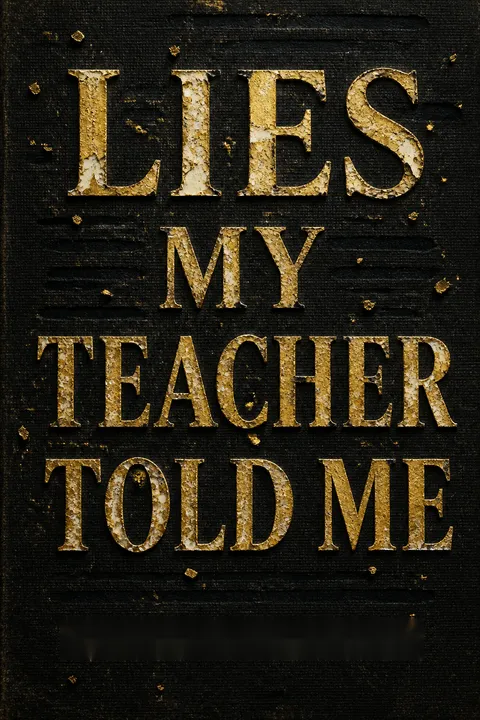


Key Takeaways
Treat the textbook as an argument, not the past itself
A polished book is not neutral. Loewen argues that standard U.S. history textbooks smooth away conflict, causes, and uncertainty while presenting national success as the natural outcome. In his 2006-07 sample, six books averaged about 1,150 pages and nearly six pounds, yet their detail often crowded out the questions that make history intelligible. Students memorized lists, then forgot them. Many never took another American history course: what high school taught became much of what they believed about the past.
The classroom stakes are civic. A course that treats history as settled facts offers little practice weighing evidence, identifying causes, or testing leaders' claims. Loewen's target is not teachers as a group. It is a system that rewards coverage and convenience over inquiry, leaving students bored and poorly equipped to judge public arguments.
What's striking is that the book treats boredom as evidence about curriculum design, not as a defect in young readers. Education research often distinguishes recall from transfer: remembering a fact is different from using knowledge in a new situation. A course organized around disputes and evidence can train that transfer. Still, textbooks are only one influence. Testing rules, class size, teacher preparation, and school resources also shape what can be taught. The critique is strongest when it targets this whole incentive system rather than assuming a single book determines civic understanding.
Give heroes their contradictions, or their lessons disappear
Icons become less useful when sanitized. Loewen calls the conversion of complicated people into spotless symbols “heroification.” Helen Keller is commonly remembered as a disabled child who overcame obstacles, while her adult life as a socialist, labor advocate, and supporter of civil liberties disappears. The familiar moral becomes hard work and personal triumph, although Keller later argued that opportunity depends partly on social conditions.
Leaders need context, too. Textbooks often praise Woodrow Wilson for idealism while omitting his segregation of federal workplaces and interventions abroad. Loewen's point is not that students must condemn every celebrated figure. It is that they should see the choices, contradictions, and collective efforts surrounding achievement. Credit for women's suffrage, for instance, belongs not only to a president but to the activists who pressured him.
A psychologically credible role model is more instructive than a flawless statue. Social learning depends on seeing choices made under constraints, including mistakes and repair. Keller's full life can also widen the idea of achievement from individual grit to changing the conditions that limit people. The caution is that correcting a flattering myth can produce a reverse caricature. A sound account preserves proportion: it neither excuses harm through historical context nor treats one failure as the whole person.
Make 1492 a turning point in power, not a first arrival
Arrival is not the whole story. Loewen argues that Columbus mattered less because he was the first person to reach the Americas than because Europe responded to his voyages with organized conquest. The Norse had reached North America centuries earlier. After Columbus, Spain sent a much larger expedition to Haiti, seeking wealth and control. Indigenous people were forced into labor and slavery, while diseases and ecological disruption devastated communities.
The encounter changed several worlds. The movement of plants, animals, diseases, people, and ideas across the Atlantic is known as the Columbian Exchange. Its effects reached Europe, Africa, and the Americas, changing food supplies, economies, and population patterns. Loewen also urges attention to possible earlier African or Phoenician voyages, but treats them as contested possibilities, not settled fact. Their value is partly in showing how textbook certainty can hide a real dispute.
The distinction between first arrival and historical consequence is a powerful causal model: events matter through what societies do with them. It also challenges the habit of awarding importance only to the person named in a familiar national story. Evidence, however, is not equally strong for every claim in this discussion. Columbus's voyages and the violence that followed are extensively documented; some proposed pre-Columbian Atlantic crossings remain controversial. Teaching both with calibrated confidence makes the argument stronger, not weaker.
Teach Thanksgiving as contact after catastrophe, not a founding picnic
The land was not empty. Before the Pilgrims established Plymouth, a 1617 epidemic had killed an estimated 90 to 96 percent of coastal New England's Native population, according to the scholarship Loewen cites. Plymouth was built at Patuxet, a Wampanoag village whose fields had already been cleared and planted. The survivors faced a radically altered political landscape, and Wampanoag leader Massasoit had reasons to seek an alliance.
Squanto was no simple side character. He had been taken from his home, enslaved in Spain, escaped, and returned to find his village devastated. His knowledge of English, local food, and diplomacy helped the newcomers survive. The familiar holiday story reduces this history to benevolent Indians rescuing grateful settlers. Loewen notes that the national Thanksgiving holiday dates to 1863, while its later association with the Pilgrims turned a complicated encounter into an origin myth.
A holiday story can teach belonging, but it can also decide whose loss counts as part of the national beginning. This example makes historical absence concrete: cleared fields, abandoned homes, and epidemic mortality shaped the settlement before the celebrated feast. A useful classroom approach is not to replace celebration with shame, but to place multiple experiences in the same account. The epidemic's precise cause and mortality estimates remain debated, so good teaching should distinguish strong evidence for catastrophic disease from uncertainty about its exact scale.
Replace the frontier line with histories of Native agency and exchange
Native societies were diverse and changing. Textbooks often place Indigenous people on one side of a moving frontier and white settlers on the other. Loewen argues that daily life involved trade, alliance, conflict, intermarriage, and cultural borrowing across a broad zone of contact. Native communities adopted and adapted European goods, while newcomers depended on Indigenous food, knowledge, guides, and diplomacy.
Change was not simply assimilation. Syncretism means combining elements from different cultures to create something new. The Plains horse culture, made possible after horses arrived from Spain, is one example. Native political ideas may also have influenced American democratic thought, though the extent of that influence is disputed. Textbooks should present such debates with evidence rather than freezing Native cultures at first contact or treating European conquest as inevitable.
This account replaces a one-way model of cultural change with interaction, selection, and adaptation. That shift matters because it recognizes Native people as political actors, not scenery in someone else's national story. It also guards against a romantic mistake: Native societies were not uniform or free from conflict, and cultural exchange could occur under severe pressure. The most durable interpretation holds both truths together: Indigenous peoples shaped the societies around them, while invasion and unequal power sharply constrained their choices.
Trace racism through slavery, Reconstruction, and the national retreat after 1877
Slavery shaped more than the South. Loewen treats racism not as a timeless prejudice but as an ideology that helped justify racial slavery and unequal power. South Carolina's 1860 secession declaration centered its grievance on the protection of slavery, despite later textbook accounts that make states' rights seem like the main cause. The institution also existed in the North, and its effects reached national politics and foreign policy.
Memory can reverse responsibility. Older accounts often depicted Reconstruction as a corrupt failure caused by Black political participation. Loewen describes how white violence and the withdrawal of federal protection helped end biracial governments. The period from roughly 1890 to 1940 brought a broader national assault on Black rights, including segregation and lynching. Textbooks may mention these events yet still leave the causes and white resistance obscure.
The key analytical move is to distinguish an unequal outcome from the system that produced it. If a course describes Black poverty or political exclusion without tracing laws, violence, and lost rights, it risks turning history into a story of individual deficiency. The same method applies beyond race: institutions distribute power, then cultural explanations can make the distribution seem natural. Loewen's emphasis on structure is useful, though it should not erase differences among regions, groups, or individual choices.
Treat class as a historical force, not a personal failure
Opportunity is shaped before effort begins. Loewen criticizes textbooks for celebrating social mobility while giving little attention to how family income affects health, schooling, college access, and work. He cites evidence that most Americans remain in the broad social class into which they were born, while textbook stories spotlight exceptional people who rose from poverty.
The omissions shape self-judgment. When a working-class student sees success presented as the reward for merit alone, unequal outcomes can look like personal failure. Loewen notes that half of the eighteen books he reviewed did not index social class or related topics. Labor history also tended to stop before recent defeats and changing working conditions. Teaching class does not require claiming that effort is irrelevant. It means examining how opportunity is distributed and how that distribution changes over time.
The distinction between effort and opportunity is central to fair explanations of achievement. In sociology, this resembles the difference between individual agency and the conditions that enable or restrict it. Making class visible can reduce shame and improve analysis without denying personal responsibility. The challenge is to avoid treating class as a single master cause. Race, gender, geography, policy, and individual decisions interact with economic position, so a useful history investigates those connections rather than swapping one oversimplification for another.
Audit official motives against actions, interests, and omitted voices
Good intentions are not an explanation. Loewen labels the standard textbook portrait of foreign policy the “international good guy” view: the United States acts to promote peace and democracy, while harmful outcomes appear accidental or are blamed on others. He contrasts that story with episodes textbooks often omit or soften, including the 1953 coup in Iran, U.S. involvement in Guatemala and Chile, and attempts to undermine Cuba's government.
Citizens also drive change. Textbooks often credit presidents and Congress for civil rights gains while minimizing the organizers who forced action. Loewen documents the FBI's surveillance and disruption of civil rights groups, alongside the movement's pressure on the government. The practical lesson is to compare public justifications with policy choices, beneficiaries, and the people who demanded change.
This is a method for reading power, not a claim that every official explanation is false. Political analysis improves when stated aims, institutional incentives, and consequences are examined separately. The same approach applies to corporations and social movements, whose public language can also obscure interests. Loewen's examples make government secrecy and citizen agency visible, but any case should be tested against documents from multiple sides. Skepticism is a discipline of verification, not an automatic verdict against authority.
Teach the recent past where today's political arguments begin
The newest history is often the least examined. Loewen finds that textbooks gave the 1960s fewer than 35 pages on average in his earlier sample, even though the decade included civil rights struggles, the Vietnam War, and political assassinations. Later books expanded coverage of the 1960s but gave little space to the 1980s, 1990s, and early 2000s, when Iraq, 9/11, and disputed elections were shaping public debate.
Vietnam shows what omission does. Textbooks often skipped defining images of the war, including My Lai and the burning of Vietnamese homes, and gave little space to why the United States entered, what the war did to civilians, or why the antiwar movement grew. Students then lacked context when politicians invoked Vietnam to argue about later wars. Recency calls for care, not silence.
The recent past is difficult because witnesses are alive and interpretations remain contested. That makes it a strong setting for teaching how evidence is evaluated, rather than a reason to postpone inquiry. Students can compare journalism, official records, testimony, and later analysis while noticing how memory changes. The limitation is that a textbook cannot responsibly settle every live dispute. It can still identify what is known, what remains uncertain, and which political claims depend on evidence that readers can inspect.
Use history to test progress, especially when the future is at stake
Improvement is not automatic. Textbooks often end by assuring students that American resilience will solve future problems. Loewen challenges this “archetype of progress,” the assumption that history moves steadily toward something better. He connects that assumption to stories of inevitable national triumph, from the dispossession of Native peoples to claims that social inequality has already been overcome.
The environment makes the question urgent. The book asks students to consider finite resources, energy use, and damage to shared ecosystems. It presents the “tragedy of the commons” as a problem in which individually sensible actions can collectively deplete a resource. Loewen argues for studying both risks and society's capacity to adapt, rather than ending with reassurance. His environmental forecasts reflect the book's 2007 horizon and should be treated as claims to investigate, not predictions guaranteed to come true.
History can illuminate how societies respond to constraints, but it cannot deliver a simple forecast. The commons model helps explain why private incentives may conflict with collective survival, while past recovery from environmental damage shows that outcomes are not predetermined. This combination supports inquiry rather than either complacency or doom. Because environmental knowledge changes, a contemporary course should pair historical examples with current scientific evidence and make clear which claims are observations, projections, or value judgments.
Train students to investigate claims, not memorize the textbook's verdict
Start with fewer questions and follow the evidence. Loewen recommends cutting the parade of disconnected topics so students can examine a smaller number in depth, using primary sources, scholarship, and local history. Sixth graders in Illinois did original research after their teacher told them that many early presidents enslaved people, a fact their textbook omitted. They wrote to the publisher and learned to read the book critically.
Ask five questions of any account:
1. When and why was it created, and for whom?
2. Whose perspective appears, and whose is missing?
3. Does the account make sense internally?
4. Do other sources support or challenge it?
5. What response does its language and imagery encourage?
These questions apply to textbooks, museum displays, films, and historical markers.
The strongest ending is a transferable method rather than a replacement canon. These questions combine source criticism, contextual reading, and attention to framing, helping students test both official narratives and counter-narratives. They also make uncertainty productive: disagreement becomes a reason to compare evidence, not a cue to stop thinking. This approach takes time and requires access to sources and skilled facilitation, so it depends on supporting teachers, not merely asking them to improvise around a flawed textbook.
Analysis
Loewen's central achievement is to make the textbook itself an object of historical study. Rather than treating omissions as accidental gaps, he connects them to adoption markets, publishing practices, classroom workload, civic rituals, and inherited racial and national stories. That systems view explains why factual corrections alone often fail: a memorable archetype can overpower a brief correction, and a curriculum built for exhaustive coverage has little room for causal argument. His narrative method is effective because it moves from familiar icons, such as Columbus, the Pilgrims, Keller, Wilson, and Lincoln, toward the conflicts those icons conceal.
The book is most persuasive when its claims rest on accessible records and well-established events: Columbus's forced labor regime, the centrality of slavery to secession, Wilson's federal segregation, or the agency of civil rights organizers. Its own argument requires a hierarchy of confidence, however. Claims about possible pre-Columbian African or Phoenician contact are not as secure as evidence for Norse settlement or European conquest. Treating these claims as equally established would reproduce the very problem the book condemns: certainty without adequate evidence. A strong reader should apply Loewen's method to Loewen, separating documented fact, interpretation, and hypothesis.
The 2007 edition also belongs to a particular moment. Its treatment of Iraq, energy, and environmental risk reflects contemporary debate and should be read as an invitation to investigate, not as timeless forecast. That qualification does not diminish its argument. The durable lesson is that democratic education requires citizens who can ask why events happened, identify who benefited, and examine which voices were excluded. History becomes relevant not by supplying patriotic comfort or moral denunciation, but by making the present's inherited choices visible and contestable.
Review Summary
Lies My Teacher Told Me receives mixed reviews, with many praising its eye-opening critique of American history textbooks and education. Readers appreciate the book's exposure of historical inaccuracies and omissions, finding it thought-provoking and important. Some criticize Loewen's repetitive style and perceived liberal bias. Many reviewers note the book's impact on their understanding of history and education, though some find it depressing or overwhelming. Overall, readers value the book's challenge to conventional historical narratives and its call for more critical thinking in history education.
People Also Read





Glossary
heroification
Sanitizing historical figuresLoewen's term for the process of turning complicated historical people into spotless, inspiring symbols. Textbooks and educational media remove conflicts, failures, and controversial beliefs, leaving a simplified moral lesson. The result can make figures such as Helen Keller and Woodrow Wilson less human and less useful as role models, while obscuring the people and movements that shaped events.
Columbian Exchange
Atlantic-world transfer of lifeHistorian Alfred W. Crosby's term for the large-scale exchange of plants, animals, diseases, people, and ideas between the Americas and the rest of the world after 1492. Loewen uses it to emphasize that Columbus's voyages transformed societies on both sides of the Atlantic, not only the Indigenous communities that faced conquest, forced labor, and new diseases.
syncretism
Cultures combining into something newThe blending of elements from two or more cultures to create new practices, institutions, or forms of life. Loewen uses the term to describe cultural change as a process of borrowing and adaptation, rather than a one-way passage from supposedly primitive to advanced. The development of Plains horse cultures after horses arrived from Spain is one example in the book.
cognitive dissonance
Resolving conflict between belief and actionA social-psychological theory, associated with Leon Festinger, describing the discomfort people experience when their beliefs conflict with their actions. Loewen applies it to historical actors who changed their views of people they exploited, and to societies that revise the past to make unjust policies seem acceptable. It helps explain how conduct can shape ideology, not only the reverse.
sasha
The living-dead pastA Kiswahili term Loewen borrows for people and events that remain within living memory. They are not simply distant ancestors because people still alive may remember, discuss, or have participated in them. Loewen argues that textbooks often treat this recent past cautiously because it is politically contested, even though students need it to understand current affairs.
zamani
The distant ancestral pastA Kiswahili term Loewen uses for the more distant past, whose people are remembered as generalized ancestors rather than as living contemporaries. He contrasts it with the sasha, the past still within living memory. In his account, textbooks more readily present the zamani with confident, settled narratives, while they often compress or avoid contentious recent events.
international good guy view
America as benevolent world actorLoewen's label for a textbook narrative in which U.S. foreign policy is presented mainly as a response to humanitarian crises and a defense of democracy. Harmful outcomes tend to be described as misunderstandings, accidents, or responses to chaos. The label contrasts with analysis that examines national interests, corporate influence, covert action, and the perspectives of people affected.
archetype of progress
History as automatic improvementLoewen's name for the assumption that societies steadily become better simply through the passage of time and continued development. In textbooks, this often appears as an upbeat national story in which past injustice is treated as a temporary obstacle already overcome. Loewen argues that this framing can conceal setbacks, environmental limits, and persistent inequality.
historiography
Study of how history is writtenThe examination of how historical accounts are produced, including who created them, when, for which audience, and from what social position. Loewen recommends historiography as a practical reading method: students can compare viewpoints, identify omitted voices, test claims against other sources, and see how interpretations change as society changes.
social stupidity
Poor reasoning about societyLoewen's use of Jules Henry's phrase for illogical thinking about social life. He argues that students can complete years of history instruction yet struggle to explain inequality, assess political claims, or connect past causes to present conditions. The term describes an educational outcome, not a lack of intelligence: rote learning can leave people without practice analyzing evidence and social structure.
FAQ
What's Lies My Teacher Told Me about?
- Critical Examination of Textbooks: The book critiques American history textbooks for inaccuracies and omissions, arguing they often present a sanitized version of history.
- Focus on Marginalized Voices: It emphasizes the importance of including perspectives from Native Americans, African Americans, and other marginalized groups to provide a comprehensive understanding of history.
- Impact on Education: Loewen discusses how these narratives affect students' understanding of their identity and society, advocating for a more honest portrayal of history.
Why should I read Lies My Teacher Told Me?
- Engaging and Accessible: Loewen writes in a style that makes complex historical issues understandable, encouraging critical thinking.
- Challenging Assumptions: The book prompts readers to question the narratives taught in school, promoting a nuanced understanding of American history.
- Cultural Relevance: Understanding true history is crucial for addressing contemporary social issues like racism and inequality.
What are the key takeaways of Lies My Teacher Told Me?
- Textbook Bias: Many textbooks present a biased, one-dimensional view of history, leading to misunderstandings.
- Importance of Diverse Perspectives: Including diverse perspectives, especially from marginalized groups, enriches the historical narrative.
- Consequences of Miseducation: Inaccurate teaching perpetuates stereotypes and alienates minority groups, hindering critical thinking.
What are the best quotes from Lies My Teacher Told Me and what do they mean?
- “Those who don’t remember the past are condemned to repeat the eleventh grade.”: Highlights the importance of learning from history to avoid ignorance.
- “History is the polemics of the victor.”: Suggests history is often written by those in power, leading to biased narratives.
- “The past is not dead; it is not even past.”: Emphasizes the ongoing relevance of history in shaping contemporary society.
How does Lies My Teacher Told Me address the teaching of Christopher Columbus?
- Myth vs. Reality: Loewen critiques the heroic portrayal of Columbus, highlighting the violent consequences of his voyages.
- Historical Context: Columbus's actions are placed within the broader context of European colonization and exploitation.
- Call for Honest Education: Advocates for a balanced portrayal of Columbus, discussing both achievements and atrocities.
What does Lies My Teacher Told Me say about the first Thanksgiving?
- Misrepresentation of Events: The traditional narrative is overly simplistic, ignoring the complex relationships between Pilgrims and Native Americans.
- Role of Native Americans: Highlights contributions of Native Americans, often downplayed in the narrative.
- Cultural Significance: Critiques Thanksgiving as a national myth that obscures historical realities of colonization.
How does Lies My Teacher Told Me discuss the impact of slavery on American history?
- Central Role of Slavery: Slavery is a foundational aspect of American history, shaping social, economic, and political landscapes.
- Racism as a Legacy: Discusses how slavery's legacy of racism and inequality persists in society.
- Critique of Textbook Narratives: Textbooks often sanitize slavery, failing to convey its brutality and inhumanity.
What does Lies My Teacher Told Me reveal about the portrayal of Native Americans in textbooks?
- Stereotypical Representations: Textbooks often depict Native Americans in one-dimensional, stereotypical ways.
- Omission of History: Highlights the lack of coverage regarding Native American history and contributions.
- Need for Inclusive Narratives: Calls for inclusion of Native perspectives to enrich the educational experience.
How does Lies My Teacher Told Me address the issue of racism in American history?
- Racism as a Central Theme: Racism is a pervasive theme that textbooks often downplay or ignore.
- Historical Context of Racism: Discusses how racism has evolved, particularly in relation to slavery and Native American treatment.
- Call for Critical Engagement: Encourages critical engagement with the history of racism to foster a more equitable society.
What are the implications of Lies My Teacher Told Me for modern education?
- Need for Curriculum Reform: Advocates for reform to include more accurate and diverse perspectives in history education.
- Encouraging Critical Thinking: Emphasizes teaching students to think critically about historical narratives.
- Empowerment through Knowledge: A more honest portrayal of history empowers students to engage with societal issues.
How does Lies My Teacher Told Me suggest improving history education?
- Incorporate Multiple Perspectives: Advocates for including diverse perspectives, especially from marginalized groups.
- Encourage Critical Thinking: Promotes critical thinking and analysis of historical narratives.
- Address Contemporary Issues: Connects past events to current social issues, enhancing relevance.
How does Lies My Teacher Told Me relate to current social issues?
- Connection to Modern Racism: Draws parallels between historical racism and contemporary issues, emphasizing the importance of understanding the past.
- Impact on Civic Engagement: A well-rounded understanding of history can lead to greater civic engagement and activism.
- Encouraging Social Responsibility: Encourages students to challenge injustices and take responsibility for their role in society.
Download PDF
Download EPUB
.epub digital book format is ideal for reading ebooks on phones, tablets, and e-readers.








