

Key Takeaways
Leave descendants more than dates: record the questions that shaped your choices.
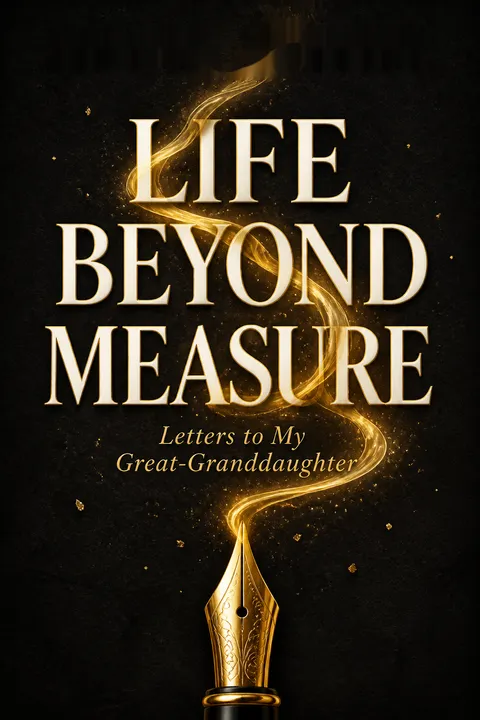
A family in one room. Poitier begins with the scene that inspired the book: at nearly eighty, he meets his newborn great-granddaughter, Ayele, with three generations of women gathered around her. He knows she may not remember him, and he knows his own picture of his grandparents is only a fragment. So he writes not a polished life story, but letters about his doubts, mistakes, beliefs, and unfinished questions.
At Ayele’s Ghanaian Outdooring ceremony, he lifts her toward the sky, then lowers her to the earth, as family members accept responsibility for guiding her. The ritual makes inheritance active: the elders are not only remembered, they are entrusted with the child.
What's striking is the choice to pass on uncertainty as well as achievement. Family stories often become tidy origin myths, but a record of doubt gives descendants something more usable: evidence of how a person revised a view, endured embarrassment, or changed course. This resembles oral history at its best, where memory preserves not only events but the meanings people made from them. Memory is also selective, and a loving narrator can soften conflict or forget inconvenient detail. The value is not that a family letter becomes an objective archive. It is that it gives later generations a starting point for questions they can test against other voices and records.
Chance opened Poitier's life, but his parents' values helped him meet it.
A fragile beginning. Poitier was born more than two months premature in Miami in 1927, weighing about three pounds. Racism made a hospital an unlikely option, and the family had no incubator or modern medical support. His father went to prepare for a burial. His mother refused to accept that outcome, sought help, and returned with a prediction from a local spiritual adviser that the child would survive and travel widely.
Poitier does not claim to know whether the prediction was supernatural or whether events later made it seem true. He credits his survival to many forces, including his mother’s determination, his parents’ care, and the natural world of Cat Island. Their lives were materially limited, but their integrity and mutual devotion became a durable inheritance.
The story resists the easy distinction between fate and personal agency. A belief can shape behavior even when its supernatural explanation cannot be verified: his mother’s confidence sustained hope and action during an acute crisis. In psychology, expectations can influence persistence, though they cannot guarantee outcomes. The account is strongest when it leaves the cause open rather than treating survival as proof of prophecy. It also makes a larger point about biography: outcomes are rarely self-made. Family, institutions, historical conditions, luck, and individual decisions combine, often in ways no one can fully reconstruct.
Reject other people's verdict on your worth, then build the skills to answer.
A door slammed shut. As a young dishwasher in Harlem, Poitier saw a notice seeking actors and went to audition, despite struggling to read aloud. The director dismissed him and told him to return to dishwashing. Poitier took the insult as a judgment about his human value, not merely his acting ability, and decided to prove the judgment wrong. He later gained a place at the American Negro Theatre by offering to work as a janitor in exchange for classes.
A waiter at another restaurant noticed his difficulty with reading and offered to teach him after shifts. That quiet generosity helped him improve a skill his acting ambitions required. His path was not confidence alone: it combined self-respect, persistence, a willingness to accept help, and deliberate learning.
This is a vivid account of agency under class and racial constraint, not a claim that determination erases structural barriers. Self-respect can protect a person from internalizing a degrading judgment, while skill-building creates a practical response to it. The waiter’s role matters as much as Poitier’s persistence: opportunity often arrives through relationships, not solitary grit. There is a useful distinction here between rejecting a verdict and rejecting feedback. The director’s humiliation was not constructive, but the underlying weakness in reading was real, and Poitier addressed it. Resilience works best when dignity and accurate self-assessment reinforce each other.
Keep necessities ahead of appetite before money's current pulls you under.
Fifteen dollars in New York. At sixteen, Poitier arrived with little money, found dishwashing work, and sometimes slept in a bus station or on a rooftop. He eventually rented a room for five dollars a week, yet still struggled to cover food, clothing, and transportation. Small pleasures, such as a movie or a malted drink, regularly competed with rent and other essentials. He describes this unstable pull between what money must cover and what he wants as a channel that can carry a person off balance.
Later, even when he earned more, money remained precarious. His practical lesson is to learn how finances work, meet basic obligations first, and define personal worth independently of income. Money matters, but it becomes dangerous when it becomes the measure of a person.
Poitier’s account makes financial advice concrete by showing how a tiny discretionary purchase can matter when income is low and irregular. Behavioral economics describes a related pressure: scarcity consumes attention, making immediate relief more compelling than future security. That is not simply poor character; it is partly a response to constrained options. A budget can help, but it cannot substitute for stable wages, housing, or social protection. The useful lesson is therefore twofold: build habits that protect necessities where possible, and avoid moralizing people whose financial margin is too narrow to absorb ordinary shocks.
Courage means choosing which line matters when fear makes every option costly.
A role he refused. During a period of unemployment, Poitier was offered a film role he badly needed. The script required him to play a father who failed to respond after criminals killed his daughter. As a father himself, he could not accept the part. Turning it down left him with a hospital bill of $150 for his daughter’s birth, which he covered by borrowing against his furniture. He did not present the choice as heroic, only as necessary to remain true to himself.
His public examples include Nelson Mandela, Thurgood Marshall, Jackie Robinson, and Paul Robeson, people who faced threats, exclusion, or reputational harm while taking a stand. Poitier’s point is not that fear disappears. Courage is deciding what one can live with when fear is present.
The story helps distinguish courage from fearlessness. Moral psychology often treats courage as action in the presence of risk, guided by a value judged more important than immediate safety or reward. Poitier’s refusal also shows that integrity can carry real economic costs, so the choice should not be romanticized as universally available. A person supporting dependents may reasonably make a different decision. The deeper question is how to identify which compromises preserve life and which corrode self-respect. His admired figures make the stakes public, while his own choice shows that moral agency can also appear in a private negotiation over work.
Notice when a pleasure starts setting your schedule, spending, or sense of control.
Small habits, larger hold. Poitier began smoking in the army to fit in, eventually reaching two or three packs a day. He gambled on cards and horse races, sometimes losing more than he could comfortably spare. One night, after losing $10,000 in Nassau, he imagined how many young relatives that money could have helped educate and decided to stop gambling. He later tested that decision in Las Vegas by carrying casino chips without playing.
He also noticed himself anticipating wine at a particular hour and stopped drinking. A frightening search for discarded cigarette butts showed him how tightly smoking had taken hold. These stories trace a gradual shift: a behavior first feels social or pleasurable, then begins to claim attention and resources. Poitier urges readers to notice that transition early.
The book offers unusually candid self-observation, especially in the image of searching the trash for cigarette ends. Modern addiction science adds an important nuance: dependence involves learning, brain reward systems, stress, and social context, not merely a weak decision. A decisive personal commitment can help some people, but many need medical care, counseling, or community support. Poitier’s account is most useful as an invitation to monitor consequences without waiting for catastrophe. When a behavior repeatedly overrides prior intentions, that pattern deserves attention and support, not just shame.
Choose love with open eyes, then keep it alive through daily care.
Romance is not a blueprint. Poitier describes his first marriage to Juanita as lasting eighteen years and bringing four daughters, while also acknowledging that neither partner understood what marriage would demand. They entered with an idealized picture, but had not carefully examined their compatibility, expectations, finances, or approach to raising children. Love mattered, but it could not answer every practical question for them.
His later marriage to Joanna grew from a different fit. Their temperaments differed, giving them more to discuss, and their relationship endured for decades. Poitier highlights a simple practice in their household: saying love aloud in ordinary moments, not saving affection for grand occasions. He also treats love as broader than romance, encompassing family, friendship, compassion, art, causes, and care for other living things.
The contrast between the marriages supports a useful distinction between affection and relationship skill. Research on close relationships often emphasizes communication, expectations, and the ability to repair conflict, rather than attraction alone. Poitier’s emphasis on expressing love is a reminder that care must be legible to the person receiving it. Still, his account is personal, not a universal formula: shared values, circumstances, and timing also shape whether a partnership lasts. The strongest advice is to replace fantasy with inquiry. Ask what each person expects of money, family, work, responsibility, and conflict before treating intensity as evidence of compatibility.
Create an inner neutral zone where attention can recover from turmoil.
A place to pause. Poitier calls a neutral zone an intentional inner refuge where a person can quiet the pressure of obligations and outside information, notice breathing and sensation, and choose what to think about without immediately judging everything. He develops the idea while describing a persistent inner turmoil that follows him at work, in solitude, and even during supposedly relaxing moments.
The proposal is not to deny problems or permanently withdraw from the world. It is to create a temporary pause, then return with greater focus. Poitier imagines entering this space at will, resting attention, and exploring a question only when ready. His childhood memories of sitting by the sea on Cat Island provide the model: solitude in nature once gave him room to listen and think.
The neutral zone resembles contemplative practices that train attention to notice thoughts without being immediately governed by them. That can create useful distance between a stimulus and a response, especially in a life crowded by news and devices. The idea is compelling as a personal practice, though Poitier presents hoped-for benefits rather than clinical evidence. A quiet pause may support reflection, but it is not a substitute for treatment when anxiety or distress becomes disabling. The image also usefully distinguishes rest from avoidance: a refuge is valuable when it restores the capacity to re-engage.
Use reason to test claims while leaving room for unresolved mysteries.
Practical reasoning, not credentials. Poitier’s father, Reggie, noticed that soil near caves enriched with bat droppings produced better tomatoes. He tested the observation on a small scale, saw the results, and found a way to carry the fertilizer to his fields using sacks and animals. He had little formal education, but experience, observation, and trial gave him a practical method for solving problems.
Poitier applies a similar questioning spirit to religion. His mother’s faith sustained her, while he remains unsure whether God exists and resists treating any human account as final proof. He argues that science and faith need not be enemies, provided neither is used to end inquiry. The practice is to distinguish what can be tested from what remains a genuine mystery.
The father’s farming story captures a core feature of scientific thinking: observe, test, compare, and revise. Formal education can strengthen that practice, but curiosity and disciplined attention are not exclusive to institutions. Poitier’s theological openness is also valuable as a model of intellectual humility. A caveat is necessary, however: his speculation that logical ability travels through generations as an inherited force is not established by the examples he offers. Separating a moving hypothesis from reliable evidence does not diminish the narrative. It makes the book’s central habit of questioning more rigorous.
Make scientific power answer to ethics, especially when its consequences reach everyone.
Invention moves faster. Poitier contrasts the rapid arrival of technologies such as cars, television, and computers with the slower pace of social change. A society may gain the ability to communicate instantly or build destructive weapons without resolving racism, inequality, or conflict. Scientific capacity alone does not determine whether a tool serves human beings well.
He traces war to the survival instinct and the pursuit of power, while insisting that people can direct their fighting energy toward better purposes: treating disease, relieving hunger, and opposing injustice. He urges readers to question official claims that war is necessary and to demand accountability from leaders. His examples of courageous public figures show that ethical judgment is not separate from history; it can help change what institutions permit.
This distinction remains useful in debates about emerging technologies: technical feasibility is not the same as social wisdom. Innovations diffuse through institutions that distribute benefits and risks unevenly, so public oversight and ethical deliberation matter alongside engineering. Poitier’s warning about war also highlights how fear can narrow debate and make extraordinary uses of force seem inevitable. Yet treating conflict as a fixed expression of human nature risks understating the role of political choices and institutions. His call to scrutinize power supplies the corrective: survival instincts may be old, but the policies built around them are made by people.
Protect clean air, water, and soil as shared conditions of survival.
The natural world is not endless. Poitier remembers Cat Island as a place where families relied on clean air, well water, fertile land, and the sea for food. Those resources seemed dependable, but he argues that industrial pollution, shrinking water supplies, damaged soil, and growing consumption make that assumption unsafe. Environmental damage is not an abstract concern: it threatens the systems that produce food, sustain health, and support other species.
He recommends both personal conservation and public pressure. Turning off unused appliances, using energy efficiently, and consuming water carefully are useful beginnings. He also urges people to challenge companies that pollute air and waterways, even when doing so carries economic costs. Protecting nature requires more than private virtue; it requires choices about what society permits and rewards.
The book’s strongest environmental insight is that human welfare depends on systems no individual can replace. This is a classic collective-action problem: people benefit from shared resources, while the costs of depletion can be delayed or shifted onto others. Household conservation can help build norms, but large-scale change also depends on regulation, infrastructure, and corporate accountability. Poitier’s language reflects the environmental concerns of his time, and individual forecasts should be read in that historical context. The enduring principle is clearer than any prediction: economic activity is not truly successful if it undermines the ecological conditions on which life depends.
Analysis
Life Beyond Measure is best understood as a memoir arranged around a relationship, not as a conventional career narrative. Poitier addresses a great-granddaughter who is too young to remember their first meetings, turning autobiography into an act of intergenerational presence. The form gives the book its central tension: he wants to offer guidance without claiming that his answers should become hers. Stories of survival, racial exclusion, precarious work, love, addiction, and public courage become occasions to show how a person thinks under pressure.
The strongest material is concrete and morally complex. A boy who has never seen his reflection finds a mirror in Nassau. A teenager reaches New York with fifteen dollars, learns to read from a waiter, and is rejected from a theater before finding a way inside. A successful actor refuses a role that violates his idea of fatherhood, despite needing the money. These episodes make principles memorable because they show their cost. His parents provide the book’s ethical center: people with little formal schooling whose practical intelligence, care, and self-command shape their son’s account of himself.
The book is less reliable when it moves from lived experience to sweeping claims about evolution, inherited reason, God, or the inevitability of war. Poitier often signals uncertainty, which is a strength, but some speculative explanations still sound more settled than the evidence allows. His environmental and technological predictions also belong to the book’s 2008 moment, not a current scientific assessment. They should be read as evidence of his concern, not as up-to-date forecasts.
That limitation helps clarify the book’s real achievement. It does not deliver a unified philosophy so much as model an ethical method: preserve memory, question authority, acknowledge uncertainty, examine consequences, and keep learning. Its enduring argument is that a life gains depth when its private choices remain connected to family history and shared human problems. The title’s measure is not fame or wealth, but the effort to live attentively, with room for wonder and responsibility.
Review Summary
Life Beyond Measure is a well-received memoir by Sidney Poitier, written as letters to his great-granddaughter. Readers appreciate Poitier's wisdom, humility, and inspirational life story. Many found his accounts of growing up in the Bahamas particularly fascinating. The book offers insights into Poitier's career, philosophy, and experiences with racism. While some readers felt certain sections were slow or overly philosophical, most praised Poitier's eloquence and the unique format. The audiobook, narrated by Poitier himself, received special commendation for his soothing voice.
People Also Read





Glossary
Outdooring
A child’s public welcomeA Ghanaian naming and welcome ceremony in which a newborn is formally presented to family and community. In Poitier’s account, the child is named, lifted toward the sky, and brought down to touch the earth. Those gathered accept a role as elders who will help protect and guide the child.
the channel between want and need
Financial pressure between desire and essentialsPoitier’s metaphor for the difficult effort to balance limited money between necessities, such as rent, food, and transportation, and discretionary wants. He uses it to describe how easily small pleasures can consume money needed for stability, especially when income is low, uncertain, and insufficient to cover basic expenses.
neutral zone
An inner refuge for attentionPoitier’s proposed mental space for temporarily stepping back from pressure and turmoil. In this zone, a person notices breathing and surroundings, quiets habitual judgment, and chooses where to direct attention. It is intended as a restorative pause that makes reflection and renewed engagement possible, not as denial of problems.
good wars
Struggles serving human welfarePoitier’s term for sustained efforts that oppose suffering rather than pursue domination. Examples include medical research, relieving hunger, helping people affected by disasters, and resisting injustice, hatred, and bigotry. The term recasts the energy of struggle as something that can be directed toward protecting vulnerable people and improving shared life.
Download PDF
Download EPUB
.epub digital book format is ideal for reading ebooks on phones, tablets, and e-readers.








