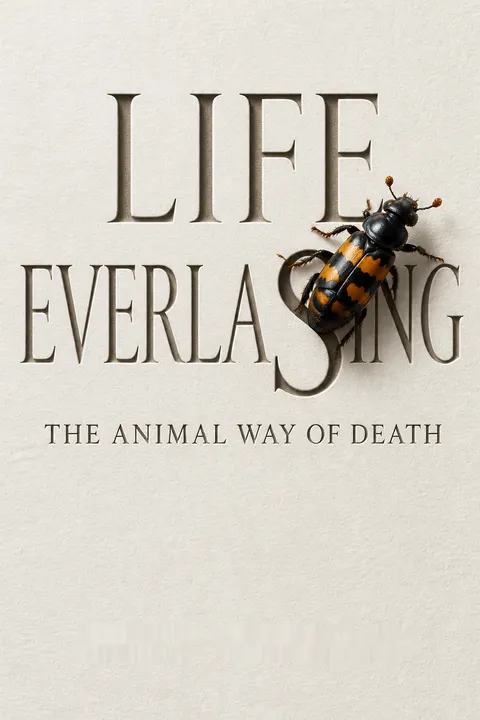


Key Takeaways
Treat death as a transfer of life, not an exit from it.
Bodies become other bodies. The book’s central claim is that death does not remove an organism from life’s web. It makes nutrients available to other organisms. Ravens spread pieces of deer through a forest; bacteria and fungi break down what remains; plants absorb the resulting chemicals and build new tissue. Even carbon dioxide released during decay can become part of a plant. These transfers happen at different speeds and scales, from a scavenger carrying a chunk of meat to microbes processing molecules in soil.
Matter cycles; lineages persist. The DNA passed between generations is not the same thing as the physical matter recycled after death. One is copied through descent, while the other is repeatedly taken apart and reused. Together, these processes connect individual lives to a much longer biological history.
The distinction between recycled matter and inherited information sharpens the book’s argument. A body can be dismantled while a lineage continues through descendants, and both forms of continuity are observable without making claims about a personal afterlife. This is a useful way to bring mortality into ecological thinking: an individual ends, but its materials enter new relationships. The idea also resists a comforting oversimplification. Recycling is not personal survival in disguise. It is a real, consequential continuity, but it does not establish that consciousness persists after death.
Read every carcass through its size, temperature, and season.
There is no single cleanup crew. The animals and microbes that use a carcass depend on its size, condition, location, and the weather. In a warm Maine summer, flies can lay eggs quickly, and their larvae may overwhelm larger scavengers. A deer carcass left in the heat drew thousands of botflies, while ravens and vultures hesitated. In winter, insects become inactive and cold can preserve meat, making mammals and ravens the main consumers.
Roles overlap. A predator may eat an animal it did not kill, while an herbivore can consume vulnerable animal life. On a large carcass, coyotes may open the hide, birds take accessible meat, maggots and beetles use what remains, and bears or rodents may finish the bones. The sequence is flexible, with one crew often creating access for another.
This layered account resembles ecological succession: communities change as conditions and resources change. The carcass is not a static object but a temporary habitat whose temperature, size, and microbial state alter who can use it. That perspective helps explain why removing a single group can affect more than one link in a food web. Still, a sequence should not be mistaken for a fixed natural order. The author’s own observations show that weather, access, and chance can redirect the process, so local conditions matter more than a universal checklist.
Look closely: tiny undertakers solve problems we barely notice.
Burying beetles turn carrion into a nursery. Beetles in the genus Nicrophorus locate small dead animals, move them to workable soil, and bury them as food for their young. A pair strips fur or feathers, shapes the carcass, and applies secretions that slow bacterial and fungal growth. The female lays eggs nearby; both parents may feed the larvae before they can eat independently. A mouse can support a dozen or more young beetles.
Observation changes the story. Heinrich watched beetles struggle to move a shrew across hard-packed ground. They could not bury it until he moved it to softer soil. He also found that beetle numbers, mating, and competition varied with carcass size and conditions. The behavior was more complex than a tidy tale of one faithful pair claiming one prize.
The beetles make visible a principle often missed in human-centered accounts of intelligence: sophisticated behavior need not resemble ours. Coordinated transport, chemical preservation, and parental care can arise without human-style planning. The author’s careful watching also demonstrates the value of natural history, especially when experimental conditions reveal a practical constraint such as soil hardness. At the same time, interpreting apparent coordination as shared knowledge requires caution. Observed outcomes can suggest capacities, but they do not by themselves reveal what an insect perceives or intends.
Human intelligence grew from the demands of finding and processing meat.
Tools changed access to food. The book examines whether early humans began mainly as hunters or scavengers, and argues that the distinction is not simple. A small hominid arriving at a carcass might have had to compete with powerful predators; sharp stone tools could make meat accessible and help defend it. Spears, endurance, cooperation, and communication could also make hunting possible. The author connects access to energy-rich animal food with the costs of a larger brain, which uses a substantial share of human energy.
The evidence is suggestive, not final. Ancient spears, butchered animal remains, and stone tools show that early humans processed large animals. The author also discusses the possibility that human hunting contributed to the disappearance of mammoths, mastodons, and other megafauna. The timing and causes of these extinctions remain debated, so the book presents a strong interpretation rather than a settled verdict.
The argument links technology, diet, cooperation, and cognition as parts of one evolutionary problem: acquiring and controlling concentrated food. That systems view is more revealing than treating tools or large brains as isolated breakthroughs. It also invites a careful distinction between a plausible mechanism and a demonstrated cause. Archaeological traces can establish that people processed animals, but reconstructing the relative importance of hunting, scavenging, climate, and other pressures is harder. The book is most persuasive when it frames human evolution as ecological entanglement rather than a simple march toward mastery.
Our industrial appetite now removes the very recyclers ecosystems rely on.
Human use has become a bottleneck. The book describes people as powerful recyclers, but not necessarily beneficial ones. Farming, industry, and population growth redirect large amounts of biological material and ancient fossil carbon toward human use. Meanwhile, habitat loss and poisoning reduce the animals that once processed carcasses. In Asia, the drug diclofenac given to livestock caused kidney failure in vultures that ate treated animals. The book reports that population modeling could explain severe declines even if only one in 760 carcasses carried the drug.
A small contamination can have wide effects. Removing carcasses or poisoning them can deprive scavengers of food and disrupt services that people rarely notice until they fail. The author argues that continued growth and untested chemicals impose costs beyond the immediate human benefit. His conclusion is not that people should stop using resources, but that ecological limits must shape how much is taken and what is left behind.
This is an argument about externalities: a product can deliver a local benefit while exporting harm through a food web. The vulture example makes that abstraction concrete, since a treatment intended for livestock can affect a scavenger far beyond the farm. It also suggests why environmental risk assessment needs to include indirect exposure and species interactions. The book’s broad indictment of growth is compelling as a warning, though it leaves difficult policy questions open. Limits must be translated into choices about access, responsibility, and who bears the costs of restraint.
Leave dead wood in forests; it is habitat, nursery, and soil.
A fallen tree keeps working. Insects bore into dead or weakened wood, fungi and bacteria break it down, and other insects feed on the first arrivals. Standing dead trees provide food and nesting sites; the book notes that more than a third of forest bird species depend on them in some way. After a trunk falls, moss can hold moisture, and seedlings such as yellow birch can take root above the leaf litter, where small seeds have a better chance of reaching light.
Decay builds the next forest. Fungi and soil organisms release nutrients, including nitrogen, and help create humus that holds water. Removing dead trees and leaves can interrupt these processes. A long-term study of 530 decaying logs in Oregon’s Cascade Mountains was already showing that fallen wood contributes more to forest health than some conventional assumptions allowed.
Dead wood is a good example of infrastructure that looks like waste when judged only by immediate appearance. Its value is distributed across time: a log can shelter organisms, support seedlings, and slowly replenish soil. This resembles the idea of natural capital, where ecosystems provide functions that are difficult to replace once lost. Forest management need not leave every fallen trunk untouched, since safety, fire risk, and timber use can matter. But treating all decay as untidiness erases habitat and nutrient processes that a replanted tree cannot quickly reproduce.
Trace nutrients across boundaries, from elephant dung to salmon rivers.
Waste is a food source. In Kenya, Heinrich and his colleagues counted about 3,800 dung beetles arriving at half a liter of fresh elephant dung in fifteen minutes. Some beetles eat at the pile; others bury dung or roll it away to feed their young. Their work aerates and fertilizes soil, while reducing the time dung remains exposed. An Australian project introduced dung beetles suited to cattle dung, helping reduce persistent cowpats and the bush flies breeding in them.
Animals move nutrients between worlds. Salmon feed in the Pacific, then return to rivers to spawn and die. Bears, birds, and other scavengers carry their nutrients into surrounding forests, where nitrogen can limit plant growth. Salmon bodies therefore link ocean productivity to terrestrial forests, just as dung beetles turn animal waste into soil resources.
These examples show that ecosystems are connected not only by who eats whom, but also by transport. A migrating animal carries nutrients across a boundary that plants, soil, and water alone might not cross in the same way. This perspective is valuable in conservation because protecting a species can also preserve a flow of resources and the communities that depend on it. Yet interventions such as introducing beetles require care. Australia’s project worked in the account given here, but introducing a species can create risks that must be evaluated rather than assumed away.
A whale fall can support a deep-sea community for decades.
A carcass can become an island. When a whale sinks to the ocean floor, its soft tissues attract sharks, hagfish, crabs, and other scavengers. After the flesh is gone, organisms colonize the bones. Bacteria use fats within them, and other species feed directly or indirectly on the resulting compounds. Scientists have identified more than 400 kinds of larger animals associated with whale falls, and the bone-based stage can continue for years or even decades.
Not all remains return quickly to life. Tiny marine plankton leave calcium-rich skeletons that accumulate into chalk and limestone. These deposits preserve traces of ancient organisms and store carbon over geological time. The contrast is striking: a whale carcass can sustain a temporary community, while microscopic bodies can help shape land and influence the atmosphere long after their organisms have disappeared.
Whale falls challenge the assumption that ecosystems require sunlight at every level. Their communities depend on stored chemical energy in the carcass and on organisms able to use the compounds released from it. They also demonstrate how one large event can create habitat in an otherwise sparse setting. The geological example extends the same idea across a much longer timescale. These cases do not make every death equally productive, but they show that ecological value can emerge from remains in forms and places invisible to ordinary observation.
Life continues through bodies, genes, metamorphosis, and inherited ideas.
Transformation can be radical. A sphinx moth begins as a caterpillar and later emerges as a flying adult. During the pupal stage, much of the larval body is broken down; groups of cells called imaginal disks help organize the adult form. This is more than gradual enlargement: the two stages occupy different ways of living, even though they belong to one life cycle. The book also describes DNA as a long chain of inheritance, copied and altered across generations.
People pass on more than genes. Heinrich traces his running development to encouragement from Lefty Gould, a war veteran who treated a struggling schoolboy as capable. The relationship became part of Heinrich’s later life. Mentors, skills, and memories can therefore continue in other people, though this cultural inheritance is not the same as a body or a mind surviving death.
The connection between biological development and cultural inheritance is evocative because both involve transformation through what came before. Yet the analogy has limits. Cells are reorganized through physiological processes, while ideas persist through memory, teaching, and institutions. Those pathways can be fragile, selective, and changed by each recipient. The distinction makes the claim stronger, not weaker: a person’s influence can be real and enduring without being confused with literal reincarnation. The moth shows continuity within a body; the mentor story shows continuity between people.
Choose a farewell that returns your body to living systems.
Disposal is also a cultural choice. The book opens with a friend asking about a natural burial and follows that request into the ecology of death. Conventional U.S. burials, as described in the book, use large quantities of hardwood, steel, concrete, and embalming fluid each year. Cremation also consumes fuel and produces emissions. Green burial offers an alternative that avoids some of these materials and allows the body to decompose more naturally, subject to local rules and available practices.
Rituals express a picture of life. Ancient Egyptians associated the emerging dung beetle with renewal and included scarab imagery in burial practices. Tibetan sky burial, as described in the book, uses birds to help dispose of human remains. These customs differ, but both make a relationship between death and the living world visible. The author favors a simple sendoff in the woods, not as proof of an afterlife, but as an acknowledgment of ecological connection.
Funeral choices sit at the intersection of personal grief, public health, law, land use, and environmental impact. The book’s strongest contribution is to make those choices discussable without treating any one ritual as universally right. A natural burial may fit a person’s values and place, while others may need or prefer different arrangements. Practical details also matter: legal requirements and land conditions vary. The deeper question is whether a society can make room for rituals that recognize bodies as biological material without reducing the dead to a disposal problem.
Analysis
Life Everlasting is best understood as natural history organized around a moral and ecological proposition: death is not outside life’s system, but one of the processes that keeps it functioning. Heinrich moves from beetles burying mice to scavengers sharing a deer, from forests recycling fallen trunks to salmon carrying ocean nutrients inland, and finally to the human rituals used to separate bodies from nature. The structure is expansive rather than strictly linear. Each observation serves as a new scale of evidence for the same connectedness.
The book’s distinctive strength is its mixture of patient field observation and large historical questions. A beetle failing to bury a shrew on hard soil becomes a lesson in how small environmental constraints shape reproductive success. A whale skeleton becomes evidence that an apparently empty deep sea can contain a specialized community. These stories make ecological processes memorable because they are narrated as events, not just diagrams. They also resist the sentimental division between beautiful life and disgusting decay: both are part of the same material circulation.
The argument is strongest when it describes observed mechanisms, such as scavenger succession, dung beetle behavior, or forest decomposition. It is more tentative when it infers ancient human motives, proposes explanations for salmon mortality, or connects particular extinctions to hunting. Those interpretations are useful hypotheses, but the evidence does not always settle among competing causes. The book’s distinction between material continuity and personal survival is also important. Ecology can show how bodies and genes persist through other forms of life; it cannot establish that individual consciousness continues.
The result is not simply a case for natural burial. It is a challenge to imagine humans as participants in ecological exchange rather than exceptions to it. That challenge carries practical force, especially where industrial systems remove carcasses, poison scavengers, or consume fossil resources without accounting for distant effects. The book’s enduring invitation is to look closely at what happens after apparent endings, then make human choices with those connections in view.
Review Summary
Life Everlasting explores the natural processes of death and decomposition in the animal world. Heinrich's detailed observations and personal anecdotes illuminate the crucial role of scavengers and decomposers in recycling nutrients. While some readers found the book fascinating and thought-provoking, others felt it lacked structure or strayed from the expected content. Many appreciated Heinrich's accessible writing style and passion for nature, though some criticized occasional inaccuracies or ethical concerns. Overall, the book offers a unique perspective on death's place in the ecosystem and challenges readers to reconsider human burial practices.
People Also Read

Glossary
Nicrophorus
burying beetle genusA genus of carrion beetles, also called burying or sexton beetles. Many species find small dead animals, move them to suitable soil, and bury them as a protected food source for their larvae. Adults may prepare the carcass and provide parental care. The genus includes multiple species with different behaviors and ecological specializations.
undertakers
organisms that recycle remainsHeinrich’s metaphor for the animals, fungi, bacteria, and other organisms that process dead bodies and plant material. The term includes scavengers such as ravens and vultures, insects such as flies and beetles, and microscopic decomposers. These organisms make nutrients available to other life, often in a succession shaped by carcass size, temperature, and condition.
whale falls
deep-sea whale carcassesA whale fall is a whale carcass that reaches the ocean floor and becomes a concentrated food source and habitat. Mobile scavengers consume soft tissue first; later communities use nutrients in the bones, often through bacteria and other specialized organisms. A single whale fall can support many species and persist as a biological resource for years or decades.
imaginal disks
cells forming adult insect structuresGroups of cells in certain insect larvae that contribute to adult structures during metamorphosis. In Heinrich’s account of a sphinx moth, these cells remain through the pupal stage while much of the larval body is broken down. They help organize the adult form, illustrating how an insect can change between very different life stages.
mycorrhiza
fungus and root partnershipA symbiotic association between fungi and plant roots. The fungal network helps a plant obtain nutrients from the soil, while the plant supplies the fungus with compounds it produces. Heinrich includes mycorrhizae among the relationships that make forest soil and plant growth part of a wider system of biological exchange.
sky burial
bird-assisted human disposalA funeral practice described in the book in which human remains are made available to scavenging birds. Heinrich discusses Tibetan sky burial as a practical way of disposing of bodies and as a ritual that can connect death with beliefs about the spirit world. Practices and meanings vary across cultures.
Download PDF
Download EPUB
.epub digital book format is ideal for reading ebooks on phones, tablets, and e-readers.








