

Key Takeaways
Use the 37-day question to make today's ordinary life count.
A deadline changes the scale. The book begins with Boyce, the author's stepfather, diagnosed with lung cancer and dead thirty-seven days later. His short final stretch prompts a daily question: What would deserve attention if time were sharply limited? The answer is not necessarily a dramatic escape or a grand bucket list. It may be being present with family, saying what matters, or finally recording the stories that loved ones should know.
Start with the life at hand. The book's challenge is to live everyday life more deliberately, not to wait for the children to grow up, the job to improve, or the perfect moment to arrive. A finite horizon makes the ordinary feel consequential: a conversation, a meal, or a small act of courage can become part of a life well lived.
What's striking is that mortality serves here as a focusing device, not a demand for constant intensity. Research on mortality awareness suggests it can provoke either avoidance or a stronger commitment to personally meaningful aims. The book steers toward the latter by asking about today's choices rather than the fantasy of a completely different life. That framing is humane, especially for people whose duties or health limit their options. Still, urgency should not become another standard for self-reproach. A meaningful day can include rest, care work, and simply getting through a difficult stretch.
Write your memories before time, grief, or illness edits them.
Stories hold identity. The author describes David Hollies, who wrote about losing his memory to a neurological disorder, and her aunt Sissy, who used calendars and repeated notes to keep track of the day as Alzheimer's advanced. The stories show how fragile personal memory can be, and how much of a person lives in remembered habits, relationships, and small details. Writing becomes more than record keeping: it helps a person interpret experience and leave a trace for others.
Begin without polishing. A focused free-write is a timed exercise in which the writer keeps moving without correcting grammar or judging the result. Afterward, a striking word or phrase becomes a prompt for a short second round. The point is not to produce literature. It is to get past the tidy, public version of a story and notice what feels important.
Autobiographical research treats memory as reconstructive: recollection is not a perfect recording but a story assembled from the present. That makes the book's writing practice useful twice over. It preserves details, and it gives the writer a way to examine what those details mean now. Yet a written account is still a perspective, not a final verdict on a life. Family members may remember the same event differently. The strongest use of personal writing is therefore both intimate and revisable: a way to understand oneself while remaining curious about other people's versions.
Choose vivid participation over safe, sensible postponement.
Make room for delight. During a frightening period in Washington, DC, when a sniper was targeting ordinary people, the author's husband rented a bright red convertible. The decision felt reckless to her, but the ride gave their daughter a joyful memory amid fear. In another episode, a convertible during wildfire smoke made for a memorable trip, though the family had not realized the air-quality warning. The stories argue for choosing experiences that bring life alive, not for ignoring real danger.
Practice noticing the small. The author's young daughter treats a tiny grape, a bus, and ordinary objects as discoveries. Adults, by contrast, often hide excitement for fear of looking foolish. The book invites readers to restore attention and play, and to find a small, personal reminder of wonder that can be carried through dull or stressful days.
The distinction between vividness and recklessness matters. Positive psychology links savoring, or deliberately attending to a pleasant experience, with greater well-being, and the tiny-grape story makes that practice concrete without requiring money or travel. The convertible stories also expose a useful tension: memorable choices can carry genuine risks, as the wildfire episode shows. A sound application is not to romanticize danger, but to ask what adds joy and meaning while taking foreseeable harm seriously. The book's best case for boldness is not thrill seeking. It is refusing to let embarrassment or routine erase participation.
Look closely enough for strangers to become particular people.
Attention makes people visible. The author first sees Mr. Walker, a homeless man near her home, as an unsettling figure. Her young daughter waves to him from the car; he waves back, smiles, and briefly becomes a neighbor rather than a category. A different encounter begins with the author's irritation at a large seatmate on a plane. Once she asks his name and listens, she learns Yaron is an Israeli policeman traveling alone, carrying memories and hopes of his own.
Look beyond the label. The book borrows the image of a microscope: Dutch observer Antoni van Leeuwenhoek studied tiny things closely enough to discover a world others had missed. Applied to human beings, the lesson is to notice complexity before deciding who someone is.
This attention resembles perspective taking, which can reduce the ease with which people flatten others into stereotypes. The stories work because they show the shift in real time: a wave or a question changes what the narrator can perceive. However, seeing someone's individuality does not remove the conditions shaping that person's life. Personal warmth cannot replace housing, safety, or fair treatment. The deeper implication is both interpersonal and structural: recognition is a necessary beginning, while generosity and policy must address the material realities that a kind encounter alone cannot solve.
Protect your values without turning every disagreement into a trial.
Know what should not be for sale. The author's husband refuses a lucrative request to buy old books by color alone so they can decorate a room. He values them as vessels of ideas, not props. The author later walks away from consulting work when she sees that an organization's diversity effort is being used to create an appearance of change without real commitment. Both choices show integrity as fidelity to what the work means, even when money or approval is tempting.
Question the rules you inherited. The author calls arbitrary habits Toast Rules, after a restaurant worker insists that toast can only be served at a particular time. Some conventions protect people; others persist because nobody has asked why. Speak up when a rule or joke harms someone, but stay open to the possibility that being correct is not the same as being effective.
Ethical action often requires distinguishing principle from procedure. Organizational research on voice suggests that people speak up more when they expect fair listening and less when dissent carries social costs. The book's examples make the personal stakes visible: integrity can mean refusing complicity, while tact can keep a conversation open. Its critique of rigid rules is strongest when aimed at habits that serve no defensible purpose. It needs a boundary, though. Some rules encode hard-won safety or rights, and breaking them casually can shift costs onto others. Question conventions, then examine who benefits and who bears the risk.
Offer care without abandoning your own capacity to give it.
Presence is a form of help. The author recounts analyst Marion Woodman recovering from illness in India, where a local woman repeatedly sat beside her in silence, offering warmth and company without a shared language. The scene presents intimacy as attention without an agenda. Other stories widen the point: accept help when it is offered, notice who can be trusted in a crisis, and make time for the relationships that carry real weight.
Care needs limits. On a flight that suffered a serious mechanical failure, the author realized she did not want to face danger beside a colleague who focused on missing pool time after they landed safely. That moment clarified the importance of choosing dependable companions. The airplane instruction to put on one's own oxygen mask first offers a parallel: self-care is not a rejection of others; it preserves the ability to care.
The account of silent companionship captures something recognized in caregiving research: support is not always advice or intervention. Sometimes reliable presence is the intervention. The oxygen-mask image also challenges the idea that self-neglect is proof of devotion. Still, an emergency reaction is only one piece of evidence about a person, and relationships should not be judged entirely by a single remark under stress. The useful distinction is between care that sustains mutual agency and rescuing that quietly makes one person indispensable. Generosity is more durable when it includes consent, boundaries, and room for the receiver to act.
Follow the patterns that bring you alive, but test your instincts.
Notice where you keep going. The book uses desire lines, the worn tracks people create across grass when official paths do not match where they need to go, as an image for repeated choices and longings. The author also describes realizing that a shadow in a photograph came from the camera she was holding, not from the surroundings. The story turns attention inward: sometimes the obstruction blamed on circumstances is partly created by one's own habits or assumptions.
Experiment instead of waiting for certainty. The author compares change to releasing monkey bars before reaching the next one. That uncertain interval can be frightening, but remaining suspended can prevent movement. A pottery-class story supports action over perfection: students who made many imperfect pots learned through practice, while those waiting to produce one flawless pot had little to show.
Desire lines are a strong image because they treat behavior as evidence. Repeated choices can reveal a preference that a polished self-description conceals. But repetition alone does not prove that a path is right; it may reflect constraint, habit, or avoidance. Likewise, intuition can be valuable when it condenses experience, but it can also reproduce bias. The pottery example offers a corrective: make a small test, observe what happens, and revise. In this view, trust is not blind faith in an inner voice. It is willingness to listen, act on a hypothesis, and learn from the result.
Slow down until your real priorities become visible.
Busyness can conceal avoidance. Facing an enormous to-do list, the author recalls novelist Toni Morrison asking which tasks were so essential that life itself depended on them. Morrison's list narrowed to two: mothering her children and writing. The point is not that everyone has the same priorities, but that urgent minor tasks can crowd out the work that gives a life direction. The author recommends examining what deserves a yes and what can be refused.
Give attention to one thing. The book asks readers to try an hour without multitasking and to eat a meal slowly enough to notice its textures, colors, and preparation. A three-hour meal at a restaurant becomes a lesson in savoring, while the author's account of a chef's illness and death sharpens the cost of rushing through ordinary pleasures.
Attention is finite, and task switching can make work feel busier while fragmenting focus. The book's single-tasking exercise is a useful way to experience that fragmentation rather than merely condemn it. Its priority question also resembles a practical decision filter: separate genuine obligations from tasks that survive only because they are familiar. Yet a stark do-or-die test can undervalue maintenance, caregiving, and rest, which rarely announce themselves as grand missions. A more complete priority system includes both meaningful projects and the recurring care that makes those projects possible.
Turn one small practice into thirty-seven days of lived evidence.
Use a short commitment as a container. The book pairs an immediate Action Challenge with a longer Movement Challenge. The first might be a brief writing exercise or a small act of kindness; the second repeats or adapts the practice over thirty-seven days. Readers are advised to choose only one or two challenges at a time, so the exercise becomes sustainable rather than another source of overwhelm.
Make values observable. The author also writes the obituary she hopes others might one day give her, then asks what daily actions would make that story true. For decisions about projects, she uses a personal list of criteria including enjoyment, learning, relationships, contribution, family, meaning, financial responsibility, and kindness. A project need not satisfy every criterion, but the list exposes whether a yes fits the life she wants.
Thirty-seven days gives the practice a memorable boundary, but it should not be mistaken for a scientifically established timeline for habit formation. The deeper mechanism is repetition with attention: the person can see what the practice changes, what obstructs it, and whether it deserves to continue. Behavioral science supports making goals concrete and reviewing progress, while also showing that context matters. The obituary exercise adds a useful reverse perspective: define the desired pattern of a life, then translate it into observable actions. A modest experiment is more informative than a sweeping promise.
Analysis
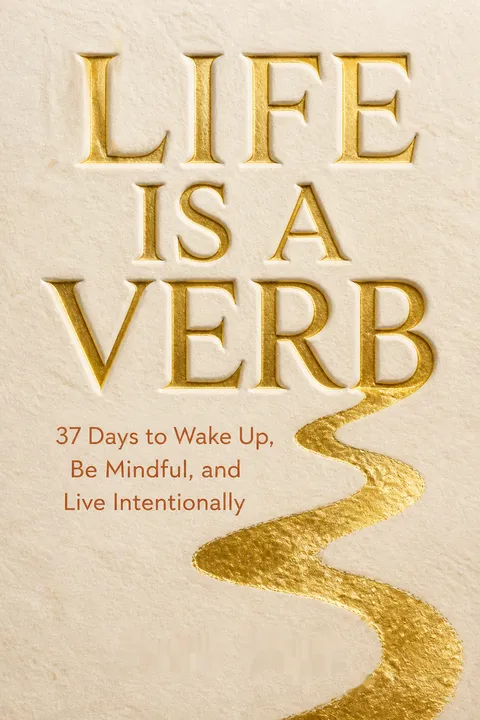
Life Is a Verb is a memoir-shaped guide to attention and choice. Its argument is not built as a conventional sequence of proofs. Instead, short personal narratives accumulate into six recurring practices: say yes to experience, extend generosity, speak with integrity, deepen connection, trust inner signals, and slow down enough to choose deliberately. The organizing crisis is Boyce's thirty-seven days between cancer diagnosis and death. That time limit gives the essays urgency, while the domestic scenes keep urgency grounded in ordinary life: a tiny grape, a child's test score, a meal, a note in a parent's handwriting.
The book's chief strength is its conversion of abstractions into exercises. Readers are asked to write quickly, notice an everyday object, make a small gesture, or repeat one practice for a defined span. This turns reflection into observable behavior and makes the book useful as a workbook as well as a collection of essays. Its stories also resist the self-help tendency to make transformation sound glamorous. A wave to a homeless neighbor, an awkward conversation, or an hour of focused attention counts.
The method has limits worth keeping in view. A personal anecdote can illuminate a principle without proving that it applies universally. Some calls to say yes or challenge convention need careful consideration of safety, resources, disability, and unequal power. The book recognizes adaptation in its exercises, but readers should retain that flexibility throughout. Its six practices are most persuasive as prompts for judgment, not commandments.
The lasting contribution is a practical ethic of authorship: write down what matters, notice what is happening, make choices that reflect those observations, and leave behind evidence of a life that was actually inhabited. The thirty-seven-day frame does not promise reinvention. It offers something more credible: a short, repeatable interval in which intention can become visible in action.
Review Summary
People Also Read





Glossary
37 days
A finite-life reminderThe book's central time frame comes from the thirty-seven days between the author's stepfather's lung-cancer diagnosis and death. It functions both as a prompt to consider what matters under a limited horizon and as a suggested period for practicing one small change. It is a framing device, not a claim that thirty-seven days guarantees a lasting habit.
Six Practices for Intentional Living
Six ways to live deliberatelyThe author's organizing framework, distilled from stories and exercises across the book. It groups intentional living into six practices: Intensity, Inclusion, Integrity, Intimacy, Intuition, and Intention. Together, they direct attention toward fuller participation, generosity toward others, principled speech, deeper relationships, trust in one's judgment, and deliberate use of time.
Intensity
Engaged participationOne of the Six Practices for Intentional Living. Intensity means entering ordinary experience with energy, attention, and openness rather than holding back until life becomes more convenient. The book illustrates it through play, wonder, and choices that create memorable engagement, while its examples also imply that participation need not mean ignoring real risks.
Inclusion
Generosity across differenceOne of the Six Practices for Intentional Living. Inclusion means making room for other people to be fully human, especially when their lives or identities differ from one's own. It involves looking beyond categories, offering attention or help, and questioning who gets treated as normal. The practice is interpersonal, but it does not substitute for addressing structural exclusion.
Integrity
Values expressed in actionOne of the Six Practices for Intentional Living. Integrity means acting and speaking in ways that remain faithful to one's principles, even when compliance, money, or approval would be easier. In the book, it includes refusing work that misrepresents change, challenging harmful speech, and questioning conventions that have no sound purpose.
Intimacy
Attentive human connectionOne of the Six Practices for Intentional Living. Intimacy means offering and receiving genuine presence, care, and connection. The book treats it as more than romance: it can appear in listening, friendship, family relationships, or quiet companionship. It also includes recognizing that healthy care needs boundaries and that tending to oneself can preserve one's capacity to care for others.
Intuition
Attention to inner signalsOne of the Six Practices for Intentional Living. Intuition refers to listening to feelings, recurring desires, and bodily or emotional responses when deciding whether a direction fits. The book encourages readers to notice these signals and take considered risks. It does not require treating every impulse as correct; reflection and experience remain important checks.
Intention
Deliberate use of timeOne of the Six Practices for Intentional Living. Intention means slowing down, identifying what deserves attention, and aligning everyday choices with deeper priorities. In the book, it appears in practices such as reducing multitasking, examining to-do lists, savoring meals, and declining commitments that do not fit the life one wants to live.
Focused free-write
Timed, unedited writingA short writing exercise used throughout the book. The writer sets a timer and keeps writing without stopping to correct spelling, grammar, or phrasing. If ideas run out, the writer continues until they return. Afterward, a striking word or phrase can serve as the starting point for a brief second round. The purpose is exploration, not polished prose.
Action Challenges
Immediate practice promptsBrief exercises placed after the book's stories. They may involve writing, observing, creating, or interacting with another person, and are designed to help a reader respond to the story in the present. The author presents them as adaptable suggestions rather than fixed instructions, including alternatives for readers who need different ways to participate.
Movement Challenges
Practices repeated over timeLonger exercises that invite readers to repeat or adapt a behavior for thirty-seven days. They are intended to create sustained movement rather than a one-time insight. Examples include noticing judgment, writing letters, or paying closer attention to others. The book recommends choosing one or two at a time instead of attempting every challenge simultaneously.
desire lines
Paths made by repeated choicesA landscape-design term for informal trails created where people repeatedly cross grass or open ground instead of following the official walkway. The book uses these visible paths as a metaphor for recurring human longings and decisions. Examining one's desire lines can reveal where actual behavior points, though repetition by itself does not show whether a path is healthy or freely chosen.
Toast Rules
Unexamined arbitrary conventionsThe author's name for rules that people treat as fixed despite their being habits, assumptions, or conveniences rather than meaningful requirements. The term comes from a restaurant encounter in which a server says toast cannot be served after a certain time. The concept encourages questioning a rule's purpose, while distinguishing arbitrary convention from rules that protect people or rights.
Download PDF
Download EPUB
.epub digital book format is ideal for reading ebooks on phones, tablets, and e-readers.








