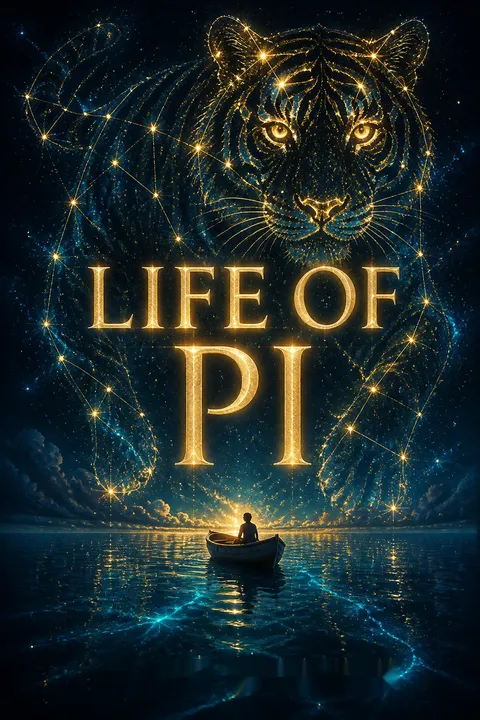


Plot Summary
Prologue
An unnamed writer, stalled in India and hungry for a story with real life in it, meets Francis Adirubasamy in Pondicherry. Francis tells him about Pi Patel, a man he knew as a boy, and urges the writer to hear Pi's account for himself.
Years later in Canada, the writer visits Pi, studies his diary and newspaper clippings, and records the tale that follows. The book begins as a story passed from one person to another, with the writer admitting that Pi's testimony is the heart of it.
The frame makes storytelling part of the plot before Pi's ordeal begins. Francis's promise is not a guarantee of documentary certainty, but an invitation to encounter a story capable of changing its listener. The writer's stalled novel gives that promise a practical consequence: he is searching not for more facts, but for a narrative that feels alive. His later use of Pi's voice further complicates authority. The account arrives through memory, notes, and an editor's selection, so the reader is primed to consider not only what happened, but how experience becomes tellable.
A Name Reclaimed
Piscine Molitor Patel grows up in his father's Pondicherry zoo, where animal routines and boundaries are part of daily life. His swimming-loving family friend, Francis Adirubasamy, known as Mamaji, inspired the unusual name.
At school, classmates twist it into a humiliating insult, and even teachers repeat the distortion. When Piscine transfers to a new school, he goes straight to the blackboard and writes Pi Patel beside the mathematical symbol and its familiar digits. Repeating the introduction in every class makes the new name stick.
His father also teaches Pi and his older brother Ravi to fear animals properly, demonstrating a tiger's power with a goat. The boy learns that curiosity is valuable, but that an animal is never a harmless human companion.
Pi's first decisive act is not escape from humiliation but the deliberate construction of a self. Mathematics gives him a name that can be repeated, taught, and recognized, turning ridicule into an occasion for authorship. The zoo supplies a second education: affection does not cancel danger, and human imagination can misread animals. His father's frightening demonstration leaves Pi with knowledge that will later become physical survival, while also establishing the novel's tension between symbolic animals and creatures that remain stubbornly real.
Three Altars, One Heart
Pi's religious curiosity carries him beyond the Hindu practices of his childhood. In Munnar, a patient priest named Father Martin introduces him to Christianity through the story of Jesus's suffering; Pi finds the vulnerable god difficult to understand, then becomes deeply drawn to the love behind that sacrifice.
In Pondicherry, a Muslim baker named Satish Kumar teaches him prayer and the intimacy of devotion to Allah. Pi continues visiting temple, church, and mosque, until a priest, imam, and pandit confront him together on the seaside promenade.
They insist he must choose one faith. Pi maintains that he wants to love God, and his parents, though bewildered, do not forbid him. He receives a prayer rug and Christian baptism, making his private convictions visible in family life.
Pi's pluralism is an embodied practice, not a tidy theory. He is moved by ritual, food, architecture, prayer, and stories before he can reconcile their doctrines. The religious leaders treat belonging as a scarce resource that must be assigned to one institution; Pi experiences devotion as something expansive enough to cross their boundaries. His parents' hesitation matters because it allows his religious life to develop without turning it into a simple rebellion. The scene establishes his habit of holding apparently incompatible truths together, a habit that will shape how he later narrates catastrophe.
Pondicherry Packs the Zoo
Political upheaval in India unsettles Pi's father, Santosh Patel, who fears that the Emergency and the removal of Tamil Nadu's government will make the family's zoo impossible to sustain. In 1976, the Patels decide to immigrate to Canada.
Santosh sells most of the animals to overseas zoos, accepting the difficult paperwork and medical inspections required to move a living collection across borders. Pi and Ravi resist the prospect of leaving Pondicherry, but the family prepares for a new life.
On June 21, 1977, they board the Japanese cargo ship Tsimtsum at Madras with their parents and animals bound for North America. The departure separates Pi from familiar streets, teachers, and Mamaji, while the ship carries his old home and a precarious future across the Pacific.
Migration begins not with a dream of adventure but with the accumulated pressure of political and economic insecurity. Santosh's decision is protective and practical, yet its cost falls unevenly: the adults calculate a future, while the boys experience the loss of a world they understand. The zoo's shipment makes this departure unusually literal. The family does not merely leave home; they transport its inhabitants, routines, and dependencies into an unfamiliar setting. The Tsimtsum therefore becomes more than a vessel. It is a fragile container for the life the Patels hope to preserve.
The Tsimtsum Goes Under
Four days after the Tsimtsum leaves Manila, Pi wakes to an irregular noise and climbs toward the main deck. He finds the ship listing, then discovers seawater blocking the stairwell to his family's cabins. Crew members on the bridge give him a life jacket, carry him away from the danger, and throw him down toward a lifeboat. A zebra crashes into the boat after him.
In the storm, Pi sees a tiger struggling in the sea and urges it toward the vessel before realizing what sharing the boat would mean. When the animal hauls itself aboard, Pi throws himself back into the water. He survives by clinging to a lifebuoy and an oar as sharks move below and the Tsimtsum sinks. The ship vanishes with his family aboard.
The catastrophe strips Pi of the roles that once organized his life: son, brother, student, and zookeeper's child. His instinct to save the tiger is immediately contradicted by the danger of its presence, forcing compassion and self-preservation into the same frantic choice. The crew's apparent rescue turns into a violent expulsion, leaving Pi unsure whether he has been helped or used. Above all, the sinking gives him no explanation and no time to mourn. Survival begins as action performed ahead of understanding.
Predators Take the Boat
The storm leaves Pi above the lifeboat, while a spotted hyena, a badly injured zebra, and eventually Orange Juice, a Borneo orangutan from his father's zoo, occupy the cramped vessel. Pi initially believes the tiger has drowned. The hyena runs in frantic circles, then tears at the zebra's broken leg and begins feeding while the animal is still alive.
Orange Juice rises to defend herself when the hyena turns on her, but the predator kills her. Pi watches, weak with grief and fear, until a Bengal tiger emerges from beneath the tarpaulin. Richard Parker kills the hyena and eats it. The tiger's sudden appearance explains the unnatural restraint among the animals and ends Pi's mistaken belief that the boat holds no larger predator.
The lifeboat becomes a miniature ecology where ordinary categories of safety and danger collapse. Pi's knowledge of zoo animals helps him read behavior, but it cannot spare him from witnessing violence at close range. Orange Juice's defense briefly unsettles Pi's assumptions about her gentleness, while the hyena's feeding makes suffering impossible to romanticize. Richard Parker's arrival changes the entire hierarchy without making Pi safe. The scene shifts the question from whether the animals can coexist to whether Pi can find a way to remain alive beside a predator.
A Raft Between Jaws
After days without food or water, Pi searches the lifeboat and finds an emergency locker. Drinking water, ration biscuits, a survival manual, ropes, oars, and life jackets give him a narrow chance. He builds a small raft from the buoyant equipment and tethers it to the boat, keeping himself above shark-filled water and away from Richard Parker.
The tiger's presence turns the raft into a precarious refuge, not a solution. Pi recognizes that waiting for the animal to starve would fail, so he begins studying its habits and uses the whistle attached to a life jacket to establish a boundary. His father's zoo lessons, once frightening childhood instruction, now become practical knowledge he must apply without error.
The survival locker offers more than supplies: it gives Pi a sequence of manageable tasks at a moment when grief threatens to overwhelm thought. The raft is both shelter and symbol of distance, but its tether makes clear that Pi cannot simply detach himself from the tiger or from the conditions that keep him alive. His father's teaching returns in altered form. Instead of learning animal danger from behind secure barriers, Pi must use that knowledge in a shared, unstable territory where every mistake has immediate consequences.
A Vegetarian Kills
Hunger forces Pi to fish, though a lifetime of vegetarianism makes killing his first catch wrenching. A school of flying fish crashes into the lifeboat during a chase by dorados. Pi struggles to kill one, then uses its head as bait and catches a large dorado. He gives much of the fish to Richard Parker, who now has a reason to tolerate the boy's presence.
Pi's hands-on work grows more competent: he learns to use hooks and gaffs, catches fish, and eventually hauls turtles aboard for meat and blood. The work feeds both castaways, but each act of killing alters Pi's sense of himself. What begins as an unbearable necessity becomes a skill he can repeat.
The first fish marks a bodily and moral threshold. Pi cannot preserve his identity as a harmless vegetarian simply by refusing to kill; refusal would leave both him and the tiger without food. Yet necessity does not erase the cost. His grief over the flying fish and later confidence with a dorado show how adaptation changes feeling as well as behavior. The scene resists a clean division between civilization and savagery: Pi's new competence is neither a moral triumph nor a simple fall, but the work required to keep life going.
A Circus at Sea
Pi recognizes that the tiger keeps him focused on immediate survival, preventing despair from consuming every waking hour. Drawing on his father's lessons about territory and dominance, he uses the lifeboat's rocking motion and a piercing whistle to make Richard Parker associate trespassing with seasickness. Training takes repetition, careful observation, and a willingness to retreat before the tiger attacks.
Pi also provides fish and fresh water from rain catchers and solar stills, which makes his presence useful to the animal. Gradually, the boat acquires the routines of a zoo enclosure: a place to rest, food, water, and boundaries. Pi becomes less a helpless passenger than the keeper of a dangerous, improvised household.
The relationship works through reciprocal dependence rather than affection in any human sense. Pi's authority is behavioral and fragile: he must repeatedly demonstrate that he controls food, water, and the terms of contact. At the same time, Richard Parker gives Pi a purpose that grief alone could not provide. Caring for the tiger is coercive labor, but it also keeps Pi oriented toward another living being. The zoo returns in radically altered form, not as a protected institution, but as a set of practices that Pi reconstructs amid exposure and fear.
The Pacific's Long Calendar
The ordeal lasts 227 days, though Pi eventually stops counting and measures time through tasks and encounters. He tends the solar stills, fishes, cures meat, gathers rainwater, prays, repairs ropes, and watches Richard Parker. A passing oil tanker fails to notice the lifeboat, crushing Pi's hope of immediate rescue.
Later, a major storm swamps the boat and destroys the raft, leaving Pi bruised, his stores damaged, and the last whistle nearly all he has left. He keeps working because each repair or meal protects the next day. The Pacific's beauty brings brief wonder, but heat, salt sores, thirst, and boredom wear down his body. When Pi and Richard Parker both lose their sight, another castaway's voice approaches.
Routine does not make the ordeal safe; it makes endurance repeatable. Pi's schedules convert an immeasurable ocean into a series of duties that can still be performed, even as his body deteriorates. The missed tanker exposes the limits of hope based on being noticed by others, while the storm destroys the modest structure Pi has built for himself. His prayers persist alongside practical maintenance, not instead of it. By the time blindness arrives, his survival system has carried him far, but it cannot protect him from the next human encounter.
Blindness Brings a Stranger
When Pi goes blind from exhaustion and deprivation, he hears another blind man nearby. The two speak about food and try to bring their lifeboats together. The stranger approaches with the intention of taking Pi's supplies, but Richard Parker kills him before he can reach Pi. Pi later finds food and water aboard the other boat, and his sight gradually returns.
He sees the stranger's remains and admits that he uses some flesh as fishing bait and eats a small amount himself. The episode leaves him horrified by what hunger has made possible, but also alive. It turns an encounter that seemed to promise companionship into another lesson in the violence of desperate survival.
The encounter offers a brief, devastating test of Pi's longing for another human voice. Shared blindness and hunger create intimacy, but they do not guarantee trust; the stranger's need becomes a threat before Pi can see him. Richard Parker again protects Pi through an act of violence, deepening the uncomfortable bond between them. Pi's later use of the dead man's flesh marks a further crossing of moral boundaries. His horror does not restore his former innocence, but it preserves his capacity to recognize the cost of what he has done.
The Island With Teeth
Near the end of the voyage, Pi reaches a floating island made of dense algae. It offers fresh water, sweet vegetation, and a vast colony of meerkats. Pi and Richard Parker regain strength there, and Pi begins to imagine staying. Then he finds human teeth wrapped inside a strange fruit-like mass in a tree.
Testing the island after dark, he discovers that its algae turns deadly and its ponds become acidic. The meerkats flee the ground for the trees each night, and Richard Parker returns to the lifeboat for safety. Pi realizes another castaway must have died there. He gathers food and water, waits for Richard Parker, and pushes back to sea rather than exchange physical comfort for certain death.
The island's abundance first appears to answer every deprivation the sea has imposed. Its green landscape offers nourishment, rest, and the possibility of ending the struggle. The teeth transform that promise into evidence of a concealed history: someone else found refuge and did not escape. Pi chooses danger over a comfort that depends on refusing to notice its price. This decision is an act of interpretation as much as survival. He tests what he sees, accepts the disturbing evidence, and leaves before the island's beauty can become another trap.
Mexico's Unfinished Farewell
After leaving the island, Pi and Richard Parker drift on until the lifeboat reaches the Mexican coast on February 14, 1978. Pi is so weakened that landing through the surf is dangerous. Richard Parker leaps ashore, runs toward the jungle, and disappears without looking back.
Pi survives, but the lack of farewell wounds him: the tiger who gave his days structure leaves no gesture that can close their relationship. Villagers find Pi, carry him to safety, and give him food; the next day, police take him to a hospital. After recovering, he settles in Canada, studies religion and zoology, and builds a family. The frame returns to Pi as an adult, still marked by the lost years at sea.
Rescue ends the physical emergency without supplying emotional closure. Pi's grief at Richard Parker's departure shows how dependence can produce attachment even when the other being cannot offer human recognition. The missing goodbye becomes a second loss layered over his family's disappearance. Recovery is therefore not a return to the life Pi had before the wreck. His later studies and family life show him building continuity, while scars, habits, and memories keep the sea present inside ordinary days.
Two Stories, One Choice
Japanese officials Tomohiro Okamoto and Atsuro Chiba interview Pi about the Tsimtsum's sinking, but his account gives them no technical explanation. They doubt the story of the tiger, the animals, and the floating island, so Pi offers another version. In it, the survivors are Pi, his mother, a wounded Taiwanese sailor, and the ship's cook.
The cook amputates the sailor's leg under the pretense of saving him, then uses the dead man's body for bait and food. After the cook kills Pi's mother, Pi kills the cook. The officials see parallels between the people and animals in the first account, but cannot prove which version is factual. They choose the animal story as the better one, and Pi accepts their answer.
The alternative account does not resolve the mystery so much as relocate it. Its brutal events echo the animal narrative, inviting the reader to connect the sailor with the zebra, Pi's mother with Orange Juice, and the cook with the hyena, while leaving Richard Parker's meaning less settled. The investigators can verify neither version, and their report cannot explain the shipwreck. Their choice therefore becomes an ethical and imaginative act rather than a finding of evidence. Pi's final question asks what kind of truth a listener is willing to inhabit when facts alone cannot restore the dead.
Analysis
Life of Pi makes survival both a physical discipline and a problem of interpretation. Pi lives because he can turn observation into procedure: he reads Richard Parker's posture, constructs a raft from the lifeboat's equipment, learns to catch fish, and organizes the day around water, food, repairs, and prayer. None of these actions cancels fear or grief. Their importance is that they keep him capable of acting while grief remains present. The animal story gives that labor a vivid structure, but the alternative account exposes how easily survival can include cruelty, complicity, and violence. The correspondence between the two versions is meaningful without being a code that can be solved with certainty. In one account, animals enact the conflicts; in the other, human beings do. The investigators can establish neither version as fact, and their technical report leaves the ship's sinking unexplained. This limit is not an argument against reason. Pi repeatedly depends on observation and practical reasoning, but those tools cannot restore his family or settle every question of meaning. The novel instead distinguishes factual explanation from the fuller work of a story: organizing experience so that a listener can bear to consider it. Pi's many religious commitments echo this method. He refuses to treat one tradition as the only possible language for encountering the sacred, just as he refuses to reduce his ordeal to a flat record of events. His final choice does not prove that the animal story happened. It shows what the story makes possible: wonder, emotional coherence, and a way to speak about endurance without pretending suffering was simple. The book leaves readers with a difficult balance. Imagination can shelter truth, but it can also obscure it; reason can test claims, but it cannot exhaust what a life means. Pi asks the reader to choose with that uncertainty intact.
Review Summary
Life of Pi receives mixed reviews, with many praising its imaginative storytelling and exploration of faith, survival, and the power of narrative. Some readers find the philosophical elements profound, while others view them as heavy-handed. The book's vivid descriptions and unexpected ending are frequently highlighted. Critics debate the religious themes and symbolism, with some finding them thought-provoking and others considering them superficial. Despite divided opinions, the novel's uniqueness and ability to spark discussion are widely acknowledged.
People Also Read








Characters
Pi Patel
The searching survivorBorn Piscine Molitor Patel and known as Pi, he is the younger son of a Pondicherry zookeeper. Curious, academically gifted, and unusually attentive to animal behavior, he studies zoology alongside religion. His devotion to Hinduism, Christianity, and Islam grows from direct encounters with worship and sacred stories, rather than from a wish to provoke his family. Pi's imagination is vivid, but it is paired with a practical mind shaped by the zoo. He notices habits, patterns, and small changes in his surroundings. That combination of faith, observation, and self-discipline defines how he responds when the familiar structures of family, home, and community are disrupted.
Richard Parker
The dangerous companionRichard Parker is a Bengal tiger from the Pondicherry Zoo, transported with the Patel family's animals when they leave India. He is powerful, territorial, and governed by instincts that Pi must learn to observe rather than sentimentalize. His presence forces Pi to treat the lifeboat as a shared space with strict boundaries. Richard Parker is not a human companion or a moral guide, though Pi's attention to his habits gives their relationship emotional weight. He represents both the reality of animal danger and the demanding purpose that can keep a person focused on the next necessary task.
Santosh Patel
The anxious zookeeperSantosh Patel runs the Pondicherry Zoo and raises Pi and Ravi with a practical respect for animals. He is modern-minded, secular, and deeply concerned with the financial and political conditions that could ruin the family's livelihood. His way of caring is often instructional: he teaches his sons that affection and familiarity never make a wild animal safe. His decision-making is shaped by responsibility, worry, and a belief that preparation can reduce danger. Pi remembers his father's guidance as both frightening and useful.
Gita Patel
The steady-hearted motherGita Patel is Pi and Ravi's mother, a reader with a calm presence and a strong instinct to protect her children. She is less concerned with formal religion than Pi is, but she respects his intelligence and tries to meet his questions with care. When family discussions become tense, she often redirects Pi toward books, a tactic that reveals both affection and discomfort with matters she cannot easily explain. Her warmth offers a gentler counterweight to Santosh's practical authority.
Ravi Patel
The teasing older brotherRavi is Pi's older brother, a popular student and gifted cricket player. Confident, funny, and fond of teasing, he enjoys the easy social authority Pi lacks. His jokes can wound, especially when they touch Pi's name or religious interests, but they also express the familiar intimacy of siblings. Ravi represents the ordinary adolescent world of sport, friends, and competition that Pi observes from a more inward, bookish position.
Francis Adirubasamy
The story's first keeperA family friend and former champion swimmer, Francis Adirubasamy teaches Pi to swim and becomes an important elder in the Patel household. Pi calls him Mamaji, a respectful family term. His stories about swimming pools in India and Europe lead indirectly to Pi's name. As an adult, Francis also connects Pi's experience to the unnamed writer who frames the narrative. His role is one of transmission: he passes on skills, memories, and a story he believes deserves to be heard.
Satish Kumar, the teacher
The scientific skepticPi's biology teacher is an avowed atheist and Communist who approaches the zoo as evidence of nature's ordered mechanisms. A childhood bout of polio shaped his belief that medicine, rather than divine intervention, saved him. He encourages Pi's scientific curiosity and helps direct him toward zoology. His rigorous naturalism challenges Pi without extinguishing their mutual respect, showing Pi that conviction can take forms very different from his own.
Satish Kumar, the baker
The Sufi teacherA Muslim baker in Pondicherry, Satish Kumar introduces Pi to the rhythms of Islamic prayer and to a personal, loving relationship with God. He is a Sufi and a memorizer of the Qur'an, whose modest bakery becomes a place of spiritual intensity for Pi. His common name matches that of Pi's biology teacher, creating a quiet link between two very different guides. Through him, Pi experiences faith as both communal discipline and intimate devotion.
Father Martin
The patient Christian guideThe priest Pi meets in Munnar receives the boy's questions with kindness rather than defensiveness. He introduces Pi to the Christian story of Jesus and emphasizes love as the key to its meaning. Pi initially finds the story troubling, but Father Martin's patience gives him room to wrestle with it. He makes Christianity accessible through hospitality and conversation rather than pressure.
The unnamed writer
The listening recorderThe writer who frames Pi's account is unnamed and openly aware of his own role in shaping it. After Francis Adirubasamy directs him to Pi, he visits Pi in Canada, takes notes, and studies the available records. He is neither an omniscient narrator nor a neutral machine; his curiosity and desire for a living story shape how the account reaches the reader. His presence keeps questions of memory, testimony, and narrative selection in view.
Orange Juice
The gentle orangutanOrange Juice is a Borneo orangutan matriarch and a celebrated animal at the Pondicherry Zoo. Pi associates her with the familiar, nurturing presence of a long-kept zoo animal. Her composure and physical strength make her distinctive among the animals Pi knows.
The spotted hyena
The relentless predatorThe adult male hyena on the lifeboat is tense, opportunistic, and frighteningly persistent. Pi recognizes the species from his father's zoo and knows not to dismiss it as a scavenger. Its behavior forces Pi to confront how quickly hunger can turn a confined space into a battlefield.
The Grant's zebra
The injured castawayThe zebra is a Grant's zebra from the transported zoo collection. It lands injured in the lifeboat and becomes the first animal whose suffering Pi must witness at close range. Its presence establishes the helplessness of the vessel's early animal occupants.
The cook
The hard-edged survivorThe cook appears in Pi's later, human account of the shipwreck. He is practical and experienced at sea, but Pi describes him as coarse, self-interested, and increasingly shaped by scarcity. He becomes a figure through whom the second version explores what desperate people may do to one another.
The Taiwanese sailor
The wounded passengerA young Taiwanese sailor appears in Pi's human account as a fellow survivor who cannot speak English. His serious injury leaves him dependent on the others, and his inability to communicate deepens his isolation. He is remembered through Pi's attention to his vulnerability and suffering.
Tomohiro Okamoto
The skeptical investigatorOkamoto is a Japanese Ministry of Transport official sent to question Pi about the Tsimtsum. Tired and methodical, he wants evidence that can help explain the ship's sinking. His skepticism is professional rather than cruel, though Pi's story tests the limits of what he considers credible. He records the practical uncertainties that the tale cannot settle.
Atsuro Chiba
The junior investigatorChiba accompanies Okamoto during the interview and learns from his senior colleague while trying to make sense of Pi's account. He is curious, sometimes uncertain, and more openly responsive to the story's imaginative possibilities. His presence softens the formality of the investigation without changing its demand for an explanation.
Meena Patel
Pi's Canadian partnerMeena is Pi's wife in the frame narrative. A pharmacist with a settled life in Canada, she appears briefly and warmly in the writer's visits. Her presence shows that Pi has built intimate relationships beyond the family and home of his childhood.
Nikhil and Usha Patel
Pi's young childrenNikhil, who goes by Nick, and his younger sister Usha are Pi and Meena's children. They appear in the frame narrative as lively, ordinary parts of Pi's Canadian household. Their ease with their father offers a glimpse of family life continuing beyond his remembered ordeal.
Plot Devices
Pi's chosen name
Identity through repetitionPiscine's name carries family history through Mamaji's swimming stories, then becomes a source of schoolyard cruelty. Pi's decision to write the mathematical symbol on the blackboard transforms the insult into a name he can claim. The device links identity to performance: he repeats the new name until teachers and classmates adopt it. Its later resonance with the novel's concern for stories and belief comes from Pi's habit of shaping the terms by which others understand him.
Territory and training
A fragile survival systemPi's zoo knowledge teaches him that animals defend familiar space and respond to signals, routines, and rank. On the lifeboat, he adapts those principles through boundaries, a whistle, and the controlled provision of food and water. The method never makes Richard Parker tame or harmless. Instead, it gives Pi a repeatable way to reduce immediate danger and maintain a shared territory. The lifeboat becomes a compressed zoo, though without its barriers, staff, or guarantees of safety.
The survival equipment
Tools turn time into actionThe lifeboat's locker contains water, ration biscuits, ropes, oars, life jackets, fishing gear, a manual, and solar stills. Each item becomes useful through Pi's observation and improvisation: the oars and life jackets form a raft, the stills turn seawater into fresh water, and the fishing gear makes food possible. The equipment does not guarantee rescue. It gives Pi tasks, supplies, and a limited margin for error, allowing routine to replace helpless waiting.
The floating island
A refuge becomes a warningThe island offers Pi fresh water, edible algae, trees, and abundant meerkats after months of hardship. Its uncanny ecology invites him to believe he has found permanent safety. The human teeth hidden inside a fruit-like growth reveal a previous castaway's fate, and Pi's nighttime test exposes the island's deadly nature. The device makes apparent abundance unreliable: the refuge is sustaining by day but lethal after dark. Pi must interpret what is hidden beneath comfort before he can decide whether to leave.
The two accounts
Truth tested by preferencePi tells the Japanese investigators an animal story and then a human story that echoes its major relationships and acts of violence. The officials cannot verify either account, and neither explains why the Tsimtsum sank. Their preference for the animal version shifts the question from proof to interpretation. The device does not supply a definitive solution; it asks what a story can communicate when facts are incomplete and trauma resists straightforward narration. Pi's framing makes the listener's choice part of the ending.
FAQ
Synopsis & Basic Details
What is Life of Pi about?
- Survival and Faith Journey: Life of Pi tells the story of Piscine Molitor "Pi" Patel, an Indian boy who survives a shipwreck and is adrift in the Pacific Ocean on a lifeboat with a Bengal tiger. It explores his struggle for survival, his complex relationship with the tiger, and his deep spiritual journey.
- Dual Narratives and Truth: The novel presents two versions of Pi's story, one fantastical with animals and one more realistic, challenging the reader to consider the nature of truth and the power of storytelling. It questions what we choose to believe and why.
- Themes of Faith and Resilience: The narrative delves into themes of faith, the will to survive, the human-animal connection, and the importance of stories in making sense of life's challenges. It's a journey of self-discovery and spiritual exploration amidst extreme adversity.
Why should I read Life of Pi?
- Unique Narrative Style: Yann Martel's writing blends vivid imagery, philosophical musings, and a compelling narrative structure, creating a thought-provoking and emotionally resonant reading experience. The story is told from multiple perspectives, adding layers of depth.
- Exploration of Complex Themes: The novel tackles profound themes such as faith, survival, the nature of reality, and the power of storytelling, prompting readers to question their own beliefs and perceptions. It's a book that stays with you long after you finish reading.
- Emotional and Intellectual Engagement: Life of Pi is not just an adventure story; it's a deeply moving and intellectually stimulating work that explores the human condition in the face of extreme adversity. It offers both a thrilling plot and profound insights into the human spirit.
What is the background of Life of Pi?
- Cultural and Religious Context: The story is set against the backdrop of India, particularly Pondicherry, a former French colony, and explores the intersection of Hinduism, Christianity, and Islam. This cultural and religious diversity shapes Pi's worldview and his spiritual journey.
- Zoological and Biological Insights: The novel incorporates detailed observations of animal behavior, reflecting Pi's background as a zookeeper's son. These insights into the natural world add depth to the narrative and highlight the complex relationship between humans and animals.
- Historical and Political Undertones: The story is set in the 1970s, a time of political unrest in India, which prompts Pi's family to emigrate to Canada. This historical context adds a layer of complexity to the narrative, highlighting the challenges of displacement and the search for a better life.
What are the most memorable quotes in Life of Pi?
- "I have a story that will make you believe in God.": This quote, spoken by Francis Adirubasamy, sets the stage for the entire narrative, suggesting that the story is not just about survival but also about faith and the search for meaning. It frames the book as a spiritual journey.
- "The reason death sticks so closely to life isn't biological necessity—it's envy. Life is so beautiful that death has fallen in love with it, a jealous, possessive love that grabs at what it can.": This quote reflects Pi's philosophical musings on life and death, highlighting the beauty and fragility of existence. It underscores the novel's exploration of mortality and the human condition.
- "The world isn't just the way it is. It is how we understand it, no? And in understanding something, we bring something to it, no? Doesn't that make life a story?": This quote encapsulates the novel's central theme about the power of storytelling and how our perceptions shape our reality. It emphasizes the subjective nature of truth and the importance of narrative in making sense of the world.
What writing style, narrative choices, and literary techniques does Yann Martel use?
- Blending Realism and Fantasy: Martel seamlessly blends realistic details with fantastical elements, creating a narrative that is both believable and magical. This juxtaposition enhances the story's themes and challenges the reader's perception of reality.
- Multiple Narrative Layers: The novel employs a layered narrative structure, with the author's voice, Pi's first-person account, and the Japanese officials' report, creating a complex and multifaceted story. This technique allows for different perspectives and interpretations.
- Symbolism and Metaphor: Martel uses rich symbolism and metaphorical language to explore deeper themes. The animals, the ocean, and the island all serve as symbols that enhance the story's emotional and intellectual depth. The use of the number Pi itself is a symbol of the irrational and infinite.
Hidden Details & Subtle Connections
What are some minor details that add significant meaning?
- The Sloth's Calm Demeanor: Pi's choice of the three-toed sloth for his zoology thesis, noting its "calm, quiet and introspective" nature, foreshadows his own need for inner peace and resilience during his ordeal. The sloth's survival strategy of being slow and unnoticed mirrors Pi's own approach to surviving at sea.
- Mamaji's Swimming Stories: Mamaji's detailed stories about swimming pools in Paris, particularly the Piscine Molitor, not only explain Pi's unusual name but also foreshadow the importance of water and swimming in Pi's life. These stories highlight the power of memory and the influence of mentors.
- The Red and Yellow Powders: The recurring mention of red kumkum and yellow turmeric powders in Hindu rituals and on religious figures foreshadows the vibrant colors of the tiger, Richard Parker, and the life-sustaining algae on the island. These colors become symbolic of faith, life, and the unexpected beauty found in adversity.
What are some subtle foreshadowing and callbacks?
- Father's Warning About Tigers: Pi's father's dramatic lesson about the danger of tigers, using a goat as an example, foreshadows Pi's later struggle for survival with Richard Parker. This early scene establishes the tiger as a symbol of both fear and respect.
- The Mirror Behind the Curtain: The zoo's sign asking "Do You Know Which is the Most Dangerous Animal in the Zoo?" and revealing a mirror foreshadows the theme of human nature as the greatest threat. This detail highlights the novel's exploration of human cruelty and self-reflection.
- The "Hairless Christians": Auntieji's mishearing of "Hare Krishnas" as "Hairless Christians" foreshadows Pi's later assertion that Hindus are "hairless Christians," Muslims are "bearded Hindus," and Christians are "hat-wearing Muslims," emphasizing the interconnectedness of faiths. This subtle detail highlights the novel's theme of religious tolerance and unity.
What are some unexpected character connections?
- Two Mr. Kumars: The fact that Pi's biology teacher and the Muslim baker share the same name, Satish Kumar, highlights the interconnectedness of different aspects of Pi's life. It suggests that both science and faith, though seemingly disparate, contribute to Pi's understanding of the world.
- Mamaji and the Author: The author's encounter with Francis Adirubasamy (Mamaji) in a coffee shop in Pondicherry, who then leads him to Pi, creates a meta-narrative connection, blurring the lines between fiction and reality. This connection emphasizes the role of storytelling and the power of personal encounters.
- The Cook and the Hyena: In Pi's second story, the cook's brutal actions mirror the hyena's savagery in the first story, suggesting that the cook is a human manifestation of the hyena's primal nature. This connection highlights the darker aspects of human behavior and the thin line between civilization and savagery.
Who are the most significant supporting characters?
- Francis Adirubasamy (Mamaji): As the inspiration for Pi's name and his swimming mentor, Mamaji plays a crucial role in shaping Pi's early life. His stories and encouragement instill in Pi a love for adventure and a sense of wonder.
- Mr. Satish Kumar (Biology Teacher): This character introduces Pi to the world of science and reason, providing a counterpoint to Pi's religious beliefs. His atheism challenges Pi to think critically and appreciate the natural world.
- Mr. Satish Kumar (Baker): This character introduces Pi to Islam and the concept of a personal relationship with God. His devotion and mysticism inspire Pi's spiritual journey and his understanding of faith.
Psychological, Emotional, & Relational Analysis
What are some unspoken motivations of the characters?
- Pi's Need for Connection: Pi's intense focus on his relationship with Richard Parker, despite the danger, stems from a deep-seated need for connection and companionship in the face of extreme isolation. This need drives his actions and his will to survive.
- Father's Fear of Political Instability: Pi's father's decision to move to Canada is driven by a fear of political instability in India and a desire to secure a better future for his family. This fear motivates his actions and his decision to sell the zoo.
- Richard Parker's Dependence: Despite his ferocity, Richard Parker's dependence on Pi for food and water reveals a vulnerability and a need for a structured environment. This dependence highlights the complex relationship between predator and prey.
What psychological complexities do the characters exhibit?
- Pi's Cognitive Dissonance: Pi's ability to simultaneously believe in multiple religions and his capacity to rationalize his actions, even cannibalism, reveal a complex psychological makeup. He grapples with the contradictions between his beliefs and his survival instincts.
- Richard Parker's Ambiguity: Richard Parker's behavior is often unpredictable, shifting between aggression and passivity. This ambiguity reflects the untamed nature of the tiger and the complex relationship between predator and prey.
- The Cook's Brutality: The cook's actions in Pi's second story reveal a deep-seated brutality and a willingness to abandon morality in the face of survival. His character highlights the darker aspects of human nature and the capacity for extreme violence.
What are the major emotional turning points?
- The Shipwreck: The sinking of the Tsimtsum is a traumatic event that shatters Pi's world and thrusts him into a desperate fight for survival. This event marks a turning point in his life, forcing him to confront his mortality and his capacity for resilience.
- The Discovery of the Island: The island's initial promise of salvation and its subsequent revelation as a carnivorous trap create a major emotional shift for Pi. This experience underscores the theme of illusion versus reality and the fragility of hope.
- Richard Parker's Departure: The tiger's abrupt departure at the end of the journey leaves Pi with a sense of loss and incompleteness. This moment highlights the complex bond formed between them and the emotional impact of their shared ordeal.
How do relationship dynamics evolve?
- Pi and Richard Parker: Their relationship evolves from one of fear and dominance to a complex interdependence. Pi learns to coexist with the tiger, understanding his behavior and establishing a fragile balance of power. This relationship becomes a central element of Pi's survival and his journey of self-discovery.
- Pi and His Family: Pi's relationships with his family, particularly his mother, are marked by love and support. Their absence after the shipwreck underscores the profound loss he experiences and the emotional toll of his ordeal.
- Pi and the Japanese Officials: Pi's interactions with the Japanese officials highlight the power of storytelling and the subjective nature of truth. His ability to craft compelling narratives challenges their perceptions and forces them to confront the limitations of their own understanding.
Interpretation & Debate
Which parts of the story remain ambiguous or open-ended?
- The Nature of the Island: The true nature of the island, whether it is a floating organism or a hallucination, remains ambiguous. This ambiguity underscores the novel's exploration of reality and the power of the mind to create its own world.
- Richard Parker's True Nature: Whether Richard Parker is a real tiger or a manifestation of Pi's own primal instincts is left open to interpretation. This ambiguity highlights the novel's exploration of the human-animal connection and the duality of human nature.
- The "Better Story": The choice between the two stories Pi offers is left to the reader, emphasizing the subjective nature of truth and the power of storytelling. The novel does not provide a definitive answer, inviting readers to consider what they choose to believe and why.
What are some debatable, controversial scenes or moments in Life of Pi?
- The Cannibalism Scene: The graphic depiction of cannibalism in Pi's second story is a controversial moment that challenges readers to confront the darker aspects of human nature. It raises questions about morality and the lengths to which people will go to survive.
- The Nature of Richard Parker: The ambiguity surrounding Richard Parker's true nature, whether he is a real tiger or a figment of Pi's imagination, sparks debate about the novel's themes and the nature of reality. This ambiguity invites readers to consider the power of the mind to create its own truths.
- The Ending's Open Interpretation: The novel's ending, with its two contrasting stories, leaves readers to decide which version they prefer. This open-endedness sparks debate about the nature of truth, the power of storytelling, and the role of faith in shaping our understanding of the world.
Life of Pi Ending Explained: How It Ends & What It Means
- Two Versions of the Story: The ending presents two versions of Pi's survival story: one with animals and one without. The animal story is fantastical and symbolic, while the human story is brutal and realistic. The choice between these two stories is left to the reader.
- The Power of Storytelling: The ending emphasizes the power of storytelling to shape our understanding of reality. Pi's ability to craft compelling narratives highlights the human need for meaning and the subjective nature of truth. The "better story" is the one that resonates more deeply with the individual.
- Faith and Belief: The ending underscores the importance of faith and belief in the face of adversity. Pi's ability to survive his ordeal is attributed to his unwavering faith and his capacity to find meaning in his suffering. The ending suggests that faith, like storytelling, can provide comfort and strength in the face of life's challenges.
Download PDF
Download EPUB
.epub digital book format is ideal for reading ebooks on phones, tablets, and e-readers.








