


Key Takeaways
Make Mars the horizon, then solve the nearer problem of cheap launch.

A vast destination. Elon Musk first imagined Mars Oasis, a small greenhouse mission meant to show that plants could grow in Martian soil. He even traveled to Russia to explore buying a refurbished missile as a launch vehicle. The price kept climbing, and the project exposed a bigger obstacle: reaching space cost too much and depended on an entrenched industry.
Orbit came first. Musk founded SpaceX in 2002 to build a low-cost rocket, the Falcon 1. He put roughly $100 million of his own money behind the effort. A city on Mars remained the ambition, but it could not begin without a reliable way to launch cargo from Earth. The first practical step toward another planet was therefore a small rocket built by a tiny, privately funded team.
A distant goal can coordinate work that otherwise looks like a collection of disconnected technical tasks. Mars gave engineers a reason to care about cost, launch cadence, and payload capacity as parts of one problem. In organizational psychology, a shared purpose can strengthen persistence, especially when progress is hard to measure. But purpose is not proof of feasibility. The useful feature here is the conversion of an enormous aspiration into a testable first milestone: put a modest payload into orbit. Without that bridge between vision and measurable progress, grand missions risk becoming recruitment rhetoric rather than an operating plan.
Recruit people who want responsibility more than a safe job description.

Small teams, broad roles. Early SpaceX employees often left stable positions for lower pay and uncertain prospects. Brian Bjelde, for instance, left NASA’s Jet Propulsion Laboratory to help build the Falcon 1’s electronics, despite having no conventional electronics-engineering background. Phil Kassouf joined before finishing his degree. They were expected to solve problems beyond the narrow boundaries of a job description, and to help with work outside their specialty when needed.
Purpose had perks. Musk offered a compelling mission, stock, quick decisions, and unusual access to real hardware. Employees could see their work affect the rocket rather than spend years on one isolated component. The office also made long hours more bearable with shared meals, snacks, games, and a close-knit team. The bargain was demanding: many worked around the clock, and some eventually left.
The story illustrates a form of job design in which autonomy and task variety can accelerate learning. Engineers gain broader competence when they can connect design decisions to hardware and test results. That advantage is strongest when the team is small enough for feedback to travel quickly. It also has a boundary: a culture built around unusually young employees with few outside obligations can mistake personal availability for a sustainable business resource. The book’s accounts of commitment are persuasive, but they also show why high ownership needs real consent, clear expectations, and room for people to step away.
Test real hardware early, because rockets expose what paperwork cannot.

Build, test, revise. SpaceX used iterative design: engineers built early versions, tested them, found flaws, and changed the hardware rather than completing years of specifications before construction. A rocket engine cannot be understood through diagrams alone. Fuel, valves, pumps, and software interact in ways that emerge only when the system is assembled and run.
Make cost visible. SpaceX also brought more work in-house, including engine development and machining. When a supplier could not deliver a usable turbopump quickly, the propulsion team learned to revise it themselves. The company advertised a Falcon 1 launch price of about $6 million, compared with roughly $26 million to $28 million for a comparable Pegasus launch. Lower cost depended on simplifying the work and shortening the path from problem to prototype, not merely asking suppliers for discounts.
This is close to the logic of experimental science: a model is useful, but an observation can overturn it. It also resembles lean product development, where short feedback cycles limit the cost of being wrong. The method is not a universal license to move fast. Rocket tests can destroy hardware, threaten workers, or endanger the public, so the right design question is where failure can be contained and made informative. SpaceX’s early unmanned flights allowed some risks that would be unacceptable with a crew aboard. Iteration works best when the experiment is fast and the consequences are bounded.
Pair engineering audacity with commercial and political fluency.
A rocket needs buyers. Gwynne Shotwell joined SpaceX to sell an unproven vehicle to government and commercial customers. Early business included a $3.5 million contract for a Defense Department satellite and a roughly $6 million Malaysian satellite mission. The latter required a launch site near the equator, since the Falcon 1 could not lift the payload into its desired orbit from California.
Navigate the institutions. SpaceX also challenged NASA’s no-bid $227 million award to Kistler, arguing that the cargo work should be competed. NASA withdrew that award and opened a new competition. In 2006, SpaceX won a $278 million development contract under the Commercial Orbital Transportation Services program. The company had to do more than build a rocket: it had to make its case to customers, regulators, and public agencies that controlled access to launch ranges and funding.
The company’s rise is not a simple story of private innovation defeating government inertia. Government agencies supplied launch access, early contracts, technical scrutiny, and eventually a market for cargo service. Shotwell’s role mattered because she translated technical ambition into commitments institutions could evaluate. This is a broader lesson in public-private projects: engineering capability and institutional legitimacy develop together. Yet litigation and public confrontation carry costs. A challenger may need to contest unfair access, but it also needs durable working relationships with the same agencies whose cooperation makes flight possible.
When Vandenberg stalled, move the rocket operation to Kwajalein.
A closed door. SpaceX spent about $7 million preparing a launch site at Vandenberg, only to be told its Falcon 1 could not fly until a valuable military satellite was safely in orbit. The Air Force did not formally reject the company, but the delay threatened its cash and schedule. Waiting for permission was not a viable strategy.
Find another route. The team had already identified Kwajalein Atoll in the Marshall Islands as a possible launch site for the Malaysian satellite, which needed an equatorial orbit. The Army wanted commercial users to help support its remote missile range, so SpaceX could work there. Engineers shipped roughly thirty tons of equipment across the Pacific and built a launch facility on eight-acre Omelek Island in about four months. The pivot was expensive and punishing, but it got the team moving again.
The episode resembles strategic adaptation under constraint: the objective stays fixed, but the route changes when a critical resource is unavailable. It also exposes the danger of relying on one gatekeeper. SpaceX’s alternative site was not a frictionless escape from government; it depended on Army cooperation, range approval, shipping, and military logistics. The useful lesson is not to treat regulation as an obstacle to ignore. It is to identify which constraints are negotiable, which are structural, and what alternative path could preserve the mission without pretending the constraints do not exist.
Make each failure alter the design, not merely the postmortem.
Three different lessons. Flight One failed when a corroded aluminum fitting cracked, allowing kerosene to catch fire near the engine. SpaceX initially blamed a technician, but investigators traced the failure to salt spray at the tropical launch site. The review also exposed other gaps, including a valve left open in the second stage. The company added sensors and stronger records for future builds.
The missed risk mattered. Flight Two reached space, then spun out of control when propellant sloshed inside the upper-stage tank. The team had considered the problem but ranked it outside its top ten risks. Flight Three failed for a different reason: residual fuel in the new engine’s cooling channels created a small thrust after shutdown, causing the stages to collide. SpaceX changed its risk reviews and added four seconds before stage separation on Flight Four.
The failures show why a postmortem must revise the system, not settle for assigning blame. Safety engineering calls this learning from near misses and failures: update procedures, instrumentation, and design assumptions so the same class of error becomes harder to repeat. SpaceX did make those changes, though its first response to Flight One included a public accusation that proved wrong. That detail matters. A blame-first culture can suppress inconvenient evidence, while a learning culture makes it easier to find it. Fast development still requires disciplined records and honest investigations.
Give a fourth attempt a deadline, a team, and permission to improvise.
Eight weeks to survive. After Flight Three failed in August 2008, Musk told the team to prepare its last Falcon 1 for launch within six weeks. There was little money left and no assurance of another chance. The first stage had to reach Kwaj quickly, so the Air Force flew it on a C-17 transport aircraft.
A crisis became a repair. As the plane descended toward Hawaii, the tank began to buckle because its pressure could not equalize quickly enough. Engineer Zach Dunn crawled into the interstage and opened a line that let air back into the tank. On Omelek, the team dismantled the rocket, replaced damaged parts, and rebuilt the stage in about a week. On September 28, Flight Four reached orbit. The mission marked the first time a privately developed liquid-fueled rocket from the United States had done so.
The C-17 emergency is memorable because it combines technical competence, rapid coordination, and a decision made under pressure. It is not a sensible template for routine operations: the flight crew and engineers faced real danger, and the repair succeeded in exceptional circumstances. The broader point is that improvisation becomes possible when people understand the system well enough to recognize what matters, communicate clearly, and act within their expertise. A deadline can focus effort, but only if it does not replace preparation, safety judgment, or the authority to stop when the risk becomes unacceptable.
Orbit proved the rocket, but NASA contracts kept SpaceX alive.
Success was not revenue. By Flight Four, SpaceX employed more than 500 people, yet reaching orbit did not immediately fill the order book or pay the bills. The company had no spare Falcon 1 rockets ready for customers, and Shotwell feared there would not be enough cash to make payroll within six to eight weeks.
Contracts bought time. NASA had already awarded SpaceX $278 million through COTS to develop cargo transport. In December 2008, the agency selected the company for a Commercial Resupply Services contract worth more than $1 billion. That award gave SpaceX the funding and credibility to build the larger Falcon 9 and Dragon spacecraft. The Falcon 1 proved the team could reach orbit. The NASA work gave the company a reason and the resources to keep building.
A technical milestone and a viable business are different achievements. The COTS and resupply awards supplied demand, external validation, and financing at the moment private launch revenue was too thin to sustain the organization. This is a useful correction to the lone-founder myth: SpaceX’s breakthrough depended on public procurement as well as private capital and engineering. Government customers also accepted risk in exchange for a new capability. The arrangement worked because each side gained something specific, but it depended on continued performance. A contract can create runway; it cannot make a weak technical program sound.
Count the human cost of speed before treating sacrifice as strategy.
Commitment had consequences. Early employees described eighty-hour workweeks, months away from home, and repeated trips between California, Texas, and Omelek. Some slept in rough island accommodations and missed time with partners and children. Several people later left SpaceX partly because the pace had become too costly. Others said they willingly traded years of ordinary life for the chance to build rockets and remained proud of the work.
A culture can outlast its founders. The company’s early employees carried its habits into Falcon 9 and later programs: direct ownership, urgency, and comfort with difficult engineering. But the book also records burnout, strained marriages, and missed childhood milestones. Speed helped SpaceX survive, yet the personal cost was not evenly distributed or automatically repaid by success.
The accounts resist two easy stories: that intense work is always exploitation, or that a compelling mission makes every sacrifice worthwhile. People can freely choose demanding work and still experience real harm from chronic stress. In high-performance organizations, urgency is valuable when it is temporary and tied to a clear bottleneck; it becomes brittle when constant overwork is treated as evidence of loyalty. The distinction matters for leaders hoping to reproduce SpaceX’s outcomes. A culture cannot be copied by imitating the hours alone. It also depends on exceptional resources, unusual risk tolerance, and employees who understand the bargain they are making.
Analysis
Liftoff is both an engineering history and a study of how a young company learns under pressure. Its narrative strength comes from keeping the Falcon 1 flights at the center. The reader sees the work move from an empty factory to tests in Texas, an improvised Pacific launch site, three failures, and finally orbit. Each launch makes the central claim tangible: SpaceX was not simply willing to attempt a difficult project; it built a process for turning technical surprises into design changes.
The book’s most important correction to the heroic-founder story is its attention to the team. Musk supplied capital, a demanding vision, and unusually fast decisions. But propulsion, avionics, structures, logistics, operations, and customer relations depended on people with distinct expertise. Shotwell’s sales and government work was as consequential as engine design. The Army’s launch range and NASA’s contracts were also part of the causal chain. SpaceX challenged the aerospace establishment, but did not succeed outside public institutions.
The narrative also contains a tension worth preserving. Iteration and risk tolerance were competitive strengths, yet Flight Two’s ignored slosh concern and Flight One’s rushed procedures show that speed can become expensive when uncertainty is dismissed. Flight Four’s emergency repair was remarkable, not a repeatable management method. The employees’ accounts of family strain and burnout make the same point in human terms: exceptional effort can solve a crisis, but it is not an unlimited resource.
The lasting lesson is therefore more precise than move fast. Build feedback into the work, give capable people real authority, keep the destination visible, and secure the customers and institutions that fund the next step. Then distinguish productive risk from preventable risk, and recognize that a company’s endurance depends on people as surely as it depends on engines.
Review Summary
Liftoff receives high praise for its engaging portrayal of SpaceX's early years. Readers appreciate the insider accounts, technical details, and human stories behind the company's struggles and successes. Many find it thrilling and inspiring, comparing it to a sci-fi novel come to life. Some criticize the narrow focus and perceived glorification of intense work culture. Overall, reviewers commend the book for its insights into SpaceX's innovative approach and the dedication of its engineers, though a few desire more context on the broader space industry.
People Also Read







Glossary
Iterative design
Build, test, reviseAn approach to engineering that moves quickly from an initial goal to concepts, tests, and prototypes. Teams use results to identify flaws and revise the design before producing a more finished system. SpaceX contrasted this with a linear process that develops requirements and qualifies components before major hardware is built.
Merlin
Falcon first-stage engineSpaceX’s kerosene and liquid-oxygen rocket engine, developed for the Falcon 1 and then adapted for larger Falcon rockets. It was named after a small falcon. Early versions used an ablative chamber, while a later version used regenerative cooling. The engine became central to SpaceX’s launch vehicles.
COTS
NASA cargo development programThe Commercial Orbital Transportation Services program was NASA’s effort to fund and oversee development of privately built systems for carrying cargo to the International Space Station. SpaceX received a $278 million award in 2006. The program helped the company develop the Falcon 9 rocket and Dragon spacecraft.
CRS
NASA resupply contractCommercial Resupply Services was NASA’s operational contract program for delivering cargo to the International Space Station. Unlike COTS, which supported development and demonstrations, CRS paid providers for supply missions. SpaceX’s award in 2008 gave the company a major source of funding and a customer for Falcon 9 and Dragon.
LOX
Liquid oxygen oxidizerLOX is liquid oxygen, stored at extremely low temperatures and used as the oxidizer in the Falcon 1’s kerosene-fueled engines. It enables rapid combustion and strong thrust, but must be handled carefully because it boils off and creates demanding storage, transport, and countdown requirements.
Slosh
Propellant movement in tanksSlosh is the movement of liquid propellant inside a rocket tank as the vehicle accelerates or changes direction. If the movement interacts with the rocket’s motion, it can destabilize the vehicle. SpaceX’s second Falcon 1 flight spun out of control after upper-stage propellant slosh contributed to an oscillation.
Ablative
Heat protection that wears awayAn ablative rocket-engine chamber or nozzle uses material that chars and flakes away under extreme heat, protecting the structure beneath it. The approach was initially chosen for Merlin because it seemed quicker and simpler to build. In practice, the chamber proved fragile, heavy, costly, and difficult to test for long burns.
Regenerative cooling
Fuel cools engine wallsA cooling method that routes propellant through channels in an engine’s chamber and nozzle before the propellant burns. The fuel absorbs heat that would otherwise damage the engine. SpaceX used this design in a later Merlin engine, improving reusability, but residual fuel in the channels contributed to the stage-collision failure on Flight Three.
FAQ
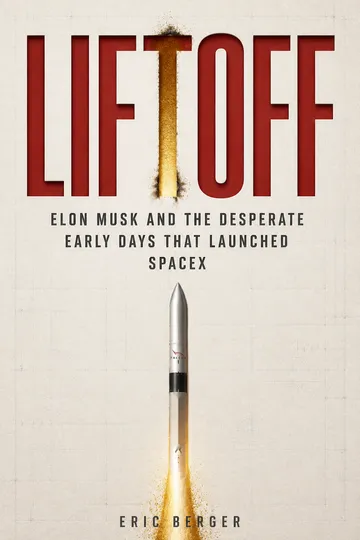
What is Liftoff: Elon Musk and the Desperate Early Days That Launched SpaceX by Eric Berger about?
- Chronicles SpaceX’s Origins: The book details the founding and early years of SpaceX, focusing on the development and repeated launch attempts of the Falcon 1 rocket from 2002 to 2008.
- Insider View of Struggles: It provides an inside look at the technical, financial, and emotional challenges faced by Elon Musk and his small team as they tried to revolutionize spaceflight.
- Human and Technical Stories: Berger highlights both the engineering hurdles and the personal sacrifices of key employees, blending technical explanations with human drama.
- Mars Ambition as Motivation: The narrative frames SpaceX’s journey within Musk’s larger vision of making humanity a multiplanetary species, emphasizing the audacity of their goals.
Why should I read Liftoff by Eric Berger?
- Rare Startup Perspective: The book offers a unique, detailed account of how SpaceX overcame near-bankruptcy and multiple failures to become a major player in aerospace.
- Technical and Emotional Depth: Berger makes complex rocket science accessible while also capturing the emotional toll and camaraderie among the team.
- Inspiration for Innovators: The story is a testament to perseverance, rapid iteration, and learning from failure—valuable lessons for entrepreneurs and engineers alike.
- Understanding Space Industry Disruption: Readers gain insight into how SpaceX challenged industry incumbents and government bureaucracy to open up commercial spaceflight.
What are the key takeaways from Liftoff by Eric Berger?
- Relentless Perseverance Pays Off: SpaceX’s survival depended on grit, teamwork, and a willingness to learn from repeated failures.
- Innovation Through Iteration: The company’s rapid build-test-learn cycles, encouraged by Musk, were crucial to overcoming technical obstacles.
- Leadership Shapes Culture: Musk’s demanding, hands-on leadership style set the tone for SpaceX’s intense, high-reward work environment.
- Risk and Reward in Aerospace: The book illustrates the high-stakes nature of rocket development, where small mistakes can lead to catastrophic failure or breakthrough success.
Who were the key early employees and leaders at SpaceX according to Liftoff by Eric Berger?
- Tom Mueller (Propulsion Chief): Designed the Merlin and Kestrel engines, overcoming major technical challenges and laying the foundation for future rockets.
- Hans Koenigsmann (VP of Avionics/Chief Engineer): Managed launch operations and mission assurance, providing steady leadership through both failures and successes.
- Gwynne Shotwell (VP of Business Development): Led sales and business development, securing critical NASA contracts and helping SpaceX transition from startup to established company.
- Other Notables: Chris Thompson (structures), Zach Dunn (propulsion and launch), and a handful of scrappy engineers who embodied the company’s hands-on culture.
How did Elon Musk’s vision and leadership style influence SpaceX’s early culture and progress in Liftoff?
- Demanding and Hands-On: Musk worked alongside engineers, made tough decisions quickly, and set extremely high standards for performance and innovation.
- Risk Tolerance and Iteration: He encouraged rapid prototyping, learning from failure, and was willing to accept calculated risks to save mass or cost.
- Vision-Driven Focus: Musk’s ultimate goal of making humanity multiplanetary kept the team motivated through setbacks and long hours.
- Direct and Candid Management: He was known for his sharp questioning, humor, and a “get stuff done” attitude, which shaped SpaceX’s unique culture.
What were the major technical challenges SpaceX faced in developing the Falcon 1 rocket and Merlin engine, as described in Liftoff?
- Engine Development Complexity: Designing the Merlin engine from scratch involved solving problems with turbopumps, combustion chambers, and cooling methods.
- Mass and Performance Tradeoffs: Every component, from slosh baffles to wiring, had to be weighed against payload capacity, leading to difficult decisions and occasional failures.
- Cooling and Reliability Issues: The initial use of ablative cooling caused reliability problems, eventually leading to a switch to regenerative cooling for better performance.
- Integration and Quality Control: Early flights revealed issues like fuel leaks, valve failures, and wiring problems, prompting improvements in documentation and assembly discipline.
What were the outcomes and lessons from the first three Falcon 1 launch attempts in Liftoff?
- Flight One Failure: The first launch failed due to a fuel leak and engine fire, teaching the team about the importance of corrosion protection and quality control.
- Flight Two Near Success: The rocket reached space but failed to orbit due to liquid oxygen sloshing, a risk the team had dismissed to save weight, highlighting the need for thorough risk assessment.
- Flight Three Collision: A software timing error led to a collision between rocket stages, emphasizing the critical importance of precise stage separation timing.
- Learning and Adapting: Each failure led to technical and procedural improvements, ultimately paving the way for the first successful orbital launch.
How did SpaceX’s launch site at Omelek Island impact the Falcon 1 program, according to Liftoff?
- Remote and Challenging Location: Omelek Island in the Kwajalein Atoll was logistically difficult, requiring transport of hardware and personnel by boat or helicopter.
- Building Infrastructure from Scratch: The team constructed launch pads, control rooms, and living quarters in austere conditions, fostering a unique company culture.
- Environmental Hazards: The tropical climate brought heat, humidity, and corrosion, causing unexpected hardware failures and personal discomfort.
- Strategic Equatorial Advantage: The site’s proximity to the equator allowed for more efficient launches to certain orbits, a key factor in its selection.
What role did government agencies like NASA, the Air Force, and D.A.R.P.A. play in SpaceX’s early development in Liftoff?
- D.A.R.P.A. Support: Provided early funding and facilitated access to Kwajalein, aligning with SpaceX’s goals for rapid, low-cost launches.
- NASA’s Initial Skepticism: Initially awarded contracts to competitors, but later validated SpaceX with the COTS program and a $278 million contract.
- Air Force Challenges: Controlled key launch ranges and imposed strict requirements, often delaying SpaceX’s launches and creating tension with the company’s fast-paced culture.
- Battling Bureaucracy: SpaceX had to protest, negotiate, and sometimes litigate to secure fair competition and contracts.
How did SpaceX approach sales and customer relations in its early years, as described in Liftoff by Eric Berger?
- Hiring Gwynne Shotwell: Her industry experience and political savvy were pivotal in navigating the aerospace landscape and securing contracts.
- Targeting Government and Commercial Clients: Early customers included D.A.R.P.A., the Malaysian government, and the Air Force Academy, providing crucial funding and credibility.
- Battling Industry Incumbents: SpaceX faced resistance from established contractors and had to fight for fair access to government contracts.
- Building Trust Through Results: Each launch attempt, even failures, helped build a reputation for persistence and technical progress.
What was the work environment and company culture like at SpaceX during the Falcon 1 era, according to Liftoff?
- Intense and Demanding: Employees worked long hours under high pressure, often sacrificing personal time and family life for the mission.
- Hands-On and Scrappy: Engineers were involved in every aspect of design, assembly, and launch, with a focus on practical problem-solving over bureaucracy.
- Camaraderie and Shared Mission: Despite hardships, the team bonded over shared meals, music, and celebrations, united by the goal of revolutionizing spaceflight.
- High Stress, High Reward: The environment was both physically and emotionally taxing, but the sense of purpose and achievement was strong.
What are the best quotes from Liftoff by Eric Berger and what do they mean?
- “Now I ask for the eleven top risks. Always go to eleven.” — Musk’s lesson from a failed launch, emphasizing the need for exhaustive risk assessment.
- “We were swinging through the trees, eating bananas not long ago.” — Musk’s reflection on the difficulty of building reusable rockets, highlighting human progress and the challenge of space technology.
- “If we couldn’t get this thing to orbit in three failures, we deserved to die.” — Musk’s candid admission of the high stakes and existential risk for SpaceX.
- “It was like having two children. I could not bring myself to let one of the companies die.” — Musk on balancing SpaceX and Tesla, revealing his deep personal commitment to both ventures.
SpaceX Series Series

About the Author
Other books by Eric Berger
Download PDF
Download EPUB
.epub digital book format is ideal for reading ebooks on phones, tablets, and e-readers.








