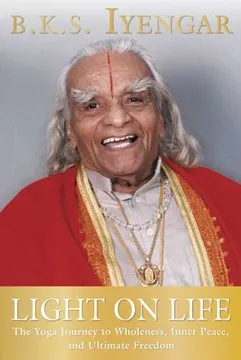


Key Takeaways
Start with the body you have; persistence can turn limitation into a path inward
A difficult beginning. Born frail in 1918, Iyengar suffered repeated illnesses and periods of deep melancholy. At fourteen, he began yoga under his brother-in-law, the teacher Krishnamacharya, initially to strengthen his body. By eighteen, he had been sent to teach in Pune, isolated and short of money, with little beyond his practice of postures. Yoga, he writes, changed his health and gave his life direction.
No instant transformation. His story is an argument for possibility through sustained practice, not a promise of quick enlightenment. Beginners may notice calm or lightness early, while deeper change takes longer. The practice is open to people who begin for practical reasons, including pain, stress, or poor fitness.
What's striking is how the memoir makes the philosophy credible through a life rather than a theory: yoga begins as a practical response to illness, then becomes a way to understand the self. That progression can reassure beginners who are skeptical of spiritual language. A personal history, however, demonstrates possibility, not guaranteed medical outcomes for everyone. The useful lesson is persistence paired with guidance, not the assumption that every condition can or should be treated through yoga alone.
Treat physical health as the first layer of wholeness, not its finish line
Five nested layers. Iyengar uses the Sanskrit term kosas for five interrelated sheaths of being: the physical body, vital energy, mind, intelligence, and bliss or soul. They are not presented as separate organs, but as a map for noticing how bodily condition, breath, emotion, thought, and insight affect one another. Health, in this view, means more than the absence of pain; it includes emotional steadiness, clarity, and ethical life.
Begin at the tangible. Posture is the accessible starting point because it gives practitioners something concrete to observe. Yet flexibility alone is not the destination. The aim is communication between layers: the body informs the mind, intelligence corrects action, and subtler awareness shapes how the body moves.
The layered map resembles a systems model: a change in one component can influence the functioning of the whole. Modern approaches to health also recognize that movement, mood, attention, and physiology interact, although they do not require a soul-based explanation. The model is most useful as a practical prompt to look beyond symptoms. It is less useful if the kosas are treated as literal anatomy or if spiritual language is allowed to replace medical assessment.
Make each pose a test of attention, not a contest in flexibility
Movement becomes action. Iyengar distinguishes movement from action: action includes awareness of what the body is doing and the intelligence to adjust it. In a posture, a practitioner notices where one side is working harder, whether the base is stable, and whether the rest of the body is responding. He describes refined bodily sensation as if the skin itself were watching. The image points to detailed awareness, not literal extra eyes.
Observe, adjust, reflect. The brain should not simply force the body toward an ideal shape. It should listen to bodily feedback, make a careful change, and assess the result. A posture that looks impressive but is performed mechanically misses the point. Precision matters because it links physical practice to concentration and self-knowledge.
This account anticipates the value of interoception, the ability to notice internal bodily signals, and of feedback-based motor learning. Rather than repeating a shape, the practitioner learns through small corrections. That makes yoga a form of inquiry, not merely exercise. Bodily signals still require interpretation: sensation can be ambiguous, and attention alone does not guarantee correct alignment. A qualified teacher can help distinguish useful feedback from strain or unsafe technique.
Choose effort that expands capacity without sacrificing tomorrow's practice
Challenge without damage. Iyengar argues that some discomfort accompanies learning, but pain should not be glorified. He distinguishes gradual stretching or strengthening from sharp, sudden pain and pain that persists or worsens. He recalls injuring himself as a young practitioner when his teacher demanded an extreme split before he was prepared. The episode supports gradual progression, not pushing through every warning.
Progress is small and steady. He advises practicing within present capacity while extending it little by little. Ten minutes of attentive work can be more valuable than an ambitious routine done badly or abandoned quickly. The test is whether today's effort supports continued practice, rather than leaving the body less able to practice tomorrow.
The distinction between productive challenge and warning pain is a valuable safeguard against the idea that suffering proves commitment. Contemporary pain science also cautions that pain does not map neatly onto tissue damage, so neither automatic retreat nor automatic persistence is always justified. The practical implication is to attend to the quality, duration, and context of pain, and to seek expert advice when symptoms are sharp, persistent, or worsening. Consistency is not worth injury.
Let breath steady attention before emotion dictates your next move
Breath as a bridge. Prana means vital energy in yoga's vocabulary, while pranayama refers to practices that regulate and extend the breath. Iyengar treats breath as a link between body and mind, and as a way to gather attention that is usually scattered among outside distractions. He describes four aspects: inhaling, pausing after inhalation, exhaling, and pausing after exhalation. The pauses are approached gradually, never by force.
Prepare before intensifying. Iyengar says the body and nervous system need a stable foundation from posture before advanced breath practice. He began pranayama only after years of asana and describes struggling with it without adequate instruction. Breath can also reveal emotional agitation: when feelings become turbulent, breathing often changes. The aim is to observe and settle, not to suppress emotion or strain for a dramatic experience.
The practical link between breathing and attention is intuitive and widely used in contemporary self-regulation approaches. Slower, attentive breathing can offer a pause in which a person notices emotion rather than immediately acting on it. Iyengar's account also assigns breath a cosmic role as life energy, which is a spiritual interpretation, not a biomedical measurement. Keeping those meanings distinct lets readers value the exercise without treating every metaphysical claim as established physiology.
Insert a pause between the trigger and the habit you have rehearsed
Three forces in consciousness. Iyengar distinguishes mind, ego, and intelligence. Mind processes sensory information and remembers what has brought pleasure or pain. Ego turns experience into a story about “me” and what “I” want. Intelligence can step back, consider consequences, and choose a different response. For example, a familiar remark from a family member may trigger irritation before the person has actually said anything hurtful.
Habits leave impressions. Samskara is Iyengar's term for the accumulated imprints that make certain reactions easier to repeat. He compares them to deposits at the bottom of a lake: repeated irritability makes the next irritated response more likely. One deliberate pause does not erase years of habit, but repeated interruption can weaken an old response and build a more useful pattern.
This model connects contemplative self-observation with modern accounts of learned responses: cues acquire meaning through repetition, and behavior can become automatic. The book's practical contribution is to treat a reaction as something that can be noticed and reshaped, rather than as a fixed personality trait. Still, habit change can be affected by biology, environment, and social pressure, not just will. A pause helps, but durable change may also require changing the conditions that keep triggering the response.
Question the identity that clings to pleasure, status, and survival
Five recurring distortions. Iyengar calls the klesas, or afflictions, patterns that cloud perception: avidya, mistaking the transient for the enduring; asmita, overidentifying with the separate self; raga, attachment to pleasure; dvesa, aversion to pain; and abhinivesa, clinging to life or fearing death. He presents them as common features of human consciousness, not as proof that a person is morally bad.
Notice what becomes “mine.” A scratch on a prized car can provoke a disproportionate response when identity has fused with possession. Similar attachment to status, praise, or a particular self-image can make change feel like a threat. Practice aims to loosen those identifications, not to abolish ordinary personality or the body's natural wish to survive.
The afflictions offer a compact lens for examining how identity amplifies ordinary desires and fears. The distinction between caring for something and making it the foundation of self-worth remains useful across consumer culture, work, and relationships. The framework is spiritual and philosophical, not a clinical diagnosis. It should not be used to shame people for grief, attachment, or fear, which can be healthy responses as well as sources of suffering.
Measure spiritual progress by how you treat people, not how poses look
Ethics belongs at the center. The eight petals of yoga include ethical restraints (yama), personal observances (niyama), posture (asana), breath regulation (pranayama), sensory withdrawal (pratyahara), concentration (dharana), meditation (dhyana), and absorption (samadhi). Iyengar insists that ethical conduct is not an optional preface to physical practice. Non-harming, truthfulness, non-stealing, self-restraint, and modesty shape how a practitioner lives with other people.
Choose life in the world. Iyengar declined the life of a renunciate and chose marriage, children, teaching, and earning a living. He describes four aims: duty, livelihood, human enjoyment, and freedom. Their balance lets a person participate in ordinary life without making pleasure or possessions the whole purpose. Friendliness, compassion, joy in others' goodness, and even-handedness toward vice are practices, too.
This emphasis makes spiritual development answerable to relationships and conduct rather than private claims of attainment. It also resists the assumption that serious practice requires withdrawal from family or work. The four aims create a useful balance between responsibility, material needs, enjoyment, and inner freedom. Ethical traditions can differ across cultures and circumstances, so their principles need thoughtful application. The strongest test is whether they reduce harm and deepen respect, not whether they enforce uniform lifestyles.
Use concentration to quiet the mind, but do not chase mystical states
Preparation, not a shortcut. Iyengar treats concentration and meditation as capacities built on ethical practice, postures, breath, and withdrawal from sensory distractions. Concentration gathers attention; meditation is a deeper stillness, not simply sitting quietly or using relaxation to manage stress. Samadhi is described as absorption in which the usual sense of separation falls away. It cannot be forced or reliably taught as a technique.
Return to ordinary life. The point is not to collect extraordinary experiences or powers. Iyengar describes kaivalya as freedom expressed in action: a person returns to daily life less governed by ego, reward, and reactive habit. The practical measure is not a claim to enlightenment, but whether perception becomes clearer and conduct more compassionate, steady, and unselfish.
The staged account offers a strong counterweight to the commercial promise that meditation is an instant fix or that unusual experiences prove mastery. It emphasizes preparation and the quality of action after practice. At the same time, readers can benefit from relaxation and mindfulness without accepting Iyengar's strict definition of meditation or his metaphysical account of samadhi. These different aims should not be confused, but neither needs to invalidate the other.
Analysis
Light on Life is at once memoir, practical guide, and philosophical map. Its organizing movement is inward: the practitioner begins with the tangible body, works through breath, mind, and intelligence, and approaches the soul. The narrative gives that structure human stakes. Iyengar's fragile childhood, difficult apprenticeship, and long practice make the argument for persistence concrete, while his choice of family and teaching over renunciation keeps the spiritual path rooted in ordinary responsibilities.
The most distinctive contribution is its account of posture as a discipline of attention. The body is not merely an object to improve, but a source of feedback that can expose imbalance, impatience, and habit. In this sense, asana functions as an experiment: act, notice, correct, and learn. Breath extends that inquiry from movement to emotion, while the distinctions among mind, ego, and intelligence explain why knowing a better choice does not automatically produce it.
The book's strongest practical claims concern attentive practice, gradual effort, self-observation, and the ethical consequences of inner work. Its larger claims about soul, cosmic energy, karma, and liberation belong to a spiritual worldview and cannot be verified by the same methods as claims about movement or breathing. Readers can engage the practices without treating every metaphysical assertion as scientific fact.
Some advice requires particular care. The idea that pain can teach resilience is balanced by Iyengar's warning against sharp or worsening pain, but readers should not mistake endurance for a substitute for medical assessment. Likewise, his broad statements about yoga's effects on illness and mental states exceed what a personal account alone can establish. Read critically, the book remains valuable because its central discipline is not credulity: it is sustained observation, correction, humility, and the effort to make private practice visible in public conduct.
Review Summary
Glossary
kosas
five layers of beingThe five kosas are the physical, energetic, mental, intellectual, and blissful or soul sheaths of a person. Iyengar uses them as a map of interrelated dimensions, not as separate anatomical structures. Yoga practice aims to bring the layers into communication and balance, so bodily work can inform mental clarity and deeper awareness.
Eight petals of yoga
integrated path of practiceThe eight petals are yama, niyama, asana, pranayama, pratyahara, dharana, dhyana, and samadhi. They refer to ethical restraints, personal observances, posture, breath regulation, sensory withdrawal, concentration, meditation, and absorption. Iyengar presents them as interdependent aspects of yoga, not isolated techniques or a set of shortcuts.
prana
vital energy or life forcePrana is the life force or vital energy described in yoga philosophy. Breath is one expression of it, but the term refers more broadly to the energy that sustains activity and links individual awareness with the larger natural world. Iyengar uses prana in both practical discussions of breathing and a spiritual account of universal vitality.
pranayama
cultivation of breath and energyPranayama is the disciplined regulation and extension of breathing, understood by Iyengar as a way to cultivate prana and steady consciousness. Its practices include inhalation, pauses after inhaling, exhalation, and pauses after exhaling. He stresses that it requires preparation through asana and should develop gradually rather than through force.
citta
field of consciousnessCitta is consciousness understood as the field in which awareness and mental fluctuations occur. Iyengar describes it as including mind, ego, and intelligence, which may work together or pull in different directions. Yoga seeks to calm and clarify citta so perception is less distorted by memory, desire, fear, and habit.
samskara
imprints that shape habitsSamskara refers to accumulated impressions that predispose a person to repeat particular thoughts and behaviors. Iyengar compares repeated reactions to deposits that build up beneath the surface of consciousness and influence later responses. Repeatedly interrupting an unwanted pattern can weaken its influence, while new actions establish different impressions.
klesa
patterns that cloud perceptionThe klesas are five afflictions that Iyengar sees as common distortions of consciousness: ignorance, pride or mistaken self-identification, attachment, aversion, and fear of death or clinging to life. They are not simply moral failings. They cloud judgment and reinforce suffering by making transient things seem permanent or central to the self.
sadhana
sustained path of practiceSadhana is committed practice directed toward transformation and self-knowledge. It includes more than repeating physical exercises: effort, observation, ethical conduct, and reflection give the practice its purpose. Iyengar contrasts sadhana with mechanical repetition, emphasizing that practice should deepen understanding and change how a person acts.
samadhi
absorbed state of unionSamadhi is the culminating state of absorption in which ordinary subject-object separation and ego-centered awareness subside. Iyengar describes it as an experience of profound unity and bliss that cannot be forced or adequately explained from outside. It is the culmination of preparation through the other aspects of yoga, not a simple relaxation technique.
kaivalya
freedom expressed in lifeKaivalya is ultimate freedom or emancipation. Iyengar distinguishes it from a temporary experience of samadhi by emphasizing freedom in action: the person returns to ordinary life without being ruled by ego, attachment, or the pursuit of rewards. In the book, it represents liberation lived in the world rather than escape from it.
Purusa and Prakrti
soul and changing naturePurusa refers to the enduring Seer or Universal Soul, while Prakrti is Nature, including the changing body and material world. Iyengar presents yoga as an exploration of their relationship within human life. The practitioner works through embodied experience to distinguish what changes from the deeper reality that the tradition regards as unchanging.
About the Author
Other books by B.K.S. Iyengar


Download PDF
Download EPUB
.epub digital book format is ideal for reading ebooks on phones, tablets, and e-readers.








