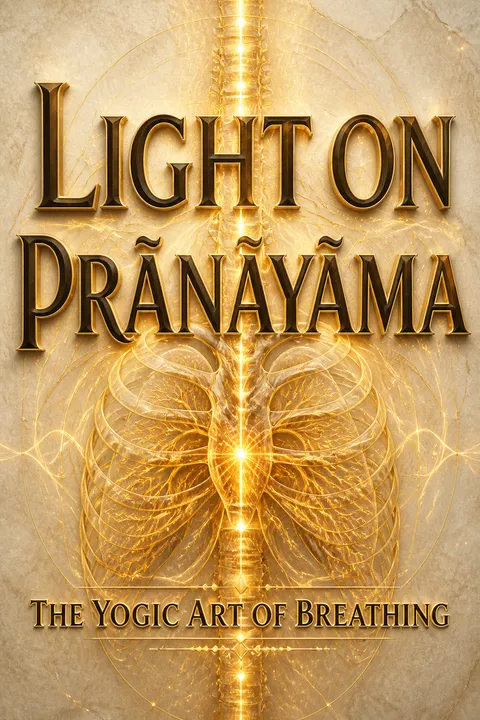


Key Takeaways
Treat breath training as a bridge from bodily skill to inner steadiness
More than deep breathing. Iyengar presents pranayama as the disciplined regulation of inhalation, exhalation, and pauses in breathing. In yogic philosophy, prana is the life force that breathing expresses, not simply the air entering the lungs. Pranayama is therefore both physical training and a way to steady attention and prepare for meditation.
A hard-won craft. Iyengar recounts that he began practicing yoga as a sick child, then struggled for years with pranayama. At first, only three or four cycles left him gasping. He kept practicing, eventually giving an hour a day to the discipline. His story supports the book’s central premise: reading about breath is not the same as learning it through patient, attentive practice.
What's striking is the book's insistence that breathing is both a bodily process and an object of attention. That combination anticipates the modern idea of interoception, the perception of internal bodily signals, which can help people notice and regulate their state. The distinction matters: yogic prana is a spiritual concept, not a measured biological substance. Readers can value pranayama as a contemplative discipline without treating its metaphysical account as established physiology.
Earn the right to control breath by first making the posture stable
Build the foundation first. Iyengar rejects the idea that beginners should learn postures and pranayama at the same time. A novice concentrating on balance and alignment has little attention left to refine the breath. His practical sequence is to develop steadiness in asana, or posture, before introducing deliberate breathing patterns. He compares yoga’s eight interdependent limbs to a tree: posture supports the practice, while pranayama prepares the mind for inward attention.
The wider discipline. The eight limbs begin with ethical commitments and personal disciplines, continue through posture and breath regulation, then turn toward sensory withdrawal, concentration, meditation, and absorption. Pranayama is not a shortcut around those foundations. In Iyengar’s account, a stable, upright seat gives the lungs room to move and the practitioner a steadier base from which to observe the breath.
This sequence resembles skill acquisition in music and sport: stable mechanics free attention for finer control. A pianist who is still fighting hand position cannot easily listen to phrasing; a practitioner struggling to sit comfortably may similarly fixate on discomfort. The analogy makes the book's sequencing persuasive, though readiness is individual. A rigid rule can exclude people with pain or limited mobility, so the underlying principle is more useful than any single ideal posture: find a supported position that allows alertness without strain.
Train the whole breathing apparatus, not just the lungs
Breathing involves the trunk. Iyengar describes the lungs working with the diaphragm, rib cage, intercostal muscles, spine, and abdominal wall. His method asks practitioners to notice how these regions expand and settle rather than imagining that the lungs act alone. He emphasizes an upright torso, an open chest, and coordinated movement through the lower, middle, and upper chest. In his account, posture can restrict breathing, while asana prepares the body to move more freely.
A concrete measure. The book estimates that an ordinary inhalation takes in about 500 cubic centimetres of air, while a deep inhalation may approach 3,000. The figures illustrate the difference between habitual and expanded breathing, though individual capacity varies. The practical lesson is not to force a larger breath, but to develop awareness of how breathing changes with posture and movement.
The useful shift here is from treating breath as a lung-only event to seeing it as coordinated movement across the torso. This is compatible with contemporary respiratory mechanics, where the diaphragm and rib cage play central roles in ventilation. It also makes posture an accessible point of observation. Still, a larger breath is not automatically a better one. Lung capacity varies with body, health, and circumstance, and attempts to maximize it can create unnecessary effort.
Use attention, not force, to make each breath quieter and more complete
Refine instead of strain. Iyengar treats pranayama as a practice of listening, adjusting, and noticing. In ujjayi, the practitioner lengthens the breath while keeping its sound smooth and the torso steady. In viloma, pauses interrupt the inhalation or exhalation, making the practitioner attend closely to each segment. The point is not to pull in air aggressively, but to guide the breath without losing ease or rhythm.
A practical progression. Iyengar first asks students to observe ordinary breathing while lying down, then to practice longer exhalations, longer inhalations, and eventually balanced breathing while seated. He warns against inflating the abdomen in a way that interferes with chest movement, and against lifting the shoulders or tightening the face. Smoothness and comfort are better measures of progress than sheer breath length.
This is a sophisticated account of attention as a motor skill. Small, repeated adjustments can make an otherwise automatic action perceptible, much as slow practice helps musicians detect timing errors. The method also discourages the familiar trap of equating intensity with progress. A caution is warranted: close monitoring can make some people anxious or overly self-conscious. The practice works best when attention remains curious and responsive, rather than turning every breath into a performance test.
Treat retention as advanced work, with clear limits and safeguards
A pause changes the practice. Kumbhaka is the deliberate suspension of breath, either after inhalation or after exhalation. Iyengar presents it as a powerful way to focus attention, but insists that students first learn steady inhalation and exhalation. He describes bandhas, or muscular locks, as ways to contain and direct energy. Jalandhara bandha uses a chin position, while mula bandha engages the pelvic floor; uddiyana bandha draws the abdomen inward after exhalation.
Respect the warning signs. The book repeatedly advises gradual practice, rest between attempts, and stopping when breathing becomes rough or strain appears in the chest, face, or head. It cautions against forceful retention and notes that some forms are unsuitable for people with particular health conditions. These are advanced techniques, not a test of toughness. The text recommends guidance from an experienced teacher, especially when learning retentions and bandhas.
The book’s most responsible instruction here is its emphasis on gradual learning and warning signs. Breath-holding can affect pressure, heart rhythm, and how a person feels, so the ability to tolerate a pause should not be confused with a health benefit. The muscular locks also demand precise instruction. This material is best understood as a description of a traditional practice, not as a self-treatment protocol or a substitute for medical guidance.
Choose breathing patterns for their distinct effects, not as interchangeable drills
Different methods, different demands. Iyengar describes a family of techniques rather than one universal breathing exercise. Ujjayi lengthens and smooths the breath. Viloma adds pauses within an inhalation or exhalation. Bhramari pairs exhalation with a soft humming sound. Sitali draws air through a curled tongue, while sitakari uses a slightly open mouth. In anuloma and pratiloma, the fingers regulate nasal airflow in different ways.
Alternate-nostril practice. Nadi sodhana combines inhaling and exhaling through alternate nostrils, with careful finger placement. Iyengar treats it as especially subtle and demanding, recommending that students build nasal sensitivity and manual control through simpler practices first. The named techniques are not presented as interchangeable shortcuts. Each changes the rhythm, sound, or route of breathing, and the book repeatedly directs practitioners to choose a form suited to their capacity.
The variety in this system resembles a practice repertoire: different patterns train different kinds of attention, from sound and rhythm to fine control of airflow. That can keep a discipline responsive instead of mechanical. Modern readers should be cautious about assigning medical outcomes to each technique, however. The book's traditional descriptions of heating, cooling, or cleansing are not equivalent to clinical evidence. Technique selection should prioritize comfort, skill, and appropriate instruction.
Make practice sustainable through moderation, routine, and an honest response to obstacles
Consistency beats heroic effort. Iyengar recommends a clean, quiet place and a regular time, with early morning as his preference. He says that even fifteen minutes a day is a minimum, while a serious practitioner may need more. He also advises leaving several hours between a meal and practice, and avoiding pranayama when tired, distressed, or congested. His five courses in the appendix move from preparatory work to primary, intermediate, advanced, and highly intense practice, over a long, staged schedule.
Name what gets in the way. Drawing on Patanjali, the book lists obstacles such as illness, doubt, laziness, distraction, and difficulty maintaining concentration. It recommends steady effort, moderation in eating and sleeping, and practices that restore balance rather than blind repetition. Iyengar’s detailed schedule is a map of progression, not a reason to push through discomfort or rush toward advanced methods.
This approach treats practice as a system shaped by time, surroundings, health, and temperament, not as a test of willpower. That is close to what behavior science calls context-dependent adherence: routines are easier to sustain when they fit ordinary life. The extensive course schedule can help structure learning, but its length may also intimidate. A flexible progression, supported by qualified instruction, preserves the book's respect for patience without turning its timetable into a universal prescription.
Use meditation to turn disciplined attention from breath toward the observing self
Breath is preparation, not the destination. In Iyengar’s eight-limbed path, pranayama prepares the practitioner for pratyahara, the drawing inward of the senses, and dharana, sustained concentration. When concentration continues without interruption, it becomes dhyana, or meditation. Samadhi names the culminating state in which the distinction between meditator and object of meditation falls away. These are spiritual aims, not simply synonyms for relaxation or focus.
Alert, not asleep. Iyengar distinguishes meditation from ordinary sleep: both may quiet activity, but meditation retains awareness. He describes the work as a gradual inward journey, supported by ethical discipline, posture, breath, and the ability to direct attention. The book also presents mantra repetition as a possible support for a wandering mind, while emphasizing that recitation alone is not realization.
The account offers a useful distinction between relaxation and contemplative attention. In many modern settings, meditation is framed chiefly as stress management; Iyengar places it within a larger ethical and spiritual project. That wider frame can make practice more meaningful, while also asking more of the practitioner. The claims about union with a universal Self belong to a philosophical tradition, not to a result that can be verified in the same way as a change in breathing rate.
Practice relaxation as an alert skill, not collapse or sleep
Savasana takes training. The corpse pose is lying still on the back while deliberately releasing unnecessary tension. Iyengar’s instructions move from physical alignment to softer breathing, relaxed senses, and a quieter mind. He emphasizes that simply lying down is not enough: the body should rest while awareness stays present. He recommends beginning with the body, then attending to breath, the senses, and the mind, rather than trying to force stillness all at once.
Return gradually. Iyengar suggests practicing for roughly ten to fifteen minutes. At the end, he advises reopening the eyes gently, turning to one side, pausing, and only then sitting up. This slow transition reflects the larger aim of the book: relaxation is not collapse, but a deliberate movement from effort toward alert ease. For readers who have just practiced, savasana is the point at which the work settles.
Savasana makes a subtle but important claim: rest can be active in the sense that it involves noticing and releasing tension, not merely stopping movement. That idea connects with modern relaxation training, where attention to bodily state is part of the technique. The detailed alignment instructions may help some practitioners, though they can also encourage over-monitoring. The best test is whether the posture supports ease and alertness, not whether every body conforms to one precise arrangement.
Analysis
Light on Pranayama is at once a practical manual, a philosophical exposition, and a record of learning through difficulty. Its governing idea is that breathing practice links bodily control to mental steadiness, then places both within a spiritual discipline. The book’s architecture follows that argument: explain yoga and prana, establish posture and preparation, teach progressively complex techniques, then turn toward meditation and relaxation. The result is not merely a catalogue of breathing exercises. It is a map of how the author believes attention can move from the visible body toward subtler experience.
The most durable contribution is pedagogical. Iyengar repeatedly asks the reader to observe small changes in posture, sound, rhythm, and effort. He makes precision a practice of perception, not just technical correctness. His autobiography reinforces the method: early failure is neither romanticized nor treated as proof of incapacity. It becomes a reason to persist carefully. His staged courses and abundant cautions further express a central conviction: progress depends on time, discernment, and readiness, not on force.
The book also combines traditional yogic concepts with anatomical language. That synthesis can make a subtle discipline intelligible, but its categories should not be collapsed into one another. Prana, nadis, chakras, and kundalini belong to a spiritual model of the body; they are not established anatomical structures. Some physiological and therapeutic claims in the text reflect its period and should not be treated as current medical guidance. This distinction need not diminish the book’s value. It clarifies what kind of knowledge is being offered: detailed instruction in a contemplative tradition, joined to the author’s lived teaching experience, rather than a modern clinical treatment manual.
Read in that light, the book’s strongest practical lesson is not to imitate advanced breath ratios. It is to develop a patient relationship with breathing, respect limits, and understand technique as preparation for attention. Its spiritual destination may not be every reader’s destination, but its method asks a broadly useful question: can awareness become precise without becoming forceful?
Review Summary
Light on Prānāyāma receives mostly high praise, with readers appreciating its exhaustive detail on breathing techniques, clear anatomical explanations, and structured progression from basic to advanced practices. Many consider it an essential reference for serious yoga practitioners and teachers. Critics note its density can be overwhelming for beginners, and some find the blend of science and mythology confusing. Several readers emphasize it works best as a study manual rather than casual reading, and many agree that learning pranayama without a mentor is challenging.
Glossary
Pranayama
Disciplined breath regulationA yogic discipline involving the deliberate regulation and refinement of inhalation, exhalation, and pauses in breathing. In Iyengar’s account, it is more than breathing exercise: it works with prana, understood in yoga as life force, and prepares the practitioner for inward attention and meditation.
Prana
Yogic life forceIn yoga philosophy, prana is the vital energy understood to animate living beings and the wider universe. Breathing is one visible expression of it, but the book uses the term more broadly than ordinary air or respiration. The concept belongs to a traditional spiritual model, not to a measured anatomical substance.
Kumbhaka
Breath suspensionA pause in breathing, either after inhalation or after exhalation. Iyengar distinguishes intentional pauses, called sahita kumbhaka, from kevala kumbhaka, a spontaneous state in which breathing becomes suspended without deliberate effort. He treats deliberate retention as advanced work requiring gradual preparation and careful attention.
Bandha
Muscular energy lockA yogic lock involving the contraction or positioning of parts of the body. Iyengar describes jalandhara bandha, involving the chin and throat, mula bandha, involving the pelvic floor, and uddiyana bandha, which draws the abdomen inward after exhalation. In the book, bandhas help regulate energy during pranayama.
Nadi
Yogic energy channelA channel through which energy is said to move in the subtle body. Yoga texts describe many nadis, with ida, pingala, and susumna treated as especially important. Iyengar sometimes compares nadis with physical tubes or nerves, but the subtle channels are part of a traditional energetic model and are not identical to anatomical structures.
Nadi sodhana pranayama
Alternate-nostril breathing practiceA pranayama technique that alternates inhalation and exhalation between the nostrils, using the fingers to regulate airflow. Iyengar presents it as a particularly refined practice requiring control of the hands, attention to nasal airflow, and steady breathing. He advises developing those skills through simpler pranayamas first.
Samavritti pranayama
Equalized breath timingA form of pranayama in which the durations of inhalation, retention, and exhalation are brought toward equality. Iyengar recommends first making inhalation and exhalation even, then introducing retentions gradually. The aim is a smooth, balanced rhythm rather than a forced count or a contest to extend the breath.
Vishamavritti pranayama
Unequal breath timingA form of pranayama in which the durations of inhalation, retention, and exhalation differ according to a chosen ratio. Iyengar describes it as more demanding than equalized breathing and warns that the altered rhythm can strain the practitioner. He recommends attempting it only after establishing control and with experienced guidance.
Kosas
Interpenetrating body sheathsThe five sheaths described in Vedantic philosophy as layers surrounding or expressing the self: the anatomical, physiological, psychological, intellectual, and bliss sheaths. Iyengar uses this framework to explain how yoga practice is understood to affect more than muscles and organs, extending from the physical body toward mental and spiritual experience.
Savasana
Alert relaxation postureA supine posture in which the practitioner lies still and deliberately releases tension. Iyengar describes it as a demanding practice because the body is relaxed while the mind remains alert. It provides rest after practice and, in the book’s spiritual framework, offers a way to quiet bodily and mental activity without simply falling asleep.
Download PDF
Download EPUB
.epub digital book format is ideal for reading ebooks on phones, tablets, and e-readers.








