

Plot Summary
The Warnovits Appeal
At oral argument, Judge George Mason hears four former hockey players challenge their convictions for assaulting Mindy DeBoyer, a fifteen-year-old who was unconscious at a party hosted by Jacob Warnovits. Warnovits filmed the assault, and years later the recording exposed what Mindy could not remember.
The prosecution began more than three years after the crime, so the appeal turns on whether the defendants concealed it long enough to suspend the statute of limitations.
Their celebrity lawyer, Jordan Sapperstein, also argues that the graphic recording should not have been shown to the jury. The case has inflamed Glen Brae with accusations about race and privilege, while the defendants remain free on bond. Mason, troubled by both legal questions, cannot yet settle on a ruling.
The case puts two kinds of time in conflict. The statute measures delay through legal categories, while Mindy’s experience shows that discovery and trauma do not necessarily begin when an offense occurs. The tape seems to offer certainty, yet it also makes the court’s use of evidence a question of law rather than simple moral judgment. Mason enters the story believing that disciplined interpretation can keep those questions separate. The public dispute over race and privilege further complicates that faith: the court must rule on legal procedure while knowing that many people will read its decision as a judgment about whose suffering counts.
A Death Threat Arrives
For several weeks, someone has sent Mason increasingly explicit threats through messages disguised as bounced email. The latest contains a link to a website that claims to know when and how he will die.
Court security chief Marina Giornale tells him that the FBI traced the messages through anonymous servers but cannot identify the sender. She suspects Jaime Colon, the imprisoned gang leader known as El Corazon, whom Mason helped keep in prison.
Mason dismisses the theory and refuses a home detail, unwilling to alarm Patrice, his wife, who is undergoing radioactive treatment for thyroid cancer. His jokes keep the danger at arm’s length, but he has not told Patrice, and the anonymous sender’s knowledge of his life begins to feel less like ordinary harassment.
Mason’s humor is both a habit and a defense: it lets him keep acting like a judge while fear gathers outside his official role. Concealing the messages from Patrice is meant as care, but it also leaves him alone with an imagined threat and denies her the chance to understand his behavior. Marina’s suspicion of Corazon gives the fear a recognizable face, yet the technical anonymity of the messages makes any explanation provisional. Meanwhile, Patrice’s treatment makes the threat of death immediate within their marriage. The book places public danger beside private illness, showing how easily a person can confuse protecting loved ones with controlling what they are allowed to know.
A Bench Divided
In conference, Judge Nathan Koll argues that a recent ruling on the state’s eavesdropping law makes the assault videotape inadmissible, even though the defense never raised that point at trial or in its appeal. Judge Summerset Purfoyle rejects the move as an improper rescue of the defendants’ case.
Mason agrees that the judges should not invent an argument the lawyers failed to preserve, but he remains troubled by the limitations question: Mindy had wondered whether she had been raped, yet never went to authorities. The three judges reach no shared rationale, and Mason takes responsibility for writing the opinion. As he struggles to explain why the case weighs on him, he nearly tells his colleagues that it feels personal.
The conference dramatizes the difference between judging a case and trying to correct its moral balance. Koll’s argument may follow the statute’s language, but it also bypasses the adversarial process that gives both sides a chance to address an issue. Purfoyle’s objection protects procedure, while Mason’s unease concerns the limits of that protection when the underlying crime is appalling. His inability to decide is not merely indecision about doctrine. The case is pressing against a private memory he has not yet admitted into his legal reasoning, exposing the judge’s fantasy that professional distance can keep the past outside the courtroom.
The Refrigerator Box
Alone in his car, Mason recalls his first year of college in 1964. Miserable and eager to escape the sexual restraint of his upbringing, he follows his friend Mario Alfieri toward a dormitory hallway where men have formed a line outside a refrigerator box. A drunken young woman, Lolly Viccino, is inside with students taking turns.
Mason pays his way in and has sex with her while she is incoherent from drinking and illness. At the time, he accepts the crowd’s assumption that the encounter is an initiation into adulthood. Now, hearing the Warnovits appeal, he can no longer hide behind that story. Lolly could not meaningfully consent, and Mason recognizes that he too exploited her.
The memory does not arrive as a clean confession. Mason has spent decades arranging the event under the harmless label of youthful foolishness, a description that protected his self-image while leaving Lolly’s experience unconsidered. The cardboard barrier and the watching crowd made exploitation seem like a shared ritual, but collective participation did not make it consensual. His recognition is therefore a psychological rupture as much as a change in vocabulary: he can no longer rely on the law’s historical standards to certify his innocence. The scene also complicates his role as judge, since he must evaluate conduct he once excused in himself.
Lolly's Sunday Morning
The next morning, Mason finds Lolly alone in the dormitory library, sick, disheveled, and unsure where she can go. He brings her cigarettes and food, then learns that her mother will not take her back after she has been expelled from college. When the dormitory proctor decides to remove her, Mason does not insist that she stay or help her find somewhere safe.
He has remembered the sexual encounter, but not how he abandoned her afterward. In the present, he tries to tell Patrice that his experience resembles the Warnovits case. She rejects the comparison before hearing the details, then notices his distraction and asks him to stop making her illness about his distress.
The morning after reveals a second failure, distinct from the sexual assault: Mason briefly sees Lolly as a person in need, but retreats when helping her would require challenging the rules and his own fear. His kindness is real, yet it does not undo his passivity. That distinction matters because his memory cannot be settled by deciding whether he meant well. Patrice’s response likewise refuses to serve as easy absolution. She is ill and needs Mason’s steadiness, while he is beginning to recognize that his moral self-image has been built partly on acts of care that stopped short of costly responsibility.
The Chief's Warning
Marina assigns Abel Birtz to accompany Mason at the courthouse, and Chief Judge Rusty Sabich privately urges him to file his retention papers rather than let the threats drive him off the bench. Rusty also maps the consequences of the Warnovits appeal.
Reversing on the tape could let prosecutors bring a new eavesdropping case; reversing on limitations could end the prosecution and provoke public fury. Mason dislikes being steered by electoral calculations, but he sees that every legal route has practical costs.
When he asks whether a judge should be disqualified whenever a case recalls his own life, Rusty answers that recognizing oneself in others is part of mercy. Mason leaves without a ruling, still unsure whether his discomfort is insight or bias.
Rusty’s intervention makes power visible without reducing it to cynicism. He is right that an appellate decision creates consequences beyond its written holding, and he is also protecting the court’s institutional standing. Mason resists because he fears that practical calculation will become a substitute for legal judgment. His question about personal identification complicates that resistance: a judge who recognizes himself in a defendant may become more humane, but may also mistake resemblance for evidence. The scene refuses an easy rule for moral distance. Instead, it shows Mason trying to decide whether self-knowledge can sharpen judgment without secretly taking the place of law.
Zeke in the Corridor
A young gang member named Khaleel appears in Mason’s chambers corridor, and Dineesha’s son Zeke arrives to defend his friend after security detains him. Marina suspects a gang operation; Mason sees no proof, but Dineesha’s distress makes clear that Zeke’s history has long burdened her.
Soon afterward, an undercover car follows Mason from home, and he confronts Marina for extending protection without permission. Then a text arrives on Patrice’s phone from Mason’s missing cell, and Judge Koll receives a threat printed on paper stained with blood.
Mason remembers that Koll sat on El Corazon’s appeal, strengthening Marina’s theory. Yet the crude letter does not fit the anonymous sender’s earlier, carefully staged messages, and Mason begins to doubt the obvious suspect.
Suspicion multiplies faster than evidence. Zeke’s criminal history makes him plausible to the investigators, while his connection to Dineesha makes the possibility painful for Mason’s staff. The bloody note gives Marina a vivid link to Corazon, but vividness is not proof; Mason notices that its theatrical form clashes with the earlier digital threats. His conflict with Marina also concerns agency. She treats protection as an obligation, while he sees undisclosed surveillance as another intrusion into the life he is trying to manage. The growing threat narrows his choices, but each new clue also exposes how readily fear turns familiar stereotypes into explanations.
The Lexus in the Garage
After work, Mason sees two teenagers in the courthouse garage, the same boys Abel had wanted security to question. He tells Abel to leave them alone, then sits in his Lexus, the one place he thinks belongs entirely to him. One teenager presses a pistol against the window and demands the car.
Mason mistakes the robbery for an assassination attempt connected to Corazon, resists, and is struck across the arm with the gun. The boys take his wallet, watch, keys, and Lexus, then drive away. Only afterward does Mason understand that they meant to steal from him, not kill him. His forearm is fractured, and the encounter leaves him shaken by how badly his legal experience failed to prepare him for being a victim.
The garage strips Mason of the interpretive authority he usually possesses. In court, he can reconstruct a crime from records and testimony; under a gun, he cannot even tell what the assailant wants. His belief that the robbery is a planned killing makes him more resistant and therefore more vulnerable. The distinction is painful: he has not merely been frightened but has acted on a mistaken story about the boys. His private refuge becomes the site where professional confidence collapses into bodily dependence. The scene makes vulnerability concrete through the fracture, the stolen keys, and his belated recognition that survival required understanding the attackers rather than his own theories.
A Robbery, Not Revenge
Police find Mason’s Lexus with two brothers, Hector and Guillermo, and he identifies them and the guns used in the robbery. Hector explains that he and his brother meant to raise money for a friend’s bail, not carry out Corazon’s revenge; he had not known Mason was a judge.
Dineesha separately admits that Zeke had taken keys to retrieve guns from her shed, then arranged for Khaleel to return them, explaining the suspicious courthouse visit. FBI analysis adds a more troubling clue: the first threatening email originated on Mason’s own courthouse computer.
The gang theory now looks weaker, and the investigation turns toward people who could enter his chambers. Mason must reconsider both the boys he misread and the threat he has been trying to explain.
The ordinary motive behind the robbery does not make it harmless, but it breaks the grand conspiracy Mason and Marina had built around it. Hector’s account restores individual motives to boys whom the adults had treated as signs of a gang network. Dineesha’s disclosure similarly turns Zeke’s suspicious appearance into a family problem involving guns, not evidence that he threatened Mason. The computer finding reverses the direction of the investigation: danger may have come from inside the courthouse rather than from a distant gang leader. Mason’s errors are now cumulative, forcing him to distinguish what he knows from what fear made plausible.
The Call to Lolly
With help from John Banion’s research, Mason finds a likely address for Lolly Viccino, now living in California, and calls her from his chambers. He does not tell her what happened in the dormitory. Lolly says she barely remembers college and has no desire to revisit that period; she has spent her life getting by and believes the past cannot be changed.
Mason tells her that his own life has gone well, then apologizes for anything he may have done to make hers harder. The call gives him no account of what she remembers and no forgiveness. Afterward, he understands that he cannot use her response to settle his guilt. Her refusal to reopen the past leaves him with the responsibility of deciding what to do now.
Mason’s call is driven by a hope he cannot quite admit: that Lolly’s present life might tell him how much harm he caused, or that she might release him from it. Her refusal blocks both fantasies. She does not provide the missing testimony that would make his memory complete, and she does not organize her life around his need for closure. Her blunt wish to move on is not proof that she was unharmed; it is simply the boundary she chooses. Mason must accept that remorse cannot purchase access to another person’s past. His only available repair is to act more honestly in the present.
The Phone's Lost Trail
Because the first email came from Mason’s computer, he narrows the possible suspects to people who could enter his chambers. He initially suspects his young clerk, Cassie Oakey, who was with him when his phone disappeared at the Hotel Gresham. At breakfast there, a security guard recalls that the phone was found in the ballroom corridor and signed out by Banion, Mason’s quiet, long-serving clerk.
Cassie confirms that Banion seemed unusually concerned when Marina seized the computer, but neither she nor Mason knows why. Back at the courthouse, Banion arrives with a resignation letter. Mason asks him what is happening, and Banion begins to cry, insisting that the conduct cannot be explained by his character alone.
The clue is mundane, almost bureaucratic: a signed lost-property form. Its power comes from how it corrects Mason’s narrative. He had let proximity and Cassie’s forceful manner make her seem more likely, while Banion’s discretion made him nearly invisible. The reversal exposes a common investigative bias: people notice the conspicuous, then mistake visibility for access or motive. Banion’s tears do not yet explain the threats, but they change the emotional register of the mystery. Mason is no longer simply identifying a perpetrator. He is confronting the possibility that someone he has relied on has been suffering in silence.
John Banion Breaks
Banion admits that watching the assault tape repeatedly, at Mason’s request, filled him with disgust and anger. He blamed Mason for making him study it and feared the judge would let the defendants escape punishment. He sent the first threat from Mason’s computer, then used anonymous servers and the stolen phone to escalate the messages.
He also sent Koll the bloody note, hoping the added threat would direct suspicion toward Corazon. Banion had no part in the garage robbery. Mason recognizes that he assigned the tape without asking how the work affected his clerk, and apologizes. Banion asks for forgiveness; Mason grants it, though he knows the police and professional authorities must still be told.
Banion’s explanation links grievance to responsibility without making them equivalent. Mason did impose disturbing work on him without checking his capacity to bear it, but Banion answered that failure with calculated threats that frightened several people. His isolation helps explain why resentment became action, yet it does not erase the harm. Mason’s apology matters because he acknowledges a real managerial failure rather than accepting blame for every choice Banion made. Forgiveness, in turn, is not concealment or acquittal. The case insists on two truths at once: a person can be accountable for wrongdoing and still be met with compassion.
Mason Writes the Opinion
Mason writes the court’s opinion affirming all four convictions. He finds that the defendants’ concealment prevented Mindy from making a credible report, so the prosecution fell within the limitations law.
He rejects Koll’s videotape argument because it was not raised earlier and does not meet the standard for correcting an unpreserved error. Mason files his retention petition, while Koll resigns, still frightened by the threats.
For Banion, Mason asks Rusty to support a confidential diversion program and suspension of his law license pending treatment; the court chief agrees to help keep the matter from becoming public spectacle. The opinion does not erase Mason’s past or repair Lolly’s life. It gives him a decision he can defend without pretending that judgment makes him innocent.
The ruling resolves the appeal through procedure, but Mason’s reasoning is no longer emotionally untouched by the facts. He affirms because the concealment provision can account for Mindy’s age and experience, not because the defendants seem deserving or because the tape makes judgment easy. His own buried conduct has taught him how self-serving stories can survive when no one challenges them, yet it has not licensed him to replace statute with private conscience. The outcome also distinguishes compassion from indulgence: Mason forgives Banion while seeking consequences and treatment, just as he affirms the defendants’ sentences through law rather than revenge. His retention filing signals continued responsibility, not moral certainty.
Analysis
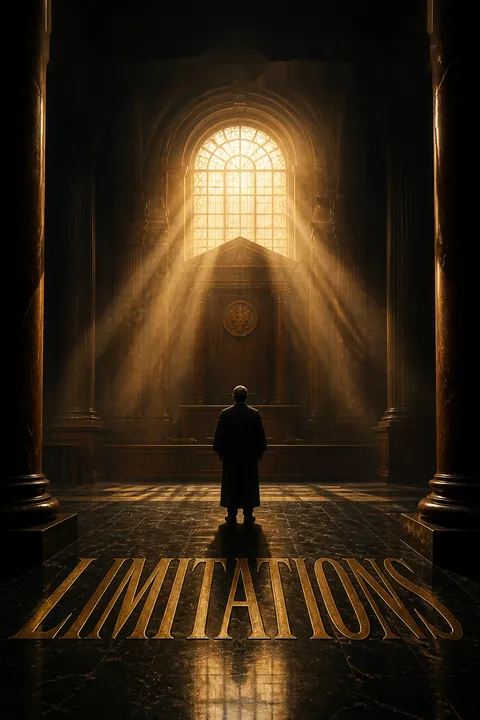
Limitations is built around a judge who discovers that legal distance can disguise personal evasion. Mason’s work asks him to decide whether a statute permits prosecution after a delayed disclosure, but the case also reopens his own encounter with Lolly, a young woman he once treated as a passage into adulthood rather than as a person with needs and limits. The novel does not make that parallel a shortcut to the ruling. Mason’s past may sharpen his attention to concealment and consent, but it cannot authorize him to ignore the law or decide the appeal by private confession.
The book is equally skeptical of certainty produced by institutions. The judges disagree about the tape, the police build a theory around Corazon, and Mason misreads a robbery as an assassination attempt. Evidence matters, but so do the assumptions that shape what people notice. Hector’s motive is painfully ordinary, while the threat campaign comes from a trusted colleague whose isolation and grievance remain real without excusing his actions. The mystery therefore tests not only who committed each act, but how quickly fear turns a person into a role: gang member, victim, judge, criminal.
Mason’s marriage and his relationship with Banion deepen the question of responsibility. He hides the threats from Patrice in the name of protection, then realizes that secrecy has made him harder to reach. He assigns Banion disturbing work without asking what it costs, yet his apology does not erase the clerk’s culpability. The novel’s moral intelligence lies in refusing to make care and accountability opposites. Mason can forgive Banion and still seek consequences; he can acknowledge his own past and still affirm the defendants through a reasoned interpretation of law. The final judgment is not a declaration that justice is perfect. It is a decision made by someone who knows more clearly what judgment cannot absolve.
Review Summary
Limitations receives mixed reviews averaging 3.48 stars. Readers appreciate Turow's legal authenticity and literary depth, particularly his portrayal of appellate judge George Mason grappling with a rape case that echoes his own past. Lawyers especially praise the exploration of tensions between law and human nature. Critics find the pacing slow and the plot lacking action typical of thrillers. Many note the book's cerebral nature and psychological complexity, though some feel it could have been more powerful. Character development and beautiful prose are consistently praised, while the thriller elements and resolution disappoint some readers.
People Also Read






Characters
George Mason
Judge facing his pastA former criminal defense lawyer, Mason is an appellate judge who takes pride in reading statutes closely and keeping personal feeling outside his rulings. His Southern manners and dry humor help him move through a demanding public role, but they can also conceal fear and self-protective habits. He is devoted to Patrice and unsettled by her illness, even as he tries to spare her from worry. The Warnovits appeal forces him to examine how his own history shapes his ideas about guilt, consent, and judgment. His central tension is not whether he cares about justice, but whether his care can coexist with the limits that make law legitimate.
Patrice Mason
Architect and anchorMason’s wife of more than thirty years, Patrice is an accomplished architect whose practical intelligence contrasts with her husband’s abstraction. She values independence, wit, and honest attention more than dramatic reassurance. Her thyroid cancer treatment confines her to isolation at the hospital, yet she resists being treated as fragile and expects Mason to remain present without making her illness a stage for his fears. Their affection is expressed through teasing and familiar rituals, but her directness can turn sharp when she feels he is withholding the truth. Patrice represents both the life Mason cherishes and the person whose needs he cannot manage by professional rules.
Marina Giornale
Court security chiefThe energetic head of court security, Marina is a former police detective with strong instincts and limited resources. She treats threats against Mason as operational problems that demand protection, even when he resists her methods. Her commitment to safety is genuine, though she also recognizes that a credible threat can help her press the County Board for funding. Their clashes reveal two competing ideas of care: Marina acts first to reduce danger, while Mason wants control over the risks he accepts.
Dineesha
Judge's trusted assistantMason’s longtime assistant is steady, discreet, and deeply loyal to him. Her devotion extends to her troubled older son, Zeke, whose repeated encounters with the law have left her carrying years of worry and hope. Dineesha knows how to keep a professional office running, but her composure cannot erase the pain of watching her son make choices that endanger his future. Her relationship with Mason is built on trust shaped by his past help to her family, which makes the moments when Zeke becomes a suspect especially painful.
John Banion
Quiet appellate clerkBanion is Mason’s permanent law clerk, a gifted researcher and writer who prefers precise work to social contact. He is reserved, solitary, and difficult for colleagues to read, yet his reliability has made him central to the chambers’ daily life. He approaches legal work with an apparent neutrality that can look like emotional distance. Beneath that reserve is a person who feels more intensely than he lets others see, especially when the law brings him close to human suffering. His difficulty asking for help becomes an important contrast to Mason’s faith in direct, reasoned communication.
Cassandra Oakey
Brilliant restless clerkKnown as Cassie, she is Mason’s rotating law clerk and the daughter of his close friend Harrison Oakey. A brilliant researcher and former tennis player, she is confident, outspoken, and often heedless of professional boundaries. Her energy can irritate Mason, but it also makes her willing to challenge his assumptions rather than quietly accept them. She is drawn to difficult assignments and has a strong sense of what seems fair, though her certainty sometimes outruns the procedural limits that govern appellate work.
Rusty Sabich
Chief judge and allyThe chief judge is Mason’s longtime friend and a shrewd manager of the appellate court. His own experience of a wrongful murder prosecution has made him vigilant about institutional credibility and political consequences. Rusty offers Mason practical counsel, sometimes crossing the line into pressure before recognizing that he has done so. He values the court as both a public institution and a legacy he has worked to strengthen. His loyalty to Mason is real, but it exists alongside a chief judge’s concern for the whole court.
Nathan Koll
Combative legal scholarA brilliant interim appellate judge and former law professor, Koll treats oral argument as a contest of intellect. He enjoys exposing weaknesses in lawyers’ positions and often turns discussion into a display of his own analytical power. His manner can alienate colleagues, while his commitment to legal principle is complicated by a need to dominate the room. In the Warnovits appeal, he raises a forceful argument about the videotape that the other judges view as procedurally problematic.
Summerset Purfoyle
Pragmatic fellow judgePurfoyle is a fellow appellate judge whose earlier career as a soul singer makes him an unusual presence on the bench. He is hardworking, sensible, and less impressed by intellectual showmanship than by the practical meaning of a ruling. In the Warnovits case, he resists using an argument the defense failed to preserve and questions whether excluding the tape would truly serve justice. His grounded style gives Mason a counterweight to Koll’s combative legal theory.
Mindy DeBoyer
Survivor of the assaultMindy is fifteen when she attends the party where the assault occurs. She is unconscious during the crime and wakes without knowing what happened, though she recognizes that something is wrong. Her age and inexperience affect how she understands her injuries and whether she can make a credible report. Years later, encountering the recording forces her to confront the event and testify about its consequences. The case turns on the gap between what she suspected and what she could know, making her perspective essential to the court’s decision.
Jacob Warnovits
Hockey captain defendantWarnovits hosts the party and is the most prominent of the four young men appealing their convictions. He supplies Mindy with alcohol and a pill, then records the assault in his bedroom. His conduct and disciplinary history make him harder to present as a merely immature participant, while the passage of years allows his defense to emphasize the lives the defendants built afterward. His case embodies the conflict between delayed accountability and the claim that people should eventually be allowed to move beyond past crimes.
Kellen Cook Murphy
Convicted hockey playerOne of the three young men convicted alongside Warnovits, Murphy is an accomplished former student whose future is interrupted by the case. His presence in the appeal helps show that the defendants are not a single type: their later records differ, though each conviction concerns the same assault.
Trevor Witt
Convicted hockey playerWitt is one of Warnovits’s former teammates and one of the defendants serving a six-year sentence. His appeal is tied to the shared videotape and to the legal question of how long a concealed crime can remain prosecutable.
Arden Van Dorn
Convicted hockey playerVan Dorn is the fourth defendant in the assault case. Like the others, he challenges the convictions after several years of living beyond high school, making the appeal a test of whether time and later conduct alter the law’s response.
Lolly Viccino
Woman from George's pastLolly is a young college student Mason encounters during a drunken party weekend in Virginia. She is struggling academically and has little family support, though her brisk manner can hide how vulnerable she is. Her experience at the party becomes a memory Mason has long misinterpreted as youthful confusion. Decades later, she has built a life far from her childhood home and wants no renewed connection to that period. Her presence forces Mason to confront the limits of what he can know about another person’s past.
Jaime Colon
Imprisoned gang leaderKnown as El Corazon, Colon leads the Los Latinos Reyes gang and is serving a long sentence for a violent attack intended to silence witnesses. Mason helped affirm his conviction, giving security staff a plausible reason to consider him a source of threats. His reputation for brutality makes him a compelling suspect, but reputation is not the same as evidence.
Zeke
Dineesha's troubled sonDineesha’s oldest son has repeatedly struggled with the law and with finding a stable path. He is sociable and persuasive, qualities that can make him seem more trustworthy than his history warrants. His relationship with his mother is affectionate but strained by her repeated efforts to help him and his tendency to draw her into fresh worries.
Abel Birtz
Assigned court guardA former police officer assigned to Mason’s security detail, Abel is large, amiable, and slower moving than his job ideally requires. He takes the threats seriously and tries to keep Mason safe, even when the judge resists his advice.
Jordan Sapperstein
Celebrity defense lawyerA nationally known appellate lawyer hired by the defendants’ families, Sapperstein argues that the prosecution came too late and that the jury should not have seen the unedited assault tape. His theatrical confidence makes him a forceful presence at oral argument.
Tommy Molto
Acting county prosecutorMolto represents the state at oral argument. A veteran trial prosecutor, he is direct about the weaknesses in his case and takes the appeal seriously enough to appear himself.
Mario Alfieri
George's college friendMason’s boisterous college friend, Mario recognizes his loneliness and pushes him toward the party crowd. His irreverence gives young George a model of freedom, though he does not understand the harm unfolding around them.
Hector
Teenage armed robberA sixteen-year-old gang member who participates in the robbery of Mason’s Lexus. Hector is quick to deny involvement, but he can also explain the ordinary financial motive behind the crime when confronted with evidence.
Guillermo
Hector's younger brotherGuillermo is the younger brother who accompanies Hector in the robbery. His age makes the police questioning more complicated and leaves his older brother speaking for him.
Plot Devices
The limitations statute
Sets the legal clockState law ordinarily bars felony prosecutions brought more than three years after a crime, but the period can be suspended when defendants conceal the offense. This rule makes the Warnovits appeal hinge on whether Mindy’s age and confusion prevented her from reporting what happened. It gives Mason a legal question that cannot be answered simply by pointing to the assault’s severity. The same statute also tests his belief that judges should interpret legislative choices rather than replace them with personal judgments about what punishment seems deserved.
The assault videotape
Evidence and moral burdenWarnovits’s recording documents the assault and helps expose the crime years after it occurred. It is powerful evidence, but its creation also violates the state eavesdropping law, raising the question of whether it should have been admitted at trial. Mason cannot watch the entire recording and assigns Banion to review it repeatedly, making the tape a burden inside the judge’s chambers as well as a contested item in court. It connects the defendants’ concealment, Mindy’s delayed discovery, and the personal past Mason is trying to understand.
The anonymous threats
Creates a false trailA series of messages escalates from vague warnings to death threats, a sinister website, a text sent from Mason’s missing phone, and a blood-stained note delivered to Koll. Their use of bounced email and anonymous servers makes tracing difficult and encourages suspicion of El Corazon. The threats steadily intrude on Mason’s home and workplace, changing how colleagues and security staff behave. The investigation eventually reveals that the messages came from within the courthouse, a fact that turns the apparent gang plot into a personal betrayal.
Lolly's buried memory
Challenges Mason's self-imageThe memory of Lolly Viccino’s college party returns as Mason hears the Warnovits appeal. He first recalls the sexual encounter, then the morning when he learned that Lolly had nowhere to go and failed to protect her from being expelled from the dormitory. The memory undermines his long-held belief that his own youth was merely awkward rather than harmful. His later call to Lolly cannot supply the certainty or forgiveness he hopes for, so he must face his past without treating her as a source of absolution.
Kindle County Legal Thriller Series


About the Author


Download PDF
Download EPUB
.epub digital book format is ideal for reading ebooks on phones, tablets, and e-readers.








