Key Takeaways
1. The Medical Establishment Has Become a Major Threat to Health.
The medical establishment has become a major threat to health.
Paradoxical outcome. Modern medicine, despite its stated goal of improving health, has paradoxically become a leading cause of illness and suffering. This "iatrogenesis" manifests in direct clinical harm, social disempowerment, and cultural erosion of coping abilities. The public, once trusting, now faces a crisis of confidence as medical leaders themselves warn against the dangers of their own "miracle cures."
Doctor-inflicted injuries. Beyond ineffective treatments, medicine actively causes pain, dysfunction, disability, and anguish. This "clinical iatrogenesis" includes:
- Side-effects from powerful drugs (addiction, mutilation, superinfections).
- Unnecessary surgeries and disabling treatments for "nondiseases."
- Malpractice, which, in complex technological hospitals, is rationalized as "random human error" or "system breakdown."
- Injuries sustained during hospitalization, which are more frequent than in most industries.
Epidemic of iatrogenesis. The damage inflicted by modern medicine now rivals that from traffic and industrial accidents, making it one of the fastest-spreading epidemics. This is not merely a matter of individual mistakes but a systemic issue, where the very intensity of the engineering endeavor transforms human survival from an organic performance into a result of technical manipulation, leading to systematic health denial.
2. Medicine Expropriates Health by Medicalizing Life and Creating Dependence.
Social iatrogenesis is at work when health care is turned into a standardized item, a staple; when all suffering is “hospitalized” and homes become inhospitable to birth, sickness, and death; when the language in which people could experience their bodies is turned into bureaucratic gobbledegook; or when suffering, mourning, and healing outside the patient role are labeled a form of deviance.
Radical monopoly. Medicine's professional autonomy has degenerated into a "radical monopoly," disabling people from self-care and mutual aid. This monopoly goes beyond commercial control; it reshapes the environment and appropriates the general characteristics that once allowed people to cope autonomously. For example:
- Intensive education turns autodidacts into unemployables.
- Intensive agriculture destroys the subsistence farmer.
- The deployment of police undermines community self-control.
Expropriation of health. This medicalization transforms personal responsibility for health into management by external agencies. It creates ill-health by increasing stress, multiplying disabling dependence, generating new painful needs, and lowering tolerance for discomfort. It also legitimizes social arrangements that exclude many, labeling the handicapped as "unfit" and breeding new categories of patients.
Budgetary capture. A significant and growing portion of national wealth is channeled into medical services, often at the expense of more effective, non-medical health determinants like food, water, and air quality. This "medicalization of the budget" is not limited to rich countries; in poorer nations, most health funds are spent on costly, high-tech interventions for a privileged few, rather than basic sanitation or primary care for the majority.
3. The Cultural Medicalization of Pain Destroys the Art of Suffering.
Culture makes pain tolerable by integrating it into a meaningful setting; cosmopolitan civilization detaches pain from any subjective or intersubjective context in order to annihilate it.
Pain as a technical problem. Modern medical civilization transforms the experience of pain from a personal challenge into a technical problem to be managed or eliminated. This deprives suffering of its inherent personal meaning, leading people to unlearn acceptance of pain as an inevitable part of conscious coping with reality.
Erosion of fortitude. Traditionally, cultures equipped individuals with virtues like patience, forbearance, and courage to transform painful sensations into meaningful suffering. Pain was recognized as an intimate, incommunicable "disvalue" that required personal response. Medicalization, however, focuses on pain as a verifiable, measurable systemic reaction, reducing it to a clinical discomfort.
Anesthesia and insensitivity. The drive to eliminate pain, even at the cost of intense aliveness and independence, has fostered a society with rising levels of induced insensitivity. This heightened threshold for physiologically mediated experience means stronger stimuli (drugs, violence, horror) are needed to feel alive, while the capacity for simple joys and pleasures declines. The "art of suffering well" becomes incomprehensible, replaced by artificially prolonged, opaque, and depersonalized maintenance.
4. Disease Entities Are Socially Invented, Not Just Biologically Discovered.
All disease is a socially created reality.
Political genesis of disease. The concept of "disease entities" is a relatively recent social construct, born from the French Revolution's idea that physicians could replace clergy and that political change would restore original health. Sickness became a public affair, no longer solely the concern of the ill. This led to the operationalization of "sickness" and "health" into objective diseases that could be managed, classified, and fitted into administrative systems.
From personal suffering to clinical entity. Historically, sickness was personal suffering reflected in the doctor's vision. Descartes' mechanistic view of the body as a machine, combined with Galileo's emphasis on measurement, paved the way for a taxonomy of diseases. Pain became a "red light" indicating mechanical trouble, allowing diseases to be isolated, categorized, and subjected to scientific study and engineering norms, rather than understood as a holistic human experience.
Normality as a clinical standard. The concept of "normality" itself, once referring to right angles, evolved to mean conformity to a common type, and then, medically, to the absence of clinical symptoms. This shift made hospital norms fundamental criteria for diagnosis and therapy, legitimizing medical intervention as a means of correcting deviance from these standards. This process, while seemingly scientific, is deeply intertwined with social and political ideologies.
5. Death Has Been Medicalized, Stripping It of Personal Meaning and Dignity.
The medicalization of society has brought the epoch of natural death to an end.
Evolution of death's image. The dominant image of death, once a culturally conditioned anticipation, has been profoundly transformed by medical civilization. From the medieval "dance of the dead" where individuals embraced their own mortality, to the Renaissance "Danse Macabre" depicting death as an egalitarian force of nature, the image evolved. The bourgeois era introduced the idea of "natural death" as a privilege for the rich, who paid to keep death at bay until old age and good health.
Clinical death as a civil right. In the 20th century, "natural death" under medical care became a perceived civil right, incorporated into union contracts. This unionized concept of "equal clinical death" is a deeply medicalized ideal, demanding lifelong institutional care as a societal entitlement. This new image of death endorses unprecedented levels of social control, making medical treatment a duty and any fatality without it a coroner's case.
The ultimate consumer resistance. Death has lost its immediacy and intimacy, becoming an event managed by professionals in high-cost "death chambers." The patient is displayed, strapped down, and controlled, while the physician, acting as a crisis manager, promises absolute priority. This "technical death" has conquered and destroyed other forms of dying, turning socially approved death into the point where a consumer, trained at great expense, is finally written off as a total loss. Dying has become the ultimate form of consumer resistance.
6. Industrialized Nemesis: Progress Itself Becomes Counterproductive.
Industrial nemesis is the retribution for dutiful participation in the technical pursuit of dreams unchecked by traditional mythology or rational self-restraint.
The Promethean curse. Just as Prometheus's hubris brought inescapable cosmic retaliation, industrial society's unbounded material progress has unleashed its own "nemesis." This modern nemesis is a structural and endemic backlash of industrial development, where man-made misery becomes a by-product of enterprises designed to improve life. It is not merely a technical mistake but a consequence of a profoundly mistaken ideology.
Built-in social frustration. Counterproductivity occurs when an institution paradoxically undermines the very things it was designed to provide. This is distinct from mere costs or negative externalities. For example:
- Time-consuming acceleration in traffic.
- Stupefying education that fosters incompetence.
- Disorienting information that creates static in communication.
- Pathogenic medicine that denies health.
Paralysis of autonomy. This specific counterproductivity stems from the industrial destruction of environmental, social, and psychological conditions necessary for non-industrial or non-professional use-values. People are conditioned for consumption rather than action, their range of autonomous activity narrowed. The "price of progress" is no longer calculable; the compound-interest installments on expanding production accrue in suffering beyond measure or price.
7. The Pursuit of Health as a Commodity Leads to Universal Morbidity.
Unsick people have come to depend on professional care for the sake of their future health. The result is a morbid society that demands universal medicalization and a medical establishment that certifies universal morbidity.
The patient majority. When medicine's diagnostic power multiplies the sick in excessive numbers, it creates "patient majorities." People are increasingly perceived as deviating from some desirable norm, becoming clients for therapy or special environments. This leads to a society where a citizen without a medically recognized status becomes an exception, and health managers arrange people by degrees of therapeutic need.
Therapeutic society. In this "triumphantly therapeutic society," everyone can become a therapist, and someone else a client. The doctor's role blurs, combining clinical service, public-health engineering, and scientific medicine. Citizens are simultaneously patients, administered subjects, and guinea pigs. This universal medicalization means health ceases to be a native endowment and becomes an ever-receding goal, an entitlement based on social justice.
Political castration of suffering. In a morbid society, diagnosed ill-health is preferable to other negative labels, offering an alibi for social and political responsibilities. People subconsciously know they are sick of their jobs and leisure but seek a medical diagnosis to relieve them of accountability. This medicalization of complaints results in the "political castration of suffering," transforming legitimate grievances against an unhealthy social order into demands for more therapies, further entrenching dependence on the industrial system.
8. Professional Monopoly and Scientism Undermine Genuine Healing and Autonomy.
As an enterprise, medicine is now concerned less with the empirical art of healing the curable and much more with the rational approach to the salvation of mankind from attack by illness, from the shackles of impairment, and even from the necessity of death.
Science as theology. Medicine, in its pursuit of applied science, has transformed from an empirical art of healing into an orthodox apparatus of bureaucratic administrators. Scientific principles serve as its theology, and technologists as acolytes. This shift from art to science means the clinic becomes a laboratory, where predictable outcomes are sought without considering the human performance of the healing person.
The physician as quack. By claiming predictable outcomes and focusing on statistical probabilities of success, the modern physician assumes the traditional posture of the quack. Failure is attributed to insufficient knowledge, lack of competence, or the patient's inability to be controlled. This approach prioritizes the interests of abstract science over the needs of society, turning practitioners into a research bureaucracy whose primary responsibility is to science, not the individual client.
Deprofessionalization as a countermeasure. Attempts to counter iatrogenesis by imposing higher scientific standards or more centralized control only reinforce this problematic scientism. True deprofessionalization would involve:
- Restricting the medical guild's monopoly on defining disease and treatment.
- Taxing medical technology and professional activity to make layman-handled means truly available.
- Guaranteeing the right of people to define their own health and organize for less destructive lives.
- Evaluating healers by the community they serve, rather than by peers.
9. Recovering Health Requires Political Action to Limit Medical Power.
The recovery of personal autonomy will thus be the result of political action reinforcing an ethical awakening.
The choice of limits. The increasing confrontation with medical nemesis presents a stark choice: either society recognizes and translates the natural boundaries of human endeavor into politically determined limits, or it accepts compulsory survival in a planned and engineered hell. This choice demands a shift from an industrial mode of production to one centered on autonomous action.
Ethical imperative for survival. To survive the loss of traditional myths, mankind must cope rationally and politically with its destructive dreams. A new ethical imperative is needed: "Act so that the effect of your action is compatible with the permanence of genuine human life." This requires a widespread agreement on procedures that guarantee the autonomy of post-industrial man and recognize the carrying capacity of the environment.
Reclaiming autonomy. The recovery of health, defined as the ability to adapt autonomously to changing environments, to grow, heal, suffer, and peacefully anticipate death, depends on political action. This means:
- Limiting transportation for efficient, free, and equitable movement.
- Limiting schooling for shared opportunities and motivation to learn.
- Limiting medical therapies to conserve the power to heal.
Ultimately, a healthy society is one with minimal and occasional medical intervention, where people are sustained by a culture that enhances the conscious acceptance of limits and requires minimal bureaucratic interference in life's fundamental processes.
Last updated:
Review Summary
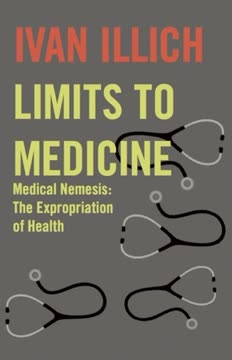
Limits to Medicine critiques the medical establishment as a major threat to health through iatrogenesis—harm caused by medical intervention. Illich argues medicine has exceeded beneficial limits, creating clinical, social, and cultural damage by commodifying health and undermining individual autonomy. Reviewers praise the book's prescience and radical analysis, noting its relevance to contemporary healthcare debates. While some find the prose difficult and statistics dated, most consider it essential reading. Critics appreciate Illich's challenge to assumptions about medicalization, though some disagree with his solutions or find his arguments overly ideological. The work remains influential in questioning industrial medicine's counterproductivity.