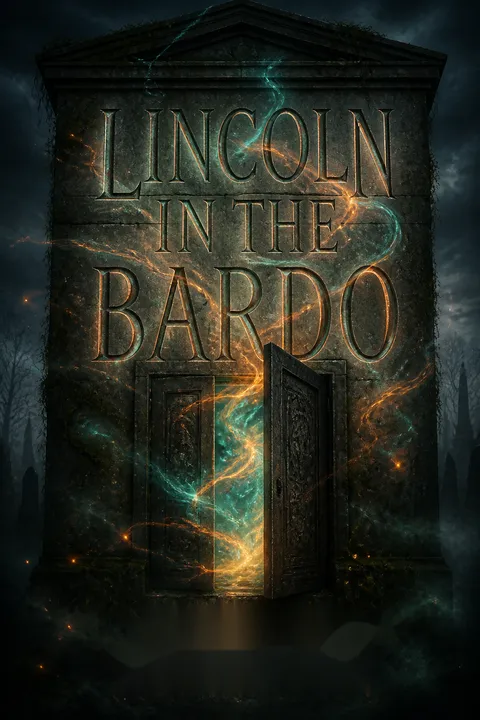


Plot Summary
The Reception Upstairs
In wartime Washington, Abraham and Mary Lincoln host a lavish White House reception while their young son Willie lies feverish upstairs. Mary fears his worsening breathing; a doctor reassures the parents that the boy will recover, and the party proceeds.
Guests eat and dance beneath bright chandeliers as the Lincolns repeatedly leave the rooms to check on Willie. His fever deepens. After days of illness, he dies, and Abraham is left bent by grief while Mary collapses into a prolonged, drugged mourning.
Willie is buried in Oak Hill Cemetery, but his coffin is placed in the Carroll family crypt rather than taken home. The country returns to its war and the Lincolns return to the White House, while their child remains behind in a borrowed tomb.
The Cemetery’s Waiting Dead
Oak Hill’s dead inhabit a strange interval they call a hospital-yard. They keep to stone homes and sick-boxes, insisting they are ill and will soon return to life. Among them are Hans Vollman, a printer killed by a falling beam, and Roger Bevins III, who took his own life after a forbidden love seemed lost. Reverend Everly Thomas tries to impose order on their improvised community.
When Willie arrives, the three men expect him to pass quickly through this place, as most children do. Instead, the bewildered boy waits for his parents to collect him. His insistence unsettles the old residents, who know that remaining too long can deform a spirit, but cannot yet persuade him that his understanding of the cemetery is wrong.
A Father Finds His Son
Vollman, Bevins, and Thomas take Willie through the cemetery to warn him about what can happen to those who linger. They show him Elise Traynor, a girl whose changing forms have trapped her against the iron boundary, but she speaks privately to Willie and leaves him shaken.
The boy returns to his stone home, where his father arrives after dark. Lincoln opens the sick-box, lifts Willie’s still body into his lap, and grieves over it. Unable to reach him any other way, Willie enters his father and feels Lincoln’s love and the bodily memory of their closeness.
Lincoln promises himself he will return. When he leaves, Willie believes the promise, and the cemetery’s residents gather around him, newly hungry for the tenderness they have never received.
The Cemetery’s False Welcome
The residents crowd around Willie, asking what it felt like to be held by Lincoln and whether his father might return. Their fascination turns him into a reluctant center of attention, while their own stories reveal lives arrested by grief, shame, thwarted desire, or unfinished business.
Then a supernatural visitation floods the grounds with food, flowers, music, and apparitions shaped like loved ones. The visitors offer each spirit a private vision of everything once wanted, using comfort and familiarity to draw them away.
Willie sees versions of his mother promising a bright future, but recognizes that his father is not truly there. Other residents yield to their visions. Willie holds on, though the effort drains him and the cemetery begins to bind him to its roof.
Tendrils Take Hold
Willie’s refusal to leave has a physical cost: pale tendrils rise through the stone beneath him and fasten his legs to the roof. The residents remember Elise Traynor’s long deterioration and fear that Willie will be covered by the same grotesque shell.
When the Three Bachelors report seeing Lincoln sitting in the grass near another part of the cemetery, Vollman and Bevins disobey Thomas’s caution and go to find him. They enter Lincoln together and discover the grief, memories, and bewilderment inside him.
Their shared presence leads Lincoln to remember the lock to Willie’s tomb and the danger of leaving it unsecured. He rises and heads back toward the Carroll crypt, while the two spirits return with him, hoping to bring father and son together again.
The Crypt Door Opens
Lincoln reaches the crypt, replaces the key in the lock, and opens Willie’s box. He touches the child’s hair and hands, but the two do not truly meet. Willie remains trapped above, and Thomas works to free him as Lincoln closes the box and prepares to leave. Vollman and Bevins urge Willie to enter his father and listen to the wish Lincoln has expressed for him to be beyond suffering.
Thomas finally shoves the boy through the roof and into the crypt. The attempt comes too late to create a conversation. Willie is left weak and bewildered as tendrils seize him again, while Lincoln walks out. The gathered dead now face a choice: keep watching the child’s destruction, or risk intervening in the living man’s path.
A Crowd Enters Lincoln
Vollman, Bevins, and Thomas enter Lincoln as he walks away, hoping their combined thoughts can make him stop. Their example draws in a crowd of spirits, including Black residents from beyond the cemetery’s iron fence.
The mass inhabitation briefly restores memories and identities that the dead had narrowed around their reasons for staying. Vollman and Bevins lose their grotesque distortions; other spirits shed burdens that had defined them. Yet the attempt also exposes the cemetery’s racial hierarchy.
White residents try to keep the Black dead from the doorway, and Lieutenant Cecil Stone leads a patrol against them. Lincoln continues walking. One by one, spirits abandon the effort, convinced it has failed, while those who remain must face Willie’s worsening condition without the power to command the President.
Thomas Risks the Roof
As Willie’s stone shell hardens around him, its tiny trapped inhabitants reveal themselves as spirits condemned for grave wrongs. Reverend Thomas recognizes that he shares their fate, though he does not know why, and remembers a terrifying judgment he once fled after death.
His fear has kept him from telling Vollman and Bevins the truth about his own afterlife. Now he chooses to act. When the beings offer Willie a choice between remaining trapped on the roof or being carried there, Thomas takes the boy and runs for the chapel, hoping its threshold can protect him.
The beings overtake them and encase minister and child together. Thomas disappears in the shell, but his effort cracks it open long enough for Vollman and Bevins to pull Willie free and race him toward the chapel.
The Chapel’s Last Lesson
The spirits carry Willie into the chapel, where Lincoln sits alone after returning to the cemetery. They have no reliable way to explain the truth to him, but Willie can enter his father. The boy settles into Lincoln’s body and hears him remember the fever, the rocks Willie had collected, and the moment he realized how ill his son was.
Lincoln’s memories make clear that Willie’s body is not a sick container from which he can recover. Willie understands that he has died and that his father cannot bring him back. The revelation does not erase his love for home; he grieves the life he will not live. But now he can distinguish longing from a possible return, and he turns toward the next step rather than clinging to the cemetery.
Willie Names the Dead
Willie leaves Lincoln and tells the cemetery’s residents that they are dead, not ill, and cannot go back to their former lives. Several spirits depart at once, including members of the Blow family, whose bonds had kept them there.
Willie’s own form flickers through the ages he will never reach, from infant to old man, before he leaves the cemetery. Lincoln is released from the boy’s presence. Passing through the grieving President, the spirits sense both his sorrow and his resolve to continue leading the Union.
His grief expands into sympathy for every family whose sons may die in the war, but it does not settle the political question before him. He must still choose how to act against the Confederacy, knowing that any course will cost lives.
The Living Carry Sorrow
As Lincoln leaves the cemetery, Thomas Havens, a Black man who had lived under slavery, enters him and presses upon him the histories of people who endured violence, exploitation, and silencing.
Mrs. Francis Hodge and Litzie Wright, who has long been unable to speak about her abuse, consider leaving the cemetery; Elson Farwell refuses, still set on revenge. Elsewhere, Vollman and Bevins recover memories of their own deaths and recognize the lives they abandoned. They go to Elise Traynor to apologize for having withdrawn when she first began to deteriorate.
Traynor asks them to try to free her. Vollman enters her burning, train-shaped shell and dies in the attempt; Bevins follows soon after. Their departures turn remorse into action, though neither can undo the harm they once feared confronting.
The Cemetery Comes Apart
The night’s revelations spread through the cemetery. Mrs. Hodge and Litzie decide to leave together, while Elson keeps his place in the yard rather than relinquish his hope of vengeance. Betsy Baron finally admits that she and her husband failed their children; she departs, and Eddie follows because he cannot bear to remain without her.
Other residents leave or collapse under the pressure of remembering what they had tried to forget. Those who stay dismiss the departures as weakness, but the morning brings no proof that their denial has protected them.
They return to their sick-boxes as daylight merges the cemetery with the living world. The Three Bachelors, still devoted to their freedom from love and obligation, return to their own boxes too, preserving their familiar promise that a new night may offer another chance.
Lincoln Rides Toward Morning
Thomas Havens remains with Lincoln as the President rides away from the cemetery, carrying the anguish of Willie’s death and the testimony of the Black dead. His grief does not resolve into comfort; it becomes a burden he must carry while returning to Mary, their surviving son Tad, and the Union war.
At Oak Hill, nightwatchman Jack Manders later finds Willie’s coffin jutting slightly from its slot and pushes it back, imagining the child’s loneliness. The other spirits settle into their inert forms as daylight joins the living and dead landscapes.
Those who remain pray for another night, another interval of movement. The novel ends without granting the cemetery’s residents a final certainty. Lincoln continues into a divided country, and the dead wait inside the bodies they cannot yet accept as gone.
Analysis
The novel makes grief a problem of attention. The cemetery’s residents stay by concentrating on the single loss, desire, or grievance that justifies their continued presence; their deadened routines are sustained by refusing the whole truth of their condition. Willie’s arrival tests that arrangement because he is still oriented toward relationship rather than self-preservation. His father’s touch briefly gives the other spirits what they have not received: recognition from the living. Yet affection alone cannot rescue them, and Lincoln cannot hear the dead who crowd into his mind. The gap between love and power remains central.
Lincoln’s mourning also refuses the comfort of exceptionalism. Willie’s death makes the President feel the wartime dead not as a number but as sons once known by name. That enlargement of sympathy does not produce a clean moral answer. Lincoln still believes the Union must prevail, even if ending the war demands further killing. The book makes this contradiction painful rather than rhetorical: compassion can deepen a person’s responsibility without removing the violence embedded in the choices available.
The cemetery’s racial divisions complicate any claim that suffering automatically creates fellowship. Black spirits are excluded even in a place where white residents fear their own erasure, and their distinct histories of enslavement and abuse cannot be absorbed into a universal account of sorrow. Havens’s presence asks whether Lincoln’s grief can become attention to people beyond his immediate family. The answer remains unfinished, as does the national conflict.
Finally, the clashing historical testimonies remind readers that no archive can reproduce the full interior life of another person. The novel does not resolve this uncertainty by claiming special access to Lincoln or the dead. Instead, it turns contradiction into an ethical demand: when knowledge is incomplete, people still have to decide whether to look closely, offer care, and act.
Review Summary
Lincoln in the Bardo receives mixed reviews, with many praising its inventive structure, emotional depth, and exploration of grief. Critics laud Saunders' unique storytelling, blending historical facts with fictional elements. Some find the experimental format challenging, while others consider it a masterpiece. The novel's portrayal of Abraham Lincoln's grief over his son's death and its connections to the Civil War are widely appreciated. However, a minority of readers struggle with the unconventional narrative style and find the book difficult to follow.
People Also Read








Characters
Willie Lincoln
The waiting childWillie is Abraham and Mary Lincoln’s affectionate, observant young son. He is curious about the world and inclined to see people directly, without the calculations adults use to protect themselves. His attachment to his parents gives him a reason to resist the strange cemetery where he finds himself, while his youth makes him vulnerable to forces he cannot understand. The novel presents him as neither a symbol nor a saint, but as a boy whose ordinary enthusiasms, questions, and need for comfort make the loss of a future painfully specific.
Abraham Lincoln
The grieving PresidentLincoln is both a father mourning Willie and the leader of a nation at war. He is capable of tenderness and self-reproach, yet public duty keeps demanding decisions whose consequences reach far beyond his family. His grief unsettles the separation between private sorrow and political responsibility: he cannot mourn only as an individual when thousands of families face similar loss. The novel depicts his humor, physical awkwardness, ambition, and deep melancholy as parts of the same person, resisting the simplification of a historical icon into either flawless hero or distant monument.
Hans Vollman
The hopeful printerVollman is a middle-aged printer whose sudden death interrupted a newly tender marriage. He remembers the care he and Anna built before they were ready to begin a physical life together, and he clings to the possibility of returning to her. His friendliness and comic self-consciousness make him an easy companion, but his insistence that he is merely ill protects him from confronting the scale of his loss. He helps guide Willie and becomes one of the cemetery’s most active spirits, drawn by affection even when he is uncertain what action can accomplish.
Roger Bevins III
The many-eyed observerBevins is a perceptive, sensory young man who loved men in a world that taught him to regard that desire as shameful. After a painful romantic disappointment, he attempted suicide, then changed his mind too late to save himself. In the cemetery, his body reflects his appetite for experience through an unsettling profusion of eyes, hands, and noses. His curiosity and loyalty make him a counterweight to Thomas’s caution and Vollman’s longing. Bevins notices how fear shapes the residents’ explanations and is willing to test their assumptions, even when he cannot be sure the test will help.
Reverend Everly Thomas
The anxious ministerThomas is a clergyman who tries to preserve order among the cemetery’s dead through counsel, ritual, and restraint. His terror often makes him appear less authoritative than his religious position suggests, but his caution comes from a private experience he cannot easily disclose. He believes action can have consequences beyond intention, and he therefore resists risks that Vollman and Bevins accept more readily. His care for Willie gradually forces him to choose between conserving his own safety and acting on behalf of someone more vulnerable.
Mary Lincoln
Willie’s bereaved motherMary is Willie’s mother and Abraham’s wife, a woman whose fear for her son competes with the public obligations of the White House. She recognizes the seriousness of Willie’s fever and suffers intensely after his death. The novel’s documentary voices describe her grief through the household’s observations, showing how a public figure’s private catastrophe becomes material for criticism and speculation. Mary’s presence anchors Willie’s memories of home, while her absence from the cemetery underscores how grief can separate even the closest family members.
Elise Traynor
The trapped young womanElise is a young woman whose hopes for love, marriage, and motherhood were cut short. In the cemetery she appears through a series of alarming shapes, and her changing condition warns the other spirits about the danger of remaining. Her memories reveal a person made vulnerable by limited choices and frustrated desire, rather than a simple cautionary figure. The older residents’ response to her forces them to confront whether their reluctance to intervene is prudence or self-protection.
Thomas Havens
The enslaved man’s witnessHavens is a Black man who lived as an enslaved servant in a household that treated him with relative kindness, yet still controlled his time and choices. He understands that comfort within an unjust arrangement does not make that arrangement free. His memories give the cemetery’s racial conflict a personal and historically grounded voice. Havens is observant and measured, but he is not passive: he chooses when to make himself known and what truths to place before someone with the power to affect the living world.
Mrs. Francis Hodge
The silenced advocateMrs. Hodge is a Black woman whose own strength has been diminished by the injustices she witnessed and endured. In the cemetery she speaks for Litzie Wright when Litzie cannot yet speak for herself, offering the protection of a surrogate mother. Her attention to another person’s pain contrasts with the cemetery’s habits of self-absorption. Hodge’s story also exposes how racial violence persists beyond death in the behavior of white residents who try to deny Black spirits access to Willie.
Litzie Wright
The wounded survivorLitzie is a young Black woman whose silence holds the history of repeated sexual violence and the many ways it could be inflicted or threatened. The novel does not reduce her to that history: her silence is a response to experiences that others have repeatedly tried to define for her. Mrs. Hodge supports her without demanding an explanation. Litzie’s eventual ability to speak and make choices is framed as an act of agency, not as an easy cure for what happened.
Elson Farwell
The servant demanding justiceFarwell is a Black man who spent his life trying to earn recognition through obedience, polished manners, and hard work. His death followed the neglect of the household he served, exposing how little protection his conduct had secured. He resents the injustice and imagines revenge against those who wronged him. His story complicates easy appeals to forgiveness: he has a reason to be angry, and no one else can decide for him what justice should mean.
The Baron couple
The unruly parentsEddie and Betsy Baron are a coarse, hard-drinking couple whose memories of poverty, parties, and family life are told through their combative banter. Their refusal to speak gently often hides a sharper pain: they know their children have stayed away, and they struggle to admit their part in that distance. They bring a rowdy, comic energy to the cemetery, but their humor also shows how people can use provocation to avoid grief until it becomes impossible to ignore.
The Three Bachelors
The airborne pleasure-seekersLippert, Kane, and Fuller are three unmarried spirits who prize flight, jokes, and independence. They mock solemnity and avoid commitments that might limit their freedom, yet their playful visits sometimes carry information that matters to the others. Their self-protective levity is not simply happiness; it also keeps them from confronting what they lacked in life. As a group, they embody the appeal and cost of a freedom organized around never risking attachment.
Jack Manders
The cemetery nightwatchmanManders guards Oak Hill and permits Lincoln to enter the cemetery after hours. He is tired, humane, and alert to the President’s grief, even when he does not know what to say. His reports about his own children make the living world feel close to the spirits who listen from their graves.
Plot Devices
The hospital-yard
A denial-shaped afterlifeThe dead inhabit a cemetery interval they interpret as a place of illness and recovery. Their sick-boxes contain their bodies, while their spirits move through the grounds at night and return to those bodies by day. Calling themselves sick allows them to delay the recognition that they have died. The device makes grief both physical and psychological: the residents are attached to their bodies, memories, and unfinished wishes, and their explanations help sustain the very condition that traps them.
Matterlight departures
The visible passage onwardWhen a spirit accepts that it has died and is ready to leave, a bright, explosive event called matterlightblooming marks its departure. Clothes and personal objects remain behind, making the absence tangible to those who stay. The phenomenon gives the cemetery a recurring threshold rather than a fixed, fully explained map of the afterlife. Each departure tests the survivors’ belief that they can remain indefinitely, while leaving its ultimate destination uncertain.
Cohabitation
Shared minds create leverageSpirits can enter living people and occupy their thoughts and sensations. A single spirit may influence a person, but a crowd can combine its attention in an effort to alter what the living person does. Cohabitation lets the dead briefly experience one another’s memories and recover parts of themselves they had narrowed around their reasons for staying. It also creates an ethically uneasy form of intervention: the spirits can influence Lincoln, but they cannot control what he chooses or guarantee that their effort will help.
The carapace
Denial made visibleWhen a spirit remains too long, the cemetery’s stone and soil begin fastening it to its home-place. Tendrils grow around the body, then harden into elaborate shells shaped by the spirit’s condition. The shell is both a punishment and a visual record of the resident’s resistance. It makes Willie’s stubbornness an immediate danger, while Elise Traynor’s changing forms establish the threat before his condition becomes severe. Its voices reveal that other condemned spirits are embedded within it.
The documentary chorus
History as contested testimonyThe novel interrupts its cemetery narrative with accounts attributed to witnesses, memoirists, letters, and later historians. Their descriptions of the White House reception, the moon, Lincoln’s face, and the family’s grief sometimes contradict one another. This form refuses a single authoritative account of a historical event and makes the reader notice how memory is assembled, revised, and used. The conflicting records also sit beside the spirits’ unreliable explanations, linking public history to private denial without treating either as perfectly transparent.
FAQ
Synopsis & Basic Details
What is Lincoln in the Bardo about?
- Grieving Lincoln visits son: The novel centers on Abraham Lincoln's grief over the death of his son, Willie, and his visits to the cemetery where Willie is interred.
- Spirits in a liminal space: The story unfolds in a bardo-like realm, a space between life and death, where spirits linger, grappling with their past lives and their inability to move on.
- Exploration of loss and connection: The narrative explores themes of grief, love, loss, and the interconnectedness of human experiences through the interactions of Lincoln and the spirits.
Why should I read Lincoln in the Bardo?
- Unique narrative style: George Saunders employs a distinctive multi-voiced narrative, creating a rich and immersive reading experience that challenges traditional storytelling.
- Profound emotional depth: The novel delves into the complexities of grief and loss, offering a deeply moving and thought-provoking exploration of the human condition.
- Blend of history and the supernatural: The story seamlessly blends historical events with supernatural elements, creating a surreal and captivating world that explores the boundaries between life and death.
What is the background of Lincoln in the Bardo?
- Historical setting: The novel is set during the American Civil War, specifically in 1862, a time of great national turmoil and personal loss for President Lincoln.
- Tibetan Buddhist concept: The "bardo" is a Tibetan Buddhist concept referring to an intermediate state between death and rebirth, which serves as the setting for the spirits' limbo.
- Grief and mortality: The story is deeply rooted in the historical context of Lincoln's personal grief over his son's death, using this as a lens to explore universal themes of mortality and the afterlife.
What are the most memorable quotes in Lincoln in the Bardo?
- "We were perhaps not so unlovable as we had come to believe.": This quote encapsulates the spirits' yearning for connection and validation, highlighting their struggle with self-worth in the afterlife.
- "You are a wave that has crashed upon the shore.": This recurring phrase, used by the spirits to encourage each other to move on, reflects the cyclical nature of life and death and the inevitability of change.
- "It was the touching that was unusual.": This quote emphasizes the profound impact of physical connection and affection, a rare and cherished experience for the spirits in their liminal state.
What writing style, narrative choices, and literary techniques does George Saunders use?
- Multi-voiced narration: Saunders employs a unique narrative structure with numerous voices, creating a chorus of perspectives that offer a rich and complex view of the story.
- Fragmented and non-linear: The narrative is often fragmented and non-linear, mirroring the chaotic and disorienting nature of the bardo and the characters' emotional states.
- Blending of historical and supernatural: Saunders seamlessly blends historical details with supernatural elements, creating a surreal and thought-provoking world that challenges traditional notions of reality.
Hidden Details & Subtle Connections
What are some minor details that add significant meaning?
- The descriptions of the sick-boxes: The sick-boxes, where the spirits are confined, are described in detail, highlighting the limitations and frustrations of their existence and their inability to fully move on.
- The recurring mention of the moon: The moon's appearance, often described differently by various characters, symbolizes the subjective nature of perception and the unreliability of memory.
- The specific details of the food and drink: The descriptions of the food and drink, often lavish and excessive, contrast with the spirits' inability to fully enjoy them, emphasizing their detachment from the physical world.
What are some subtle foreshadowing and callbacks?
- The Traynor girl's transformations: The Traynor girl's constant transformations into different forms foreshadow the impermanence and instability of the spirits' existence in the bardo.
- The recurring phrase "We say these things to speed you along": This phrase, used by the spirits when trying to convince others to move on, foreshadows their own eventual departures and the cyclical nature of the bardo.
- The mention of the beam that hit Vollman: The beam that hit Hans Vollman is mentioned early in the story, and its significance is revealed later, highlighting the arbitrary nature of fate and the fragility of life.
What are some unexpected character connections?
- The shared experience of the Barons and Elson Farwell: The Barons, a white couple, and Elson Farwell, a black man, share a common experience of being marginalized and mistreated, highlighting the universality of suffering.
- The connection between Mrs. Blass and Miranda Debb: Mrs. Blass, an old woman, and Miranda Debb, a young girl, share a connection through their shared experiences of loss and longing, transcending age and social status.
- The shared experience of the three main spirits: Hans Vollman, Roger Bevins III, and Reverend Everly Thomas, despite their different backgrounds and personalities, are connected by their shared desire for meaning and purpose in the afterlife.
Who are the most significant supporting characters?
- The Bachelors: These characters provide comic relief and a contrasting perspective on the seriousness of the other spirits' situations, highlighting the tension between avoidance and acceptance.
- Mrs. Francis Hodge: Her compassion and empathy for others make her a key figure in the community of spirits, as she works to support and uplift those around her.
- Elson Farwell: His struggle with anger and resentment over the injustices he faced in life highlights the themes of forgiveness and the enduring impact of trauma.
Psychological, Emotional, & Relational Analysis
What are some unspoken motivations of the characters?
- Lincoln's need for connection: Lincoln's visits to the cemetery are driven by his unspoken need to connect with his son and find solace in his grief, even if it means interacting with the spirits.
- The spirits' desire for validation: The spirits' interactions with each other and with Lincoln are motivated by their unspoken desire for validation and recognition of their lives and experiences.
- The Bachelors' fear of commitment: The Bachelors' playful and carefree attitude masks their unspoken fear of commitment and their desire to avoid the deeper issues of life and death.
What psychological complexities do the characters exhibit?
- Lincoln's internal conflict: Lincoln is torn between his duties as President and his overwhelming grief, highlighting the psychological toll of leadership and personal loss.
- The spirits' denial and clinging to the past: The spirits' inability to accept their deaths and their clinging to the remnants of their earthly lives reveal the psychological complexities of grief and the fear of the unknown.
- The Reverend's internal struggle: The Reverend's internal struggle with his faith and his doubts about the afterlife highlights the psychological complexities of belief and the human need for meaning.
What are the major emotional turning points?
- Lincoln's first visit to the crypt: Lincoln's initial visit to the crypt where Willie is interred marks a turning point, as it sets the stage for his interactions with the spirits and his journey through grief.
- The spirits' collective effort to help Willie: The spirits' decision to work together to help Willie move on marks a turning point, as it highlights their capacity for empathy and their desire for connection.
- Willie's acceptance of his death: Willie's eventual acceptance of his death and his decision to move on to the afterlife marks a turning point, as it symbolizes the possibility of peace and liberation.
How do relationship dynamics evolve?
- The spirits' initial isolation to community: The spirits initially exist in a state of isolation, but their interactions with each other and with Lincoln lead to the formation of a community, highlighting the importance of connection and shared experience.
- The evolving relationship between Lincoln and Willie: Lincoln's relationship with Willie evolves from one of grief and longing to one of acceptance and letting go, highlighting the transformative power of love and loss.
- The changing dynamics among the spirits: The relationships among the spirits evolve as they confront their past lives and their fears about the afterlife, leading to moments of both conflict and connection.
Interpretation & Debate
Which parts of the story remain ambiguous or open-ended?
- The nature of the bardo: The exact nature of the bardo and its rules remain ambiguous, leaving the reader to question the boundaries between life and death and the nature of reality.
- The ultimate fate of the spirits: The ultimate fate of the spirits who move on from the bardo is left open-ended, leaving the reader to ponder the possibilities of the afterlife and the nature of redemption.
- The meaning of Lincoln's transformation: The extent of Lincoln's transformation and the long-term impact of his experience in the bardo remain ambiguous, leaving the reader to consider the complexities of grief and the challenges of leadership.
What are some debatable, controversial scenes or moments in Lincoln in the Bardo?
- The spirits' attempts to manipulate Lincoln: The spirits' attempts to manipulate Lincoln and influence his actions raise questions about the ethics of their interference and the nature of free will.
- The graphic descriptions of the spirits' suffering: The graphic descriptions of the spirits' suffering and their often grotesque physical forms may be disturbing to some readers, raising questions about the limits of empathy and the nature of pain.
- The portrayal of Lincoln's grief: The portrayal of Lincoln's grief as both a source of strength and a potential weakness may be controversial, raising questions about the nature of leadership and the role of personal emotions in public life.
Lincoln in the Bardo Ending Explained: How It Ends & What It Means
- Willie's departure: Willie's departure from the bardo signifies the acceptance of death and the possibility of peace, but also highlights the finality of loss and the enduring impact of grief.
- Lincoln's return to the living world: Lincoln's return to the living world, though marked by a sense of loss, is also a testament to his resilience and his commitment to his duties as President.
- The spirits' varied fates: The varied fates of the spirits, some moving on and others remaining trapped, underscore the complexities of the afterlife and the different paths individuals take in their journey through grief and acceptance.

Download PDF
Download EPUB
.epub digital book format is ideal for reading ebooks on phones, tablets, and e-readers.








