

Key Takeaways
Treat instability as the new social condition, not a temporary interruption
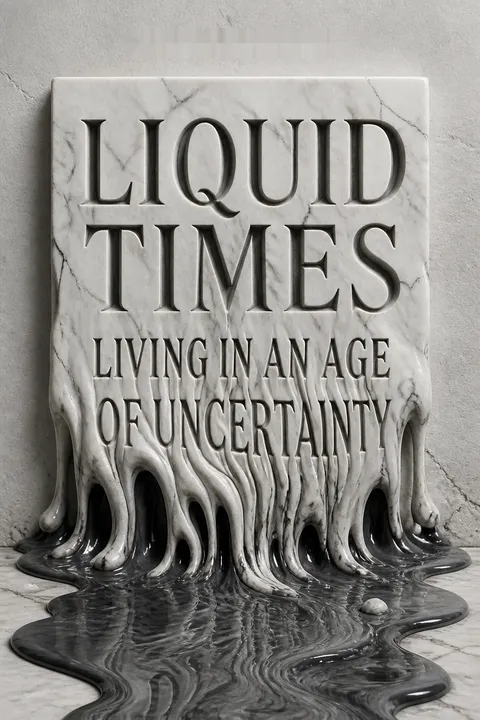
Forms expire quickly. Bauman calls the present condition liquid modernity: social arrangements change so rapidly that institutions, work patterns, and shared expectations struggle to remain dependable. Plans that once assumed a stable career or lasting community now compete with short-lived opportunities and sudden reversals. People are expected to adapt, even when the forces disrupting their lives are beyond their control. Flexibility becomes a personal duty, not a freely chosen talent.
Power travels farther. Economic power increasingly operates globally, while political decision-making remains largely national or local. As collective protections weaken, people face shared problems as private burdens. Society comes to feel less like a structure with durable supports and more like a shifting web of connections that can be made or broken.
The idea is strongest as a description of mismatched timescales. A person may need years to build a career, a community, or a sense of trust, while markets and institutions can reorganize in months. That mismatch helps explain why uncertainty feels personal even when its causes are structural. The metaphor should not be mistaken for a claim that every institution has dissolved: laws, families, and public services still offer varying degrees of continuity. The useful question is which arrangements remain stable enough to support long-term commitments, and who has access to them.
Don't mistake personal safety rituals for security against economic uncertainty
Fear changes its address. Bauman distinguishes security, meaning confidence in one’s livelihood, relationships, and future, from safety, meaning protection against immediate bodily threats. When people cannot influence the deeper sources of insecurity, anxiety often attaches itself to visible risks: crime, illness, strangers, or unsafe streets. Locks, cameras, guarded housing, and protective purchases can feel like solutions, but they do not repair unstable work or fraying social support.
Defenses can amplify fear. The book describes a feedback loop: anxiety prompts defensive measures, and those measures make danger seem more present. A heavily fortified home may provide some practical protection, yet it can also signal that the surrounding world is hostile. Businesses can sell products into this unease, while media coverage and political campaigns keep attention fixed on immediate threats.
This distinction clarifies why a society can be materially safe in many respects and still feel deeply insecure. A visible hazard is easier to name and act on than a fragile job or a disappearing safety net, so attention gravitates toward the former. That does not make locks or security measures irrational; some threats are real, and protection can matter greatly to those exposed to them. The sharper test is whether a response reduces a specific danger or merely offers the sensation of control while leaving the source of anxiety untouched.
Scrutinize security campaigns that expand fear while shrinking public freedoms
Threat becomes political capital. A personal safety state is a state that increasingly justifies its authority by promising protection from crime, terrorism, and other bodily dangers, rather than by providing broad social security. Bauman argues that this shift can redirect public attention from problems such as unemployment and economic insecurity toward threats that governments can more visibly confront.
Responses can backfire. In the book’s account of West Germany, only 7 percent of citizens in 1976 treated personal safety as a leading political concern. Two years later, after terrorist attacks and conspicuous security measures, a considerable majority ranked it above unemployment and inflation. Bauman argues that the crackdown helped raise fear and the terrorists’ visibility, while civil liberties narrowed. He also cites research available at the time that found no significant link between harsher penalties and the volume of crime.
The central warning is about incentives: leaders can gain authority by appearing decisive against threats, even when the chosen response does little to reduce danger. This makes public evaluation especially important. Did the measure prevent harm, or did it mainly expand surveillance, punishment, and executive power? The argument is not that terrorism or crime is imaginary. It is that emergency responses deserve evidence and limits, because fear can make extraordinary restrictions feel ordinary. Measures that protect the public should be judged by outcomes as well as by their forceful appearance.
Global markets create displaced people, then wealthy states block their escape
Modernization leaves people behind. Bauman uses the phrase human waste for people made redundant by economic change, especially when farms, local businesses, and community supports can no longer sustain them. He argues that earlier industrial powers could push surplus populations toward territories treated as empty; once markets and modern life span the globe, those outlets disappear. The book cites a contemporary estimate that 1 percent of the world’s population held 90 percent of its wealth, underscoring the stark inequality accompanying this transformation.
Displacement meets closed borders. Refugees fleeing war or ruined livelihoods may be kept in camps that are officially temporary but endure for years. They can lose home, work, legal standing, and control over their future, while wealthier countries try to contain migration near its source. Bauman’s point is that globally produced problems are being left for vulnerable people and nearby poorer countries to manage locally.
The phrase human waste is deliberately harsh: it exposes the logic by which institutions treat people as disposable when they no longer fit an economic role. Yet the metaphor also risks reproducing the dehumanization it condemns, so it should be read as an accusation against the system, not as a description of people. The analysis connects migration to the distribution of power: capital can cross borders more easily than displaced families can. A humane response therefore requires more than emergency relief. It requires asking how displacement is produced and how responsibility is shared.
Make social protection part of democracy, not an optional benefit
Rights need usable resources. Drawing on T. H. Marshall, Bauman traces citizenship through personal rights, political rights, and social rights. The right to vote matters, but people facing hunger, insecure housing, or relentless survival pressures may lack the time and resources to use political freedoms effectively. Social protection, in this view, is collective insurance against individual misfortune, not simply a transfer of wealth.
Security enables participation. Stable services, workplace protections, and social provision can give people enough confidence to plan, organize, and make claims on government. Bauman points to the Fordist factory, where relatively durable jobs and trade unions allowed workers to negotiate over time. When shared protections are weakened, the risks of failure are privatized, and formal political equality can coexist with sharply unequal power to shape decisions.
This argument resembles the distinction between possessing a right on paper and having the real capacity to exercise it. Democracy depends not only on ballots and legal protections but also on conditions that let people participate without risking basic survival. Social provision cannot by itself guarantee political voice, and large bureaucracies can fail or exclude people. Still, the practical test is compelling: can citizens challenge decisions, organize with others, and withstand setbacks? Where basic security is absent, the political system may remain formally open while becoming inaccessible to many of its members.
Notice when local communities are asked to solve problems made global
Cities absorb distant forces. Bauman describes urban areas as places where global changes become immediate: migration, insecure work, weakened public services, and fears about safety all appear in local streets and institutions. The globally connected can often relocate when conditions worsen. Residents with fewer resources are more likely to remain and contend with local consequences, even when they had little influence over the forces that produced them.
Politics stays close to home. Public officials are pressed to address problems whose causes may lie beyond their reach. A city council can face demands about housing refugees or protecting residents from violence, while the economic and political forces shaping those pressures operate across borders. This gap between global power and local authority leaves local government overloaded, and can make visible outsiders convenient targets for frustrations rooted elsewhere.
The city is a useful scale for seeing how large systems become lived experience. It also reveals a danger in treating local action as sufficient: neighborhood decisions can improve daily life, but they cannot alone regulate mobile capital, prevent distant conflicts, or distribute responsibility across countries. Local institutions still matter because they are where people encounter policy and one another. The challenge is to connect practical local responses to wider coordination, rather than asking municipalities and residents to absorb the consequences of decisions made elsewhere.
Build shared urban spaces instead of buying isolation from strangers
Fear can be built into space. Mixophobia means discomfort with the variety of unfamiliar people and ways of life found in cities. Its counterpart, mixophilia, is attraction to that variety and to the opportunities it brings. Bauman argues that gated housing, guarded entrances, and other forms of separation can make encounters with difference rarer, leaving unfamiliar people more mysterious and intimidating.
Design shapes the chances to meet. The book discusses interdictory spaces, places designed to block, discourage, or monitor certain users. Examples include paths made difficult to reach, benches or ledges made uncomfortable to occupy, and public areas watched by security systems. Such designs can offer reassurance to some residents while making others feel excluded. Open public places, shared facilities, and ordinary opportunities for repeated contact can make coexistence more familiar and less dependent on stereotypes.
The argument treats architecture as a social force, not mere scenery. Repeated, low-stakes encounters can help people learn how to share space without requiring instant agreement or intimacy. That is a promising civic function of parks, libraries, and streets. Yet openness alone does not dissolve inequality, and residents may seek secure spaces for understandable reasons. The relevant design question is not whether every boundary should disappear, but whether a city provides genuinely shared places where different groups can meet without one group being treated as a threat by default.
Stop confusing endless self-reinvention with progress toward a better society
The destination becomes a chase. Bauman contrasts the gardener, who imagines and tends a larger social order, with the hunter, who pursues the next prize without responsibility for replenishing the wider landscape. He argues that liquid modern life increasingly encourages the hunter’s outlook: people are urged to stay competitive, update themselves, and avoid falling behind, while shared plans for a better society lose credibility.
Escape replaces improvement. Consumer culture offers new products, styles, jobs, and identities as ways to leave dissatisfaction behind. But changing the surface of life may not resolve its deeper unease. The hunt itself can become the point, because reaching a goal quickly gives way to another pursuit. Bauman’s modern utopia is therefore less a settled ideal than an endless effort to remain in the race and avoid exclusion.
The contrast helps distinguish innovation from compulsive novelty. Change can improve lives, and personal experimentation can be a genuine source of freedom. The problem arises when adaptation becomes an individual obligation with no shared destination, so that every disappointment is interpreted as a failure to update oneself. Consumer choice then offers movement without much control over direction. A useful question is whether a new pursuit expands durable options for people, or simply resets the competition and makes yesterday’s security feel obsolete.
Make humane alternatives last instead of accepting the next chase as inevitable
Keep the possibility of repair. Bauman does not offer a finished blueprint for a secure society. He argues that confidence in collective improvement has weakened as power moves beyond the reach of national politics and individuals are left to manage uncertainty alone. The older utopian ambition of designing a better common world gives way to a more private effort to keep moving and avoid defeat.
Choose what deserves room. The book closes by turning attention toward humane possibilities already present within an imperfect society: acts of care, cooperation, and shared life that resist its harsher logic. Recognizing them is not enough; they need protection and continuity. This is a modest but demanding alternative to resignation. It asks people to notice which practices preserve dignity and connection, then help make those practices part of ordinary life rather than brief exceptions.
The ending avoids two easy answers: faith in a perfect final design and surrender to the claim that nothing can change. Its emphasis on sustaining workable alternatives resembles institution-building at a human scale: a practice matters more when people can rely on it, not merely admire it. That insight is hopeful, but it also raises a practical question. Care and cooperation need time, resources, and rules that protect them from exhaustion or capture. Small humane spaces can demonstrate another way to live, yet they need broader political support to endure.
Analysis
Liquid Times is best read as a connected diagnosis, not as a collection of separate complaints about anxiety, migration, cities, and consumerism. Its central mechanism is a mismatch: economic and political power becomes mobile and difficult to govern, while responsibility for coping with the consequences is pushed toward individuals and local institutions. Fear, exclusion, and frantic self-reinvention are not independent pathologies in this account. They are adaptations to a world in which people are expected to remain flexible without reliable collective protection.
That systemic lens is the book’s enduring strength. It links the private sensation of insecurity to public choices about welfare, borders, policing, and urban design. It also explains why measures that appear protective can deepen the conditions they address: separation makes strangers less familiar, and security campaigns can displace rather than resolve social anxieties. The result is a sociological argument with practical force. It asks readers to inspect not only what people fear, but which institutions make some fears manageable and others politically useful.
The framework also has limits. Bauman’s broad historical contrasts can make a varied world look more uniform than it is. The book largely centers affluent societies and presents globalization as a powerful, sometimes almost singular force, while offering less detail about differences among labor markets, welfare systems, and political institutions. Its conceptual language is vivid, but it does not always specify how to measure a society’s liquidity or determine which policy would reconnect power and democratic accountability.
Those limits do not undo the diagnosis. They point toward a useful next step: treat liquid modernity as a question to investigate, rather than a total explanation. Which protections remain durable? Who can leave a failing place, and who cannot? Which public spaces foster trust, and which policies shift costs onto the least powerful? Bauman’s most productive contribution is to make those questions part of the same conversation.
Review Summary
Liquid Times receives mixed reviews. Many readers find Bauman's analysis of modern society insightful, particularly regarding globalization, fear, and uncertainty. The book is praised for its examination of how social bonds are weakening and security concerns are increasing. Some appreciate Bauman's critique of consumerism and individualism. However, others find the writing style difficult or the arguments repetitive. A few reviewers criticize the book for being too pessimistic or lacking concrete solutions. Overall, readers value the book's perspective on contemporary social issues, even if they don't always agree with all of Bauman's conclusions.
People Also Read



Glossary
Liquid modernity
rapidly changing social arrangementsBauman’s term for a phase of modern life in which social forms, institutions, and routines change too quickly to provide dependable long-term frames for action. People must repeatedly adjust their plans and identities as work, relationships, and public arrangements lose stability. The term emphasizes not change alone, but the difficulty of making durable commitments within it.
Negative globalization
global forces without global controlBauman’s description of globalization in which capital, trade, information, and security threats cross national boundaries, while democratic politics and effective public authority remain largely tied to individual states. The resulting imbalance leaves societies exposed to forces they cannot adequately govern and encourages local institutions to manage consequences they did not create.
Human waste
people treated as economically redundantBauman’s deliberately disturbing term for people whom economic and social change casts out as surplus, unwanted, or lacking an accepted role. He applies it especially to displaced populations and refugees who lose livelihoods and legal standing, then face barriers to resettlement. The phrase criticizes systems that treat human beings as disposable, rather than describing their worth.
Personal safety state
state legitimated through bodily protectionBauman’s term for a state that increasingly bases its authority on promises to protect citizens from immediate threats to personal safety, such as crime, terrorism, or dangerous outsiders. This focus can displace the social state’s role in protecting people from economic insecurity and misfortune, while making visible security measures politically valuable.
Mixophobia
fear of social differenceBauman’s term for anxiety or aversion prompted by the variety of unfamiliar people and lifestyles encountered in urban settings. It can encourage residents to seek homogeneous neighborhoods and avoid shared spaces. Such separation may offer temporary reassurance, but it can also reduce familiarity and make future encounters with difference feel more threatening.
Mixophilia
attraction to urban varietyBauman’s term for the attraction of diverse city life, including its unfamiliar people, experiences, and opportunities. Mixophilia coexists with mixophobia: urban variety can unsettle residents while also drawing them toward the novelty and possibility that cities offer. Bauman sees shared encounters as a way to make difference more understandable and coexistence more workable.
Interdictory spaces
spaces designed to exclude usersA specialized urban-design term used by Bauman for places arranged to obstruct, discourage, or monitor access. Examples include routes that are difficult to reach, surfaces designed to prevent lingering, and areas under constant surveillance. These spaces divide users and protect selected areas through exclusion, rather than encouraging public gathering and interaction.
Permanently temporary
enduring life without secure settlementBauman’s description of conditions in which a situation officially treated as temporary becomes prolonged without offering a stable future. Refugee camps are a central example: residents may remain for years while lacking secure prospects of return, settlement, or participation in a new society. Time passes, but the people affected cannot build a reliable long-term life.
FAQ
What's "Liquid Times: Living in an Age of Uncertainty" about?
- Author's Exploration: Zygmunt Bauman explores the concept of "liquid modernity," where social structures are in constant flux, leading to uncertainty in individual life pursuits.
- Key Themes: The book discusses the transition from solid to liquid modernity, the separation of power and politics, and the impact of globalization on social and individual stability.
- Focus on Uncertainty: Bauman examines how these changes create a pervasive sense of insecurity and fear, affecting how people live their lives.
- Societal Implications: The book delves into the societal and political implications of these transformations, questioning the future of democracy and social solidarity.
Why should I read "Liquid Times: Living in an Age of Uncertainty"?
- Understanding Modernity: It provides a deep understanding of the current phase of modernity and its impact on individual and collective life.
- Insight into Globalization: The book offers insights into how globalization affects power dynamics, politics, and personal security.
- Relevance to Current Issues: Bauman's analysis is highly relevant to contemporary issues such as economic instability, migration, and the erosion of social safety nets.
- Thought-Provoking: It challenges readers to think critically about the future of society and the role of individuals within it.
What are the key takeaways of "Liquid Times: Living in an Age of Uncertainty"?
- Fluid Social Structures: Social forms are no longer stable, leading to a lack of long-term reference points for individuals.
- Power and Politics Separation: The divorce of power from politics creates untameable uncertainties and weakens political institutions.
- Individual Responsibility: Individuals are increasingly responsible for navigating uncertainties without collective support.
- Globalization's Impact: Globalization exacerbates inequalities and challenges traditional notions of justice and security.
How does Bauman define "liquid modernity" in "Liquid Times"?
- Constant Change: Liquid modernity is characterized by rapid and continuous change, where social structures do not solidify.
- Short-lived Forms: Social forms decompose faster than they can be established, making long-term planning difficult.
- Individual Focus: Individuals must adapt quickly to changing circumstances, often without reliable social frameworks.
- Uncertainty and Fear: This fluidity leads to pervasive uncertainty and fear, affecting personal and societal stability.
What is the significance of the separation of power and politics in "Liquid Times"?
- Power Shift: Power has moved to global, extraterritorial spaces, beyond the control of local politics.
- Political Ineffectiveness: Politics remains local and struggles to address global issues effectively.
- Increased Uncertainty: The lack of political control over global powers contributes to widespread uncertainty.
- State Functions: States are forced to outsource functions, leaving individuals to navigate market forces alone.
How does Bauman address the issue of globalization in "Liquid Times"?
- Global Inequality: Globalization increases income polarization, benefiting a small percentage of the population.
- Open Societies: Societies are open to global influences but lack control over their own destinies.
- Cultural Impact: Globalization affects cultural identities and creates tensions between local and global forces.
- Security Challenges: The global circulation of capital and commodities challenges traditional notions of security and justice.
What role does fear play in "Liquid Times: Living in an Age of Uncertainty"?
- Fear of Inadequacy: Individuals fear inadequacy due to the constant need to adapt to changing circumstances.
- Self-Perpetuating Fear: Fear becomes self-reinforcing, as defensive actions create more fear.
- Social Fragmentation: Fear leads to social fragmentation, as individuals focus on personal safety over collective solidarity.
- Political Exploitation: Politicians exploit fear to maintain power, often exaggerating threats to personal safety.
How does Bauman view the future of democracy in "Liquid Times"?
- Challenges to Democracy: The separation of power and politics undermines democratic processes and institutions.
- Social Rights: Without social rights, political rights become meaningless for many individuals.
- Legitimacy Crisis: The retreat of the state from social functions creates a legitimacy crisis for democratic governance.
- Need for Global Solutions: Bauman suggests that democracy and freedom can only be secured on a global scale.
What are the best quotes from "Liquid Times: Living in an Age of Uncertainty" and what do they mean?
- "If you wish peace, care for justice": This quote emphasizes the importance of justice as a foundation for lasting peace, highlighting global inequalities.
- "Progress has turned into a sort of endless and uninterrupted game of musical chairs": Bauman critiques the notion of progress, suggesting it creates constant competition and insecurity.
- "The demon of fear won’t be exorcized until we find (or more precisely construct) such tools": This quote underscores the need for new tools to manage fear and uncertainty in a globalized world.
- "The future of democracy and freedom may be made secure on a planetary scale – or not at all": Bauman argues for global solutions to address the challenges facing democracy and freedom.
How does Bauman address the concept of "human waste" in "Liquid Times"?
- Capitalism's Byproduct: Bauman describes "human waste" as the surplus population created by capitalism's global expansion.
- Disposal Crisis: The world faces a crisis in managing this "waste," as traditional outlets for surplus populations are no longer available.
- Refugee Plight: Refugees epitomize "human waste," often left in limbo without prospects for integration or return.
- Moral Responsibility: Bauman challenges societies to address the ethical implications of treating people as disposable.
What is Bauman's perspective on urban life in "Liquid Times"?
- Urban Danger: Cities, once safe havens, are now seen as sources of danger and insecurity.
- Segregation Trends: Urban areas are increasingly segregated, with voluntary and involuntary ghettoes forming.
- Mixophobia vs. Mixophilia: Bauman explores the tension between the fear of diversity (mixophobia) and the attraction to it (mixophilia).
- Laboratories of Coexistence: Cities are potential laboratories for learning to live with diversity and difference.
How does "Liquid Times" relate to the concept of utopia?
- Utopia's Evolution: Bauman discusses the shift from utopian dreams of a perfect society to individual pursuits of happiness.
- Hunter's Utopia: In a society of hunters, utopia is about continuous pursuit rather than a final destination.
- Escape vs. Improvement: Modern utopias focus on personal escape from discomfort rather than collective societal improvement.
- Endless Pursuit: The idea of utopia has transformed into an endless pursuit of personal satisfaction and change.
About the Author




Download PDF
Download EPUB
.epub digital book format is ideal for reading ebooks on phones, tablets, and e-readers.








