

Plot Summary
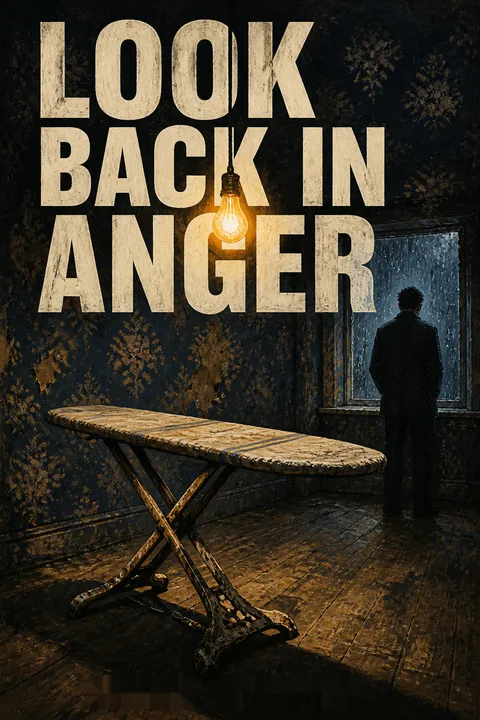
The Ironing Board Falls
On a cold Sunday, Jimmy Porter needles his wife, Alison, while their lodger Cliff tries to soften the room’s sharp edges. Jimmy’s complaints about their stalled life turn into a scuffle; he shoves Cliff into Alison, and the fallen ironing board leaves her arm burned. As Cliff tends the injury, Alison admits she is pregnant but has not told Jimmy.
She fears he will take the news as manipulation, not welcome it as their child. When Jimmy returns, he apologizes and confesses that his cruelty is deliberate, born of wanting her too intensely. The two slip into their private bear-and-squirrel game, briefly tender again, until a phone call announces Alison’s friend Helena is coming.
The domestic comedy is built from small, physical irritations: a newspaper, a shirt, a tea pot, an iron. Their ordinary scale makes Jimmy’s aggression harder to dismiss as mere rhetoric, because it enters the body and leaves Alison hurt. Cliff’s soothing care contrasts with Jimmy’s need to provoke a response, but Alison’s pregnancy deepens the conflict: intimacy has produced a future neither spouse can safely discuss. The animal game offers a temporary retreat from accusation into mutual play. Its interruption by Helena’s call marks how precarious that refuge is. The scene makes tenderness real, but shows it cannot by itself repair a pattern of harm.
Helena Enters the Flat
Two weeks later, Helena Charles has moved into the cramped flat and helps Alison prepare a meal while Jimmy plays trumpet in the next room. Alison tells her how she met Jimmy at a party, defied her wealthy family to marry him, and moved with him into Hugh Tanner’s crowded London flat.
There, Jimmy and Hugh treated Alison as a symbol of the class they opposed, even dragging her into raids on her family’s social circle for food and money. Hugh eventually left England, and Alison and Jimmy settled in the Midlands. Alison admits she is pregnant and still has not told her husband. Helena, alarmed by the strain and the coming child, tells Alison she must either make Jimmy change or leave.
Alison’s recollection complicates the simple picture of a victim trapped by a tyrant. She chose Jimmy, partly because his defiance made her feel she was entering a life with consequence, yet she also describes being used as a bridge into the very class he despised. Her account of the raids turns class conflict into lived humiliation, not just political argument. Helena’s practical ultimatum responds to the pregnancy as a change in responsibility, but it also imposes her own moral framework on Alison. The flat becomes a contested space where each woman interprets care differently: Alison remembers loyalty, Helena sees danger, and Jimmy’s trumpet makes conversation feel perpetually interrupted.
Church Becomes a Battleground
When Alison and Helena prepare to attend church, Jimmy treats their plan as an attack on him and resumes his assault on Alison’s family and beliefs. His anger shifts when Helena challenges him to account for his pain. He describes spending a year as a child beside his dying father, a veteran wounded in Spain whom the rest of the family treated as an embarrassment.
Jimmy says that watching the man die taught him helplessness and anger before he was old enough to understand either. The women still prepare to go. Then a call reports that Mrs Tanner, Hugh’s mother and Jimmy’s friend, has suffered a stroke. Jimmy asks Alison to come with him; she does not. Helena has already wired Alison’s father to collect her.
Jimmy’s story of his father gives his anger a history without making it harmless. As a boy, he was forced into the role of sole witness to an adult’s suffering; as a man, he tries to force others to witness his own. The story explains why indifference wounds him so sharply, but his use of it also corners Helena and Alison, making compassion feel like an obligation extracted under pressure. The stroke call abruptly tests those claims against action. Jimmy asks Alison to accompany him, but she cannot cross the threshold into his grief. Her refusal is not a verdict on Mrs Tanner; it shows how exhausted the marriage has become.
The Colonel Comes for Alison
The next evening, Colonel Redfern finds Alison packing while Jimmy is in London with Mrs Tanner. He admits that he and Alison’s mother went too far in trying to prevent the marriage, using investigators and accusations against Jimmy.
Alison recognizes that her father, like Jimmy, is stranded in a vanished world, though each responds to change differently. She cries against him, then leaves with him rather than waiting for Jimmy’s return. Helena stays behind because she has a possible acting job in Birmingham.
Cliff gives Helena Alison’s note and goes out to look for Jimmy, unwilling to be present for the hurt that is coming. The departure leaves the flat without its old mediator, and Helena alone with the message Alison could not deliver herself.
Colonel Redfern’s admission breaks the family conflict out of its familiar pattern of accusation. He does not suddenly understand Jimmy, but he can acknowledge that his own side acted unjustly. His gentleness makes Alison’s choice feel less like a triumph of one class over another than a retreat toward a place where she may rest. Cliff’s departure matters for the same reason: his humor has been a form of mediation, and he knows the household has depended on him to absorb its collisions. Helena’s decision to stay places her, not Cliff, in the path of Jimmy’s return. The flat is becoming a stage with fewer witnesses and fewer buffers.
Helena Slaps Jimmy
Jimmy returns from London after sitting with Mrs Tanner through her final hours. He finds Alison gone and reads her note as another polished evasion. When Helena tells him Alison is pregnant, he refuses to soften, insisting that he has just watched someone he loves die and cannot be expected to respond as Helena wishes. He attacks her as well, and Helena slaps him.
The blow silences them both; then she kisses him, and their antagonism becomes an affair. The act does not present the kiss as a cure for either person’s loneliness. Jimmy has lost Mrs Tanner and Alison has left; Helena’s intervention offers immediate closeness, but it begins in the same charged atmosphere of injury and power that shaped the marriage.
The slap is a physical boundary and a turning point, but it does not settle the moral question raised by Helena’s presence. Jimmy’s grief is genuine, yet he uses it to deny the importance of Alison’s pregnancy and to strike at Helena’s vulnerability. Helena’s response joins resistance to desire in one gesture. Their affair therefore grows from recognition and conflict at once, not from a clean romantic choice. The scene also shows how pain can become a credential in Jimmy’s household: whoever is suffering most seems entitled to demand the room’s attention. The new intimacy may feel like rescue, but it inherits the flat’s existing habit of confusing intensity with care.
Cliff Leaves the Menagerie
Several months later, Helena lives with Jimmy, while Cliff still shares the flat and works with him at the sweet stall. In the familiar Sunday routine, Cliff tells Jimmy he plans to leave and find different work.
Jimmy accepts the decision with a mixture of affection and resignation, recognizing that his loyal friend has spent years cushioning the marriage’s fights. After Cliff goes to prepare his shirt, Jimmy and Helena admit their attachment and plan to abandon the stall for a fresh start as performers.
Their plans end when Alison appears in the doorway, ill and rain-soaked. Jimmy leaves quickly, giving the women space. Helena brings Alison tea, and the former rivals sit together in a room where Alison’s belongings have been replaced by Helena’s.
Cliff’s departure removes the person who could turn a quarrel into a joke or care for someone after it became physical. His choice is neither a dramatic betrayal nor an escape from affection; it is an attempt to build a life not organized around Jimmy’s needs. Jimmy and Helena’s plan to perform together imagines another beginning, but it arrives just as Alison returns. The changed dressing table makes the passing months visible without explanation: Helena has not merely visited, she has occupied Alison’s place. Jimmy’s retreat leaves the two women to speak directly, and their conversation shifts the story away from his control of the room.
The Bear and Squirrel Return
Alison tells Helena she lost the baby and came back without intending to reclaim Jimmy. Helena recognizes that she cannot continue the affair while Alison is ill and suffering, so she tells Jimmy she is leaving. After Helena goes, Alison apologizes for not sending flowers to Mrs Tanner’s funeral, and Jimmy admits how deeply that omission wounded him.
Alison then explains the miscarriage: pain and grief finally forced her to understand the helplessness he had wanted her to feel. She collapses, and Jimmy catches her, asking her to stop trying to prove her suffering to him. They revive their bear-and-squirrel game, not as an escape from what happened, but as a fragile way to offer each other tenderness again.
The ending refuses a clean moral victory. Helena leaves because she can no longer reconcile her conduct with her beliefs, while Alison’s return is driven by grief rather than a claim of marital entitlement. Her miscarriage is not a punishment or a lesson imposed by the plot; it is a physical loss that gives her access to the pain Jimmy has repeatedly demanded she recognize. His embrace matters because, for once, he does not turn that pain into proof that he has won. The animal game restores a shared language, but its innocence is altered by what the couple now knows. Their reconciliation is real, though the final tenderness does not erase the injuries that made it necessary.
Analysis
The play locates postwar disillusionment not in a public square but in a rented room where politics becomes personal. Jimmy’s contempt for class privilege and cultural complacency is not simply a set of opinions; it is bound to his childhood memory of watching his father die while other adults kept their distance. That history gives his demand for feeling real force, but his method turns feeling into a test others can only fail. Alison’s quietness is similarly more than temperament. She has crossed class lines by marrying Jimmy, yet his insistence that she prove her loyalty makes her past and family into evidence against her.
Cliff’s humor keeps the household from splitting immediately, though it also allows the others to postpone decisions. Helena enters believing that firm moral judgment can interrupt the cycle, then discovers that desire has drawn her into it. Her eventual refusal to continue the affair marks a limit she chooses for herself, not a victory over Alison. The play gives no simple hierarchy of virtue: Jimmy is capable of tenderness and cruelty, Alison of reserve and deep feeling, Helena of conviction and complicity.
The animal game offers the couple a language for intimacy that bypasses debate. It is comforting precisely because it narrows the world to two creatures, yet that shelter cannot prevent pregnancy, bereavement, or the consequences of leaving. The ending’s return to the game is therefore neither a cure nor a denial. It is a modest act of mutual recognition after Alison has experienced a loss Jimmy cannot claim as his own. The play’s emotional insight lies in distinguishing intensity from understanding. Love may require exposure to pain, but pain does not grant ownership of another person, and suffering cannot be made meaningful by forcing someone else to suffer too.
Review Summary
Look Back in Anger received mixed reviews, with some praising its raw energy and social commentary, while others criticized its misogynistic elements and unlikable protagonist. Many found Jimmy Porter's constant anger and verbal abuse towards his wife disturbing. Some appreciated Osborne's portrayal of post-war British society and class tensions. The play was seen as groundbreaking for its time, introducing the concept of the "angry young man" and kitchen sink realism to British theatre. However, modern readers often find it dated and problematic in its treatment of women.
People Also Read





Characters
Jimmy Porter
The furious provocateurJimmy is a young, educated man who runs a sweet stall and treats ordinary life as an insult that must be answered. He attacks class privilege, political complacency, religious certainty, and the emotional reserve of those closest to him. His sharp intelligence and comic inventiveness make him magnetic, but he also uses language to corner people and force reactions. The childhood experience of watching his father die helps explain his sensitivity to indifference and his fixation on pain, without excusing his cruelty. Jimmy wants relationships to carry the same intensity he brings to argument. He struggles to accept that another person’s quietness may be different from rejection, and that closeness cannot be secured by provoking a wound.
Alison Porter
The guarded wifeAlison is Jimmy’s wife, raised in a comfortable, socially prominent family and now living in a cramped flat far from the life she knew. Her quietness can look like passivity, but it is also a way of containing conflict she does not know how to answer. She chose Jimmy against her family’s wishes, yet has never fully shared his appetite for ideological battles or emotional exposure. She is observant about the contradictions in the people around her, including her father’s nostalgia and Jimmy’s anger. Alison’s reserve protects her from being consumed by other people’s demands, but it also leaves her unable to communicate care in the form Jimmy recognizes. Her story turns on the difficult distinction between enduring love and surrendering one’s own limits.
Cliff Lewis
The affectionate mediatorCliff is Jimmy’s friend and business partner, a working-class man whose relaxed humor steadies the household. He is affectionate with Alison and offers practical care without demanding that she explain herself. His physical play with Jimmy lets the men express fondness through mock combat, while his easy manner softens Jimmy’s sharper attacks. Cliff is no passive fool: he sees the damage in the marriage and understands how his presence has helped keep the household together. Yet being needed as a buffer is not the same as having a life of his own. His warmth gives the flat some of its rare ease, and his independence gradually presses against the role everyone expects him to play.
Helena Charles
The decisive friendHelena is Alison’s friend, an actress whose polished manners and strong sense of right and wrong unsettle Jimmy. She arrives prepared to help Alison, bringing a confidence and decisiveness Alison often lacks. Helena judges Jimmy harshly, but she is also drawn to the force of his personality and does not remain safely outside the household’s conflicts. Her certainty is both strength and limitation: she acts when Alison hesitates, yet must confront what happens when desire pulls against her principles. Helena’s presence exposes that moral judgment does not make anyone immune to emotional entanglement. She is practical, self-possessed, and more vulnerable than her composure first suggests.
Colonel Redfern
The displaced fatherAlison’s father is a retired colonial officer, gentle beneath the habits of command. He remembers the life he knew before returning to England and feels out of place in a society that has changed around him. Unlike his wife, he is not eager to condemn Jimmy, and he can admit that the family’s effort to stop the marriage caused harm. His nostalgia is sincere, but it also keeps him oriented toward a past he cannot recover. In Alison, he recognizes a tendency toward quiet compromise that they share. His visit gives their relationship a chance for candor without turning him into an easy solution to her troubles.
Hugh Tanner
Jimmy’s absent allyHugh was Jimmy’s close friend and Alison’s uneasy housemate during the early days of her marriage. He shared Jimmy’s contempt for the upper-class circles Alison came from, but carried their defiance into more brazen acts. His decision to leave England ended the three-way arrangement and left Jimmy with a lasting sense of abandonment. Though Hugh never appears onstage, Alison’s memories show how his presence shaped the marriage before the Midlands flat became home.
Mrs Tanner
Jimmy’s working-class confidanteHugh’s mother is an older working-class woman who has supported herself and her son through years of labor. Jimmy is deeply attached to her, valuing her directness and the care she offers without social pretension. She helped him establish his sweet-stall business and remains an important emotional connection beyond the flat. Her kindness gives Jimmy a model of affection that is not based on argument or status.
Mrs Redfern
Alison’s controlling motherAlison’s mother opposes her marriage to Jimmy and tries to protect her daughter through intrusive, class-conscious tactics. Jimmy sees her as the embodiment of privilege and uses her as a target in his attacks on Alison’s family. Although she never appears onstage, her choices help shape the couple’s history and Alison’s sense of having crossed a line she cannot easily uncross.
Nigel Redfern
The polished politicianAlison’s brother is a military-trained, politically ambitious figure who represents the respectability Jimmy despises. Jimmy portrays him as confident but incurious about ordinary people. Nigel’s public career sharpens the contrast between the Redferns’ established status and Jimmy’s outsider anger.
Madeline
Jimmy’s formative admirerMadeline is an older woman who mattered greatly to Jimmy when he was young. He remembers her as curious and alert to the world, qualities he feels are missing from his present life. She remains part of the personal history he expects Alison to acknowledge.
Webster
The sharp-tongued friendWebster is one of Alison’s friends and a fellow performer. Jimmy respects his wit and conviction, even while disliking his company. His offstage presence gives Jimmy an example of someone whose opinions have energy and bite.
Miss Drury
The watchful landladyMiss Drury owns the house where the Porters rent their cramped flat. Her rules and complaints about the tenants’ housekeeping form part of the household’s daily friction. She remains outside the central relationships but helps define the narrow, rented world they inhabit.
Plot Devices
Sunday routine
Domestic pressure cookerThe Sunday papers, tea, ironing, and Jimmy’s complaints recur as a familiar household pattern. Their repetition makes stalled time tangible and gives small disruptions unusual force: the ironing accident, a visitor’s arrival, or an argument over a paper can tip the room into crisis. Because the action remains in the same flat, the routine also exposes how each character copes with confinement. Jimmy tries to break the sameness through provocation, Alison works quietly through it, and Cliff turns it into banter. The routine is not mere scenery; it is the pressure that repeatedly brings their incompatible needs into contact.
Bear and squirrel game
A private refugeThe teddy bear and woolly squirrel stand for the animal identities Jimmy and Alison invent for one another. In the game, they can exchange affection without having to answer the political and emotional demands that make ordinary intimacy painful. It lets the couple become playful and dependent in a way they cannot manage through direct discussion. The objects also connect Alison’s early life in the flat to the couple’s most vulnerable moments. Their return at the end signals an attempt to recover tenderness, while the weight of the intervening losses keeps the game from being purely childish.
Trumpet and church bells
Sound as confrontationJimmy’s trumpet and the church bells repeatedly interrupt the flat’s conversations. The trumpet gives Jimmy a way to fill the space with his own energy, while the bells bring the outside world and its religious institutions into a household already divided over belief. Both sounds frustrate characters who want quiet, and their timing intensifies moments of decision. The noises also make the flat feel less sealed off than it appears: streets, neighbors, church, and public life press against its walls. Sound becomes a form of pressure that the characters can hear but rarely control.
Class inheritance
A marriage under siegeThe difference between Alison’s privileged family and Jimmy’s working-class background supplies both the couple’s original attraction and a continuing source of injury. Jimmy interprets social security as complicity and attacks the Redferns as representatives of an order that has excluded him. Alison’s memories reveal that she was sometimes made a pawn in his and Hugh’s rebellion, while Colonel Redfern’s reflections show that the older generation also feels displaced by historical change. Class therefore operates through concrete actions: family interference, borrowed money, social visits, work, and the choice of where Alison can go when the marriage becomes unbearable.
FAQ
Synopsis & Basic Details
What is Look Back in Anger about?
- Synopsis: Look Back in Anger centers on the tumultuous marriage of Jimmy and Alison Porter, living in a cramped attic flat in post-war England. The play explores themes of class conflict, disillusionment, and the struggle for identity, as Jimmy's relentless anger and intellectual frustration create a toxic environment for himself, his wife, and their friend Cliff.
- Focus on relational dynamics: The play examines the destructive power of unresolved anger and the challenges of maintaining intimacy in the face of societal and personal pressures. It delves into the complexities of love, betrayal, and the search for meaning in a world that seems to have lost its way.
- Character-driven narrative: The plot unfolds through intense dialogue and emotional confrontations, revealing the characters' inner turmoil and their desperate attempts to connect with one another amidst their conflicting desires and ideologies.
Why should I read Look Back in Anger?
- Raw emotional intensity: The play offers a visceral and unflinching portrayal of human relationships, capturing the raw emotions of anger, frustration, and despair with remarkable honesty. Jimmy Porter's passionate outbursts and Alison's quiet suffering create a compelling and unforgettable dramatic experience.
- Exploration of social issues: Look Back in Anger provides a powerful commentary on the social and political landscape of post-war Britain, exploring themes of class conflict, disillusionment, and the search for identity in a rapidly changing world. The play's critique of societal norms and its call for authenticity resonate with contemporary audiences.
- Literary significance: As a seminal work of the Angry Young Men movement, Look Back in Anger revolutionized British theatre, challenging traditional conventions and paving the way for a new wave of playwrights who dared to explore taboo subjects and experiment with form.
What is the background of Look Back in Anger?
- Post-war Britain context: The play is set against the backdrop of post-war Britain, a time of social and economic upheaval, disillusionment with traditional values, and a growing sense of frustration among young people. The characters' struggles reflect the anxieties and uncertainties of a generation grappling with the aftermath of war and the challenges of building a new society.
- Class conflict: Look Back in Anger explores the deep-seated class divisions in British society, highlighting the resentment and frustration felt by working-class individuals like Jimmy Porter, who feel excluded from the privileges and opportunities enjoyed by the upper class. Jimmy's anger is fueled by a sense of injustice and a desire for social change.
- The "Angry Young Men" movement: The play is considered a key work of the "Angry Young Men" movement, a group of British writers and artists who emerged in the 1950s and expressed their discontent with the established social and political order. These artists challenged traditional conventions and explored taboo subjects, reflecting the anxieties and frustrations of a generation.
What are the most memorable quotes in Look Back in Anger?
- "Don't you see? I'm in the mud at last! I'm grovelling! I'm crawling!": This quote encapsulates Alison's emotional breakdown and her realization that she has finally reached the depths of despair that Jimmy has been pushing her towards. It highlights the destructive nature of their relationship and the pain they inflict on each other.
- "There aren't any good, brave causes left.": This quote reflects Jimmy's disillusionment with the post-war world and his sense that there is nothing meaningful left to fight for. It captures the apathy and cynicism that characterized the "Angry Young Men" movement.
- "I suppose people of our generation aren't able to die for good causes any longer.": This quote speaks to the lack of purpose and direction felt by many young people in post-war Britain. It suggests that the sacrifices and heroism of previous generations have left them with nothing to strive for.
What writing style, narrative choices, and literary techniques does John Osborne use?
- Realistic dialogue: Osborne employs realistic and often confrontational dialogue to reveal the characters' inner thoughts and emotions. The dialogue is characterized by its sharp wit, biting sarcasm, and emotional intensity, capturing the raw energy of human interaction.
- First-person perspective: While not strictly a first-person narrative, the play is heavily filtered through Jimmy's perspective. His monologues and outbursts dominate the stage, shaping the audience's understanding of the events and characters. This creates a sense of immediacy and intimacy, but also raises questions about the reliability of his viewpoint.
- Symbolism and imagery: Osborne uses symbolism and imagery to enhance the play's themes and create a deeper level of meaning. Recurring motifs, such as the bear and squirrel game, the cramped attic flat, and the sound of jazz music, contribute to the play's overall atmosphere and reinforce its central ideas.
Hidden Details & Subtle Connections
What are some minor details that add significant meaning?
- The tattered teddy bear: The large, tattered toy teddy bear on the chest of drawers symbolizes lost innocence and the characters' attempts to cling to childhood comforts in the face of adult anxieties. It represents a desire for simplicity and affection in a world of complex emotions and disillusionment.
- Alison's ironing: Alison's constant ironing symbolizes her attempts to maintain order and control in a chaotic environment. It represents her efforts to create a sense of normalcy and domesticity amidst the emotional turmoil of her marriage. The act of ironing also highlights her role as a traditional housewife, a role that clashes with Jimmy's desire for a more liberated and unconventional lifestyle.
- The Sunday newspapers: The "jungle of newspapers and weeklies" surrounding Jimmy and Cliff symbolizes their intellectual stagnation and their inability to engage meaningfully with the world around them. The newspapers represent a constant stream of information and opinions, but the characters seem unable to process or act upon it, highlighting their sense of powerlessness and alienation.
What are some subtle foreshadowing and callbacks?
- Jimmy's stories of watching his father die: Jimmy's repeated references to watching his father die foreshadow his own emotional vulnerability and his fear of abandonment. These stories reveal the source of his anger and his desperate need for connection, as he seeks to avoid the loneliness and despair he experienced as a child.
- Alison's comment about getting used to things: Alison's remark that she's "great one for getting used to things" foreshadows her eventual departure and her decision to leave Jimmy. It suggests that she has reached a breaking point and can no longer tolerate the emotional abuse and instability of their relationship.
- The bear and squirrel game: The bear and squirrel game, initially presented as a playful escape from reality, becomes a recurring motif that reflects the changing dynamics between Jimmy and Alison. As their relationship deteriorates, the game loses its innocence and becomes a symbol of their inability to connect on a deeper level.
What are some unexpected character connections?
- Jimmy and Colonel Redfern: Despite their initial animosity, Jimmy and Colonel Redfern share a sense of disillusionment with the modern world and a longing for a more authentic and meaningful existence. They both feel like outsiders in a society that has lost its way, creating a surprising connection between them.
- Helena and Jimmy: Despite their initial antagonism, Helena and Jimmy share a certain intellectual intensity and a willingness to challenge societal norms. This shared trait leads to their passionate affair, highlighting the complex and unpredictable nature of human attraction.
- Cliff and Alison: Cliff and Alison's close friendship provides a source of comfort and support for both of them. Their genuine affection and understanding create a safe space where they can express their vulnerabilities and find solace from the emotional turmoil of their lives.
Who are the most significant supporting characters?
- Cliff Lewis: Cliff serves as a crucial emotional buffer and confidant. His departure in Act Three signals a significant shift in the dynamic, leaving Jimmy more isolated and forcing Alison to confront her situation directly.
- Helena Charles: Helena acts as a catalyst for change. Her presence forces Alison to re-evaluate her marriage, and her eventual departure sets the stage for the play's final confrontation and attempted reconciliation.
- Colonel Redfern: Colonel Redfern provides a contrasting perspective, representing the older generation and traditional values. His visit allows for a broader exploration of societal changes and the challenges of adapting to a new world.
Psychological, Emotional, & Relational Analysis
What are some unspoken motivations of the characters?
- Jimmy's fear of vulnerability: Beneath his aggressive exterior, Jimmy is driven by a deep-seated fear of vulnerability and abandonment. His constant attacks on Alison and others are a defense mechanism, designed to protect himself from being hurt or rejected.
- Alison's desire for peace: Alison's quiet endurance masks a profound desire for peace and stability. She longs to escape the emotional turmoil of her marriage and find a sense of security and belonging. Her eventual departure is motivated by a desperate need to protect herself from further pain.
- Helena's search for meaning: Helena's involvement with Jimmy is driven by a search for meaning and purpose in her life. She is drawn to his passion and intensity, hoping to find a sense of fulfillment and excitement that is lacking in her own conventional existence.
What psychological complexities do the characters exhibit?
- Jimmy's sadomasochistic tendencies: Jimmy exhibits a complex mix of sadism and masochism in his relationships. He derives pleasure from inflicting pain on others, but also seems to crave punishment and self-destruction. This creates a cycle of abuse and resentment that is difficult to break.
- Alison's passive-aggressive behavior: Alison's quiet endurance and passive resistance can be interpreted as a form of passive-aggressive behavior. She avoids direct confrontation, but subtly undermines Jimmy's authority and expresses her discontent through silence and withdrawal.
- Helena's moral conflict: Helena experiences a significant moral conflict as she becomes involved in an affair with Jimmy. She struggles to reconcile her actions with her deeply held beliefs, leading to feelings of guilt and shame.
What are the major emotional turning points?
- Alison's revelation of her pregnancy: Alison's pregnancy reveal to Cliff is a major turning point, highlighting her vulnerability and the emotional distance between her and Jimmy.
- Helena slapping Jimmy: Helena slapping Jimmy is a pivotal moment, marking a shift in their relationship and leading to their passionate encounter.
- Alison's return and miscarriage: Alison's return and revelation of her miscarriage is a climactic moment, forcing Jimmy to confront the consequences of his actions and leading to a fragile reconciliation.
How do relationship dynamics evolve?
- Jimmy and Alison's relationship: Their relationship evolves from a passionate but volatile connection to a state of mutual resentment and despair. Alison's departure and eventual return mark a turning point, leading to a fragile reconciliation based on shared grief and a recognition of their mutual dependence.
- Jimmy and Cliff's relationship: Their relationship evolves from a close friendship to a state of tension and unease. Cliff's departure signals a loss of innocence and a recognition of the destructive forces at play in Jimmy's life.
- Alison and Helena's relationship: Their relationship evolves from a supportive friendship to a complex mix of betrayal and understanding. Helena's affair with Jimmy creates a rift between them, but they eventually find a way to forgive each other and acknowledge the shared pain they have experienced.
Interpretation & Debate
Which parts of the story remain ambiguous or open-ended?
- The future of Jimmy and Alison's relationship: The play's ending offers a fragile reconciliation, but it remains unclear whether Jimmy and Alison can truly overcome their past traumas and build a healthy, sustainable relationship. The final scene leaves the audience wondering whether their love is strong enough to withstand the challenges that lie ahead.
- The extent of Jimmy's self-awareness: It is debatable whether Jimmy truly understands the root causes of his anger and whether he is capable of genuine change. While he expresses remorse and vulnerability in the final scene, it is unclear whether this is a temporary state or a sign of lasting transformation.
- The role of societal forces: The play raises questions about the extent to which societal forces, such as class divisions and post-war disillusionment, contribute to the characters' struggles. It is open to interpretation whether their problems are primarily personal or whether they are symptoms of a larger social malaise.
What are some debatable, controversial scenes or moments in Look Back in Anger?
- Jimmy's verbal abuse of Alison: Jimmy's relentless verbal attacks on Alison are a source of controversy, raising questions about the nature of abuse and the extent to which his behavior can be excused by his own suffering. Some critics argue that his words are unforgivable, while others suggest that they are a symptom of his deep-seated pain and frustration.
- Helena's affair with Jimmy: Helena's affair with Jimmy is a controversial moment, raising questions about morality, betrayal, and the complexities of human desire. Some viewers condemn her actions as selfish and destructive, while others see them as a reflection of her own search for meaning and fulfillment.
- The play's ending: The play's ending, with Jimmy and Alison returning to their bear and squirrel game, is open to interpretation and has been the subject of much debate. Some critics see it as a sign of hope and reconciliation, while others view it as a cynical and unsatisfying conclusion that suggests the characters are doomed to repeat their destructive patterns.
Look Back in Anger Ending Explained: How It Ends & What It Means
- Return to the bear and squirrel game: The play concludes with Jimmy and Alison engaging in their familiar "bear and squirrel" role-playing. This return to their childish game suggests a retreat from the complexities and pain of adult relationships.
- Ambiguous reconciliation: While there is a sense of tenderness and understanding in their final embrace, the ending is far from a definitive resolution. The audience is left to question whether their reconciliation is genuine or merely a temporary respite from their ongoing struggles.
- Cycle of dependence: The ending can be interpreted as a commentary on the cyclical nature of their relationship. Despite their attempts to break free from their destructive patterns, they ultimately return to the familiar comforts and limitations of their shared world. The "bear and squirrel" game becomes a symbol of their codependency and their inability to fully escape the confines of their emotional cage.
Download PDF
Download EPUB
.epub digital book format is ideal for reading ebooks on phones, tablets, and e-readers.








