

Plot Summary
The Conch Calls Everyone
After an aircraft is shot down during a war, twelve-year-old Ralph1 wakes on a tropical island beside Piggy,2 a bespectacled boy with asthma.2 They find a conch shell, and Ralph1 blows it to gather the scattered survivors. The boys elect Ralph1 chief,1 while Jack,3 the former leader of a choir,3 takes charge of the older singers and turns them into hunters.
Piggy,2 who first suggested the meeting, is mocked after Ralph1 reveals the nickname he had asked him to keep private. Ralph1 chooses Jack3 and Simon4 to explore the island with him. They confirm there are no inhabitants and no visible sign of rescue. On the return journey, they find a trapped piglet, but Jack3 cannot bring himself to stab it. He vows that next time he will.
The opening makes leadership appear to arise from a mixture of competence, image, and ceremony. Piggy supplies practical thinking, but Ralph possesses the shell and the ease that make other boys follow him. Jack already has a trained group and a strong sense of entitlement, so the election does not erase the rival authority he represents. Their first failure to kill the piglet also matters: the boys have the tools and the appetite for adventure, but not yet the emotional permission to hurt. The island initially feels like freedom from adults; the private humiliation of Piggy hints that children bring old social habits with them.
A Signal Fire Runs Wild
At the first full assembly, Ralph1 explains that the aircraft was destroyed and nobody knows where the survivors are. He proposes rules, a speaking turn for whoever holds the conch, and a fire on the mountain to attract passing ships. When a little boy with a birthmark13 describes a frightening creature in the woods, Ralph1 dismisses it as a nightmare, though the younger children remain uneasy.
The boys rush uphill to build a signal fire, but they have no matches. Jack3 grabs Piggy's glasses and Ralph1 uses their lenses to focus sunlight on the kindling. The dry pile catches, then spreads into the forest before the boys can control it. Piggy2 points out that the birthmarked child13 is missing from the crowd. The boys cannot find him.
The first fire exposes the gap between announcing a rule and possessing the discipline to carry it out. Ralph's plan is sensible, yet the boys treat its most important instrument as an exhilarating group project rather than a responsibility that requires steady care. Piggy's glasses make knowledge useful, but Jack's seizure of them shows how easily usefulness can be turned into force. The missing child casts a shadow over the victory without giving the boys a way to understand what has happened. Their laughter and excitement do not cancel the consequence. The island's first collective achievement is also their first failure to protect one another.
Shelters Against the Hunt
As days pass, Ralph1 and Simon4 are left to build shelters while most of the boys swim, play, or eat fruit. Jack3 spends hours tracking pigs and returns without meat, increasingly absorbed by the chase.
He admits that the forest can make him feel watched, an unease that echoes the littluns' fear of a beast. Ralph1 insists that shelters matter because the children need protection and a place that feels like home. Simon4 quietly helps the younger boys reach fruit, then slips away to a concealed clearing in the forest.
His kindness and solitary retreat set him apart from both Ralph's1 public responsibilities and Jack's3 growing hunger to hunt. The island still offers food freely, but the boys are beginning to organize their days around competing needs.
This stretch replaces the first day's glamour with repetitive labor, and the characters respond differently to that loss. Ralph looks for visible work that preserves the possibility of return; Jack finds purpose in tracking and mastering prey. Neither impulse is simply false, but their priorities become increasingly difficult to reconcile. Simon's care for the littluns does not depend on recognition or rank, and his hidden clearing gives him a private space outside the group's noisy contests. Meanwhile, the boys' fear acquires a social dimension: even Jack, who mocks the beast, feels hunted in the forest. Their anxieties are not confined to the youngest children.
The Ship Passes Unseen
One afternoon, Ralph1 spots a ship on the horizon and races to the mountain, where the signal fire has gone out. Jack3 and his hunters return carrying a dead pig, their faces painted and their excitement fixed on the kill. They had taken the boys who were meant to tend the fire. Ralph1 tells Jack3 that the ship might have rescued them; Jack3 responds by boasting about the hunt and then strikes Piggy,2 breaking one lens of his glasses.
The group relights the fire, and Jack3 shares roasted meat, even forcing a portion on Simon4 after Simon4 gives Piggy2 some of his own. The feast reunites the boys briefly, but Ralph1 is left furious that hunting took precedence over the signal. He calls an assembly to confront what has happened.
The missed ship gives the boys' disagreement a cost they can measure: rescue was not an abstract hope but a possibility passing directly before them. Jack's success is real, since he has provided meat and earned admiration, but the same success makes neglect of the fire easier to excuse. Violence against Piggy reinforces the hierarchy already present in their teasing, while the broken lens weakens the practical tool on which the group's fire depends. The shared meal briefly disguises the conflict, yet Simon's quiet transfer of food to Piggy offers a different kind of authority, based on attention rather than spectacle. Ralph's assembly is an attempt to restore consequences to the group's decisions.
The Beast Enters Debate
Ralph1 uses the assembly to remind the boys that they have neglected water storage, shelter building, sanitation, and the signal fire. He forbids cooking fires away from the mountain and tries to turn the littluns' fear of the beast into a problem they can discuss.
Jack3 insists that no beast exists, but the younger boys tell of nightmares and a shape they believe they saw. Piggy2 argues that fear may come from people themselves, while Simon4 struggles to express a similar thought.
When the debate turns to ghosts and what might live in the sea, Ralph1 cannot bring the meeting back under control. Jack3 attacks the authority of the conch and leads the boys into a frenzied mock hunt on the beach. The rules still exist, but the group has learned how quickly excitement can drown them out.
Ralph's effort to manage fear through procedure is both humane and limited. He understands that neglected routines threaten survival, but the boys' anxiety does not yield to a vote or a logical explanation. Jack exploits that uncertainty by promising the confidence of hunting, a response that turns fear into shared aggression. Piggy's suggestion that people themselves may be frightening is more unsettling than the idea of an animal because it points toward a danger the boys cannot simply track and kill. Simon senses this but lacks the public fluency to make himself understood. The conch can organize speech, yet it cannot guarantee that anyone will listen.
A Dead Man on Mountain
During the night, an air battle takes place above the island. A dead parachutist drifts down and catches among the rocks on the mountain, where the wind repeatedly lifts his body. The twins, Sam and Eric,6 are on fire duty when the moving figure startles them. They flee to Ralph1 and report seeing a furry creature with claws and wings.
At dawn, Ralph1 calls the boys together, and Jack3 urges an expedition rather than letting fear keep them near the shelters. They search the island's far end, exploring a rocky outcrop they have named Castle Rock. As darkness approaches, Ralph,1 Jack,3 and Roger5 climb the mountain to investigate. They see the parachutist's shape move in the wind and run away, convinced that the beast is waiting above them.
The parachutist is an adult body displaced into the children's world by a war they cannot see or understand. Its movement is real, but its meaning is supplied by frightened observers, turning a corpse into evidence for a monster. The episode links the violence outside the island to the fear developing within it without making the boys capable of recognizing that connection. Jack's call to investigate strengthens his standing because he offers action where Ralph can offer only caution. Yet both boys retreat when confronted with the figure. Their fear is not a simple failure of courage; darkness and isolation have made interpretation itself dangerous.
Jack Breaks the Circle
The morning after the mountain expedition, Ralph1 admits that the boys could not fight what they saw and fears that their rescue signal is lost. Jack3 turns the admission into an attack on Ralph's1 leadership, claiming that Ralph1 is cowardly and no true hunter.
He asks the group to vote Ralph1 out, but nobody raises a hand. Humiliated, Jack3 abandons the assembly and declares that he will form his own group for hunting. Ralph1 and Piggy2 remain with the conch and the dwindling number of boys.
They decide to move their fire from the exposed mountain to the beach, where the group can tend it without going near the apparent beast. Piggy2 helps light it with his remaining lens. Meanwhile, Jack3 gathers followers and promises hunting, meat, and a life apart from Ralph's1 rules.
Jack's failed vote reveals that the old forms of legitimacy still have force, but not enough to settle the struggle. He cannot win the chief's title through procedure, so he exits and builds authority through promises that answer immediate appetites. Ralph's beach fire is a practical adaptation, though its lower visibility makes it a compromised signal. Piggy's ingenuity sustains the group, but the dependence on his damaged glasses is increasingly precarious. The separation is more than a dispute over leadership: each group now organizes survival around a different priority. Jack offers belonging through action and hunting; Ralph's remnant accepts inconvenience in order to preserve the possibility of rescue.
A Gift for the Beast
Jack3 establishes himself as chief3 among the boys who have joined him and leads them into the forest to hunt. They pursue a sow with piglets, wound her with spears, and finally kill her by surrounding and stabbing her. Jack3 orders the head mounted on a sharpened stick as an offering to the beast, then leaves with the others to prepare a feast and obtain fire from Ralph's1 group.
Simon,4 alone in his hidden clearing, sees the severed head surrounded by flies. In his feverish vision, it becomes the Lord of the Flies and tells him that the beast is not an animal he can hunt, but something within the boys themselves. Simon4 collapses. The hunters' offering has given physical shape to a truth the group has repeatedly been unable to face.
The sow's head is both a trophy and an attempted bargain: Jack's tribe treats fear as a power that can be placated with blood. The act consolidates the group's shared identity through violence, while the flies and the exposed carcass strip the ritual of any noble appearance. Simon's vision gives language to the insight that public debate could not hold. The beast is not a separate creature but the violence and appetite already active among the boys. Because Simon receives this knowledge in isolation and illness, it arrives without the authority or protection needed to make it persuasive. His collapse leaves the insight stranded at the edge of the group's attention.
Simon Brings the Truth
Simon4 wakes and climbs to the mountain, where he finds the parachutist tangled in its lines. He frees the body from the rocks, then staggers downhill to tell the others that the supposed beast is only a dead man. At Jack's3 feast, Ralph1 and Piggy2 have joined the gathering, drawn by food and the promise of protection.
As a violent storm breaks, Jack's3 followers begin a rhythmic hunt dance, and the others join the circle. Simon4 emerges from the forest, trying to report what he has discovered. In the lightning and confusion, the boys mistake him for the beast and attack him together. The storm drives them apart only after Simon4 has been killed. The tide later carries his body out from the shore.
Simon reaches the truth through direct observation, but knowledge alone cannot overcome a group already absorbed in ritual and fear. The storm supplies sensory confusion, while the dance gives each boy cover inside a collective action. Their violence is not planned as a murder, yet the shared rhythm does not make it harmless; it makes responsibility harder for each participant to feel. Ralph and Piggy's presence in the circle complicates any clean division between the civilized group and Jack's hunters. The scene turns the boys' earlier play-acting into lethal behavior. Simon's attempt to correct the story arrives at the exact moment when the group is least able to recognize him.
Glasses Stolen at Night
After the storm, Ralph1 and Piggy2 sit with the remaining boys and acknowledge that Simon4 was killed, though Piggy2 insists it was an accident and urges Ralph1 to deny their own part in the dance. Sam and Eric6 return from Jack's3 group with injuries and evasive explanations.
At night, Jack3 leads a raid on the beach shelter. His hunters attack Ralph's1 group in the darkness, leaving Ralph1 bruised and Piggy2 battered, then escape with Piggy's glasses.
The conch remains untouched, revealing that they came for the means to make fire, not for the group's symbol of discussion. Without the glasses, Piggy2 cannot see properly and the others cannot easily light their signal fire. Jack's3 tribe now has both a leader and the practical advantage of controlling fire.
The boys' response to Simon's death shows how denial functions as a form of self-protection. Piggy tries to confine the event to accident and darkness, while Ralph cannot fully accept that explanation. Their disagreement is not merely about facts; it is about whether belonging to the group also means sharing responsibility. The raid then makes Jack's power materially effective. He does not take the conch, which has little use to his project, but steals the glasses that let Ralph's group create fire. The attack strips the opposition of sight and practical independence, showing how political dominance can be built by taking control of a resource rather than winning an argument.
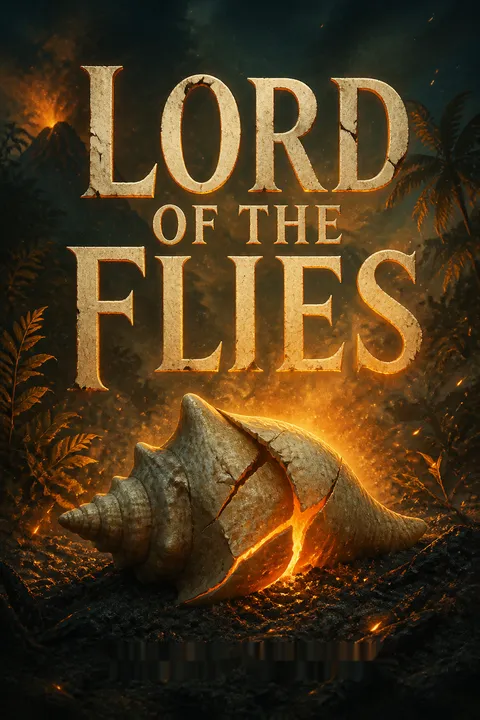
The Conch Shatters
Ralph,1 Piggy,2 and the twins decide to confront Jack3 at Castle Rock and ask for Piggy's glasses back. Piggy2 carries the conch, believing that a direct appeal to fairness may still matter. Jack3 refuses to return the glasses, and Ralph1 fights him with his spear. When Piggy2 tries to speak, Roger5 releases a boulder from above.
It strikes Piggy2 and knocks him from the cliff into the sea; the conch breaks into fragments. Jack3 declares himself chief3 and attacks Ralph,1 while his tribe captures Sam and Eric.6 The boys who once gathered around the shell now stand under Jack's3 armed authority. Ralph1 escapes into the forest, injured and alone, as the twins are forced to submit to the tribe.
The confrontation makes the collapse of the group's institutions literal. Piggy brings the conch as a final appeal to shared rules, but Roger's violence destroys both its holder and the object that authorized public speech. The boulder is not an accidental force of nature: Roger deliberately releases it, while Jack's command converts the aftermath into a declaration of rule. Piggy's dependence on fairness leaves him exposed in a place governed by coercion. Ralph's surviving escape does not restore his leadership; he has lost his closest ally, the conch, and the twins. Authority has shifted from a group that could disagree to one that can compel obedience.
Smoke Draws the Navy
Ralph1 hides near Castle Rock and learns from Sam and Eric6 that Jack's3 tribe plans to hunt him across the island. They warn him that Roger5 has sharpened a stick at both ends, then secretly give him food. The next day, Ralph1 hides in a thicket as the boys search for him. When they cannot reach him, they set the brush alight and drive him from cover.
Ralph1 runs through the spreading fire and bursts onto the beach, where he falls before a naval officer14 and sailors who have come ashore after seeing the smoke. The officer14 asks who is in charge and learns that Ralph1 is. The boys are taken off the island. Ralph1 finally weeps for the friends he has lost and for what they have become.
The signal fire's meaning has come full circle: the boys create smoke first as a deliberate plea for rescue, then Jack's hunt turns the whole island into a blaze that draws adult attention. Rescue arrives through the very danger meant to kill Ralph, an outcome that preserves the difference between survival and moral repair. The naval officer sees children and a spectacle of disorder, but his presence also recalls the war that caused their isolation. Ralph's tears follow the release of immediate danger, when he can no longer keep grief subordinate to action. The ending offers escape, not restoration: the boys leave the island, but the losses and knowledge acquired there remain.
Analysis
Lord of the Flies tests the comforting idea that rules survive simply because people once agreed to them. Ralph's1 assemblies, the conch, the shelters, and the signal fire all require ongoing labor and consent. None operates by itself. As the boys tire, grow hungry, and become frightened, Jack3 offers a competing form of order: hunting, feasting, protection, and a leader whose decisions need not be debated. His authority is not an absence of organization; it is an organization built around appetite and force.
The island also makes social responsibility visible through material dependence. Ralph1 needs Piggy's2 judgment, while the group needs Piggy's glasses to make fire. Yet the boys repeatedly confuse usefulness with worth, mocking Piggy2 even as they rely on him. Simon's4 insight offers a more difficult account of the beast, but perception without social standing cannot protect him or persuade the group. The tragedy is therefore not that nobody sees what is happening. Piggy2 identifies practical failures, Ralph1 recognizes the fire's importance, and Simon4 understands the source of fear. Their knowledge is scattered among characters who lack enough power, trust, or shared language to act together.
The violence escalates through rehearsals and permissions. A missed signal fire is excused by a successful hunt; play becomes a ritual; paint makes responsibility feel less personal; fear makes a stranger look like a monster. The boys do not cross into brutality in one sudden leap. They repeatedly accept smaller evasions until collective action becomes harder to interrupt than to join.
The naval officer's14 arrival does not prove that civilization has triumphed. The war outside the island has already placed the children in danger, and the officer's14 world is itself organized around violence. Rescue ends the boys' immediate isolation, but it cannot reverse what they did to one another. The novel's unsettling claim is not that rules are useless, but that they are fragile achievements, sustained only when people accept responsibility for enforcing them, especially when fear and desire make that responsibility inconvenient.
Review Summary
Lord of the Flies is a polarizing novel that explores the dark side of human nature through a group of stranded boys on an island. Many readers find it thought-provoking and chilling, praising its allegorical depth and examination of civilization versus savagery. However, some criticize its dated language, graphic violence, and pessimistic view of humanity. The book's impact and symbolism are widely recognized, though opinions vary on its realism and moral implications. It remains a controversial yet enduring work that continues to spark debate and analysis.
People Also Read

Characters
Ralph
The elected chiefRalph is a fair-haired boy of about twelve whose confidence and appearance make him an appealing leader. He wants the boys to enjoy the island, but he understands that rescue depends on organized work, especially keeping a signal fire alive. His authority rests on assemblies, shared rules, and the conch, not on force. That makes him capable of compromise and, at times, slow to see how quickly other boys can abandon procedure. Ralph is not naturally as analytical as Piggy2, yet he learns to recognize the value of practical thought and to take responsibility for decisions. His struggle is to preserve a public-minded idea of leadership when immediate excitement repeatedly tempts the group away from it.
Piggy
The practical thinkerPiggy is a thoughtful, physically vulnerable boy with asthma and thick glasses. He is observant, articulate, and quick to see the practical consequences of the group's choices, from keeping names to maintaining a fire. Yet the other boys mock his body and manner, and his intelligence rarely grants him the social authority it deserves. He attaches importance to procedure because rules offer protection when strength and popularity decide who gets heard. His relationship with Ralph1 combines loyalty and frustration: he supplies plans that Ralph1 can turn into action, while seeking recognition as more than a useful adviser. Piggy's insistence on reason is not coldness; it is his way of making an unstable world answerable.
Jack
The hunting leaderJack begins as the commanding head of a choir, accustomed to directing others and expecting his qualifications to be recognized. He is ambitious, physically bold, and keenly responsive to the mastery and approval that hunting offers. The island gives him room to turn discipline into domination: he can organize the boys, provide food, and make fear feel manageable through action. His rivalry with Ralph1 is rooted partly in status and partly in a genuine difference of priorities. Jack is more comfortable than Ralph1 with immediate appetite, spectacle, and coercion. Face paint helps him shed self-consciousness, making it easier to act as a forceful group leader rather than as an individual accountable to familiar rules.
Simon
The quiet truth-seekerSimon is a slight, inward boy whose kindness shows most clearly in unobserved acts, such as helping the littluns reach fruit. He is physically sensitive and sometimes overwhelmed in public, which makes assemblies a difficult place for him to explain what he senses. Unlike Jack3, he does not seek mastery through hunting; unlike Ralph1, he does not organize others through formal leadership. Simon's solitary walks and hidden clearing suggest a need for quiet in which he can attend to experiences the group dismisses. He is perceptive about fear and human behavior, but his reserve leaves him poorly equipped to make insight persuasive. His moral seriousness comes through as attention to others rather than as a claim to authority.
Roger
The watchful enforcerRoger is a quiet, secretive boy who watches others before revealing what he thinks. At first, habits inherited from ordinary society limit how far he will go in frightening the younger children. As the island's protections weaken, his interest in power becomes more direct and disturbing. Roger rarely needs Jack's3 charisma; he works through intimidation and the possibility of violence. His stillness contrasts with the noisy excitement of the hunters, making him difficult for the others to read. He represents the danger of cruelty that does not need to justify itself through leadership, hunger, or fear.
Sam and Eric
The inseparable twinsSam and Eric are twins whose closeness makes them seem almost like a single unit. They are energetic and generally willing to help, but their dependence on each other makes independent action difficult. They take turns at the signal fire, explore with the older boys, and often speak in each other's presence. Their loyalties are shaped by the pressure of whichever group has power around them, leaving them caught between friendship, fear, and self-preservation. As a pair, they show how an individual boy's judgment can be overwhelmed by the need to stay safe within a group.
Maurice
The eager followerMaurice is a broad, sociable choir boy who readily joins the island's games and group activities. He follows Jack3 into hunting and participates in the boys' growing rituals, but he still carries traces of the ordinary moral habits he knew before the crash. His easy laughter makes him an effective member of a crowd, though it can also help him avoid thinking too hard about what the group is doing. Maurice illustrates how participation can slide from play into harm without a clear moment of decision.
Robert
The game turned targetRobert is one of Jack's3 hunters and takes part in the boys' increasingly violent games. When the hunt is rehearsed around him, he experiences firsthand how quickly a pretend victim can become genuinely frightened and hurt. He is not a prominent decision-maker, but his role reveals the group's changing boundaries: the boys discover that imitation can generate real pain, then struggle to treat that discovery as a warning.
Percival Wemys Madison
The homesick littlunPercival is one of the youngest boys, anxious and easily overwhelmed by the island's unfamiliar routines. He clings to the remembered details of his home address as though repeating them might restore the adult world around him. His distress makes visible the cost of isolation for children who cannot explain or manage their fear. Percival's need for comfort contrasts with the older boys' efforts to turn uncertainty into rules, hunting, or jokes.
Henry
The absorbed littlunHenry is a young boy who becomes absorbed in watching tiny sea creatures move through the wet sand. His attention to them gives him a brief sense of control over a world much larger than himself. He represents the littluns' separate, child-sized life on the island.
Johnny
The bold littlunJohnny is a sturdy, fair-haired littlun with a naturally combative streak. He joins the younger boys' games and often asserts himself when they are left to their own devices. His presence helps establish the littluns as a distinct group with their own small rivalries and routines.
Phil
The uneasy dreamerPhil is a littlun who reports waking outside after a frightening dream and believing he saw a large shape among the trees. His account intensifies the group's uncertainty because it blurs the line between nightmare and something witnessed. Phil is not trying to lead the others; he is trying to make them take his fear seriously.
The marked littlun
The first missing childThis youngest boy is distinguished by a large birthmark on his face. He is timid in the first assembly and struggles to explain what he believes he saw in the woods. His fear gives the older boys an early chance to respond with care, though they instead laugh at his account.
The naval officer
The outside authorityThe naval officer is an adult whose uniform, sailors, and boat represent the organized world beyond the island. He approaches the boys with a military officer's practical interest in what has happened and who is in charge. His presence contrasts with the children's improvised society and recalls the larger wartime world that shaped their situation.
Plot Devices
The conch
A fragile right to speakRalph1 and Piggy2 use the conch to call the boys together and establish a rule that the holder may speak without interruption. Its authority depends on the group's willingness to respect a shared procedure, rather than on the shell's practical power. As Jack3 challenges Ralph1, the conch becomes a visible test of whether the boys still accept collective decision-making. Piggy2 carries it when he asks Jack3 for his glasses, hoping that an appeal to fairness can still reach the tribe. The conch links leadership, speech, and mutual recognition, while its vulnerability shows how easily an institution can fail when its members stop granting it force.
Piggy's glasses
Sight becomes firePiggy's2 glasses allow Ralph1 to focus sunlight and ignite kindling, making them essential to the boys' signal fire. Their practical value gives Piggy2 influence, but it also makes him vulnerable to anyone strong enough to seize them. The glasses connect intellectual ability to material survival: Piggy2 can see and reason, while the group needs his lenses to create flame. When Jack's3 hunters take them, Ralph's1 group loses the means to light its fire easily. The device shows that knowledge is powerful only when its tools remain accessible, and that controlling a resource can matter more than persuading people to agree.
The signal fire
Rescue made visibleRalph1 proposes the fire as a beacon for ships, turning the boys' hope of rescue into a task that requires fuel, watchfulness, and cooperation. At first they build it in an uncontrolled rush; later they struggle to keep it burning while hunger, fear, and Jack's3 hunts pull the group apart. The fire therefore measures the distance between a declared goal and the daily discipline needed to achieve it. Smoke can attract help, but flame can also consume the forest. Near the end, a fire set to flush Ralph1 from hiding becomes visible to adults. Rescue arrives, but not through the boys' steady stewardship of the signal they first planned.
The beast
Fear given a shapeThe beast begins as a littlun's frightening report and grows through nightmares, rumors, and ambiguous sightings. The parachutist's corpse gives the boys something real to misread, but their belief in a pursuing monster survives even after the body is found. Jack3 turns that belief into a reason for hunting and protection, while Simon's4 private vision identifies the deeper danger as something within the boys themselves. The beast works as a moving explanation for anxiety, allowing the group to treat fear as an outside enemy. It is also a measure of how poorly the boys can recognize the violence developing among them.
Face paint
A mask loosens restraintJack3 paints his face with clay and charcoal before hunting, initially using the disguise to approach pigs without being recognized. The mask changes more than his appearance: it helps him escape self-consciousness and makes the hunters feel like a distinct group. Later, paint allows the boys to hide individual expressions inside a collective identity. Their actions become easier to intensify when no familiar face seems fully exposed. The device links camouflage with social permission: what begins as a practical hunting technique becomes a way to distance the boys from the consequences of their conduct.
FAQ
Synopsis & Basic Details
What is Lord of the Flies about?
- Boys stranded, order collapses: A group of British schoolboys are stranded on a deserted island after a plane crash and attempt to govern themselves, but their initial efforts at civilization quickly devolve into savagery and violence.
- Struggle for power: The novel explores the conflict between two boys, Ralph, who represents order and democracy, and Jack, who embodies primal instincts and the desire for power, as they vie for leadership.
- Human nature explored: The story is a dark exploration of human nature, suggesting that the capacity for savagery and evil is inherent in all individuals, and that civilization is a fragile construct.
Why should I read Lord of the Flies?
- Timeless exploration of evil: The novel offers a timeless and disturbing look at the potential for evil within human nature, making it relevant to any era and prompting deep reflection.
- Symbolism and allegory: The rich symbolism and allegorical nature of the story provide layers of meaning, making it a rewarding read for those interested in literary analysis and interpretation.
- Thought-provoking themes: The book tackles complex themes such as the nature of civilization, the loss of innocence, and the dangers of unchecked power, encouraging readers to question their own beliefs and assumptions.
What is the background of Lord of the Flies?
- Post-WWII context: Written in the aftermath of World War II, the novel reflects the disillusionment and anxieties of the time, questioning the idea of inherent human goodness and the fragility of societal structures.
- Critique of utopian ideals: Golding's work serves as a critique of utopian ideals and the belief in the perfectibility of humanity, suggesting that even in the absence of external constraints, human nature can lead to chaos.
- Inspired by Coral Island: Golding was inspired by R.M. Ballantyne's "The Coral Island," a story of boys on a desert island, but he subverts its optimistic tone to explore the darker side of human nature.
What are the most memorable quotes in Lord of the Flies?
- "Maybe there is a beast... maybe it's only us.": This quote by Simon encapsulates the central theme of the novel, suggesting that the true source of fear and evil lies within the boys themselves, not an external monster.
- "Which is better—to have rules and agree, or to hunt and kill?": This question posed by Piggy highlights the fundamental conflict between civilization and savagery, and the choice the boys must make.
- "Ralph wept for the end of innocence, the darkness of man's heart.": This final line of the novel captures the tragic loss of innocence and the profound understanding of human nature that Ralph gains through his experiences.
What writing style, narrative choices, and literary techniques does William Golding use?
- Allegorical narrative: Golding employs an allegorical narrative, where the characters and events represent abstract ideas and concepts, allowing for a deeper exploration of human nature and society.
- Symbolic language: The novel is rich in symbolism, with objects like the conch, the signal fire, and the pig's head representing key themes and ideas, adding layers of meaning to the story.
- Third-person limited perspective: The narrative is primarily told from Ralph's perspective, allowing readers to experience his growing disillusionment and understanding of the boys' descent into savagery.
Hidden Details & Subtle Connections
What are some minor details that add significant meaning?
- Piggy's glasses as intellect: Piggy's glasses, initially used to start the fire, symbolize intellect and reason, and their gradual loss of function mirrors the boys' descent into irrationality and savagery.
- The choir's black robes: The choir's black robes, initially a symbol of order and discipline, become a symbol of darkness and savagery as Jack's choir transforms into a hunting tribe.
- The island's scar: The "scar" on the island, created by the plane crash, symbolizes the initial intrusion of civilization and the damage it can inflict, foreshadowing the boys' destructive actions.
What are some subtle foreshadowing and callbacks?
- Simon's premonition: Simon's early understanding of the beast as something within the boys foreshadows his tragic death and the revelation of the boys' inner savagery.
- The pig hunt practice: The boys' initial playful pig hunts foreshadow the later, more brutal hunts and the eventual killing of Simon, demonstrating the gradual escalation of violence.
- The painted faces: The boys' use of face paint, initially for hunting, becomes a symbol of their loss of identity and their embrace of savagery, a transformation that is subtly foreshadowed early on.
What are some unexpected character connections?
- Ralph and Piggy's reliance: Despite their differences, Ralph and Piggy form a crucial partnership, with Piggy's intellect complementing Ralph's leadership, highlighting the importance of diverse perspectives.
- Jack and Roger's sadism: Jack's desire for power is mirrored in Roger's sadistic tendencies, showing how unchecked authority can lead to extreme cruelty and violence.
- Simon and the Lord of the Flies: Simon's encounter with the Lord of the Flies reveals a deeper understanding of the beast, connecting his spiritual insight to the source of evil on the island.
Who are the most significant supporting characters?
- Samneric's moral struggle: Samneric's internal conflict between loyalty to Ralph and fear of Jack highlights the difficulty of maintaining morality in the face of overwhelming pressure.
- Roger's embodiment of sadism: Roger's increasing cruelty and violence represent the darkest aspects of human nature, demonstrating the potential for evil when societal constraints are removed.
- The littluns' vulnerability: The littluns' fear and dependence on the older boys underscore the fragility of innocence and the devastating impact of the boys' descent into savagery.
Psychological, Emotional, & Relational Analysis
What are some unspoken motivations of the characters?
- Ralph's desire for order: Ralph's unspoken motivation is to maintain order and civilization, driven by a deep-seated need for structure and a belief in the possibility of rescue.
- Jack's hunger for power: Jack's unspoken motivation is a deep-seated desire for power and control, fueled by his ego and a need to dominate others.
- Piggy's need for acceptance: Piggy's unspoken motivation is a desire for acceptance and respect, driven by his insecurities and his longing to be valued for his intellect.
What psychological complexities do the characters exhibit?
- Ralph's disillusionment: Ralph's psychological journey involves a gradual disillusionment as he witnesses the boys' descent into savagery, forcing him to confront the darkness within himself and others.
- Jack's regression: Jack's psychological complexity lies in his regression from a civilized choirboy to a primal savage, revealing the fragility of societal conditioning.
- Simon's spiritual insight: Simon's psychological complexity is rooted in his spiritual insight and his ability to perceive the true nature of the beast, setting him apart from the other boys.
What are the major emotional turning points?
- The first pig kill: The first successful pig hunt marks a turning point, as the boys' excitement and bloodlust foreshadow their descent into savagery and the loss of their innocence.
- Simon's death: Simon's tragic death is a major emotional turning point, as it represents the complete triumph of savagery and the loss of any remaining hope for reason and morality.
- Piggy's death: Piggy's death is another major emotional turning point, as it signifies the complete breakdown of order and the loss of the last voice of reason on the island.
How do relationship dynamics evolve?
- Ralph and Jack's rivalry: The initial rivalry between Ralph and Jack evolves into a bitter conflict, reflecting the larger struggle between civilization and savagery, and the destructive nature of unchecked power.
- Ralph and Piggy's alliance: The alliance between Ralph and Piggy strengthens as the boys descend into chaos, highlighting the importance of intellect and reason in the face of primal instincts.
- The tribe's groupthink: The tribe's dynamic shifts from a group of individuals to a unified, savage entity, demonstrating the dangers of groupthink and the loss of individual identity.
Interpretation & Debate
Which parts of the story remain ambiguous or open-ended?
- The naval officer's understanding: The naval officer's reaction to the boys' savagery is ambiguous, leaving the reader to question whether he truly understands the depth of their depravity and the implications for society.
- The future of the boys: The novel ends with the boys being rescued, but the long-term psychological impact of their experiences is left open-ended, prompting reflection on the lasting effects of trauma and violence.
- The nature of evil: The nature of evil itself remains ambiguous, with the novel suggesting that it is both an internal and external force, leaving the reader to ponder the complexities of human nature.
What are some debatable, controversial scenes or moments in Lord of the Flies?
- The killing of Simon: The killing of Simon is a controversial scene, as it raises questions about the boys' culpability and the extent to which they are responsible for their actions, given their descent into savagery.
- The treatment of Piggy: The constant bullying and mistreatment of Piggy is a controversial aspect of the novel, highlighting the dangers of prejudice and the vulnerability of those who are different.
- The ending's message: The ending, with the boys being rescued, is debatable, as it raises questions about whether civilization can truly redeem the boys and whether the darkness within humanity can ever be overcome.
Lord of the Flies Ending Explained: How It Ends & What It Means
- Rescue by naval officer: The boys are rescued by the naval officer, drawn to the island by the fire set by Jack's tribe, ironically fulfilling Ralph's initial goal of rescue through the signal fire.
- Ralph's emotional breakdown: Ralph weeps for the loss of innocence and the darkness of man's heart, demonstrating his profound understanding of the boys' descent into savagery and the fragility of civilization.
- Irony of rescue: The rescue is ironic, as the boys are saved by the very civilization they had abandoned, highlighting the thin veneer of order and the potential for savagery within all of humanity.
Download PDF
Download EPUB
.epub digital book format is ideal for reading ebooks on phones, tablets, and e-readers.








