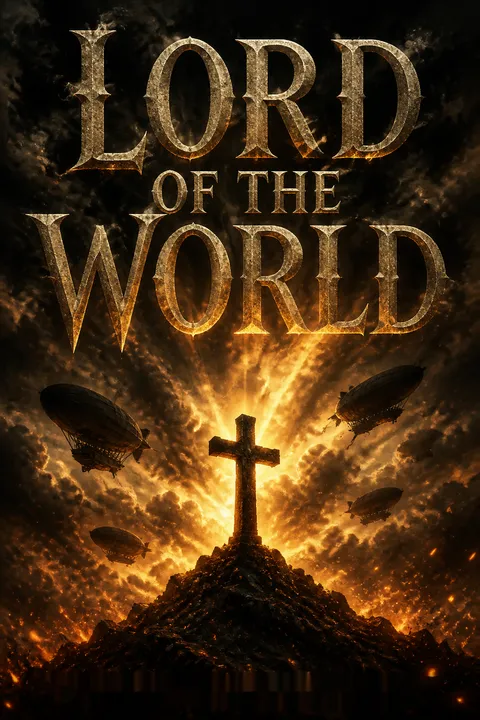


Plot Summary
Prologue
In a future London buried beneath its own machinery, the elderly statesman Mr. Templeton gives Father Percy Franklin a history of the world’s political and religious transformation. Communism has replaced monarchy and private enterprise; Humanitarianism has become a public faith, while Catholicism dwindles.
Templeton warns that Europe’s growing unity may turn against the Church, and that a charismatic leader could give this secular order its human face. His account frames the coming struggle before the main story reveals the people caught inside it.
The prologue makes political history feel less like a backdrop than a mechanism already moving toward its next stage. Templeton’s retrospective catalogue shows how reforms, each presented as practical and humane, have gradually remade the state and its assumptions about human nature. His warning is not that social change is inherently evil, but that a society can mistake administrative success for a complete account of existence. Percy listens from within a world that looks prosperous and peaceful, so the danger is not visible as simple oppression. It arrives disguised as coherence.
The East Starts Moving
In a future London of underground homes, silent motorways, and swift aircraft called volors, newly elected Communist MP Oliver Brand studies broken reports from the East. A vast Eastern Empire is massing troops, and a mysterious American delegate named Julian Felsenburgh is appearing before crowds from Siberia to India.
Oliver’s wife, Mabel, shares his Humanitarian belief that humanity can unite without a supernatural God, but even she senses the scale of the danger. Oliver thinks Felsenburgh may be persuading the East to choose peace, though the reports are too incomplete to confirm it. The crisis begins as a contest between two visions of world order, with the possibility of war pressing against the comfortable certainty of the West.
The opening places political suspense inside domestic confidence. Oliver and Mabel do not experience their secular creed as bleakness; they see it as a humane achievement, which makes the approaching crisis harder for them to interpret. Felsenburgh first appears not as a person but as a name passed through damaged communications, a blank onto which rival hopes can be projected. The technological calm of London sharpens the irony: the society that believes it has outgrown conflict is suddenly dependent on one unknown man to prevent it.
Death at Brighton
On a trip to Brighton, Mabel notices a young priest with white hair before a government volor crashes into the station square. She watches him kneel beside a dying passenger, offer the crucifix, and perform the last rites before the euthanasia officials arrive. At home, Oliver dismisses the priest’s faith as an old delusion and explains death as the end of individual life.
Mabel agrees in principle, yet the sight of blood on her shoe unsettles the neatness of his explanation. For the first time she has watched someone die, and she realizes that she had no words ready for the dying man. The collision leaves her with a question her Humanitarian creed cannot quite quiet.
The crash gives the novel its first embodied argument. Oliver can reduce Catholic belief to an idea, but Mabel has seen it acted out at the point where abstractions lose their shelter. The priest’s response is not proof of doctrine; it is a form of presence that Mabel recognizes as meaningful before she knows what she thinks about it. Her bloodstained shoe is a small physical remainder of an event her husband tries to declare finished. The discrepancy between his explanation and her experience becomes the first crack in her certainty.
Francis Loses Faith
At Westminster, Father Francis tells Percy Franklin that he has stopped believing and intends to leave the priesthood. Percy has spent months trying to help him, but Francis now regards Christian faith as untrue, while Percy believes Francis has let feeling and intellectual pride crowd out prayer.
Their parting exposes the pressure on Catholics as Humanitarianism spreads through public life and even priests abandon the Church. Percy turns to prayer after Francis leaves, asking for strength as he imagines the Church enduring a long season of silence and suffering.
Meanwhile, reports of Felsenburgh’s influence continue to multiply. Percy cannot yet explain why the stranger’s name troubles him, but he senses that the world’s changing allegiance is gathering around a single person.
Francis’s departure gives the religious crisis an intimate cost: a shared vocation cannot survive when its central truth has become, for one man, an empty form. Percy’s response is compassionate but severe, reflecting his conviction that belief involves the will and moral life as well as argument. The scene also establishes the novel’s psychological asymmetry. The secular world’s claims feel immediate and emotionally persuasive, while faith must be maintained through deliberate practice. Felsenburgh’s rising prominence supplies this private fracture with a public counterpart, a new center of authority that promises unity without transcendence.
A Bullet at Trafalgar
While Oliver addresses a vast crowd at Trafalgar Square, a Catholic man shoots him in the arm. The crowd seizes and kills the attacker before he can be tried, while Oliver urges them to spare him.
Newspapers celebrate the assault as proof that the Communists, too, can suffer for their principles, and Oliver recognizes that the incident has strengthened his political cause. At home, Mabel wishes the crowd had not killed the man, and Oliver’s elderly mother, raised Catholic, reacts uneasily when he boasts that Braithwaite did more for humanity than Christ.
Oliver asks Mabel to watch for signs that his mother is returning to religion. The attack makes public violence personal, but he still sees it as useful evidence in a larger political struggle.
The shooting briefly complicates the easy moral division between a violent past and a peaceful present. Oliver’s genuine attempt to protect his assailant coexists with his recognition that the attack benefits his movement. Mabel, by contrast, remains focused on the dead man as a person rather than as political evidence. The crowd’s killing of the attacker anticipates a contradiction that will become impossible to ignore: a society can condemn violence rhetorically while absorbing it into its account of justice. The mother’s restrained reaction quietly links public conflict to the household’s older religious memory.
Peace Has a Face
During Oliver’s visit to a European conference, word reaches him that Felsenburgh has persuaded the Eastern powers to abandon war. London erupts into celebration, and Felsenburgh arrives in a white volor to be greeted by a crowd whose silence and devotion astonish Percy, who has come to visit the dying Mrs. Brand.
Mabel sees the American from a distance and feels that the figure she has been waiting for has finally appeared. Oliver returns home transformed by the same encounter, convinced that Felsenburgh embodies humanity’s promise.
The peace settlement is real, but its emotional force gathers around one man rather than an institution. For Percy, the crowd’s adoration feels like a rival revelation; for Mabel and Oliver, it seems to confirm their faith in the human race.
Felsenburgh’s entrance converts a diplomatic achievement into a sacred event. The crowd’s response shows that the need for worship has not disappeared with supernatural belief; it has found a new object. Mabel and Oliver interpret the same magnetic presence through their hopes for humanity, while Percy experiences it as a threat to the faith he has struggled to preserve. This difference matters: Felsenburgh’s power operates not chiefly through policy but through the audience’s experience of being gathered into one will. Peace becomes persuasive because it feels embodied and immediate.
The Rosary Remains
The servant Phillips secretly brings Percy to Mrs. Brand, who asks to return to the Catholic Church before she dies. Percy hears her confession, then faces Oliver and Mabel, who allow him to do what he believes necessary. Mabel later tries to persuade the old woman that Felsenburgh’s new order has fulfilled Christianity’s hopes, but Mrs. Brand continues to ask for the priest.
She dies with her rosary clenched in her hand. Oliver kisses the beads and comforts Mabel, who believes she acted kindly even though she could not change his mother’s mind. Phillips loses his position for helping Percy, yet Percy remembers his courage. The old woman’s private choice leaves a stubborn counterimage to the public celebration of Felsenburgh.
Mrs. Brand’s final insistence resists both political pressure and family affection without becoming a public spectacle. Mabel’s attempt to comfort her is sincere, which makes the failure more painful than a simple clash between antagonist and believer. The rosary survives as a physical trace of a relationship to God that the new order cannot translate into its own categories. Oliver’s tenderness toward the beads reveals that his convictions do not erase his capacity for reverence, even as he refuses the belief they represent. Phillips’s quiet risk-taking gives the scene a second, more precarious form of loyalty.
The Order of Christ
As defections mount, Percy is summoned to Rome to advise Pope John XXIV, known as Papa Angelicus. He describes Felsenburgh’s influence and argues that Catholics need a new, mobile order of priests and laypeople, women and men, committed to poverty, obedience, and readiness for martyrdom.
The Pope establishes the Order of Christ Crucified, then invites believers across the world to join it. Applicants are carefully examined, and many are sent out to serve communities where ordinary church structures are failing.
Percy becomes Cardinal-Protector of England and helps the Vatican interpret reports of growing hostility. The new order gives isolated Catholics a practical network, but its work also exposes members to arrest and mob violence as the secular powers tighten their control.
The new order translates Percy’s diagnosis into an institution designed for vulnerability rather than influence. Its members possess little property and no distinctive uniform, so their authority depends on service and shared risk. The Pope’s decision also counters the political logic of centralization with a different kind of organization: not a single ruler gathering the world beneath himself, but many local agents held together by a common discipline. The order’s rapid growth suggests that religious commitment is not simply fading. It is being forced into forms that can survive without public protection.
One President, One Worship
After refusing separate offers of power, Felsenburgh accepts the new office of President of Europe, gaining authority over the continent’s governments. The states then develop a public Humanitarian worship built around the stages of life, with ceremonies modeled on religious ritual.
Francis, now outside the Catholic Church, helps the government organize services in Westminster Abbey, while Mabel welcomes the chance for shared worship. Percy sees the new ceremonies as a rival faith rather than a harmless civic custom, especially as Catholics face growing pressure to participate.
Felsenburgh’s political influence and the new rites reinforce one another: the President offers a visible focus for unity, and the ceremonies give that unity a recurring public form. The Church’s new order grows even as more believers leave it.
This turning point shows secular politics acquiring the structures it once dismissed as superstition. The new worship answers a genuine human need for ritual, memory, and collective expression, but it also makes participation a measure of political belonging. Francis’s expertise demonstrates how religious forms can be detached from the beliefs that once gave them meaning and repurposed by the state. Felsenburgh’s authority therefore becomes more than administrative. The ceremonies make his vision habitual, allowing power to enter private feeling under the appearance of communal celebration.
Rome Pays for the Plot
As the New Year worship approaches, Phillips warns Percy that Catholic conspirators plan to destroy Westminster Abbey during the ceremony. Percy and Cardinal Steinmann rush toward Europe to alert the authorities, but their volor meets a vast formation of aircraft headed for Rome.
The conspirators’ intended attack on the Abbey is exposed, yet the government treats the Catholic threat as justification for a punitive strike against the Church’s center. In London, Mabel watches the mob carry a crucifix, an impaled child, and a hanged priest through the streets.
Oliver, who had accepted the government’s decision, returns home after the destruction of Rome is announced. The Church’s failed conspiracy does not protect its people; instead, it supplies the pretext for a massacre that overwhelms even Mabel’s confidence in Humanitarian peace.
The episode refuses the comfort of assigning violence to one side alone. Catholic conspirators prepare an atrocity, but the state converts that threat into permission for a far greater act of collective destruction. The distinction between defensive justice and revenge collapses under the scale of the response. Mabel’s witnessing of the street procession makes the ideological argument bodily: her new faith must now account for the spectacle of people treating human beings as trophies. The scene does not make the plotters innocent. It shows how a system that claims exclusive moral authority can use their guilt to erase its own restraints.
Felsenburgh Takes the Abbey
On New Year’s Day, Mabel attends the Abbey’s feast of Maternity, still shaken by the violence and Rome’s destruction. The ceremony is built around a monumental image of a mother and child, but the crowd’s attention shifts when Felsenburgh enters.
His presence quiets the assembly; then he speaks, drawing its grief and hope into a single account of humanity’s failure and future. He praises the maternal figure and the crowd surges toward the sanctuary, finally hailing him as divine.
Mabel experiences his appearance as reassurance after the previous night’s horrors, and she tries to believe that his authority can restore peace. The Abbey has become the stage where the new religion’s political leader is recognized not merely as its representative, but as its living god.
The service’s imagery and choreography expose how readily religious longing can be redirected without being extinguished. A maternal ideal, intended to represent life in general, becomes the setting for Felsenburgh’s personal apotheosis. His speech acknowledges human cruelty, but the crowd’s emotional release transfers responsibility to the leader who claims to interpret it. Mabel’s renewed trust is not simple gullibility; it is a response to the unbearable alternative of accepting that peace has failed. The ceremony offers her a coherent story again, though that coherence depends on placing one person beyond ordinary judgment.
The Test Act
Five months later, Felsenburgh’s policy moves from public worship to compulsory belief. The new Test Act requires people to declare whether they believe in God, treating Christian allegiance as treason against the unified human community.
Oliver signs the measure, arguing that a single world has the right to remove any element it considers a threat to its collective life. Mabel confronts him, but his political reasoning cannot reconcile her to the law. She leaves home without telling him where she is going and seeks out Francis, now a government organizer of worship.
She asks him to explain why Catholics believe in God, hoping to understand the position she is expected to reject. His account of faith as more than reason leaves her with no argument that can restore her confidence in the new order.
The Test Act exposes the coercion latent in a politics that treats humanity as one body with one legitimate will. Oliver’s reasoning follows the system’s premises consistently, which makes the danger more profound than personal hypocrisy. Mabel’s departure marks a break not only with him but with the shared language that once held their marriage together. Her questions to Francis are a serious effort to understand, not yet a return to faith. The scene reveals a limit of rational persuasion: once moral certainty has been made compulsory, the inner life becomes a jurisdiction the state claims to own.
Mabel Faces the Dark
Mabel checks into a supervised euthanasia home in Manchester and waits through the required days before her appointment. She writes Oliver a farewell letter, explaining that she cannot live within the new order even though she accepts its logic.
As a nurse prepares the gas apparatus, Mabel notices a darkness and distant rumbling that the nurse cannot see or hear. Alone, she begins to address the God she has insisted does not exist, asking for mercy for Oliver and for persecuted Christians.
She puts on the mouthpiece and turns the handle. As the gas takes hold, her awareness separates from her body and enters a reality she had never admitted was possible. The scene ends as she sees and understands something beyond the world she had rejected.
Mabel’s last choice is not presented as a tidy conversion or a victory of argument. She reaches toward God at the moment when her own explanations have ceased to provide shelter, and the novel makes that movement inseparable from fear, grief, and physical vulnerability. The nurse’s ordinary perception contrasts with Mabel’s altered experience, leaving open the boundary between bodily crisis and revelation. Her wish to protect Oliver persists even as she leaves him. That final concern gives her spiritual search a relational shape rather than turning it into an abstract debate.
The Pope in Nazareth
After Rome’s destruction, Percy survives with a few senior churchmen and becomes Pope Silvester III, living in secrecy at Nazareth. When Felsenburgh’s Test Act threatens the remaining Catholics, Silvester summons a council to decide how the Church should respond.
Cardinal Dolgorovski secretly gives the world government information about the Pope’s location and the meeting. Felsenburgh proposes sending an international fleet to kill the Pope and the assembled leaders; Oliver, still unable to find Mabel, agrees and joins the expedition.
The council at Nazareth learns of Dolgorovski’s betrayal, but Silvester refuses to spend its remaining time on recrimination. He sends villagers away and prepares to celebrate Mass with the gathered clergy. The political machinery now converges on the small town where Christianity began.
The move to Nazareth contracts the novel’s global conflict into a fragile, nearly invisible community. Silvester’s secrecy preserves continuity, but it also makes the Church dependent on trust among a handful of people. Dolgorovski’s betrayal shows how the state can recruit not only force but the exhaustion and doubt of those it opposes. Oliver’s participation is especially bitter because his private loss does not interrupt his commitment to the system. The Pope’s refusal to center the council on accusation shifts attention from political calculation to spiritual preparation, setting up a final contrast between human power and religious surrender.
The Last Mass
On Pentecost, Silvester gathers the surviving church leaders for Mass after learning that the attack is imminent. He distributes authority across the Church, sends the villagers toward safety, and tears up the lists he had prepared, trusting the assembly to God rather than to a plan of escape.
The Syrian priest serving him experiences the liturgy as the material world loosening around it. Outside, Felsenburgh’s volors close over the plain of Esdraelon, and Oliver travels among those who expect to end Christianity by killing its remaining leaders.
The Mass continues as the aircraft approach. The priest perceives the Eucharistic procession, the powers of heaven, and the final encounter between Christ and Felsenburgh. Then the world itself passes from view.
The climax places two forms of authority in direct opposition: a fleet organized to eliminate dissent and a small religious community that refuses to answer force with force. Silvester’s destruction of his lists makes his final act a relinquishment of control, not a tactical maneuver. The Syrian priest’s perception collapses the distinction between liturgy and cosmic event, so the Mass becomes the novel’s answer to the claim that political unity is the highest reality. The ending does not resolve the conflict through a human victory. It makes the limits of worldly power visible by allowing the material world itself to disappear.
Analysis
Lord of the World imagines a society that has achieved many things people reasonably desire: peace between nations, material comfort, public health, and a common civic language. Its central warning is that these goods can become the basis of a total political theology when a society decides that nothing exists beyond the human collective. The novel’s Humanitarian order does not abolish worship; it redirects worship toward humanity, then uses ritual and law to make that redirection compulsory.
The opposition between Oliver and Percy is therefore not simply a contest between intelligence and faith. Oliver’s reasoning is coherent within its premises, and his tenderness toward Mabel and his mother makes him more credible than a conventional tyrant. The danger lies in the way his belief in humanity permits the state to define which humans are expendable. The collective body becomes sacred, while actual individuals can be removed in its name. Felsenburgh’s charisma completes this transformation by giving an abstract system a face that people can love and obey.
Mabel’s arc gives the political argument its intimate measure. She does not reject Humanitarianism because it lacks beauty or emotional force. She embraces its worship, trusts its leader, and only recoils when the social order’s violence becomes impossible to explain as a temporary lapse. Her crisis is the recognition that a creed can be humane in intention yet unable to place limits on power once its ideal is treated as absolute. Her final movement toward God remains mysterious, preserving the novel’s insistence that spiritual experience cannot be reduced to public evidence.
The novel’s own theological position is deliberately uncompromising. It presents Catholic faith as the only ground capable of honoring individual suffering without converting it into a cost of progress. Its apocalyptic ending turns that claim into an image rather than a debate: political power gathers to erase the Church, while the Mass becomes the point from which worldly history is judged. The conclusion is not a blueprint for civic life. It is a warning about the moral price of any system that mistakes unity for truth and compassion for permission to control.
Review Summary
Lord of the World is a prophetic dystopian novel that imagines a future where secular humanism dominates and Catholicism is persecuted. Readers praise Benson's prescient predictions about technology and society, as well as his lyrical writing style. The book explores themes of faith versus atheism and the rise of an Antichrist figure. While some found it slow-paced or overly Catholic in perspective, many consider it a powerful and thought-provoking work that remains relevant today. The abrupt ending divided opinions.
People Also Read

Characters
Percy Franklin
The Church's clear-eyed witnessA young English priest with prematurely white hair, Percy serves as an observer and interpreter of the crisis around him. His intelligence makes him useful to the Church, but it also exposes him to the strongest arguments of the secular world. He does not possess unshakable emotional certainty: he experiences fear, spiritual dryness, and the seduction of Felsenburgh’s public presence. What sustains him is disciplined practice, especially prayer, and a willingness to keep acting when conviction brings no comfort. Percy’s relationship with Father Francis reveals his limits as a guide, while his service to the Church tests whether faith can persist without social power or immediate vindication.
Oliver Brand
The apostle of human unityOliver is a gifted Communist politician whose public energy and private warmth make him persuasive rather than merely doctrinaire. He believes humanity can organize peace without appeal to a transcendent God, and he takes pride in the practical reforms that support that conviction. His love for Mabel is sincere, but he often assumes that her emotional resistance can be quieted by stronger reasoning. Oliver is not portrayed as personally cruel; he can pity opponents and grieve over family loss. His danger lies in the way he converts a collective ideal into permission for state force, accepting increasingly severe measures while continuing to understand himself as humane.
Mabel Brand
A believer in the balanceMabel is Oliver’s wife, thoughtful and emotionally perceptive, with a genuine hunger for ritual and shared meaning. She begins as a committed Humanitarian who sees humanity as the highest expression of life, yet her encounters with death and suffering unsettle the clean boundaries of that belief. Mabel’s compassion is not abstract: she worries about the dying, objects to mob violence, and cares for Oliver even when their convictions divide them. Her receptivity to Felsenburgh reflects both intellectual hope and a need for a personal center in a changing world. She is most vulnerable when an ideal asks her to silence the part of herself that still grieves.
Julian Felsenburgh
The world’s magnetic leaderFelsenburgh is an American political newcomer whose linguistic skill, spotless public reputation, and extraordinary charisma make him an effective mediator. He first becomes known through reports of his speeches in the East, then through the peace settlement that makes him famous across continents. Supporters interpret his composure as proof that humanity has produced its ideal representative; opponents see the same influence as spiritually dangerous. He is difficult for other characters to understand because his appeal is experienced more strongly than it can be explained. His public manner combines apparent tenderness with a readiness to defend the collective order against whatever it defines as a threat.
Pope John XXIV
The stubborn spiritual sovereignKnown as Papa Angelicus, John XXIV is an elderly Pope who has deliberately centered Catholic life in Rome, sacrificing worldly approval and much of the Church’s former infrastructure. He believes the Church exists to cultivate holiness, not to compete with modern states on their own terms. His policies can seem severe or impractical, yet his calm authority contrasts with the political frenzy beyond the Vatican. John listens to Percy’s proposal for a new order and responds with decisive action, revealing a leader who can recognize when inherited structures no longer meet the moment.
Father Francis
The priest who defectsFrancis is a gentle, melancholic priest whose faith erodes under the pressures of the new age. He and Percy share a vocation, but Francis comes to regard Catholic belief as beautiful yet untrue. After leaving the Church, he applies his knowledge of religious ceremony to the state’s Humanitarian worship. His path shows how a hunger for ritual can survive the loss of the theology that once gave ritual its meaning. Francis is earnest rather than cynical, which makes his transition more unsettling to Percy and more persuasive to those building the new public faith.
Mrs. Brand
The household's old CatholicOliver’s elderly mother carries memories of a Christianity her son regards as obsolete. She is quiet, affectionate, and attentive to ordinary household life, but her old prayer book and religious habits reveal a faith that has not entirely left her. Her relationship with Oliver is loving, though his fear that she may return to Catholicism exposes the ideological strain within the family. She offers a counterpoint to the novel’s public conversion scenes: belief can remain private, embodied in familiar practices, even when the surrounding culture has moved on.
Mr. Phillips
The secretary with a consciencePhillips works as Oliver Brand’s secretary and moves within the political world without sharing its confidence. He is hesitant and anxious, but his conscience leads him to help Mrs. Brand contact Percy despite the risk to his employment. His actions suggest that moral courage may first appear as an inconvenient refusal to stay silent. Phillips does not possess the certainty of a committed Catholic, yet he recognizes that the Church deserves a fair hearing and that political pressure should not decide what a person may believe.
Father Blackmore
The priest who reads the stormBlackmore is an older English priest who watches the political and religious atmosphere with practical caution. He recognizes a dangerous stillness beneath public routine and suspects Felsenburgh’s rise signals more than an ordinary change of leadership. Unlike Percy, he speaks in direct historical comparisons and urges attention to patterns of crisis. His observations help Percy understand that the Church faces not only individual defections but a movement capable of reorganizing society around a single authority.
Cardinal Steinmann
Percy's German allySteinmann is the German Cardinal-Protector, an experienced church leader who accompanies Percy through the crisis surrounding Rome and the threatened Catholic community. His age and physical presence contrast with Percy’s youth, but he accepts Percy’s judgment when events demand rapid decisions. Steinmann represents the Church’s international character, a bond that persists even as political borders and loyalties are being reorganized.
Cardinal Dolgorovski
The pressured cardinalA Russian cardinal whose communications with church authorities become essential as the political crisis intensifies. His position places him between the Catholic hierarchy and the governments demanding conformity. He is a reminder that the Church’s survival depends on fragile networks of information and trust.
Father Corkran
The Pope's devoted chaplainAn English priest who serves Percy and later attends the Pope in Palestine. Corkran carries out practical duties in a world where ordinary communication and church administration have become dangerous. His steady service helps connect the hidden leadership of the Church with its scattered communities.
Plot Devices
Volors
Speed becomes world powerVolors are aircraft that carry passengers across continents and enable governments to coordinate at unprecedented speed. Their presence makes the futuristic society feel efficient and interconnected, but the same technology turns political decisions into immediate military force. A volor crashes in Brighton and exposes Mabel to death; Felsenburgh uses one to appear before adoring crowds; later, fleets carry out attacks against the Church. The aircraft therefore connect the novel’s domestic scenes to its global scale, while showing how instruments of convenience can become instruments of destruction.
Humanitarian worship
Ritual sanctifies the stateThe new public faith treats humanity and the cycle of life as sacred, using music, processions, incense, images, and scheduled festivals. Its appeal is not merely political: Mabel and many others feel a real need for shared ceremony, while former priests such as Francis contribute practical knowledge. By giving collective ideals a sensory form, the worship binds citizens emotionally to the social order. Its ceremonies also create a setting in which the state can define loyalty as a religious duty and elevate its political leader beyond ordinary accountability.
Order of Christ Crucified
A church built for dangerPercy proposes a new Catholic order made up of priests and laypeople, women and men, committed to poverty, obedience, and readiness to suffer. Pope John XXIV establishes it as a flexible network that can operate without the wealth, visibility, or stable institutions that once supported the Church. Members carry messages, serve isolated communities, and undertake dangerous work. The order gives Catholics a practical structure when governments and mobs threaten their ordinary means of worship. Its central device is not secrecy for its own sake, but a willingness to serve without expecting safety or public recognition.
Euthanasia homes
Death becomes civic procedureGovernment-supervised euthanasia homes offer a controlled, respectable route out of life to those judged unable or unwilling to continue. The practice is treated as compassionate social care, not as a religious or moral crisis, and its familiar presence shapes how characters discuss death. At Brighton, officials arrive to end the suffering of crash victims; later, Mabel enters a home when she can no longer live within the society she once supported. The institution gives the novel a concrete measure of how completely its culture has made death a matter of administration.
The Test Act
Belief becomes treasonThe Test Act turns the conflict over religion into an official question of political loyalty. People must declare whether they believe in God, and Christian allegiance is treated as a threat to the unified human community. The act follows the rise of compulsory public worship and makes the government’s claim explicit: private conscience is no longer private when it contradicts the state’s chosen account of humanity. It drives Mabel from Oliver’s home and prompts the Pope to gather the Church’s remaining leaders at Nazareth, where the law becomes the immediate cause of the final confrontation.
Download PDF
Download EPUB
.epub digital book format is ideal for reading ebooks on phones, tablets, and e-readers.








