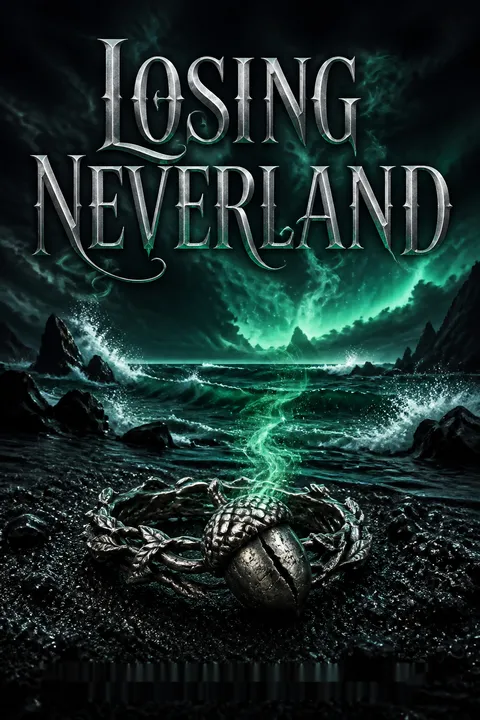


Plot Summary
The Window Breaks Again
At nearly forty, Wendy has built a life around her twin daughters, Jane and Margaret, and the memory of Peter, who vanished when they were both seventeen. During a storm, he appears in her bedroom and demands the thing she stole from him, threatening the girls if she refuses.
His face carries the darkness of Jas Hook, the pirate identity Peter once treated as a game. He insists Wendy must help recover what they both lost, then breaks the window and carries her into the night. Wendy clings to him despite fear and old anger. She cannot tell whether she is choosing to leave or being pulled by the old attachment that has shaped her life.
The return begins as coercion, not reunion. Peter uses Wendy's maternal fear to secure her cooperation, while her willingness to follow him exposes how desire and agency have become tangled over years of unresolved grief. His demand for something stolen is also a distorted accusation: he treats their separation as Wendy's crime, though the story will gradually show how both were manipulated and both made choices. The daughters make the past materially present. Wendy is no longer the girl Peter remembers, and any attempt to reclaim her must contend with the life she built without him.
A Captain Without Peter
Wendy wakes aboard the Jolly Roger, Peter's pirate ship, with her brother John serving as his first mate. John regards his sister as a traitor, while Peter insists he brought her back for a purpose, not affection. He has already killed the man he considers Wendy's husband, and his jealousy sharpens when he notices the iron acorn ring she still wears.
Wendy asks after Peter, but he presents Hook as the only self left, blaming her for the darkness that consumed him. He orders her to help him find what they lost, then leaves her locked in his quarters until morning. The ring unsettles him more than her defiance, revealing that his carefully rehearsed hatred has never made him indifferent.
The ship turns intimacy into captivity. Peter controls Wendy's movement and information, yet the ring unsettles the persona he performs, exposing a private attachment that contradicts his claims of emotional death. John's presence complicates the power arrangement: he is Wendy's brother, but years of loyalty to Peter have made him an antagonist in her eyes. Peter's accusation that Wendy killed the boy he was suggests a struggle over identity, not merely romance. The story frames Hook as both a chosen mask and a consequence of pain, while refusing to excuse the harm he inflicts under it.
The Acorn Promise
Years before the ship, Peter had visited Wendy's bedroom at night, playing music and leaving her an acorn button as a promise that he would return. At seventeen, Wendy wakes to find him beside her again. He brings her brothers, John and Michael, into the adventure and offers to show them his island.
Tinker Bell's pixie dust lifts the children through the open window, while Peter tells Wendy that Neverland will feel complete with her there. Wendy leaves her familiar home willingly, believing the journey will join her to the boy she has waited for. The acorn button becomes more than a keepsake: it marks a promise neither of them yet understands, one that will survive their separation.
Wendy's departure is an act of longing, but it is not informed consent to the future Peter imagines for her. His invitation promises belonging while concealing how possessive he can become. The button gives a small, concrete form to a relationship founded on waiting: it allows Wendy to hold an absent person close, but also binds her to an expectation that he will return. Flight makes escape feel effortless, yet the decision carries Wendy away from the only world where she has obligations and toward a place whose rules are largely Peter's own.
Skull Rock Turns Bloody
In Neverland, Peter and Wendy's closeness turns physical at Skull Rock, where he introduces her to the danger and excitement he associates with love. Soon afterward, several lost boys, led by Slightly and Cubby, try to take advantage of Wendy while Peter is away. Tootles approaches her first, but Peter returns and stops him with his hook.
He kills Tootles, then kills Slightly and Cubby when Wendy identifies their roles. The other boys retreat, and Peter brings Wendy to his room, where he tends to her and promises to protect her. Wendy feels both safer and more frightened: the boy who comforts her has also shown how quickly he can make violence a form of possession.
Peter's rescue is morally double-edged. He interrupts an assault, but his response replaces the boys' violation with his own claim over Wendy, expressed through lethal punishment and ownership. Wendy's relief is genuine, as is her alarm; neither cancels the other. This episode establishes a pattern that will define their adult conflict: care arrives through control, and protection is difficult to separate from domination. Peter's tenderness afterward does not erase the deaths. Instead, it reveals a boy who can recognize Wendy's vulnerability while lacking the emotional distance to respond without making her safety an extension of his authority.
The Lagoon Takes Michael
Peter's insistence that Wendy belongs at his side provokes Tinker Bell, Tiger Lily, and their allies. At the lagoon, the mermaids and Indians attack, and Wendy throws herself into danger to help Michael when he is badly wounded. Peter catches Wendy as she falls, but when Michael later tumbles toward the rocks, Peter cannot fly to him.
Michael survives with grave injuries and needs treatment beyond Neverland. Wendy takes him home, choosing her brother's survival over the world Peter has built around her. Peter's ability to fly begins to fade after their intimacy, and her departure leaves him with a failing magic and no way to follow her as he once did.
The attack makes Neverland's apparent freedom look less like an escape from adult danger than a world with its own unstable authorities. Wendy's choice to leave is grounded in care for Michael, not a simple rejection of Peter. Yet Peter experiences it as abandonment because he has mistaken her love for a promise to remain available to him. His failing flight gives that emotional rupture a physical consequence: he cannot cross between worlds without help. The episode shifts the story's central question from whether Wendy will stay to whether either lover can recognize obligations beyond their desire.
The Ring Cannot Keep Them
After Wendy returns to London, Peter visits her and gives her an iron ring topped with the acorn button, a pledge meant to protect her from the fae and bind their futures. They finally make love, but her guardian Jake soon appears and attacks Peter. Wendy knows she cannot leave Michael or safely bring Peter into her dangerous household, so she tells Peter she no longer believes in magic or in their future together.
He leaves for Neverland, hearing rejection where she intends protection. Later, when Jake threatens her newborn twins, Wendy shoots him and secures his promise to leave them alone if she stays away from Neverland. The lie that saves Peter from Jake also becomes the wound that shapes both their lives.
Wendy's deception is an act of care that reproduces the very abandonment it is meant to prevent. She decides what Peter can survive without giving him the truth, while Peter interprets her words through his fear of being left. Their conflict is not a failure to love but a failure to negotiate danger together. The ring records their commitment, yet cannot substitute for honest communication or shared responsibility. Jake's threat makes Wendy's choice urgent and consequential, and her later defense of the twins shows that she has learned to protect herself directly, even while preserving the secret that keeps Peter away.
Seventeen Years Of Waiting
Peter returns to Neverland and turns himself into Hook, a captain who rules through fear and buries the boy Wendy loved beneath a pirate's hardness. John remains with him as first mate. Peter secretly returns to London for years, watching Wendy's life from Kingston Gardens.
When he sees her with their twin daughters, he understands that taking her back would also uproot the girls, so he stays away until they are grown and have left for college. Tinker Bell supplies the pixie dust that lets him cross between worlds, while pursuing her own designs on his future. Once Wendy is living alone, Peter kills the man he sees as his rival and brings her back to the Jolly Roger.
Peter's restraint is real, but it coexists with surveillance and possessiveness. He protects the twins from Neverland while denying Wendy the chance to know he has seen them, so his sacrifice also preserves his control over the story of their separation. Becoming Hook gives grief a usable identity: the captain can punish others and avoid admitting dependence. Tinker Bell's role in his returns makes magic politically charged, not neutral. Her assistance keeps Peter connected to Wendy even as it allows her to shape the conditions under which he can act.
The Old Cave Reopens
Peter takes Wendy to Skull Rock and restrains her while trying to make the place repeat their past. Instead, Wendy refuses to accept his version of their history and tells him that both of them helped destroy what they had. When he sends the watching lost boys away, she makes clear that fear will not make her obey.
Peter cuts her bonds rather than forcing the scene further. Soon after, a fae attack sends Wendy toward a cliff. Peter cannot fly, so he catches her with a vine and hauls them both into a cave. Wendy sees the limit of his power, and Peter has to depend on judgment and strength rather than magic to keep her alive.
The cave revises their old dynamic through a small but consequential choice. Peter still begins by staging control, yet Wendy names the injury beneath his accusation and refuses to play the role he assigns her. His release of her is not a complete moral repair, but it interrupts escalation and leaves room for trust to be rebuilt. The cliff rescue then strips away the supernatural advantage that once made Peter feel invulnerable. His dependence on a vine, and on Wendy's cooperation, turns rescue into collaboration rather than spectacle.
Pixie Dust Remembers
Wendy confronts Tinker Bell in the cave, challenges her jealousy, and even takes Peter's hook to threaten the fae. Peter prevents the confrontation from becoming a fight and invites Wendy to dinner at their old home in Hangman's Tree. During the meal, Wendy notices that Peter's appearance has changed in ways ordinary aging cannot explain.
The wine contains pixie dust, and its magic pulls her into memories she has been unable to reach. Peter stays beside her as she relives them, and she wakes with a clearer sense that their story began before the bedroom visits she remembers. The dust opens a path into the past, but it also makes memory a dangerous force neither can easily control.
Wendy's confrontation with Tinker Bell marks a shift from being discussed as a prize to acting as a participant in the island's politics. Taking the hook reverses the usual image of Peter as the sole wielder of force, even if she does not use it. The dust then complicates the apparent intimacy of the dinner: memory is not recovered through calm conversation but chemically and magically imposed. The episode asks whether truth can heal when it arrives without consent. Peter's presence offers comfort, but his willingness to use magical means remains part of the danger.
The First Meeting Returns
The memories reveal that Wendy and Peter met as children in Kingston Gardens, before the visits she thought were their beginning. After Wendy's father dies, Jake takes control of the household and threatens her; Nana tries to protect her, but Jake kills her.
Peter and his shadow rescue Wendy and her brothers, then Peter carries Wendy toward Neverland. Tinker Bell had already interfered with their memories, making Peter believe he had always belonged to the island and obscuring their first bond.
In the present, Peter admits he watched Wendy and the twins for years, staying away for their safety. Wendy explains that Jake never touched her and that she protected their daughters. They recognize how secrecy and manipulation shaped their separation.
The revelation replaces a romantic origin myth with a history of childhood danger and magical interference. Peter's bond with Wendy did not begin as a clean escape into fantasy; it began when he recognized her vulnerability and acted, while Tinker Bell tried to redirect his identity and loyalties. The recovered memory does not absolve Peter's later choices, nor Wendy's decision to lie, but it explains why their attachment has survived so many false beginnings. Their present confession matters because it restores information that each had withheld, allowing love to become something more reciprocal than longing.
John's Bargain Burns
Tinker Bell's scheme becomes visible when she confronts John, Wendy's brother, over the bargain that was meant to help her control Peter and Neverland. John resists harming Wendy, but Tinker Bell forces information from him and kills him when he will not cooperate. She then sets Hangman's Tree on fire while Peter and Wendy sleep.
Smoke traps them inside, and Peter reveals that he can no longer fly. They climb the waterfall wall together and escape the flames by hand, with Wendy helping Peter when his grip fails. The burning home forces them to abandon any hope of safety on the island. They run toward Cannibal Cove and the Jolly Roger as Tinker Bell's pursuit closes in.
John's death makes the political cost of Tinker Bell's influence immediate and personal. His divided loyalty cannot survive a system that treats people as instruments, first bargaining for power and then punishing resistance. The fire performs a parallel function: it destroys the shared domestic space Peter and Wendy had returned to and forces them into motion. Their escape depends on physical effort and mutual aid, not the magic that once carried them between worlds. The scene turns the loss of flight from a private limitation into a test of whether they can survive as partners.
Wendy Cuts The Wings
Aboard the Jolly Roger, Peter and Wendy face Tinker Bell, Tiger Lily, the mermaids, and the fae. Tinker Bell reveals that she wants Wendy dead so Peter will belong to her and Neverland can be ruled on her terms. When she lunges with a dagger, Peter steps between her and Wendy and takes the wound.
Wendy grabs Peter's hook, cuts Tinker Bell's wings, then drives the weapon into her side. The fae fall into battle with the pirate crew while Tiger Lily's fighters attack from the other direction. Wendy stays with Peter as he bleeds, and the battle leaves them with one desperate route of escape: the plank above the storm-tossed sea.
The climax reverses the story's recurring rescue pattern. Peter still protects Wendy, but she no longer waits passively for him to act; she takes his weapon and ends the threat herself. The act is not a simple victory, since violence costs Peter blood and leaves the couple exposed to the surrounding battle. Tinker Bell's confession clarifies that her magical power was also a bid for ownership, mirroring Peter's earlier possessiveness in a more openly political form. Wendy's decisive action distinguishes protection from control: she acts to preserve a shared future, not to possess Peter.
The Sea Starts Over
With Tiger Lily's forces closing in, Wendy helps the wounded Peter reach the plank. They leap into the sea together, but the storm and current wrench them apart. Wendy loses strength beneath the water, then the story returns her to the familiar bedroom where Peter once visited her at night. He is there again, playing music, and this time Wendy senses that the repeated beginning carries knowledge from everything they have endured.
They imagine building a different story together rather than surrendering to the old pattern of waiting and departure. Their reunion offers emotional closure, but its dreamlike recurrence leaves the mechanics uncertain: it may be a new beginning, a return, or a cycle that has not yet been escaped.
The ending grants the lovers reunion without providing a stable explanation for how they survived or where they are. That uncertainty is structurally meaningful: the story has repeatedly made memory, time, and magic unreliable, so a cleanly literal resolution would contradict its governing logic. Wendy's renewed awareness changes the familiar bedroom scene from innocent repetition into a possible act of revision. She and Peter can imagine a future only because the old story has been exposed as shaped by lies, fear, and outside interference. The emotional resolution is mutual commitment; the practical resolution remains deliberately unsettled.
Epilogue
From a portal, Tiger Lily watches Peter and Wendy's renewed beginning and mourns Tinker Bell, whom she loved. She rejects the idea that the couple's happy thoughts or pixie dust can protect them from what comes next.
Rather than attack immediately, she decides to wait until they reach the other side and can face her in a fair fight. Her grief has become a promise of vengeance, leaving the lovers' apparent fresh start under a new shadow.
The coda shifts the story's emotional center from reunion to the cost of victory. Tiger Lily is not simply a surviving antagonist: her grief for Tinker Bell reveals a private attachment beneath the island's political rivalries. Her decision to wait, rather than strike while the couple is vulnerable, gives her revenge a code of its own and suggests that she sees conflict as a contest between equals. This ending refuses to let romantic closure erase the harm done across Neverland. Peter and Wendy may have found one another again, but the world around them remains capable of turning love into a new struggle.
Analysis
Losing Neverland treats the refusal to grow up as more than a fantasy of freedom. For Peter, it begins as protection from a childhood marked by neglect and violence. He builds a world where play can replace ordinary authority, but then reproduces that authority through the captaincy of Hook. His refusal to name grief does not keep him innocent. It gives grief a weapon and makes other people live inside his denial.
Wendy's arc challenges the idea that love requires choosing one world over another. She leaves Neverland to save Michael, protects her daughters from Jake, and later refuses to abandon them merely to restore her romance with Peter. Her care is not weakness, though Peter repeatedly mistakes it for rejection. The story's crucial change occurs when both stop treating sacrifice as proof of love and begin to speak plainly about what each has endured.
Magic functions as an unstable form of power. Pixie dust enables escape but also exposes memory; Tinker Bell's spells offer control while obscuring the desires they cannot govern. The recovered childhood meeting reframes the lovers' bond as something real that existed before the stories they told themselves, yet it does not erase the harm of their later choices. The ending offers emotional renewal rather than certainty. Peter and Wendy can imagine a different future, but Tiger Lily's coda insists that private reconciliation cannot undo public violence. Love may offer a way home, but it does not make the world harmless.
Review Summary
Losing Neverland received mixed reviews, with many praising its dark, twisted reimagining of Peter Pan. Readers appreciated the unique take on Peter/Hook, intense chemistry between characters, and surprising plot twists. Some found the age difference and explicit content concerning. Critics noted pacing issues and confusing plot elements. Audiobook narration garnered praise. Overall, fans of dark retellings and spicy romance enjoyed the book, while others found it uncomfortable or hard to follow. The emotional depth and creative storytelling were frequently highlighted as strengths.
People Also Read






Characters
Wendy Darling
The returning storytellerWendy is a London woman and mother whose history with Peter began before either of them understood what Neverland would cost. She is drawn to wonder and to the feeling of being chosen, yet her instinct to care for her brothers and daughters repeatedly competes with her longing for Peter. She carries old hurt without being reduced to it: as the story progresses, she names the ways Peter has harmed her, confronts Tinker Bell, and acts for herself when danger returns. Her growth lies not in becoming less loving, but in refusing to let love require silence or self-erasure.
Peter Pan, Jas Hook
The lost boy turned captainPeter is Wendy's enduring love, a boy raised on escape who grows into the pirate captain Jas Hook. His charm, confidence, and appetite for danger help him survive, but his fear of dependence turns affection into possession and rejection into violence. He wants Neverland to remain a place where no one must grow up, even as his choices force him to mature in painful ways. Wendy exposes both his tenderness and his capacity for cruelty. The distinction between Peter and Hook matters to him, though the story shows how easily one identity can feed the other.
Tinker Bell
The jealous fairy powerTinker Bell is a powerful fae whose small size in flight contrasts with her imposing presence on the island. She wants Peter's attention and resents Wendy's ability to reach him in ways magic cannot command. Her pride makes her quick to treat affection as a contest and Neverland as something she has a right to govern. She is clever, volatile, and capable of both assistance and manipulation, keeping her motives difficult for others to read.
John Darling, Smee
The divided first mateJohn is Wendy's younger brother, one of the children who first travels with her to Neverland. He remains there and becomes Peter's first mate, earning the name Smee within the pirate crew. His loyalty to Peter is tangled with his bond to Wendy and with his own history of leaving home after Michael's injury. John often sees Peter's failures more clearly than Peter does, but his position aboard the Jolly Roger makes every honest judgment dangerous.
Michael Darling
Wendy's wounded brotherMichael is Wendy's younger brother and a child drawn into Peter's adventures alongside John. His serious injury in Neverland forces Wendy to choose medical care and family responsibility over remaining with Peter. The injury continues to shape the family's life long after the adventure, giving Wendy's departure a concrete necessity rather than making it a simple rejection of romance.
Jane Darling
One of Wendy's twinsJane is one of Wendy's twin daughters. She is seventeen when Peter returns, old enough to leave home for college and young enough to echo the age at which Wendy first followed him to Neverland. Jane's absence from the island does not make her irrelevant: the thought of her safety shapes Peter's decision to stay away for years.
Margaret Darling
One of Wendy's twinsMargaret is Jane's twin sister and Wendy's daughter. Like Jane, she is accepted to college at seventeen, leaving Wendy alone when Peter comes back. Her resemblance to Wendy at the age Peter first knew her makes the twins a living reminder of the life Wendy built beyond Neverland.
Tiger Lily
The island's proud princessTiger Lily is a princess with political authority and a fierce sense of pride. She resists Peter's assumption that Neverland belongs to him and is wary of Wendy's influence over the island's balance of power. Her relationship with Tinker Bell and her ties to the Indians give her loyalties beyond her rivalry with Peter. She is strategic, self-possessed, and unwilling to be treated as an ornament in someone else's adventure.
Jake
The household's dangerous enforcerJake begins as the right-hand man of Wendy's father and takes authority over the household after the father's death. He uses that power to frighten Wendy and control the people around her. His presence explains why London is not a safe refuge and why Wendy makes choices that Peter cannot understand from Neverland. Jake's appetite for control makes him a threat even when he is not physically present.
Nana
The children's protectorNana is the household nurse who cares for Wendy, John, and Michael. She offers Wendy warmth and stories when the adults around the children fail to provide safety. Her protective presence gives the Darling home a fragile counterweight to its hidden violence.
Peter's shadow
The watchful rescuerPeter's shadow acts independently and helps him protect Wendy during the danger in her childhood home. Its quick, silent movements connect Peter's imaginative world to the physical crisis unfolding around the children. The shadow functions as more than a playful fragment: it carries out the protective work Peter cannot manage alone.
The Lost Boys
Peter's unruly crewThe Lost Boys are Peter's companions in Neverland, a group shaped by games, loyalty, and his shifting rules. Their presence makes his island feel communal, but their behavior can turn dangerous when they imitate his belief that everything is play. They reveal how Peter's unchecked authority affects those who depend on him.
Plot Devices
Pixie dust
Flight and buried memoryPixie dust gives characters the ability to fly and cross distances that separate London from Neverland. Its use is not purely liberating: Tinker Bell controls access to it, making travel dependent on her power and bargains. When Wendy consumes dust in the wine, it draws hidden memories to the surface, turning the same magic that once enabled escape into a means of confronting the past. The device links wonder to vulnerability, since it can carry someone away, reveal truths without warning, or leave them dependent on the person who supplies it.
The acorn ring
A promise made physicalPeter first gives Wendy an acorn button so she will remember him and believe he will return. Later, he sets the button into an iron ring, joining the childhood token to a pledge of protection and commitment. Iron offers defense against the fae, while the ring's survival through years of separation makes it evidence that Wendy did not simply forget him. Its meaning shifts with the relationship: it can represent hope, possession, protection, and the burden of waiting, depending on who is holding it.
Peter's shadow
Protection beyond reachPeter's shadow can move separately from him and act in the physical world. During Wendy's childhood crisis, it helps Peter intervene against Jake and protect the children. The shadow makes the boundary between fantasy and reality porous before Wendy ever reaches Neverland, and it gives Peter a means of acting when he is not directly beside her. Its independence also echoes the split between Peter Pan and Jas Hook, suggesting that parts of a person can take on lives and functions the person does not fully control.
Neverland's suspended time
A refuge with a priceNeverland offers Peter a place where ordinary adulthood and its demands seem distant. Its island politics, dangers, and magic make it feel like a world outside familiar time, but it does not stop Wendy from aging or from carrying responsibilities back to London. The contrast gives Peter's refusal to grow up emotional force while exposing its limits: Wendy must leave when Michael needs care, and Peter cannot preserve their relationship by pretending that no one changes. Neverland is both sanctuary and trap, depending on whose needs its rules serve.
Escapism Series

Download PDF
Download EPUB
.epub digital book format is ideal for reading ebooks on phones, tablets, and e-readers.








