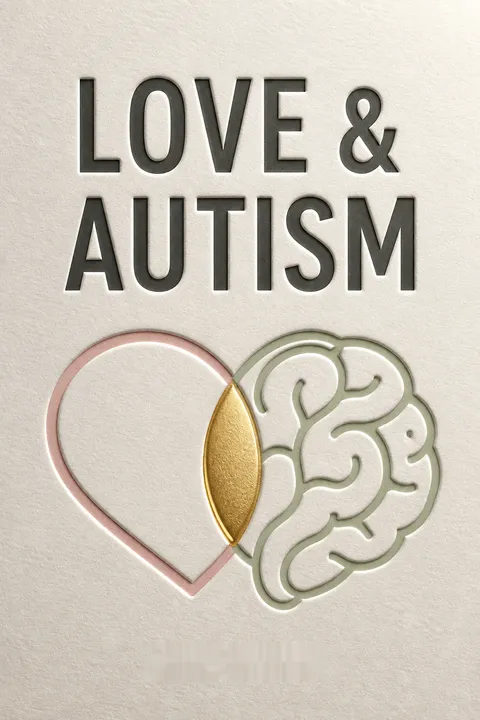


Key Takeaways
Love has no neurotypical template; measure it by safety and being known
Love is not a performance test. Kay Kerr begins with a teenage kiss abroad: its simplicity made it easier to understand than later relationships crowded with unspoken rules. That clarity opens onto the book’s larger question: who decided that love must look like eye contact, hugs, a large friendship group, or a conventional romance? Autistic people may express care through sharing an interest, seeking company, or trusting someone with their distress. Friendship, family, animals, and chosen kin can matter as deeply as partnership.
Difference is not deficiency. Kerr frames autism as a way of being, not a broken version of a single normal brain. That does not erase disability or support needs. It widens the picture to include the pleasures, loyalties, and forms of connection that a deficit-only account leaves out.
What's compelling is the shift from judging visible behavior to asking what a relationship feels like from within. This resembles a broader principle in disability studies: access and dignity depend on whether people can participate without having to imitate a socially dominant norm. The framing also resists treating romance as the final proof of adulthood. Its useful caution is that affirming difference should not romanticize every difficulty. Sensory distress, isolation, and dependency can be painful, and recognizing autistic forms of love should make support more responsive, not less necessary.
Treat empathy as a two-way translation problem, not an autistic defect
Empathy has more than one form. Cognitive empathy means inferring what another person feels from cues such as tone or facial expression. Affective empathy means emotionally sharing or responding to their feelings. Michael describes being deeply affected by his family’s moods, even when he cannot tell what caused them. His experience challenges the assumption that difficulty reading social signals means indifference.
Communication runs both ways. The double empathy problem, proposed by autistic researcher Damian Milton, describes how autistic and non-autistic people can misunderstand each other because they use different expectations and communication styles. Kerr argues that non-autistic people also need to learn how autistic people communicate. The solution is not to declare one style correct, but to make meaning together.
The double empathy problem is powerful because it changes the question from “Which person lacks social skill?” to “What did each person expect the other to understand?” That shift is useful in classrooms, families, and workplaces, where a misunderstanding can be mistaken for disrespect. Yet mutual misunderstanding does not mean equal power: institutions usually set the rules, and autistic people bear more of the cost when those rules exclude them. Reciprocity therefore requires more than asking both sides to try harder. It requires changing the conditions of interaction.
Stop rewarding the mask; make room for autistic needs and movement
Fitting in can be costly. Masking is hiding or minimizing autistic traits to meet other people’s expectations. It can be deliberate, learned, or automatic, and it is not as simple as choosing to remove a disguise. Kerr describes years spent copying social cues and suppressing needs, followed by burnout that made work, sleep, and socializing much harder. During an interview, Michael yawns and moves while remaining engaged. His behavior prompts Kerr to question why stillness and eye contact are treated as evidence of respect.
Build in room to recover. Masking can help someone navigate a particular situation, but it can also conceal distress from people who might otherwise offer support. Rest, sensory adjustments, and honest communication are not signs of failure. They are part of making daily life sustainable.
Masking connects to a familiar minority-stress pattern: people who anticipate judgment spend energy monitoring how they appear, even when no one is openly hostile. The analogy helps explain why outward competence can hide exhaustion. It also needs nuance. Some autistic people mask for safety, privacy, or practical reasons, and disclosure is not always safe. The goal should not be compulsory authenticity, which would simply impose another rule. A more useful aim is to make environments flexible enough that a person has choices about when to adapt and when to rest.
Replace functioning labels with a map of changing support needs
A single label obscures a whole person. “High-functioning” can lead others to overlook serious needs; “low-functioning” can wrongly imply limited understanding or agency. The five people in the book differ from one another, and each can need different support at different times. Tim, for example, is non-speaking and needs help with communication and sensory demands, yet develops rich interests and complex views. Michael’s public confidence does not mean he never needs support.
Support is not a measure of worth. The book cites research reporting suicide rates around three times higher for autistic people than non-autistic people, with particular concern for young people. That statistic does not prove a single cause, but it underscores the stakes of isolation and inadequate support. Describe the person and the support needed, rather than ranking their ability to function.
Replacing a global label with a profile of specific needs aligns with a basic insight from personalized care: support works best when it targets the actual barrier, not a category presumed to explain everything. It also avoids equating independence with value. The challenge is practical, since schools and funding systems often demand simplified classifications to allocate resources. Rejecting reductive labels should not mean rejecting assessment or services. The better response is to make administrative descriptions precise enough to secure support without turning them into predictions about a person’s intelligence, future, or humanity.
Assume competence, then give communication the tools and time it needs
Speech is not a measure of thought. Tim stops speaking after early words and is diagnosed as autistic at three. His mother, Sarah, builds learning around his visual strengths, using photographs and books to connect words with daily life. Later, Tim chooses partner-assisted typing, a communication method in which a partner provides physical support as he types on a speech-generating device. He says it gives him a way to express his thoughts.
Access changes participation. At high school, staff initially refuse to facilitate his typing, leaving him unable to communicate there and isolated from learning and social life. The book reports that an estimated 25 to 30 per cent of diagnosed autistic people do not develop spoken language, while many use other communication methods. Assume a person has thoughts and preferences, then work to discover how they can communicate.
Tim’s story exposes a dangerous shortcut: treating speech as a proxy for intelligence, comprehension, or personhood. Communication access is not an optional reward for students who already appear easy to teach. At the same time, any supported communication method needs careful attention to the individual’s control, authorship, and reliability. That scrutiny should protect the communicator, not serve as an excuse to deny communication altogether. The central ethical test is whether systems invest in understanding the person, rather than deciding in advance that no meaningful conversation is possible.
Read autistic lives through culture, gender, and race, not stereotypes
There is no single autistic profile. Noor is a Malaysian-born Muslim woman living in Australia, navigating migration, family expectations, faith, and racism as well as autism. She shares her story under a pseudonym because being openly autistic can expose her to judgments about her competence. Her experiences challenge stereotypes that autistic people are naturally good at maths, fluent in many languages, or drawn to one predictable kind of life.
Whose stories get recognized matters. Early autism research focused on white boys, and the book links that history to missed or delayed recognition for girls, women, and people of colour. Noor’s story also shows how the “model minority” stereotype can make Asian people seem uniformly successful and obedient, obscuring individual needs. Diagnosis and support improve when professionals listen beyond the familiar template.
Noor’s account makes representation a question of power, not simply visibility. A diagnostic template shaped around one group can mistake other people’s differences for personal failure, while social stereotypes can make their distress harder to notice. Intersectional thinking helps explain why the same trait may be interpreted differently depending on race, gender, class, and culture. It also counsels restraint: no single story can stand in for a whole community. Better practice combines lived experience with individualized assessment, rather than replacing one narrow stereotype with a new universal account.
Make closeness explicit; do not demand mind-reading as proof of love
Clear words reduce avoidable hurt. Chloë and Jacob learn to explain plans and needs rather than relying on hints or the expectation that a partner should simply know. Their schedules help them feel secure, but they also discuss what happens when one wants to change the routine. Chloë realizes that a gift can be sincere without matching every preference she has mentioned; Jacob learns that asking directly is more useful than guessing.
Trust grows through honesty. Noor’s later relationship begins with direct questions and an open conversation about her bipolar diagnosis and medication. Her partner takes time to learn what it means rather than rejecting her or pretending to understand. Their examples do not offer one script for every couple. They show how explicit communication can make room for different needs, histories, and ways of showing care.
Direct communication is often treated as unromantic because popular stories prize intuition and surprise. These relationships suggest a different standard: care can mean reducing ambiguity rather than performing effortless mind-reading. That is useful well beyond autism, since partners differ in culture, temperament, and past experience. Directness alone is not enough, however. It must be paired with consent, curiosity, and the freedom to say no. A clear request is an invitation to understand, not a demand that the other person comply.
Treat distress as information about conditions, not misconduct to suppress
Behavior has a context. A meltdown is an intense response to overwhelming circumstances, not a chosen tantrum. Jess describes years of being disciplined and verbally abused at school for struggles linked to her needs, while adults failed to recognize the harm being done. The book’s “Coke bottle” analogy explains how stress can accumulate through noise, rushed transitions, and sensory discomfort until a person can no longer contain it. What looks like a sudden outburst may follow a long period of overload.
Change the conditions. Tim’s school distress worsens when staff block his communication and coping methods. Noor also learns to protect her daughter from therapies that prioritize compliance over wellbeing. Asking what happened before distress, and what support would help, is more useful than punishing the visible reaction.
This approach resembles trauma-informed practice: behavior is examined as a response to context, not merely as an isolated problem to extinguish. It can help adults notice the quiet signs of overload as well as the obvious ones. But context should not become an excuse to ignore safety or abandon caregivers who need help. The practical task is to reduce preventable triggers, preserve autonomy where possible, and respond safely when distress occurs. That is more demanding than discipline alone, but it is also more likely to address the cause.
Let special interests, friendship, and chosen routines count as full lives
Joy belongs in the picture. Special interests are deeply absorbing pursuits that can bring autistic people pleasure, learning, and connection. Michael’s lifelong fascination with trains and animals leads him toward travel, public storytelling, and acting. Jess finds community through online fandom, cosplay, creative hobbies, and caring for animals. Their interests are not merely distractions from a supposedly more important life.
Romance is not the only ending. Michael once saw marriage, children, and a home as the definition of success. Television dating brings opportunities, but it also prompts him to imagine other ambitions. Friendship, family, creative work, familiar routines, and time with animals can make a life rich. The book’s young autistic contributors describe love in many forms, from caring for people to feeling at home with pets, music, and shared activities.
The emphasis on joy corrects a public conversation that often treats disability as a catalogue of risk. Interests can support identity and provide natural settings for connection, especially when conventional social scenes are exhausting. Their value should not depend on whether they become productive, employable, or impressive to outsiders. At the same time, passion is not automatically a cure for loneliness or inaccessible environments. A full life may include intense interests and substantial support needs together. The point is not that joy cancels hardship, but that hardship should not erase joy.
Analysis
Love & Autism is best understood as a collection of lives arranged into an argument: autism is not just a set of observable deficits, and autistic people are not defective versions of a single social ideal. Kerr’s method matters. Rather than build a clinical manual, she lets recurring experiences emerge across five distinct biographies, her own reflections, and younger contributors’ words. A train enthusiast, a non-speaking advocate, a migrant Muslim woman, a creative adult, and a young couple do not add up to one representative autistic person. Together, they make the category feel more human and less falsely uniform.
The book’s most useful conceptual move is relational. Misunderstandings are not automatically evidence that an autistic person lacks empathy or social ability; they can arise because people are using different cues and assumptions. That reframing changes how a reader might respond to an awkward interaction, a shutdown, or a request for directness. It also exposes a tension: communication may be reciprocal in principle, but institutions still have the power to define acceptable behavior. A classroom that blocks a student’s communication method is not simply a two-sided misunderstanding. Inclusion requires changing who controls the conditions of participation.
Kerr also avoids equating affirmation with ease. Her stories include abuse, burnout, exclusion, depression, and demanding support needs. Pride is presented not as a denial of pain, but as a refusal to let pain become the whole story. That distinction is crucial for families and professionals: rejecting the deficit-only model should not mean minimizing disability or withholding practical help.
The book’s limits follow from its strength. Personal narratives can reveal what standardized accounts miss, but they cannot establish how every autistic person thinks, loves, or communicates. Kerr acknowledges this, and the reader should retain that caution. The strongest lesson is not to adopt a new universal template. It is to listen closely, replace assumptions with questions, and build relationships and services around the actual person in front of you.
Review Summary
Love & Autism is praised for its heartfelt exploration of neurodivergent love through the stories of five autistic Australians. Readers appreciate the book's authenticity, inclusivity, and celebration of autism as part of human diversity. Many find it validating and insightful, offering a fresh perspective on autism beyond stereotypes. The book covers various aspects of love, including self-love, family, and relationships. While some readers found the structure challenging, most highly recommend it for both autistic individuals and those seeking to understand autism better.
People Also Read
Glossary
Neurodiversity
Natural variation in mindsNeurodiversity describes the range of ways human brains develop and function. The book traces the term to autistic sociologist Judy Singer in the 1990s and explains that it also names a movement challenging the idea that one neurological style is the only correct one. A community can be neurodiverse; an individual is neurodivergent or neurotypical.
Double empathy problem
Mutual communication mismatchThe double empathy problem, proposed by autistic researcher Damian Milton, describes how autistic and non-autistic people can struggle to understand one another because they experience and communicate about the world differently. It challenges the assumption that social misunderstanding is solely an autistic deficit. The concept calls for learning and adjustment across groups, while recognizing that social institutions often favor non-autistic expectations.
Masking
Hiding autistic traitsMasking is the conscious or unconscious effort to hide, minimize, or compensate for autistic traits in order to meet social expectations or avoid negative reactions. It can involve copying social cues or suppressing natural movement and sensory needs. Masking is not always a simple choice, and sustaining it can be exhausting or make support needs less visible.
Special interests
Deeply absorbing pursuitsSpecial interests are subjects or activities that an autistic person pursues with sustained attention and enthusiasm. They may offer pleasure, expertise, learning, regulation, and a way to connect with others. The book challenges portrayals of these interests as inherently obsessive or troubling, emphasizing that their value should not depend on whether they appear useful to outsiders.
Partner-assisted typing
Supported device-based communicationPartner-assisted typing, or PAT, is a communication method in which a partner provides physical support while a person types on a device that can generate speech. Tim uses this method to communicate after developing literacy without a reliable means of self-expression. In his account, physical feedback supports movement toward typing, while emotional and regulatory support also helps him communicate.
Meltdown
Overwhelm responseA meltdown is an intense response to overwhelming circumstances in which an autistic person loses behavioral control. The book distinguishes it from a tantrum, emphasizing that it is not a chosen tactic. Sensory overload, unexpected changes, accumulated stress, and other demands may contribute. Recognizing triggers and providing support can reduce distress more effectively than treating the visible behavior as misconduct.
Shutdown
Inward overload responseAn autistic shutdown is an inward response to high stress or overload. A person may become extremely lethargic, unable to move, or unresponsive as their capacity to process demands is exceeded. It is related to a meltdown but can be less visible to other people. The book emphasizes noticing withdrawal and reduced responsiveness rather than assuming a person is coping well.
Stimming
Repetitive self-regulationStimming is repetitive movement, sound, speech, or interaction with objects, such as rocking, tapping, or hand-flapping. Autistic people may use it to manage sensory overload, adapt to a new environment, or calm themselves. The book rejects the assumption that visible stimming is automatically a problem, and treats it as a potentially useful response rather than behavior that must always be suppressed.
FAQ
1. What’s "Love & Autism" by Kay Kerr about?
- Explores Autistic Love Stories: The book is a narrative nonfiction that delves into the lives and relationships of five autistic Australians—Michael, Jess, Noor, Tim, and Chloë—showcasing the diversity of autistic experiences with love, friendship, and family.
- Celebrates Neurodivergent Perspectives: Kay Kerr, an autistic author herself, uses interviews, personal reflections, and essays to highlight the strengths, challenges, and joys of being autistic, especially in the context of relationships.
- Challenges Deficit Narratives: The book intentionally moves away from the traditional deficit-based view of autism, instead focusing on what autistic people bring to their relationships because of, not despite, their neurodivergence.
- Blends Memoir and Journalism: Kerr weaves her own story and insights with those of her interviewees, creating a tapestry of autistic voices and experiences.
2. Why should I read "Love & Autism" by Kay Kerr?
- Authentic Autistic Voices: The book centers lived experiences and first-person perspectives, offering a rare, honest look at autistic life and love from within the community.
- Educational and Empathetic: It provides valuable insights for autistic readers, their families, educators, and anyone interested in neurodiversity, helping to foster understanding and acceptance.
- Breaks Stereotypes: By sharing diverse stories, it dispels common myths about autism, such as the idea that autistic people lack empathy or cannot form meaningful relationships.
- Uplifting and Hopeful: The tone is celebratory and affirming, focusing on joy, resilience, and the many ways autistic people experience and express love.
3. Who are the main people featured in "Love & Autism" by Kay Kerr, and what are their stories?
- Michael: Known from "Love on the Spectrum," Michael is a passionate, empathetic man navigating dating, friendships, and family, while embracing his authentic self.
- Jess: Diagnosed as a child, Jess’s story covers her creative pursuits, struggles with bullying, coming out as gay, and building a life and relationship on her own terms.
- Noor: A Malaysian-Australian Muslim woman, Noor’s narrative explores migration, cultural expectations, trauma, mental health, and her journey to self-acceptance and motherhood.
- Tim: A non-speaking autistic man, Tim’s story highlights his advocacy, the challenges of communication, and the deep bond with his mother, Sarah, who helped him find his voice.
- Chloë: A young woman with strong self-awareness, Chloë’s journey includes navigating school, friendships, queer identity, and building a loving partnership with another neurodivergent person.
4. What are the key takeaways from "Love & Autism" by Kay Kerr?
- Autism Is Not a Deficit: The book reframes autism as a natural variation in human neurology, not something to be fixed or pitied.
- Love Takes Many Forms: Autistic people experience and express love in diverse, valid ways—romantic, platonic, familial, and self-love are all explored.
- Community and Acceptance Matter: Finding community and self-acceptance are crucial for autistic well-being; support and understanding from others can be transformative.
- Language and Labels Are Important: The book advocates for identity-first language ("autistic person") and challenges the use of functioning labels, emphasizing the harm they cause.
5. How does "Love & Autism" by Kay Kerr define and discuss key concepts like masking, empathy, and functioning labels?
- Masking: Refers to autistic people hiding or minimizing their traits to fit in; the book explains the emotional toll and exhaustion this causes, and the importance of unmasking for well-being.
- Empathy: Challenges the myth that autistic people lack empathy, distinguishing between cognitive and affective empathy, and introducing the "double empathy problem"—the idea that communication breakdowns are mutual, not one-sided.
- Functioning Labels: Critiques terms like "high-functioning" and "low-functioning," arguing they are reductive, stigmatizing, and fail to capture the dynamic, individual nature of support needs.
- Neurodiversity: Emphasizes that neurodiversity is a natural and valuable part of human variation, not a disorder.
6. What advice or insights does "Love & Autism" by Kay Kerr offer for autistic people and their families?
- Prioritize Support and Acceptance: Focus on meeting support needs and celebrating autistic identity, rather than trying to "normalize" or change autistic people.
- Value Different Communication Styles: Recognize and respect that autistic communication may differ from neurotypical norms, and that both are valid.
- Seek Community: Finding other autistic people and supportive spaces can be life-changing for both autistic individuals and their families.
- Advocate for Affirming Therapies: Be cautious of therapies aimed at compliance or masking; seek out neurodiversity-affirming professionals and approaches.
7. How does "Love & Autism" by Kay Kerr address intersectionality—such as culture, gender, and sexuality—in autistic experiences?
- Cultural Diversity: Noor’s story, among others, highlights how culture, migration, and religion intersect with autism, affecting diagnosis, acceptance, and self-understanding.
- Gender and Sexuality: The book discusses the underdiagnosis of women and gender-diverse people, and features queer autistic experiences, challenging the stereotype that autism is a "male" condition.
- Multiple Marginalizations: Explores how racism, ableism, and sexism compound challenges for autistic people of color, women, and LGBTQ+ individuals.
- Representation Matters: Emphasizes the need for more diverse autistic voices in media, research, and advocacy.
8. What are some of the most powerful quotes from "Love & Autism" by Kay Kerr, and what do they mean?
- "Love has always intrigued me, in part because I have carried for a long time a feeling that I am doing love wrong." – Reflects the central theme of questioning societal norms and finding one’s own way to love.
- "To diverge from what is typical is to develop interesting perspectives, unique ideas and new ways of thinking." – Celebrates neurodivergence as a source of creativity and insight.
- "There are no right or wrong brains, all forms of neurological development are equally valid, and equally valuable." (citing Jac den Houting) – Affirms the neurodiversity paradigm.
- "Loving yourself in a world that measures you by what you can’t do is a radical act." – Underscores the importance of self-acceptance and pride for autistic people.
9. How does "Love & Autism" by Kay Kerr challenge common stereotypes and misconceptions about autism?
- Debunks the Empathy Myth: Shows through lived experiences that autistic people often have deep empathy, sometimes even more so than neurotypicals.
- Rejects the "Tragic" Narrative: Refuses to frame autism as a tragedy or burden, instead highlighting joy, resilience, and achievement.
- Counters the "Male, Child, Math Genius" Stereotype: Features women, people of color, non-speaking individuals, and those with varied interests and abilities.
- Clarifies That Autism Is Lifelong: Emphasizes that autistic children become autistic adults, and that support and understanding are needed at all ages.
10. What role does language play in "Love & Autism" by Kay Kerr, and why is it important?
- Identity-First Language: Kerr and many contributors prefer "autistic person" over "person with autism," seeing autism as integral to identity.
- Rejects Deficit-Based Terms: Avoids terms like "disorder," "high/low functioning," and "ASD" outside of medical contexts, to reduce stigma.
- Explains Neurodivergent Terminology: Provides clear definitions for terms like "stimming," "meltdown," "shutdown," and "neurodiversity."
- Empowers Self-Description: Encourages people to use the language that feels right for them, and to respect others’ choices.
11. What practical strategies or methods does "Love & Autism" by Kay Kerr suggest for building affirming relationships and communities?
- Direct Communication: Encourages open, explicit communication about needs, boundaries, and feelings, rather than relying on subtext or mind-reading.
- Accommodate Sensory and Support Needs: Suggests practical adjustments—like meal planning, downtime, and sensory-friendly environments—to make relationships and family life work.
- Celebrate Special Interests: Recognizes the value of autistic passions and encourages sharing them as a form of connection and joy.
- Model Self-Advocacy and Boundaries: Shows the importance of advocating for oneself and teaching children to do the same, especially in the face of misunderstanding or ableism.
12. How does "Love & Autism" by Kay Kerr contribute to the broader conversation about neurodiversity and autistic pride?
- Centers Autistic Narratives: Adds to the growing body of work by autistic authors, prioritizing lived experience over outsider perspectives.
- Promotes Neurodiversity-Affirming Paradigms: Advocates for seeing autism as a valuable part of human diversity, not a problem to be solved.
- Encourages Societal Change: Calls for more inclusive, accessible, and accepting communities, workplaces, and schools.
- Inspires Self-Love and Community Pride: Aims to replace shame with pride, both for current and future generations of autistic people.
Download PDF
Download EPUB
.epub digital book format is ideal for reading ebooks on phones, tablets, and e-readers.








