

Key Takeaways
A coherent message made Biden’s good fortune usable, not inevitable
A simple case endured. Biden entered the race as a familiar but doubted candidate: too old, too cautious, and not especially strong onstage. He argued that voters should choose character, competence, and a return to national decency over Trump’s disruption. His campaign’s language about restoring the country’s moral center and strengthening the middle class was broad, but it gave his candidacy a recognizable shape through a punishing primary and an extraordinary general election.
Consistency created room for luck. Biden repeatedly benefited from events he did not control, including the Iowa caucus breakdown, the consolidation of rivals behind him, and Trump’s handling of COVID-19. Yet luck alone could not explain why he remained viable. His message fit voters who wanted Trump gone without embracing a political revolution, and he largely stayed with it even when his advisers urged changes.
What’s striking is that a message can be politically thin in policy detail yet powerful as a sorting signal. Biden offered voters a familiar, low-risk alternative, not a detailed theory of national renewal. That helped different groups attach their own hopes to him. In organizational terms, consistency also reduced the burden of coordination: staff could adapt tactics without rewriting the candidate’s rationale. The limitation is that coherence can be mistaken for depth. A unifying message can hold a coalition together while leaving unresolved what its members expect from governing.
Keep opponents divided, and a durable minority can dominate a crowded race
Pluralities can be enough. Bernie Sanders built a committed following and hoped to turn a crowded, proportional-delegate primary into a path to the nomination. His support often sat around a quarter of the electorate, a strong base but far from a majority. Warren offered a nearby progressive alternative, while Biden and several other candidates competed for voters seeking a more moderate choice. As long as rivals split the opposition, Sanders could win delegates without persuading most Democrats.
Unity changed the arithmetic. The early contests showed that Sanders had not expanded much beyond his loyal core. After Biden’s South Carolina victory, Buttigieg and Klobuchar dropped out and endorsed him. Their exits helped Biden reach delegate thresholds across more states and districts, while Sanders lost the advantage of a fragmented field. The nomination turned less on a sudden conversion to Biden than on voters and politicians coordinating around the candidate they saw as the strongest alternative to Sanders.
This is a clear example of how electoral rules shape strategy. Proportional allocation sounds like it should reward broad support, but in a crowded field, a disciplined minority can accumulate delegates while the majority remains divided. Coordination problems are not unique to politics: groups often agree on what they oppose yet struggle to choose a shared alternative. The account also warns against reading a plurality as proof of majority consent. Sanders’s strength was real, but delegate advantage and broad public approval are different things.
Give a campaign manager authority before the crisis, not after it
Biden’s structure slowed decisions. His 2020 operation relied on longtime advisers who had access to him but often lacked clear responsibility, alongside younger staff hired to modernize and diversify the campaign. Biden delayed hiring, spending, and launching. When advisers disagreed, few were willing to challenge him directly. Greg Schultz, the campaign manager, could not reliably make decisions without approval from Biden and his senior circle, leaving the operation slow and its authority unclear.
The costs surfaced in Iowa. Biden invested late and unevenly in the state, then poured more time and money into it after a poor showing at a major party event. When he finished fourth in the caucuses, Schultz was demoted through a news story rather than a direct conversation. Anita Dunn took control of the budget, and Jennifer O’Malley Dillon eventually brought stronger operational discipline. The campaign’s problems were not simply one manager’s failure; they reflected a candidate and senior team that had not delegated clearly.
The campaign illustrates a classic principal-agent problem: a leader wants accountability but keeps decision authority close, so subordinates carry responsibility without the power to act. Under normal conditions, that may look like deliberation. Under deadline pressure, it becomes delay. The book’s scenes also show how loyalty can degrade feedback: staff who fear an outburst soften bad news, making the leader less informed precisely when candor matters most. A caveat is that clear hierarchy cannot guarantee good judgment, but it makes errors easier to identify and correct.
Earn trust with pivotal communities before asking them to rescue you
Relationships outlast campaign slogans. Biden’s strategy depended on strong support from Black voters, especially in South Carolina, while appealing to moderate white voters in competitive states. That coalition was not automatic. His record on busing, the 1994 crime bill, and Anita Hill created real vulnerabilities. Stacey Abrams warned him that Democrats could overinvest in persuading a small number of swing voters while neglecting voters who already agreed with them but needed registration and turnout support.
Clyburn’s support had a history. Representative Jim Clyburn had known Biden for decades and wanted evidence that Biden would recognize Black leadership and representation. He urged Biden to promise a Black woman a seat on the Supreme Court. Biden made that commitment during a South Carolina debate, and Clyburn endorsed him the next day. The endorsement carried moral and political weight because it came from an established relationship, not simply a last-minute appeal for votes.
The episode connects political trust to the broader idea of relational capital: credibility accumulates through repeated interactions and can be mobilized when stakes rise. Clyburn’s influence mattered, but treating it as a magic endorsement would miss the work and history behind it. The section also exposes a difficult strategic tradeoff between persuading swing voters and mobilizing a base. Those goals are not mutually exclusive, yet campaign resources are limited, and neglect can turn a supposedly loyal constituency into an abstraction rather than a partner.
A dramatic endorsement matters when it validates a coalition already in motion
South Carolina reopened the race. Biden had placed fourth in Iowa and fifth in New Hampshire, then managed only a distant second in Nevada. His campaign was nearly out of money, and rivals were courting his supporters. In South Carolina, he won 49 percent of the vote, including 61 percent among Black voters. Clyburn’s endorsement helped make Biden’s viability visible to voters and party elites, but the win also reflected Biden’s longstanding ties and his appeal to many voters who prioritized defeating Trump.
The shift accelerated quickly. Buttigieg and Klobuchar withdrew before Super Tuesday and endorsed Biden. Their departures helped Biden win states where he had little or no campaign organization, including Minnesota. He won 10 of the 14 Super Tuesday states and took a large delegate lead. The authors describe this as the Clyburn Effect, a mixture of the endorsement’s real influence and the broader perception that the party had found its strongest anti-Sanders candidate.
Endorsements can work as coordination devices. They tell voters, donors, and other political actors that a candidate is viable, reducing the risk of backing someone who may soon disappear. Clyburn’s intervention mattered because it arrived at a moment when Biden’s own campaign had little momentum and because it carried credibility across communities. Still, the label can compress too much causality into one person. The endorsement did not create Biden’s coalition from nothing; it helped make an existing coalition easier to recognize and join.
In a crisis, leadership is judged by decisions and by visible conduct
COVID-19 changed the campaign’s test. Trump entered 2020 believing the economy and his base-building strategy gave him a strong path to reelection. As the virus spread, he alternated between acknowledging its danger privately and minimizing it publicly. He focused heavily on the economic cost of restrictions, struggled to show sympathy for those affected, and eventually held an indoor rally in Tulsa that drew a much smaller crowd than promised.
Biden benefited from contrast and restraint. He suspended rallies, stayed home because of the health risk, and criticized Trump’s response. Some Democrats worried that his absence made him look weak, but it also kept him from making the kinds of damaging appearances that had hurt him in the primary. The book’s argument is not that staying home was automatically wise in every campaign. In this case, Trump’s visible mismanagement made Biden’s caution look more responsible, even when Biden’s own campaign remained largely out of view.
A crisis tests both administrative competence and emotional credibility. Voters often judge leaders not only by outcomes they cannot fully control, but by whether their account of reality matches what people experience. Trump’s insistence that the threat would fade collided with rising illness and economic pain. Biden’s restraint created a useful contrast, though it also risked disappearing from public view. This is a reminder that responsible caution still needs communication: absence can signal discipline to one audience and passivity to another.
Treat voting systems and field operations as strategic assets, not plumbing
Operational failure reshaped the story. A campaign’s internal reporting system helped Buttigieg track Iowa caucus results, while the state party’s reporting app failed and public results stalled. The delay deprived Sanders of a clear moment to claim momentum, helped Buttigieg avoid an immediate defeat narrative, and gave Biden temporary cover from a poor finish. Separately, Buttigieg’s strong Iowa organization had placed captains across the state, giving his campaign a better view of results when others were flying blind.
The general election repeated the lesson. COVID-19 forced Biden’s team to rely heavily on remote voter contact. Some Black and Latino organizers argued that phone and text outreach could not replace neighborhood canvassing, which also supported local political networks. The campaign eventually resumed some door-knocking. Technology, staffing, and contact methods were not neutral back-office choices: they affected what campaigns knew, what voters heard, and which communities could be reached.
The section is a useful corrective to the tendency to treat logistics as separate from political substance. A reporting app can shape who appears to be winning; field staffing can determine which voters are contacted and whose work is funded. These systems distribute visibility and influence, not merely information. At the same time, the book shows that data are only as reliable as the process that produces them. A sophisticated tool can create false confidence if testing, fallback plans, and local knowledge are missing.
Win the map by building turnout where delegates and electoral votes concentrate
The rules reward geography. Democratic delegates were awarded both statewide and by congressional district, with a 15 percent threshold determining eligibility in many contests. Biden’s analytics team focused on districts where his coalition could clear that bar and win large shares of delegates. In Alabama’s Seventh District, for example, Biden’s strong performance gave him all eight district delegates. In the general election, the Electoral College made a small number of states far more consequential than the national popular vote.
Turnout moved the decisive places. Biden’s campaign focused on Pennsylvania, Michigan, and Wisconsin, while also looking for openings in Georgia and Arizona. In Georgia, Biden’s path depended heavily on increased support in the Atlanta region. In Arizona’s Maricopa County, his vote total rose sharply compared with 2016. The book also records a weaker-than-hoped-for Democratic turnout in some Black-majority urban areas, a reminder that support in polling does not guarantee votes at the ballot box.
The numbers reveal a basic feature of winner-take-all systems: national popularity and governing power can diverge because votes are not equally consequential everywhere. Campaigns therefore optimize for pivotal places, not for an abstract national majority. That may be rational under the rules while still feeling inequitable to voters outside battlegrounds. The account also cautions against treating demographic groups as fixed voting blocs. Communities are internally diverse, and turnout depends on organization, local context, and the campaign’s ability to make participation feel consequential.
Close elections reward preparation, but luck cannot be mistaken for mandate
The victory was real and narrow. Biden won 306 electoral votes and more than 81 million popular votes, yet the decisive states were remarkably close. Trump lost Wisconsin, Georgia, and Arizona by a combined 42,918 votes. In 2016, Clinton had lost Pennsylvania, Michigan, and Wisconsin by 77,736 votes combined. Biden’s margin was enough to win under the rules, but not enough to make the country’s divisions disappear.
Preparation made the breaks count. Biden’s campaign had a coherent rationale, relationships with key constituencies, and a map built around delegate and electoral rules. Yet its early failures, the pandemic, and Trump’s own decisions repeatedly altered the race. The election exposed both the strength of Biden’s coalition and its limits: Trump gained votes, Republicans performed well down ballot, and the country remained closely divided. The result was a legitimate victory, not evidence that the political conflict had been settled.
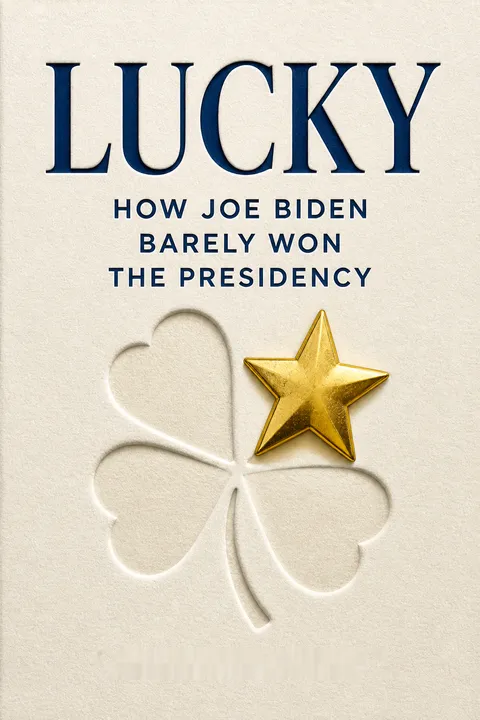
The book’s title captures a useful distinction between outcome and explanation. Luck describes contingency, while design describes the preparation that lets a campaign respond when circumstances change. Neither alone is sufficient. A narrow Electoral College win can be decisive legally while remaining weak evidence of broad consensus. That distinction matters beyond elections: institutions can produce clear winners from deeply divided populations. The narrative is strongest when it holds both facts together, rather than letting victory become either destiny or mere accident.
Analysis
Lucky is political journalism built as a campaign thriller, but its deeper subject is the gap between a candidate’s theory of victory and the machinery required to enact it. Biden’s early campaign often contradicted its own premise: a candidate selling steadiness presided over delayed decisions, blurred authority, weak preparation, and strained relationships with staff. The eventual win therefore cannot be read as proof that the operation was sound. It shows instead that a coherent political identity can survive significant operational failure when the environment changes in ways that favor it.
The narrative’s central causal chain is persuasive but difficult to isolate. Clyburn’s endorsement, rival withdrawals, Super Tuesday voting, the pandemic, and Trump’s response all mattered, yet they interacted. The endorsement was both a signal and a relationship; withdrawals both expressed Biden’s new strength and helped create it. This is a familiar problem in historical explanation: turning points are visible in retrospect, but their effects depend on the conditions already in place. Biden’s coalition, electoral strategy, and recognizable contrast with Trump made contingent events politically useful.
The book also treats political campaigns as organizations with cultures, not just message machines. Biden’s advisers filtered information through loyalty and proximity. Sanders’s campaign struggled with control and expansion. Trump’s operation repeatedly bent toward the president’s impulses. In each case, internal structure shaped what the public eventually saw. The strongest insight is that campaign competence includes the ability to receive unwelcome information, allocate authority, and adapt without losing identity.
The account’s dependence on anonymous campaign sources gives it unusual access to private deliberations, but it also means many motives and counterfactuals remain interpretations. The resulting story is vivid, not a controlled test of why voters chose as they did. Its final perspective is appropriately unresolved: Biden won decisively under constitutional rules, while the narrow margins, turnout gaps, and down-ballot results showed that the country had not delivered a unified verdict. The victory was both a successful outcome and a warning against confusing institutional resolution with political consensus.
Review Summary
Lucky: How Joe Biden Barely Won the Presidency receives mixed reviews. Many readers find it an engaging insider account of the 2020 election, praising its detailed coverage of campaign strategies and behind-the-scenes events. The book's central argument that Biden's victory relied heavily on luck resonates with some readers. However, critics note potential bias, overuse of anonymous sources, and omission of key events. Some reviewers appreciate the authors' willingness to critique all candidates, while others find the portrayal of certain politicians, particularly Kamala Harris, overly harsh.
Glossary
Clyburn Effect
Endorsement-driven coalition shiftA shorthand for the political impact of Representative Jim Clyburn’s endorsement of Biden before the South Carolina primary, combined with the perception that Biden had become the strongest alternative to Bernie Sanders. The endorsement helped validate Biden with voters and party elites, while rival withdrawals and voter consolidation amplified its effect.
firewall
Expected stronghold stateA campaign term for a state or group of voters expected to protect a candidate from defeat. Biden’s campaign called South Carolina a firewall because it expected strong support from Black voters there to keep his nomination effort alive after losses in Iowa and New Hampshire.
red mirage
Early misleading Republican leadThe appearance that a Republican candidate is leading on election night because in-person votes are counted before many mail-in ballots. In 2020, Democrats were more likely to vote by mail, and several states counted those ballots later, so early returns could make Trump appear ahead before the full vote was reported.
thresholding
Winning all district delegatesThe book’s term for a candidate receiving at least 85 percent of the vote in a congressional district and thereby taking all of that district’s delegates. The example illustrates how a strong district-level result could produce a substantial delegate gain even when statewide competition remained divided.
pooh-bahs
Biden’s longtime senior advisersAn informal label used within Biden’s campaign for the longstanding advisers and confidants who had worked with him for years. They had deep personal access and often shared his instincts, but their influence could make it difficult for newer staff to challenge him or make decisions quickly.
About the Author
Other books by Jonathan Allen

Download PDF
Download EPUB
.epub digital book format is ideal for reading ebooks on phones, tablets, and e-readers.








