

Key Takeaways
Build a long apprenticeship before the world calls you an overnight success
The breakthrough came late. Alan Rickman was 42 when Die Hard introduced him to a global audience as Hans Gruber. Yet the apparent overnight arrival rested on years of work: he studied at RADA, trained in regional repertory theatre, and spent time as a graphic designer before acting became his vocation. His stage experience gave him a sturdy base before Hollywood found him, and he resisted being confined to villain roles by choosing very different parts, from romantic lead to alien and angel.
Fame was not the measure. The diaries track jobs, rehearsals, travel, and doubts rather than a smooth ascent. Even after becoming synonymous with Severus Snape, Rickman kept looking for work that tested him. The career is not a ladder so much as repeated apprenticeships, each demanding fresh attention.
Rickman’s timeline complicates the entertainment industry’s obsession with early discovery. His story suggests that accumulated craft can make a late opportunity look sudden to outsiders. It also resists turning his career into a formula: long training does not guarantee fame, and exceptional talent cannot be scheduled. The useful distinction is between preparing for recognition and depending on it. His varied choices show how experience can broaden an artist’s range, while the diaries make clear that success does not remove uncertainty or the need to keep learning.
Treat performance as disciplined listening, not a display of personality
The work starts with attention. Rickman repeatedly prized actors who listened, responded, and made a scene feel discovered rather than prepackaged. He was impatient with performances built from habits or assumptions, and he disliked directors who supplied line readings instead of creating room for actors to work. In his own early notes, the actor’s instrument is not separate from the person: the body, attention, and life all feed the performance.
Preparation creates freedom. During rehearsals for Antony and Cleopatra, Rickman worried that the text was being spoken without enough thought about its meaning. Once the company examined the lines and their actions, the play became clearer and more alive. His ideal was not spontaneity without structure, but freedom made possible by exact work, trust, and concentration.
This account of acting has a close kinship with skilled listening in music and conversation. A performer’s job is not simply to transmit an emotion but to register another person’s cues and let them alter the response. Preparation can make that responsiveness possible instead of restricting it. Still, Rickman’s demand for precision sometimes risks making interpretation sound like a single correct answer. The stronger lesson is that rigor should sharpen attention, not close down other actors’ discoveries.
Demand humane working conditions because collaboration shapes the art
A set has a moral climate. On Mesmer, Rickman fought for rehearsal, clear discussion, fair treatment of performers, and basic respect for the crew. He objected when actors were treated as objects to be moved or when the work was rushed to satisfy production demands. The conflicts drained him, but the crew’s generosity stayed with him: at the end of filming, they gave flowers to him and his co-star, creating a farewell that felt earned.
Better conditions changed the work. Rickman noticed the difference when directors listened, prepared, and welcomed ideas. He valued Anthony Minghella’s openness and remembered collaborators who could challenge him without reducing the actor to a tool. The diaries show that artistic quality did not come from talent alone. Trust, time, and the practical organization of work affected what performers could actually make.
The diaries offer a useful corrective to the myth that harshness is the price of great art. Rickman’s experience suggests that people work more fully when they can raise concerns and contribute knowledge, especially across a multilingual crew or a hierarchy with uneven power. A humane environment is not a guarantee of excellence, and a difficult production can still yield strong work. But treating respect as an artistic resource, rather than a courtesy added afterward, changes what a team can risk and discover.
Defend the work from marketing logic without worshipping your own instincts
Art and product collide. Rickman repeatedly watched financing, editing, awards, and publicity reshape work after the creative process had begun. He fought over Mesmer when backers wanted a more conventional love story, and he worried when editing made a performance or film less complex. During A Little Chaos, he resisted notes that seemed to reduce the story to a simpler romance, arguing that context and character mattered to the audience’s understanding.
Conviction needs examination. Rickman was not immune to self-doubt. He rewatched his work with discomfort, questioned whether his judgments were fair, and knew that his certainty could make him difficult. His diaries record both the value of resisting reductive changes and the danger of treating every disagreement as proof that others do not understand the work.
Rickman identifies a real tension: commercial decisions can clarify a project for its audience, but they can also flatten what made it worth making. His best defense is not that artists are always right. It is that revisions should be judged against the work’s purpose, not merely against market familiarity. His self-questioning matters because artistic integrity can become a shield for ego. A useful test is whether an objection protects a meaningful feature of the work or only the creator’s preferred version.
Spend your influence making other artists less alone
Generosity was active. Emma Thompson’s foreword recalls that artists often thanked Rickman after his death for the help he had given them. The diaries show the less visible side of that support: he offered notes to friends, helped young performers prepare, encouraged Eddie Izzard toward a role, and took genuine interest in colleagues’ work. He could be sharply critical, but the editor stresses that this candor was usually spoken directly and came from affection rather than public point-scoring.
Friendship meant showing up. Rickman made time for family, longtime friends, and new collaborators even while managing a crowded schedule. He and Rima Horton built a life that included travel, meals, political discussion, and quiet domestic routines. His care was not abstract benevolence. It appeared in practical acts, sustained attention, and the willingness to share his experience without making another person feel small.
Rickman’s generosity resembles mentorship at its most useful: specific, candid, and tied to the other person’s development rather than the mentor’s image. That kind of help can circulate through a creative community, connecting people who might otherwise face opaque gatekeeping alone. There is a boundary worth keeping in view. His diary sometimes shows him absorbing other people’s difficulties until he was depleted. Support is most durable when it strengthens another person’s agency without requiring the supporter to become everyone’s emergency service.
When a silenced person needs a stage, take the risk
A project became a public test. Rickman and journalist Katharine Viner shaped My Name Is Rachel Corrie from the diaries and letters of an American activist killed by an Israeli military bulldozer while protesting home demolitions. The circumstances were disputed. When the play’s New York transfer was postponed amid accusations of political bias, Rickman argued that the decision suppressed a voice that audiences should be allowed to hear. The production later reached New York, but the dispute exposed how quickly cultural institutions can retreat under pressure.
Advocacy required persistence. Rickman was not simply lending his name. He helped develop the material, stood by the production through public criticism, and kept insisting that the work be judged onstage. The episode connects his artistic principles to his politics: a theatre can make space for testimony, especially when the subject is uncomfortable.
The project raises a lasting question about who gets to define balance. A single-person work based on one activist’s writings cannot represent every account of a conflict, but that limitation is not a reason to erase it. The more responsible response is to make room for testimony while giving audiences context and room to disagree. Rickman’s commitment shows how a prominent artist can absorb some institutional risk on behalf of a less powerful voice, though advocacy still benefits from transparency about what a production can and cannot claim.
Watch how ambition and self-protection quietly steal your present
The diary catches recurring habits. Rickman often described observing his own life from a distance, a stance he called being at a once-remove. It helped him assess performances and read situations, but he also saw how it could make intimacy harder. Across the years he records indecision, overwork, anxiety about choices, and the temptation to avoid calls or bury himself in career concerns. His entries can be funny about these patterns, but they are rarely complacent.
Reflection was not always release. He knew that analysis could become another form of delay. A quiet day might restore focus, or become an excuse to postpone decisions; a demanding role could bring purpose, or consume all other parts of life. By noting these shifts across decades, the diary turns vague unease into recognizable patterns that can be questioned.
Repeated self-observation can function like a personal feedback loop: a pattern becomes easier to interrupt once it has a name. Rickman’s notes are valuable because they preserve not only conclusions but reversals, moments when he recognizes his own behavior and still struggles to change it. That honesty keeps the diary from becoming a victory narrative. Yet journaling can intensify rumination if every feeling becomes an object for inspection. Reflection is most useful when it returns attention to a choice in the present.
Keep ordinary acts of care central when illness narrows life
The final months became intimate. Rickman’s last diary entry was in December 2015. After his pancreatic cancer diagnosis, he continued to see friends, plan a home, and make decisions about his funeral as his health declined. His hospital room became a small gathering place, furnished with a lamp, cushions, a tree, and a bird-feeder. Friends visited, sometimes laughing together, while Rima remained at his side. He died on 14 January 2016, with his wife present and without pain.
Care kept its ordinary scale. The final account is not a grand lesson about defeating illness. It is a portrait of people bringing familiar objects, sharing conversation, and carrying out practical wishes. Rickman even helped plan the décor of the flat he and Rima were buying. The gestures did not undo the loss, but they preserved his participation in the life around him.
The closing pages resist the temptation to turn dying into a tidy moral. They show agency persisting in small decisions, while also acknowledging that illness took away work and strength. The room’s familiar objects matter because care is often made tangible: someone brings a lamp, arranges a visit, or listens to a preference. These details do not make suffering beautiful or fair. They show how companionship can preserve dignity without pretending that love controls the outcome.
Analysis
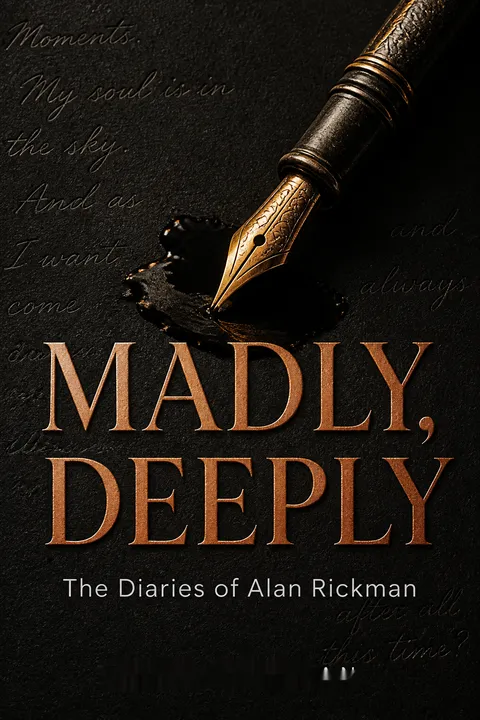
Madly, Deeply is not a conventional autobiography with a clean arc from hardship to triumph. It is a selected record of work and daily life, drawn from more than a million words of diaries and organized across 1993 to 2015, with earlier entries added at the end. That structure makes its central subject less Rickman’s fame than the friction between artistic standards and the conditions under which art gets made. The same actor who demands exactness can be impatient, self-protective, or hard to direct. The diaries gain force by preserving those contradictions rather than resolving them into a polished persona.
The book’s recurring drama is a contest over attention. Rickman wants directors to attend to actors as thinking collaborators, producers to attend to the story rather than a market category, and institutions to attend to voices they might prefer to avoid. In private, he struggles to give comparable attention to his own needs beyond work, and repeatedly sees how career, travel, and obligation can crowd out rest. His self-criticism is therefore not a side note. It complicates his public insistence on artistic freedom and keeps that insistence from sounding uncomplicatedly noble.
Because the diaries were selected and edited after his death, they cannot be treated as a transparent, complete record. Their blunt judgments reveal a vivid temperament, but they also reflect the partial knowledge and emotion of the day they were written. The opening context and the estate’s final account help locate those pages, while the reader still has to distinguish Rickman’s immediate verdict from the whole truth of a person or production. What emerges is an unusually useful portrait of creative labor: not a glamour story, but an account of craft, ego, friendship, politics, and mortality repeatedly negotiating space with one another.
Review Summary
Madly, Deeply received mixed reviews, with some praising its intimate look into Rickman's life and thoughts, while others criticized its disjointed nature and questioned whether it should have been published. Many found the diary entries too brief and cryptic, lacking context. Some readers appreciated Rickman's wit and insights, while others felt the book revealed a more critical side of him. The book's editing and presentation were frequently mentioned as areas for improvement. Overall, opinions were divided on whether the diaries provided meaningful insights into Rickman's life and career.
People Also Read


Glossary
once-remove
observing life from distanceRickman uses this phrase for his tendency to watch himself and situations from a slight distance rather than fully entering them. He saw this as useful for assessing performance and maintaining perspective, but potentially damaging in relationships, where constant observation could become hesitation, control, or emotional withdrawal.
the instrument
the actor’s embodied selfIn Rickman’s reflections on acting, the actor’s instrument is the person who performs: body, voice, attention, and lived experience. Unlike a musician’s instrument, it cannot be set aside after practice. The idea makes an actor’s everyday life part of the conditions that shape performance, while highlighting the physical and emotional demands of the work.
process
the work of making a performanceRickman repeatedly uses process to mean the practical and creative work before and during performance: rehearsal, preparation, discussion, experimentation, and the gradual discovery of a scene. He objects when productions jump straight to shots or finished effects without giving actors time to understand the material, while recognizing that the process itself can be untidy and contested.
FAQ
1. What is Madly, Deeply: The Diaries of Alan Rickman about?
- Personal and professional chronicle: The book is a compilation of Alan Rickman’s diaries from 1974 to 2015, offering an intimate look at his life, career, and inner thoughts.
- Behind-the-scenes insights: It covers his journey from early theatre days to iconic film roles, including candid reflections on acting, directing, and the entertainment industry.
- Emotional and philosophical depth: The diaries explore themes of creativity, relationships, illness, and mortality, providing a nuanced portrait of Rickman as both artist and individual.
2. Who is the author of Madly, Deeply: The Diaries of Alan Rickman and how was it compiled?
- Alan Rickman’s own words: The diaries were written by Alan Rickman, the acclaimed British actor and director known for roles like Severus Snape and Hans Gruber.
- Posthumous publication: After Rickman’s death, the diaries were edited and compiled with contributions from friends, editors, and his wife, Rima Horton.
- Additional perspectives: The book includes forewords, prefaces, and a postscript by Rima Horton, adding context and emotional resonance to Rickman’s story.
3. Why should I read Madly, Deeply: The Diaries of Alan Rickman?
- Unfiltered access to Rickman: Readers gain rare insight into Rickman’s private thoughts, creative struggles, and personal growth, beyond his public persona.
- Artistic and industry lessons: The diaries offer valuable lessons on acting, directing, and navigating the complexities of film and theatre.
- Emotional and inspirational: The book is both a moving tribute and a source of inspiration, exploring universal themes of resilience, love, and the human condition.
4. What are the key takeaways from Madly, Deeply: The Diaries of Alan Rickman?
- Artistic integrity matters: Rickman emphasizes the importance of honesty and dedication in creative work, resisting commercial compromises.
- Life and art are intertwined: He views acting as inseparable from authentic living, with personal experiences shaping artistic expression.
- Resilience through adversity: The diaries chronicle his battle with illness and personal loss, highlighting his determination to live and create fully.
5. How is Madly, Deeply: The Diaries of Alan Rickman structured?
- Chronological diary format: The book is organized year by year, featuring daily or periodic entries that capture events, thoughts, and reflections.
- Supplementary materials: It includes personal photographs, illustrations, and footnotes that provide context for people, places, and events mentioned.
- Contextual contributions: Forewords, prefaces, and a postscript by Rima Horton and friends offer additional perspectives on Rickman’s life and legacy.
6. What are the most memorable quotes from Madly, Deeply: The Diaries of Alan Rickman and what do they mean?
- On acting and life: “演員的表演樂器就是自己,不只是用來練習和表演——也必須使用於生活上。” This highlights Rickman’s belief that acting is deeply connected to authentic living.
- On talent and responsibility: “你要不擁有這種才能,要不根本沒有。要學習的是去找出自己的才能,以及承擔伴隨而來的責任。” He stresses the importance of recognizing and embracing one’s gifts with accountability.
- On mortality: “死亡的麻煩之處在於,這之後不會有『接下來』了,只剩下曾經與從前。” This poignant reflection captures the finality of death and the value of memories.
7. What are the main themes explored in Madly, Deeply: The Diaries of Alan Rickman?
- Art and creativity: Rickman’s passion for theatre and film, his meticulous approach to roles, and his thoughts on the nature of acting are central themes.
- Personal relationships: The diaries chronicle his lifelong partnership with Rima Horton, friendships, and reflections on love and loss.
- Mortality and illness: His private battle with cancer and awareness of mortality are documented with honesty and poignancy.
8. How does Madly, Deeply: The Diaries of Alan Rickman portray Alan Rickman’s personality?
- Complex and multifaceted: Rickman is shown as generous yet challenging, humorous yet reserved, and deeply thoughtful.
- Private yet caring: He fiercely guarded his privacy but was deeply supportive and loyal to those close to him.
- Witty and warm: Despite a sometimes stern exterior, his playful spirit and warmth are evident, especially in anecdotes from friends.
9. What insights does Madly, Deeply: The Diaries of Alan Rickman provide about his acting philosophy and creative process?
- Acting as self-expression: Rickman believes an actor’s instrument is themselves, requiring vulnerability and authenticity in both life and art.
- Balance of control and surrender: He discusses the need to balance technical skill with emotional openness for truthful performance.
- Continuous growth: The diaries reveal his commitment to learning, humility, and nurturing talent with discipline and self-awareness.
10. What key events and projects are covered in Madly, Deeply: The Diaries of Alan Rickman?
- Major film roles: The diaries detail his work on the Harry Potter series, Die Hard, The Italian Job, and A Little Chaos, with behind-the-scenes anecdotes.
- Theatre and directing: Rickman reflects on his stage work, including performances and directorial efforts, sharing insights into rehearsals and creative challenges.
- Personal milestones: The book covers his health struggles, family life, friendships, and significant moments of grief and celebration.
11. How does Madly, Deeply: The Diaries of Alan Rickman depict his battle with illness and final days?
- Candid documentation: Rickman openly discusses his diagnosis with cancer, the treatments, and the physical and emotional toll.
- Determination to live fully: Despite illness, he continued to work, create, and maintain relationships, focusing on life’s pleasures.
- Emotional closure: The postscript by Rima Horton provides a heartfelt account of his last weeks, honoring his spirit and legacy.
12. What does Madly, Deeply: The Diaries of Alan Rickman reveal about his relationships and personal life?
- Lifelong partnership: The diaries chronicle his deep bond with Rima Horton, from their early relationship to marriage.
- Friendships and collaborations: Rickman’s interactions with friends, co-stars, and directors are candidly recorded, showing both support and occasional conflict.
- Balancing fame and privacy: He navigates the challenges of public life, seeking moments of solitude and normalcy amid media attention.
Download PDF
Download EPUB
.epub digital book format is ideal for reading ebooks on phones, tablets, and e-readers.








