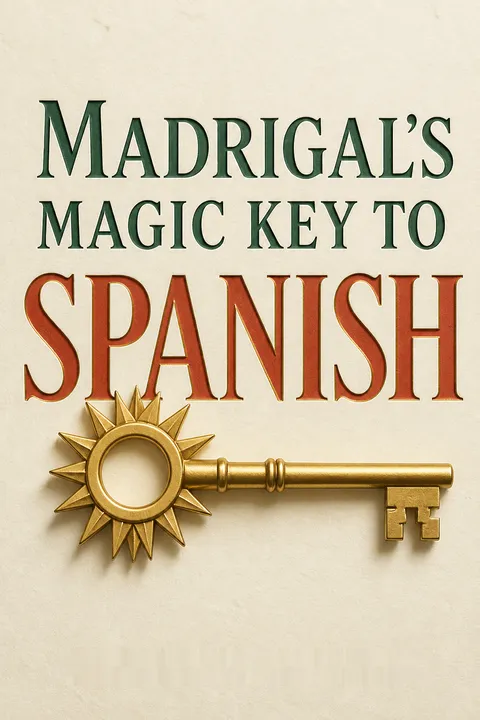


Key Takeaways
Treat familiar English words as launchpads, not a Spanish vocabulary list
Start with what transfers. Madrigal opens by showing how many English words resemble Spanish ones. Words ending in “al” or “ble” often look nearly the same, while many English words ending in “ic,” “tion,” and “ity” map to Spanish forms ending in “ico,” “ción,” and “idad.” These patterns can unlock a large starting vocabulary without memorizing each word separately.
Use the patterns carefully. The book’s categories are practical clues, not universal conversion rules. Some familiar-looking words mean something different, and many words do not follow the patterns. Madrigal’s deeper lesson is to notice resemblance, make a tentative guess, then check whether the word fits its context and pronunciation.
The method turns prior knowledge into leverage: a learner who already knows English-derived vocabulary can recognize Spanish sooner than a blank-slate approach suggests. That is a strong starting point because recognition creates early momentum. The risk is false confidence. Similar spelling can encourage a learner to assume identical meaning or pronunciation, a common problem in closely related languages. The most useful practice is therefore not merely guessing, but making a guess and testing it against a sentence, a dictionary, or a fluent speaker.
Turn each new word into a sentence before you try to memorize it
Create with small pieces. Madrigal asks learners to combine familiar nouns, verbs, and adjectives into many possible sentences. A beginner might take a person, a form of “to be,” and a description, then change one piece to make a new statement or question. This turns a small vocabulary into active material instead of a stack of disconnected translations.
Use the word immediately. The lessons move from recognizing cognates to forming sentences, asking questions, and answering them in short dialogues. Madrigal argues that a word used in a self-made sentence is more memorable than one repeated in isolation. The method is deliberately playful, with recurring comic questions about monkeys, dinners, and unlikely activities to keep drills from feeling entirely mechanical.
Sentence-making develops more than vocabulary recall. It teaches learners to notice how words depend on one another, which is the beginning of grammatical fluency. The comic dialogues also make repetition less punishing by giving practice a small narrative frame. Still, productive practice can reinforce a mistaken pattern if no correction follows. The strongest version of Madrigal’s approach pairs invention with an answer key or feedback, so learners retain both the freedom to experiment and a reliable signal about what works.
Master a few verb endings, then reuse them across whole conversations
Make endings do the work. The book presents Spanish verbs as reusable patterns. For many regular verbs, the infinitive ending identifies a family, and replacing it changes who acts or when. In the preterite of regular “ar” verbs, for instance, the book teaches “é” for “I” and “ó” for a singular subject other than “I.” It later adds plural forms and present-tense patterns. Spanish often omits subject pronouns because the verb ending helps identify the subject.
Practise whole exchanges. Madrigal repeatedly puts forms into questions and answers, rather than leaving them on a chart. Her label “third man” refers to the singular third-person form, which she also uses for formal “you.” That shorthand is memorable, but it is not a standard grammatical term and can obscure the distinction between formal address and third person.
The book’s central teaching move is to find a pattern that generates many utterances. A learner who understands a few endings can begin producing new sentences rather than waiting to retrieve a memorized phrase. The “third man” label makes an abstract form vivid, but its catch-all explanation is less precise than the Spanish grammar it aims to simplify. A useful teaching metaphor should lower the entry barrier without becoming the learner’s permanent model. The patterns matter; the terminology should eventually give way to standard person and number labels.
Start with past-tense stories to make Spanish immediately useful
Give verbs a reason to appear. Madrigal introduces the past before the present because it lets beginners recount what they did, saw, and experienced. She treats narration as a practical early goal, then builds an initial past tense from familiar words. One productive route begins with Spanish nouns ending in “ación”: remove that ending and add a verb ending. For example, the pattern turns a noun for preparation into a past-tense form meaning “I prepared.”
Build a usable core. The early lessons practise preparing a meal, visiting someone, buying a ticket, and talking on the phone. A learner can combine those verbs with people, places, and times to tell a simple story. The book presents this as a way to generate far more material than rote memorization allows.
Beginning with narration gives grammar an immediate communicative purpose. Instead of learning forms as abstract furniture, the student uses them to report events and connect one action to another. The “ación” conversion is an especially efficient example of how vocabulary and verb learning can reinforce each other. It remains a shortcut, not a complete account of Spanish verb formation: many verbs cannot be built reliably from English-looking nouns. Its best role is to get a beginner speaking, while systematic conjugation and correction fill in the gaps.
See tense forms as a small toolkit for time and action
Reuse a few constructions. The book assembles several ways to place an action in time. “Ir a” plus an infinitive expresses a near or planned future; “estar” plus a present participle describes an action in progress; “haber” plus a past participle forms a compound past. The imperfect describes ongoing conditions or repeated past actions, while the preterite presents a completed event. Madrigal illustrates the contrast with a repeated morning routine versus one particular purchase.
Let context guide the choice. The book also introduces commands and conditional forms, giving the learner ways to request, advise, or imagine. Its explanations are intentionally compressed, but tense choice is not always decided by a single English equivalent. The surrounding story and the speaker’s intended emphasis matter.
The toolkit approach helps learners see that grammar is not an inventory of unrelated endings. A few constructions can express plans, ongoing activity, completed events, habits, and hypothetical outcomes. The contrast between a repeated routine and a one-time event is particularly useful because it links form to meaning. The caution is that English and Spanish do not divide time in exactly the same way. Memorizing a one-to-one translation may help at first, but learners need examples in context to hear what each form contributes.
Group irregular verbs by family instead of treating each as a freak
Look for shared behavior. Madrigal calls irregular verbs “nonconformist verbs” and gathers important ones into families. Several share distinctive patterns in the past tense, while related verbs built from “poner,” “tener,” and “traer” often retain features of their base verbs. She also organizes stem-changing verbs by what happens inside the root: for example, some change “e” to “ie” in much of the present tense, while others shift a vowel in particular past-tense forms.
Learn patterns with their limits. The book recommends practising these verbs in grouped charts and sentences instead of treating every form as unrelated. Family resemblance reduces the apparent size of the problem, but the forms still need repeated use. Some exceptions do not fit the broad pattern, so the charts are maps rather than guarantees.
Grouping exceptions is a powerful alternative to the belief that irregularity means randomness. Once learners see a shared stem or recurring set of endings, a difficult verb can become evidence for a pattern rather than a solitary fact. The playful “nonconformist” label also gives an intimidating topic a human scale. The category should not imply that all irregular verbs behave alike, however. Learners benefit from grouping similar forms while keeping a clear record of where each family changes and where it does not.
Translate the relationship, not the English sentence shape
Spanish may frame the same idea differently. The lessons show that a direct word-for-word translation often misses how Spanish organizes meaning. The book contrasts “ser” and “estar,” introduces “tener” in expressions for hunger, cold, age, or fear, and explains “gustar” as something being pleasing to someone. It also teaches the personal “a” before certain people who receive an action, and object pronouns that stand in for people or things.
Track who relates to what. Reflexive verbs add another shift: the action can turn back on the subject, as when someone gets dressed or washes. Madrigal teaches pronoun placement through repeated examples, including how pronouns attach to an infinitive in some constructions. These are not decorative details. They tell the listener who acts, who experiences the action, and what the action concerns.
This is where the book moves beyond word conversion and asks learners to adopt Spanish ways of packaging an event. The examples make a useful point: translation is not substitution, but a choice about grammatical perspective. Madrigal’s simple cues help a beginner notice those differences early. Some rules, especially the permanent-quality shortcut for “ser” and temporary-state shortcut for “estar,” are only rough guides. Meaning depends on usage and context, so learners should treat the book’s oppositions as first footholds rather than exhaustive definitions.
Use the subjunctive when desire or uncertainty leaves an action open
Separate wishes from facts. Madrigal introduces the subjunctive through situations where an action is wanted, hoped for, feared, doubted, or not yet settled. “I want to go” describes one person’s intention and takes an infinitive; “I want you to go” involves another person and calls for a different verb form. The lessons also use the subjunctive after expressions of necessity, possibility, and hope, and in references to an unknown person or thing.
Notice whether it has happened. The book contrasts a future action after words such as “when” with a completed past event. That contrast gives beginners a useful question to ask: is the action still uncertain or pending, or is it already a fact? The subjunctive’s endings are introduced through the same command forms learners have practised.
The explanation offers a memorable semantic center: the subjunctive often appears when a speaker is not simply reporting an established event. Connecting mood to desire, uncertainty, and unrealized action gives learners a better starting point than memorizing a long trigger list. The boundary is not reducible to one test, and the book’s rules are simplified, but the core question remains useful: is the speaker asserting an event, or placing it inside a wish, judgment, possibility, or condition? That distinction encourages attention to meaning as well as form.
Speak aloud, retrieve from memory, and test what you can actually produce
Make practice portable. Madrigal recommends small reminder cards that learners can review during spare moments. The cards hold word-building patterns or sentence frames, prompting the learner to generate additional examples rather than simply reread a list. Across the lessons, learners read forms aloud, translate in both directions, form their own sentences, and check answers against keys.
Measure production, not recognition. Regular tests ask learners to supply vocabulary, conjugations, and translations without the answer in view. They expose whether a pattern can be retrieved and used, rather than merely recognized on the page. Madrigal also urges students to listen to the rhythm of Spanish and to practise speaking from the earliest lessons. The book’s routine is simple: notice a pattern, say it, use it, and check it.
The practice design alternates explanation with active production. That matters because seeing a correct form is easier than retrieving it under pressure, and a card that asks for new examples demands more than passive review. Reading aloud also makes pronunciation part of learning instead of an afterthought. The book’s promise that a created word will never be forgotten is too absolute; memory fades, and practice needs revisiting. Its more defensible insight is that varied retrieval and meaningful use give patterns repeated chances to become accessible.
Analysis
Madrigal’s method is a practical argument against treating a language as a warehouse of words and rules. Its organizing idea is generative: notice a pattern, use it to create a form, place that form in a sentence, then reuse it in a conversation. That sequence links vocabulary, grammar, and speaking from the opening lessons. The book’s recurring dialogues, comic absurdities, reminder cards, and translation tests all serve that larger purpose. The learner is not asked to wait until mastery arrives before speaking. Speech is part of how mastery is built.
The strongest part of the approach is its use of transfer. English and Spanish share enough vocabulary for familiar forms to provide a genuine foothold, and common verb patterns let a learner produce more than a memorized phrasebook permits. The book also makes grammar concrete by tying it to communicative jobs: narrating a completed event, describing a repeated past action, making a request, or expressing a desire about someone else. Those are memorable reasons to learn forms. The same compression that makes the book approachable can mislead. Cognate transformations are tendencies, not dependable conversion laws. The “third man” metaphor obscures the distinction between third-person forms and formal address, and several grammar explanations are presented as stronger rules than they are. The preterite-first sequence is motivating, but it cannot substitute for a balanced account of common present-tense use and meaningful listening. The book’s claim that every learner succeeds is promotional, not evidence that its method works equally well for every student.
A modern reader can preserve the method’s engine while updating its safeguards: generate sentences, retrieve forms from memory, read aloud, and seek correction, while treating each shortcut as a hypothesis to verify. The book is most valuable as an energetic speaking primer, not as a complete or authoritative grammar reference. Its lasting contribution is the insistence that learners can create with a language before they know everything about it.
Review Summary
Madrigal's Magic Key to Spanish is highly praised for its effective approach to teaching Spanish. Readers appreciate its simplicity, practical exercises, and ability to build vocabulary quickly. Many found it superior to other language learning methods. The book's age (published in 1951) is both a strength and weakness, with some outdated references but timeless teaching techniques. Some criticisms include the lack of emphasis on informal "tú" forms and limited coverage of idiomatic expressions. Overall, it's considered an excellent resource for beginners and those refreshing their Spanish skills.
People Also Read


Glossary
third man
singular non-first-person formMadrigal’s teaching label for a singular verb form used for he, she, or it, and also for formal usted. The book treats it as the form for everyone and everything other than the speaker. This metaphor may help beginners notice a recurring verb ending, but it is not standard grammatical terminology and can blur third person with formal second-person address.
nonconformist verbs
grouped irregular verbsMadrigal’s playful name for important irregular Spanish verbs. She groups them by shared features in their present and past forms, including families related to tener, poner, and traer. The label is meant to make irregular verbs seem less arbitrary: many share patterns even when they do not follow the regular conjugation rules.
radical changing verbs
verbs with changing stemsMadrigal’s term for verbs whose endings follow familiar patterns while a vowel in the stem changes in certain forms. The book groups these changes by type, such as e changing to ie or o changing to ue in much of the present tense. Some groups also have specified changes in particular past forms.
personal a
a before certain human objectsThe preposition a placed before certain direct objects that refer to people, as in sentences about visiting or inviting someone. Madrigal introduces it as a cue to the person affected by the verb and contrasts it with actions directed at things. It is a grammatical marker, not a word that should always be translated as “to.”
acid test
English to-or-for checkMadrigal’s heuristic for choosing an indirect object pronoun: ask whether the English verb can naturally be followed by “to” or “for” the person. If so, she directs learners toward the indirect object form; if not, toward a direct object form. It is a beginner’s sorting aid, not a universal rule for Spanish verbs or pronoun choice.
FAQ
1. What is Madrigal's Magic Key to Spanish by Margarita Madrigal about?
- Comprehensive Spanish learning: The book offers a creative and proven approach to learning Spanish, focusing on leveraging similarities between English and Spanish to accelerate vocabulary and comprehension.
- Emphasis on creation: Rather than rote memorization, Margarita Madrigal’s method empowers learners to create Spanish words and sentences from the very first lesson.
- Practical language skills: The course promises that readers will be able to speak, read, write, and think in Spanish, preparing them for real-world communication.
- Coverage of grammar and verbs: It covers essential grammar, regular and irregular (nonconformist) verbs, and practical sentence construction.
2. Why should I read Madrigal's Magic Key to Spanish by Margarita Madrigal?
- Proven, enjoyable method: The book’s approach has helped over a quarter of a million students, with a focus on making learning Spanish pleasurable and effective.
- Rapid vocabulary building: Readers quickly gain a large working vocabulary by recognizing and converting English words into Spanish.
- Strong foundation in verbs: The book emphasizes mastering the most important verbs, especially irregular ones, which are crucial for fluency.
- Clear explanations: Complex grammar topics are broken down with clarity, making the book suitable for both beginners and intermediate learners.
3. What are the key takeaways from Madrigal's Magic Key to Spanish by Margarita Madrigal?
- You already know Spanish: The method shows that English speakers already know thousands of Spanish words due to cognates and similar word endings.
- Active creation over memorization: Creating words and sentences leads to deeper, longer-lasting learning than passive memorization.
- Mastering irregular verbs is essential: Focusing on the eighteen nonconformist verbs is the most important advice for Spanish learners.
- Learning should be joyful: The book’s philosophy is that pleasure and curiosity drive effective language acquisition.
4. What are the best quotes from Madrigal's Magic Key to Spanish and what do they mean?
- “And gladly wolde he lerne and gladly teche” (Chaucer): This quote underscores the book’s belief that learning and teaching should be joyful and enthusiastic.
- “A word that you create stays with you forever”: Highlights the power of active participation in language learning, rather than passive memorization.
- “Nothing you could study before or after these verbs could compare in importance with them”: Stresses the critical role of mastering the eighteen nonconformist (irregular) verbs for Spanish fluency.
5. How does Margarita Madrigal’s method in Madrigal's Magic Key to Spanish help learners build vocabulary quickly?
- Recognizing cognates: The book categorizes thousands of Spanish words that are identical or very similar to English words, making them easy to learn.
- Word formation rules: Simple rules for converting English endings (like “tion” to “ción,” “ist” to “ista”) allow learners to create new Spanish words confidently.
- Use of reminder cards: Learners are encouraged to write categories and examples on cards for frequent, casual review, reinforcing vocabulary retention.
- Accelerated learning: This approach gives learners a large, ready-made vocabulary from the start, speeding up progress.
6. What pronunciation guidance does Madrigal's Magic Key to Spanish by Margarita Madrigal provide?
- Consistent vowel sounds: Spanish vowels are pronounced consistently: A as “ah,” E as in “bet,” I as “ee,” O as “oh,” and U as “oo.”
- Consonant rules: The book details how to pronounce consonants, including regional variations (e.g., “C” and “Z” as “TH” in parts of Spain).
- Practical tips: Learners are given clear, simple rules to ensure accurate pronunciation from the beginning.
7. How does Madrigal's Magic Key to Spanish by Margarita Madrigal teach Spanish verb tenses, especially the past tense?
- Early introduction: The book introduces the past tense early, as it is essential for everyday conversation and storytelling.
- Simple conjugation rules: Learners are shown how to form past tense verbs by changing endings, with clear examples and patterns.
- “Third man” concept: The method uses the “third man” figure to help learners remember verb endings for different subjects in the past tense.
- Coverage of preterite and imperfect: The book explains the difference between preterite (completed actions) and imperfect (ongoing or repeated actions) with visual aids and exercises.
8. What are nonconformist (irregular) verbs in Madrigal's Magic Key to Spanish by Margarita Madrigal, and why are they important?
- Definition: Nonconformist verbs are irregular verbs that do not follow standard conjugation rules and often have unique forms.
- Eighteen essential verbs: The book identifies a “club” of eighteen crucial nonconformist verbs, including “ir,” “tener,” “hacer,” and “decir.”
- Patterns and similarities: Many share similar endings in the past tense, making them easier to learn as a group.
- Critical for fluency: Mastering these verbs is described as the single most important step for progressing in Spanish.
9. How does Madrigal's Magic Key to Spanish by Margarita Madrigal explain direct and indirect object pronouns?
- Direct object pronouns: “Lo” and “la” are used for masculine and feminine objects or persons, replacing the direct object before the verb.
- Indirect object pronouns: “Le” and “les” are used for “to/for him, her, you,” and “to/for them, you plural,” with the “acid test” being if “to/for” fits after the verb in English.
- Combination rules: When both pronouns are used, the indirect comes first, and “le” changes to “se” before “lo/la/los/las.”
- Word order: Pronouns precede the verb except in affirmative commands, where they attach to the end.
10. What is Margarita Madrigal’s approach to reflexive verbs in Madrigal's Magic Key to Spanish?
- Definition and examples: Reflexive verbs indicate the subject acts on itself, such as “me lavo” (I wash myself), and are more common in Spanish than English.
- Pronoun placement: Reflexive pronouns precede the verb in all tenses, but attach to infinitives and gerunds (e.g., “lavarme”).
- Additional meanings: Reflexive verbs can express “to get” or “to become,” and are used for reciprocal and impersonal actions.
- Practice and charts: The book provides full conjugation charts and exercises for mastering reflexive verbs.
11. How does Madrigal's Magic Key to Spanish by Margarita Madrigal teach the Spanish subjunctive mood?
- Present subjunctive use: Triggered by expressions of desire, doubt, hope, or necessity involving two people (e.g., “Quiero que vengas”).
- Endings and forms: “Ar” verbs end in “e,” “er/ir” verbs end in “a,” with pronouns always preceding the verb.
- Common triggers: Includes phrases like “espero que,” “dudo que,” and impersonal expressions such as “es necesario que.”
- Past and compound subjunctive: The book covers the past subjunctive and present perfect subjunctive, with charts and exercises for practice.
12. What practical vocabulary, idiomatic expressions, and conversational examples does Madrigal's Magic Key to Spanish by Margarita Madrigal provide?
- Extensive vocabulary lists: The book offers a large, alphabetically organized vocabulary covering common and specialized terms.
- Idiomatic expressions: Includes colorful idioms and common phrases, such as “Dar gato por liebre” (to cheat) and “¿Cómo está usted?” (How are you?).
- Conversational practice: Dialogues and exercises use verbs in various tenses and contexts, helping learners practice real-life communication.
- Cultural notes: The book enriches learning with cultural references and practical expressions for everyday situations.
Download PDF
Download EPUB
.epub digital book format is ideal for reading ebooks on phones, tablets, and e-readers.








