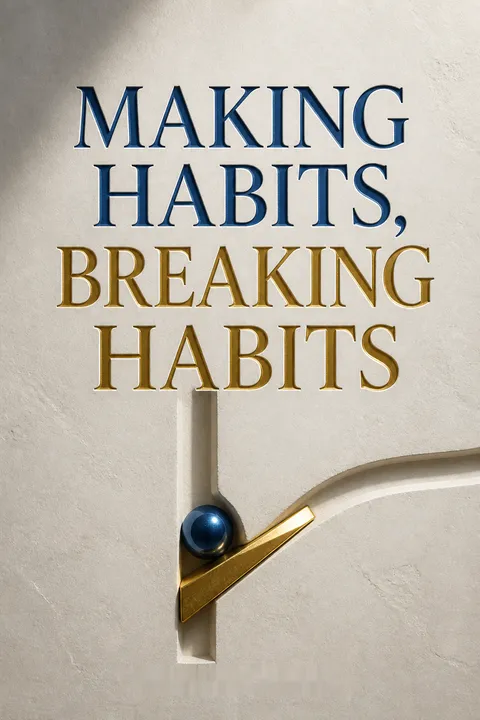


Key Takeaways
Expect habit formation to vary, not obey a universal 21-day deadline.
The famous deadline misleads. The popular 21-day claim grew from a plastic surgeon’s observations about patients adjusting to physical changes, not research showing that every behavior becomes habitual in three weeks. In a University College London study, 96 people repeated a chosen daily behavior and reported how automatic it felt. Habit formation took 66 days on average, but varied widely: drinking water after breakfast became automatic quickly, while an exercise routine remained difficult for some participants even after 84 days.
Repetition still pays. Early repetitions usually produced the biggest gains in automaticity, with progress slowing over time. Missing a day or two did not appear to derail formation. The practical lesson is to judge progress by growing ease, not by an unbroken streak or an arbitrary calendar date.
The correction matters because false deadlines turn ordinary friction into apparent personal failure. A gradual curve is a better model: early effort can produce visible gains, while the final stretch may feel slow. That pattern appears in skill acquisition more broadly, where beginners often improve quickly before progress becomes incremental. Still, the 66-day figure is an average from a small study of selected daily behaviors, not a reliable forecast for every person or goal. It offers a reason to persist, not a new magic number.
Design the setting because habits answer familiar cues before conscious plans.
Context is part of the behavior. Habits tend to emerge when the same action is repeated in a stable situation. A coffee shop can cue a familiar order; a particular route can prompt a driver to reach for the car keys. In diary research, people described between one-third and half of daily activities as habitual, often performed in the same places and around the same people.
Change the surroundings, change the prompts. Students who moved to another university found it easier to alter familiar activities, including TV watching and exercise. New rooms, people, and routines interrupted old cues, making deliberate choices more likely. Context also includes social routines: family meals can create shared identity, while friendships often grow through repeated shared activities, not merely similar opinions.
This account makes behavior less mysterious and more designable. Instead of treating a routine as a private test of character, it directs attention to the places, objects, and people that repeatedly summon it. That connection is central to environmental psychology and to choice architecture, the practice of arranging options so some actions become easier to notice or perform. Context is not destiny, however. People can act against a cue, and stable routines can be protective, especially in families and workplaces. The key question is whether a familiar setting is supporting the intended behavior or quietly preserving an obsolete one.
Do not trust confidence when a familiar routine keeps winning.
Intention loses ground to repetition. When a habit is weak, a person’s stated plans can predict what they do. As a habit strengthens, past behavior becomes a better guide than current intention. In research on fast food, news watching, and bus use, strong habits made people less likely to follow plans to change. Yet the people with the strongest habits were also the most confident about predicting their behavior, despite being less accurate.
Goals can cue the wrong means. A person who has learned to associate drinking with enjoyable socializing may be nudged toward alcohol simply by thinking about socializing. The social goal remains, but the habitual response can outlive its usefulness. Habits can serve old goals automatically, even when circumstances have changed.
The confidence finding exposes a subtle problem: familiarity can feel like agency. A routine is easy to explain after the fact, so it can seem consciously chosen even when the situation triggered it automatically. This resembles the planning fallacy, in which people overestimate their ability to control future behavior. A useful response is not to distrust every intention, but to treat repeated behavior as evidence about what the environment currently rewards. That shift makes self-assessment more empirical: compare a plan with what actually happens, especially in the settings where the old routine is strongest.
Track automatic thoughts instead of trusting every explanation about yourself.
Introspection has blind spots. In a face-choice experiment, researchers secretly switched the chosen image for some participants. Most failed to notice and confidently explained why they supposedly preferred the face they had not chosen. People can also mistake a thought pattern for an objective reading of reality. A pessimistic attributional style, for example, treats setbacks as personal, permanent, and beyond control. In a study following 5,000 students, serious depression developed in 17% of those with this style, compared with 1% of the rest.
Notice the loop, then test it. Rumination can feel like problem-solving while keeping attention fixed on distress. Cognitive behavioral therapy helps people identify automatic negative thoughts and examine them against experience, rather than simply trying to suppress them. Mindful observation can make recurring cues and reactions easier to spot.
The distinction between observation and explanation is valuable well beyond habit change. Human beings often invent coherent accounts for behavior whose causes are only partly available to awareness. Cognitive therapy responds by treating thoughts as hypotheses to examine, not verdicts to obey. That stance preserves personal agency without pretending that introspection is perfectly accurate. The depression statistic is striking, but it does not mean a pessimistic thinking style alone causes depression; the book presents it as one risk factor among interacting influences. Patterns deserve attention, not simplistic diagnosis.
Build habits with specific if-then plans attached to daily events.
Give the intention a trigger. An implementation intention is a plan that links a recognizable situation to a specific action: if a particular event occurs, then a defined behavior follows. It is more useful than a vague promise because it identifies both when to act and what to do. Across 94 studies involving more than 8,000 people, these plans had a medium-to-large effect on goal achievement. In one study, people who made specific plans ate about half a serving more fruit and vegetables each day, while a comparison group made no increase.
Choose cues that will happen. A daily event, such as arriving at work, is generally more dependable than a clock time that must be remembered. Keep the action clear, anticipate obstacles, and plan a response to them. The WOOP exercise clarifies this process: Wish, Outcome, Obstacle, and Plan.
The strength of an if-then plan is cognitive economy. It moves part of the decision out of the moment, when distraction, fatigue, or competing desires can take over. This resembles programming a simple rule in advance: the cue initiates the response without requiring a fresh debate. The plan still depends on choosing a cue that actually occurs and an action that fits the situation. A beautifully written plan attached to an unreliable trigger is only a wish in formal clothing. Reviewing failed attempts can reveal whether the cue, action, or obstacle plan needs adjustment.
Replace unwanted routines instead of trying to erase them by force.
Suppression can strengthen the pull. In a well-known experiment, participants told not to think about a white bear thought about it more after the instruction ended. The same rebound can affect habits: repeatedly trying not to think about smoking or a snack can keep the temptation mentally active. A more useful strategy is to create a competing response, such as chewing gum instead of smoking, and connect it to the situation that used to trigger the old behavior.
Change the conditions, too. Moving, changing jobs, or even rearranging a room can interrupt familiar cues. When relocation is unrealistic, pre-commitment can help: remove the tempting option or make it harder to access before self-control is strained. Old habits may remain dormant rather than disappear, so familiar situations can bring them back. Plan for those situations instead of treating a lapse as proof that change is impossible.
Replacement recognizes that habits occupy a functional slot. A behavior may provide stimulation, comfort, or a pause, so simply removing it can leave the original need unanswered. This connects with behavioral substitution in clinical treatment, where a safer action competes with a harmful one. Environmental changes add another layer by reducing the number of moments that require active resistance. The approach should not imply that every habit has one simple substitute; addiction, distress, and material constraints can demand professional or social support. Still, planning for a cue is more realistic than assuming it will never return.
Make healthy behavior easier through small environmental redesigns.
The surroundings quietly set portions. In one popcorn study, people with strong cinema-eating habits consumed roughly the same amount whether hungry or not, and whether the popcorn was fresh or stale. In a meeting room, the changed context disrupted the routine, and participants ate about 50% less. Other studies described in the book found that larger containers and plates, visible food, and nearby snacks can all encourage greater consumption without people noticing.
Make modest changes repeatable. A fruit bowl placed in view, smaller serving dishes, or eating with the non-dominant hand can interrupt automatic eating. Exercise also benefits from a reliable cue and self-monitoring, such as counting steps. For smoking, behavioral cues matter alongside nicotine dependence: nicotine replacement therapy can raise quit success, but planning for the situations linked to smoking remains important.
Small environmental adjustments are powerful partly because they reduce reliance on moment-to-moment self-control. Public health design uses the same insight when it makes safer or healthier options more accessible. The popcorn finding is memorable because it shows how context can outweigh appetite, yet a single experiment cannot predict every eating choice or solve obesity. Food behavior is also shaped by income, stress, culture, and access. Environmental redesign works best as a practical aid, not as a claim that individual choices exist outside social conditions.
Treat safety routines as systems that need safeguards against autopilot.
Repetition can hide an error. In 1988, Delta Flight 1141 crashed after taking off without its flaps and slats set for takeoff. The pilots exchanged the correct checklist responses, but the interval was so brief that investigators questioned whether the controls had actually been checked. A familiar checklist can become a performance from memory rather than an inspection of reality.
Design a pause into the system. A Glasgow train driver once departed against a red signal after relying on a familiar signal from the guard. A device called the Driver’s Reminder Appliance later required an extra action before power could be applied, prompting the driver to check the signal. Seat-belt use also rose sharply after legal requirements and enforcement, following years of educational campaigns with limited effect. Procedures and surroundings can protect against predictable human slips.
These accidents make a crucial distinction between blaming an individual and engineering a safer system. In aviation, healthcare, and other high-stakes settings, a routine needs verification because fluent performance can conceal missing steps. This is the logic behind checklists, forcing functions, and independent checks: not assuming that trained people are immune to distraction. The same principle applies to ordinary life, though safeguards should be proportionate to risk. A small reminder may help with a forgotten task; a medication or transportation process may require layered checks.
Escape expert ruts by adding constraints, distance, and playful alternatives.
Knowledge can narrow the search. In the two-string puzzle, participants had to connect strings that were too far apart to reach. Some solved it by making pliers swing like a pendulum, using a familiar object for an unfamiliar purpose. Expertise can produce the same functional fixedness: a strong association with the usual use of a tool or idea blocks alternatives. In a word puzzle, people with greater baseball knowledge were more easily misled by baseball clues.
Change the frame before solving. Constraints can help creativity by giving an open-ended task a workable shape. Abstracting a problem, imagining it at a distance, or asking what would happen if a familiar condition changed can loosen habitual thinking. Engineers found a ski-vibration solution by connecting the problem to how an added layer improved the sound of bowed instruments. Creative work still needs focused evaluation after exploration.
Creativity here is not the opposite of discipline. It is a sequence: loosen the first obvious interpretation, generate alternatives, then concentrate on testing them. This resembles design thinking, where reframing the problem can matter as much as producing candidate solutions. Expertise supplies the raw material for analogy, but it also makes familiar answers easy to retrieve. The useful goal is not to discard expertise, but to make it temporarily less dominant. Constraints help when they focus exploration; overly narrow constraints can instead prevent a genuinely new solution.
Keep happiness habits fresh by varying them and returning attention to now.
Pleasure fades through familiarity. Lottery winners in one study reported happiness much like before their windfall six months later. Positive changes can quickly become ordinary, so a routine that once felt rewarding may become emotionally flat. Gratitude exercises and writing about a realistic best possible future can improve well-being, but repeating them mechanically risks the same habituation.
Vary the practice and attend to the experience. Small changes in timing, place, or method can renew attention. In a mobile-phone study, people’s minds wandered in nearly half of sampled moments; unpleasant and neutral thoughts were associated with lower happiness than engagement with the current activity. Savoring can mean noticing a pleasure as it happens, sharing a success, or revisiting a positive memory. The aim is not endless novelty, but renewed contact with what a familiar activity offers.
This insight separates a habit’s reliable beginning from the quality of the experience itself. Automatic routines save effort, but happiness often depends on attention, meaning, and variation. Research on adaptation similarly suggests that people adjust to many improved circumstances faster than they expect. That does not make circumstances irrelevant: safety, health, and economic security matter profoundly. The narrower point is that external upgrades alone may not sustain emotional gains. Small variations can restore engagement, while mindful attention helps prevent an enjoyable activity from becoming merely another task on autopilot.
Analysis
The book’s central achievement is to relocate habit change from the realm of character to the interaction between action, context, and repetition. Its argument moves from the anatomy of automatic behavior, through everyday settings such as food, work, relationships, and digital media, toward methods for building, breaking, and refreshing routines. That arc matters: practical advice becomes more convincing after the reader sees how often ordinary behavior is cued outside awareness.
The most useful distinction is between an intention and the machinery that carries it out. A person can sincerely want to exercise and still follow a well-rehearsed route to the car. The book’s answer is not to abandon intention, but to give it leverage through specific plans, environmental changes, monitoring, and replacement behaviors. This is a durable contribution to popular psychology because it makes behavior change observable and testable rather than purely inspirational.
Its stories also widen the scale of explanation. The pilots who recited a checklist without adequately checking, the train driver who followed a familiar signal, and the cinema audience eating stale popcorn all illustrate how settings can shape action. Habits are not only private routines; they are also social and institutional patterns. That view anticipates modern interest in choice architecture and human factors, where safer behavior is supported by the design of systems rather than assigned solely to individual willpower.
Some claims deserve careful handling. The 66-day estimate comes from a limited sample and should not be treated as a personal deadline. Laboratory demonstrations show that unconscious cues can influence behavior, but do not establish that every proposed priming effect is large or dependable in daily life. The book’s discussion of willpower as a depleting resource is also more useful as a caution against overreliance on resistance than as a settled physiological law. These limitations do not weaken its main practical message: observe repeated behavior, identify the cue, and change the conditions that keep producing it. The strongest habit strategy is less a heroic promise than a well-designed routine that can survive ordinary distraction.
Review Summary
Making Habits, Breaking Habits offers insights into habit formation and breaking, backed by scientific research. Readers appreciate its practical advice, debunking of myths, and accessible writing style. Many found the book informative and useful for understanding and changing habits, though some felt it was overly long or lacked actionable steps. The book's emphasis on long-term strategies, mindfulness, and implementation intentions resonated with many readers. While some compared it favorably to similar books, others felt it didn't offer much new information.
People Also Read







Glossary
automaticity
Effortless, low-awareness actionAutomaticity is the degree to which a behavior occurs with little conscious attention or deliberate effort. Repetition in a stable context can make an action feel increasingly automatic. In the book, automaticity is a defining feature of habit, not a fixed threshold reached after a universal number of days.
implementation intention
Situation-linked action planAn implementation intention is a specific plan that links a recognizable situation to an action, often expressed as an if-then structure. The situation acts as a cue, and the planned response is the behavior to perform. Such plans make intentions more actionable and can also prepare a response to anticipated obstacles.
mental contrasting
Compare a goal with obstaclesMental contrasting involves imagining a desired outcome and then considering the real obstacles that stand between the present situation and that outcome. Comparing aspiration with reality helps a person judge whether a goal is attainable and, when expectations are strong enough, can strengthen commitment and action planning.
WOOP
Wish, outcome, obstacle, planWOOP is a structured exercise for turning a goal into a plan. The letters refer to Wish, Outcome, Obstacle, and Plan. A person identifies a desired change, imagines its best result, names a likely obstacle, and makes a specific if-then response to that obstacle.
reperception
Observe reactions with perspectiveReperception is the ability to notice automatic thoughts and reactions as events occurring in a particular context, rather than immediately treating them as facts or instructions. The book links this perspective to mindfulness: observing experience with openness can reveal habits that are otherwise difficult to recognize.
capture error
A stronger routine takes overA capture error occurs when a familiar, well-practiced action sequence takes control of behavior, diverting a person from what they intended to do. It often happens in a familiar setting when attention wanders, such as entering a room for one purpose and beginning a different routine associated with that room.
Janusian thinking
Hold opposing ideas togetherJanusian thinking is a creative process of conceiving apparently opposite ideas at the same time and exploring whether they can be integrated. The term refers to Janus, the Roman figure traditionally depicted facing in two directions. The book presents this approach as one route to breakthroughs that escape habitual assumptions.
deficient self-regulation
Weak monitoring and controlDeficient self-regulation describes problematic online use in terms of two shortcomings: deficient self-observation, meaning a person fails to notice how much time and energy the behavior consumes, and deficient self-reaction, meaning the person struggles to control it. The concept avoids assuming that every excessive Internet habit is a distinct addiction.
functional fixedness
Seeing only familiar usesFunctional fixedness is the tendency to perceive an object or idea only in terms of its familiar function. This mental set can obstruct creative problem-solving by making alternative uses difficult to imagine. In the book’s example, pliers can become a swinging weight in a puzzle, but their ordinary uses make that solution less obvious.
FAQ
What's Making Habits, Breaking Habits about?
- Focus on habits: The book delves into the psychology of habit formation and change, explaining why we develop habits and how they can be altered.
- Research-based insights: Jeremy Dean uses scientific studies to provide evidence-based strategies for changing habits, combining psychology with practical advice.
- Structured approach: It is divided into three sections: the anatomy of a habit, everyday habits, and habit change, offering a comprehensive understanding of habits.
Why should I read Making Habits, Breaking Habits?
- Practical strategies: The book provides actionable techniques for forming good habits and breaking bad ones, making it a valuable resource for personal improvement.
- Understanding behavior: It helps readers gain insight into the psychological underpinnings of their habits, leading to greater self-awareness and control.
- Research-backed: The strategies are grounded in scientific research, ensuring credibility and effectiveness in personal development.
What are the key takeaways of Making Habits, Breaking Habits?
- Habit formation takes time: It takes an average of 66 days to form a habit, emphasizing the need for patience and persistence.
- Context matters: Habits are influenced by their context, and changing your environment can help disrupt old habits and form new ones.
- Implementation intentions: Using "if-then" plans can effectively create new habits by linking specific situations to desired behaviors.
What is the 21-day myth mentioned in Making Habits, Breaking Habits?
- Origin of the myth: The 21-day habit formation idea originated from Dr. Maxwell Maltz's observations, but it has been misapplied to all habits.
- Research findings: A study from University College London found it takes 66 days on average to form a new habit, highlighting variability.
- Implications for change: Understanding the longer process helps set realistic expectations and maintain commitment to goals.
How does Making Habits, Breaking Habits define a bad habit?
- Negative impact: A bad habit is a behavior with negative consequences for health, well-being, or productivity.
- Automatic nature: Bad habits are often performed automatically, making them difficult to control or change.
- Resistance to change: They are deeply ingrained and require conscious effort and strategies to overcome.
What is the concept of implementation intentions in Making Habits, Breaking Habits?
- Definition: Implementation intentions are specific plans linking situational cues to desired behaviors, structured as "If [situation], then I will [behavior]."
- Effectiveness: This method increases the likelihood of following through on intentions by preparing the mind to act when the cue arises.
- Customization required: Tailoring these plans to fit individual circumstances ensures they are specific and flexible.
How can I effectively break a bad habit according to Making Habits, Breaking Habits?
- Identify triggers: Become aware of situations that trigger your bad habit by tracking when and where it occurs.
- Replace with a competing response: Substitute the bad habit with a less harmful behavior, like drinking water instead of snacking.
- Use implementation intentions: Create "if-then" plans to navigate tempting situations, increasing the likelihood of making conscious choices.
What is the WOOP method mentioned in Making Habits, Breaking Habits?
- Wish, Outcome, Obstacle, Plan: WOOP is a goal-setting technique that clarifies intentions by identifying wishes, outcomes, obstacles, and plans.
- Effective goal setting: It encourages realistic thinking about challenges, preparing mentally for setbacks and increasing commitment.
- Research support: Studies show WOOP leads to higher success rates in achieving personal goals by combining positive visualization with practical planning.
How does mindfulness play a role in habit formation according to Making Habits, Breaking Habits?
- Increased awareness: Mindfulness helps recognize automatic behaviors, allowing for better self-regulation and control.
- Emotional regulation: It aids in managing emotions and thoughts that may lead to reverting to old habits, fostering resilience.
- Practical techniques: Mindfulness exercises, like meditation, enhance self-awareness and improve the ability to make conscious choices.
What role does context play in habit formation according to Making Habits, Breaking Habits?
- Environmental cues: Habits are often triggered by specific environmental cues, making context changes effective in disrupting old habits.
- Social influence: The behaviors of those around us can impact our habits, encouraging change when others alter their habits.
- Routine disruption: Moving or changing jobs can remove familiar cues, offering a fresh start to establish new routines.
What role does self-control play in habit formation according to Making Habits, Breaking Habits?
- Limited resource: Self-control is like a muscle that can become fatigued, so it's essential to manage it wisely throughout the day.
- Pre-commitment strategies: Making decisions in advance when self-control is high can set you up for success during weaker moments.
- Building self-control: Engaging in activities requiring self-control, like exercise, can strengthen overall self-regulation abilities.
What are the best quotes from Making Habits, Breaking Habits and what do they mean?
- "Habits are the invisible architecture of everyday life." This highlights how habits shape daily experiences and decisions, often unconsciously.
- "The key to change is to make it easy." Simplifying habit formation increases the likelihood of success in changing behaviors.
- "Mindfulness is the antidote to mindlessness." Being present and aware in actions helps prevent falling into automatic, unhelpful behaviors.
Download PDF
Download EPUB
.epub digital book format is ideal for reading ebooks on phones, tablets, and e-readers.








