

Key Takeaways
Build trust by seeing the person, not merely occupying the manager's chair
Connection beats rank. At a failing startup, employees sat uncomfortably with a CEO who appeared at the company’s wake. He was not cruel; he had simply spent little time with the people or product, so his title could not create trust. Lopp’s central claim is that managing means learning what each person needs, what motivates them, and how they communicate. The team builds the product. The manager’s job is to help the team do it well.
Notice the changing human. What motivates someone this month may frustrate them next month. Regular attention matters more than a polished all-hands presentation, especially when the company is under stress.
The distinction between being a decent person and being experienced as a trustworthy leader is useful. Trust is built through repeated evidence: attention, candor, and follow-through, not just good intentions. This resembles relational accounts of leadership, where people judge authority through everyday interactions. The limit is that connection cannot mean granting every preference or becoming a friend to every employee. Fairness and clear decisions remain essential. The practical test is whether people can raise a concern early without having to first prove that they deserve to be heard.
Judge managers by translation, advocacy, and follow-through, not visible busyness
Management is different work. Employees may see their manager talking, attending meetings, and wonder what is being accomplished. The manager’s job is to gather information, explain the team’s work upward, translate organizational decisions downward, and remove obstacles. The manager should understand the work well enough to represent it, recognize personal blind spots, and do what they promise.
Use a practical diagnostic. The Rands Test is an 11-point check on communication, strategy, business health, career development, and trust. It asks whether people have useful one-on-ones, understand company direction, can disagree with a boss, and know what comes next in their careers. The author treats 11 as unusually healthy, 8 to 10 as a warning of gaps, and below 8 as a sign to investigate.
This reframes management as an information and coordination role rather than an elevated version of individual work. The Rands Test is valuable because it turns a vague judgment, “management is bad,” into questions about where communication fails. Its score is a prompt, not a scientific measurement: a high score can coexist with poor judgment, and a low score may reflect circumstances beyond one manager’s control. The strongest use is to identify a specific broken channel, then ask what action would make work clearer or safer.
Keep stable execution and disruptive invention in productive tension
Two kinds of builders. Stables favor dependable plans, coordination, and risk reduction. Volatiles favor autonomy, bold experiments, and breaking with convention. The labels describe work tendencies, not fixed personality types. After a product’s first release, the engineers who survived the frantic build may become protective Stables, while newer Volatiles want another risky leap.
The conflict has a history. A contractor named Stephen forced a stalled startup team to make its software work visibly. The push helped produce a first release and attract customers, but shortcuts left years of cleanup and scaling problems. The lesson is not to choose order or disruption. Stable execution keeps a business credible; volatile energy challenges it before the original product becomes the only thing it knows how to build.
This is a memorable way to describe the tension between exploiting what works and exploring what might work next. A company that funds only exploration may never deliver reliable products; one that funds only execution may optimize itself into irrelevance. The useful management move is to create room for experiments while making their risks and cleanup costs visible. The categories should stay provisional. A person can favor careful engineering on one project and radical change on another, depending on the stakes and evidence.
Use weekly one-on-ones to hear what status reports cannot reveal
Make the conversation reliable. Lopp recommends meeting each direct report at the same time every week, keeping the appointment, and allowing at least 30 minutes. A one-on-one is not mainly a place to repeat project data that already exists elsewhere. It is a protected chance to hear what a person thinks, feels, or has not yet said.
Listen for the kind of meeting unfolding. An Update is routine information. A Vent is emotional release, so listening comes before advice. A Disaster is an escalation in which the person may feel cornered; reacting defensively can make it worse. Start with a low-pressure question, pay attention to tone and pauses, and avoid rushing to solve the problem before understanding what the person needs.
The strongest insight is that listening has a preventive function. Regular conversation can expose frustration while it is still manageable, rather than after it turns into a resignation or public conflict. This fits the broader idea that psychological safety depends on people believing that speaking up is worthwhile. Still, attentive listening is not a substitute for action. If the same concern appears repeatedly, the manager needs to name the pattern, agree on next steps, and return to the issue with evidence of follow-through.
Make information and process explain themselves before rumors do
Silence invites invention. During a possible layoff, a valued engineer wondered whether she would be fired because no one had explained her standing. Lopp argues that people fill information gaps with stories, often the most alarming story they can imagine. Managers should share relevant context consistently, explain what a message means, and ask what employees actually heard.
Process should carry values. As a team grows, informal habits stop reaching everyone. Written procedures can preserve how decisions are made, but they become empty bureaucracy when nobody can explain why they exist. Lopp urges teams to question processes constructively and revise those that no longer serve their purpose. He also rejects routine handwritten status reports when existing tools and conversations can supply better information.
The useful distinction is between more information and more signal. A flood of forwarded messages can overwhelm people just as surely as secrecy can starve them. Communication needs both context and curation: what is known, what is uncertain, and when the next update will come. The book’s insistence that process reflect values is also a safeguard against rules becoming detached from their purpose. Yet not every rule can be explained in a quick conversation; some exist to meet legal, safety, or operational constraints that still deserve transparent explanation.
Run meetings toward decisions, not attendance or theatrical debate
Give the room structure. Lopp distinguishes alignment meetings, which share tactical information, from creation meetings, which tackle hard problems. Both need an agenda and a referee: someone responsible for keeping the discussion useful, noticing who has checked out, and deciding when to redirect or stop. If a meeting has no clear purpose, it may not need to happen.
Record what changed. A meeting should end with decisions, open questions, and named owners. Notes matter because attendees leave with different memories and interpretations; those differences can turn a clarifying discussion into fresh confusion. In a conflict meeting, identify who can decide, who is affected, and what each side needs before debating solutions. A meeting has done its job when people can act without scheduling the same conversation again.
The book treats meetings as a coordination tool with a real cost, not as proof that work is happening. That emphasis is especially apt in cross-functional teams, where people may use the same words with different assumptions. A referee can prevent domination and surface disengagement, but too much control can also silence useful dissent. The goal is not smoothness for its own sake. A productive meeting may be uncomfortable, provided the disagreement becomes clearer and the group leaves with a decision, an owner, or a reason to reconvene.
Challenge bad plans, then own the decision and its consequences
Disagreement protects judgment. When employees stop questioning a manager, the manager can mistake silence for agreement and become overconfident. Saying no forces a proposal to confront its trade-offs. When debate stalls, a manager may need to issue a mandate: decide, explain the reasoning clearly, and then speak individually with people affected by the result. A decision is not complete just because the room nodded.
In a crisis, learn before acting. Lopp’s response begins by collecting evidence and building a shared picture of the problem. The leader then checks the proposed fix with experienced outsiders, assigns each task to one named owner, and sends steady updates. Acting fast can feel reassuring, but action based on a wrong diagnosis can spread the damage.
This combines two forms of accountability: employees need permission to challenge authority, and leaders need the courage to decide when discussion has stopped producing insight. The crisis sequence reflects a basic systems principle: interventions can create new failures when the cause is poorly understood. Its strongest protection is explicit ownership paired with broad input. The caution is that delay also carries costs. In emergencies with immediate danger, containment may be necessary before a complete diagnosis, followed by rapid reassessment as new facts arrive.
Protect time to think, but start impossible work with one small action
Let difficult ideas develop. The Soak is Lopp’s term for gathering information, testing an idea by explaining or writing it, then stepping away so the mind can continue working in the background. It is useful for major decisions, not an excuse to avoid them. He contrasts deliberate thinking with reacting from familiar habits, and recommends allowing time after a release to examine what went wrong and what should change.
Start before estimating the whole mountain. Trickle theory means beginning an overwhelming task with one small piece, then repeating and adjusting. Faced with 537 unreviewed bugs, Lopp found that the first estimates were misleading: practice made later reviews much faster. A manager should also stay close to how the team builds, even without coding full-time, by using its tools and understanding its architecture.
This pairs incubation with action rather than treating them as rivals. Unstructured time can help people see connections that a crowded meeting misses, while a tiny first step generates information that abstract planning cannot. The account also cautions against pretending every estimate is knowable before work begins. Still, reflection needs boundaries: time-sensitive tasks may not permit a long soak, and a small action is not progress if it avoids the real bottleneck. The practical cycle is explore, test, pause when useful, and revise.
Fit leadership to each person's motives, focus, and appetite for risk
Use labels as clues, not verdicts. Incrementalists tend to make achievable progress but can lose sight of the destination. Completionists see a more complete solution but may struggle to get others moving. The manager’s job is to connect their strengths: help the incrementalist see the larger plan, and help the completionist turn a long-range design into action.
Protect what makes good work possible. Some engineers need long, uninterrupted stretches of concentration and a workspace that helps them enter deep focus. Others gain energy from rapid information switching or frequent collaboration. Watch for changes in routine and ask directly when someone seems disengaged. Keep meaningful work available, distribute tedious tasks fairly, and do not promise exploration time only to reclaim it for every new emergency.
The book’s personality sketches are most useful as hypotheses for adapting communication, not as boxes for sorting colleagues. The incrementalist and completionist tension, for example, can expose a real trade-off between shipping value now and avoiding repeated rework. Focus also has organizational costs: interruptions affect the person interrupted and the people depending on their output. A fair system protects concentration without treating every preference as absolute, and checks whether a work style is helping the team rather than merely feeling familiar.
Hire through multiple lenses because interviews reveal only a glimpse
Gather different evidence. Lopp calls trusted interviewers who can reliably assess a candidate bellwethers. He recommends distinct perspectives on technical ability, contribution to team culture, and the candidate’s likely direction, such as whether they favor strategic change or focused execution. The whole team should contribute observations, and interviewers should hear one another before settling on a view.
Do not confuse consensus with certainty. A résumé and a few conversations cannot show how someone behaves under real pressure. A hiring manager still makes the decision, and sometimes a hire should deliberately change an unhealthy team pattern even when the group resists. The process improves the evidence, not the certainty. Work samples and public projects can add context, but no short assessment replaces learning how the person actually works.
This approach recognizes that hiring is a noisy inference problem. Different interviewers can notice different things, and a structured debrief can correct an early impression before it hardens into consensus. However, “culture fit” can become a polite name for similarity or exclusion. The useful question is whether a candidate’s behavior supports the team’s work and values, not whether they resemble current members. Diverse perspectives are valuable only when decision-makers can distinguish evidence from preference and give dissent a fair hearing.
Spend your first 90 days learning the team's unwritten operating system
Keep the interview open. The Ninety-Day Interview is Lopp’s name for treating the first three months in a job as continued mutual discovery. A newcomer does not yet know the team’s history, relationships, working language, or decision habits. The suggested moves are to observe daily routines, accept invitations to meals, ask what acronyms mean, and listen before trying to remake the place.
Test your understanding carefully. After building context, take on a small responsibility, disagree about something that matters, and watch how the group responds. Notice how decisions are made and who people trust. The point is not to perform confidence or collect allies quickly. It is to learn enough to distinguish a genuine organizational problem from a habit that only feels strange because it is unfamiliar.
The 90-day frame gives newcomers permission to treat uncertainty as data rather than a personal failure. It also makes onboarding reciprocal: the employer is still being evaluated by the employee. The suggested social rituals can help reveal tacit norms, but they should not become a demand to work excessive hours or socialize outside someone’s comfort. Observation is most useful when paired with explicit questions about priorities, decision rights, and success. Otherwise, a newcomer may learn the folklore without learning which parts are still true.
Treat boredom and lowered trust as resignation warnings, not surprises
Notice the first small signal. Boredom may appear as a changed routine or a quiet comment that a person cannot see what comes next. Lopp describes “shields down” as the moment an employee considers another opportunity and realizes that something important at work is not being met. The trigger may be a lack of growth, a broken promise, poor information, or work that has stopped engaging them. Ask what changed before the resignation arrives.
Leave without burning the bridge. A departing employee should avoid promising work they cannot finish, make time for important relationships, and resist the urge to send a final attack by email. Managers should continue treating the person fairly through their last day. Departure is not always preventable, but the way people handle it can preserve trust and future relationships.
The emphasis on the first moment of disengagement is more actionable than treating resignation as a sudden event. It encourages leaders to investigate small mismatches before they become settled beliefs about the company. Yet not every departure signals managerial failure: people change priorities, and a better opportunity can be reason enough to leave. The goal is not to retain everyone at any cost. It is to make concerns discussable, respond honestly, and avoid turning a normal career transition into unnecessary damage.
Analysis
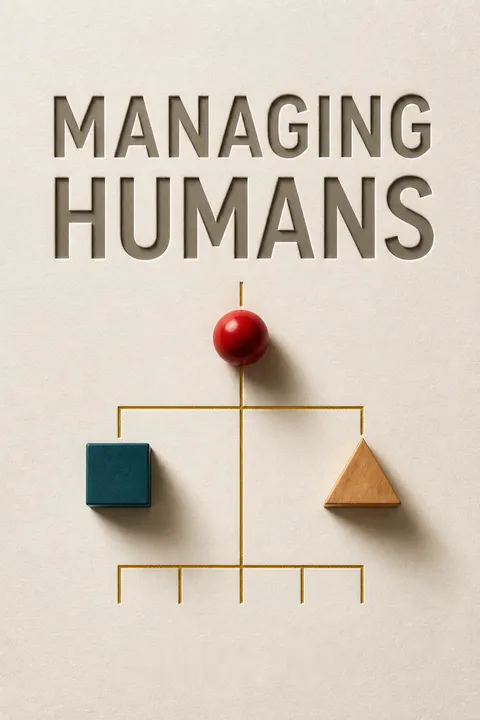
Managing Humans is a practitioner’s book about the invisible work required to make technical teams function. Its stories range from a startup’s fragile first product to awkward one-on-ones, stalled meetings, and an employee quietly deciding to leave. The recurring argument is that management is not a title or a set of grand pronouncements. It is the work of noticing people, routing information, clarifying ownership, and making decisions that help others build.
The book’s strength is its attention to ordinary moments with outsized consequences. A canceled check-in, a vague executive update, or a meeting without a decision can change how people interpret the whole organization. Its named concepts, such as Stables and Volatiles or the Twinge, give managers memorable handles for patterns that otherwise remain hard to discuss. The advice is especially useful in software organizations, where technical work is interdependent and the people doing it may experience process as either necessary coordination or needless interference.
Its limits follow from the same source. These are experience-based models, not universal laws or validated diagnostic instruments. Labels can clarify behavior, but they can also flatten a person into a type. The book’s Silicon Valley setting assumes access to managers, hiring, and career mobility that many workers do not have. It also sometimes celebrates intense work styles that deserve scrutiny rather than imitation. The most reliable reading is therefore neither literal nor dismissive: use the stories to ask better questions, then test the advice against the team’s circumstances.
Taken together, the book offers a distinctive theory of leadership as attention under conditions of complexity. The manager cannot know everything, but can create channels that expose what matters: regular conversations, explicit decisions, explainable process, and honest updates. The aim is not a frictionless workplace. It is a team where disagreement produces learning, urgency does not erase judgment, and people understand how their work connects to the larger effort.
Review Summary
Managing Humans receives mixed reviews, with an average rating of 3.93/5. Readers appreciate its insightful advice on managing software engineers and its entertaining writing style. Many find it helpful for new managers and relatable for those in tech. However, some criticize its reliance on stereotypes and outdated perspectives. The book's structure as a collection of blog posts is both praised for readability and criticized for lack of cohesion. While some readers highly recommend it, others find it less applicable outside Silicon Valley or for non-stereotypical engineers.
People Also Read









Glossary
Rands Test
Team health checklistAn 11-question diagnostic for assessing communication, strategic understanding, business context, career development, and trust within a team or company. It asks about practices such as regular one-on-ones, the ability to disagree with a boss, and whether employees understand the business. The score is meant to reveal areas to investigate, not to serve as a precise measurement.
Stables and Volatiles
Execution and disruption stylesTwo broad engineering tendencies that often conflict inside a growing company. Stables value coordination, reliability, and risk management; Volatiles favor autonomy, experimentation, and challenging established plans. The terms describe useful but incomplete tendencies, not permanent personality categories. A healthy organization needs both dependable execution and people willing to question whether the current product or process is still adequate.
Twinge
Experience-based warning signalA manager’s intuitive sense that a story, plan, or report does not quite add up. The feeling may come from recognizing a familiar pattern without immediately knowing which details triggered it. A Twinge is not proof that a plan is wrong. It is a cue to ask specific questions, check assumptions, and look for missing dependencies before accepting the story.
The Soak
Deliberate problem incubationA way of thinking through a difficult problem by first gathering information, testing an understanding through conversation or writing, and then stepping away. During the pause, the mind can continue combining the material without deliberate attention. The Soak is intended to help produce a considered response or original idea, not to justify indefinite delay.
Trickle theory
Progress through small startsA technique for approaching a task that feels impossibly large or difficult. Instead of estimating the entire burden and becoming immobilized, begin with one small unit of work, then continue and adjust the method as experience accumulates. The first unit may reveal that the estimate was wrong or that the work needs a different approach.
Incrementalists and Completionists
Progress and completeness tendenciesTwo contrasting approaches to solving problems. Incrementalists emphasize achievable progress within current constraints, sometimes at the expense of a complete solution. Completionists seek a thorough, durable answer, sometimes without a practical path to deliver it. Their disagreement can improve a product when a manager helps them understand each other’s needs and turn competing insights into action.
Bellwethers
Trusted interview assessorsA small group of interviewers whose judgment is especially trusted for particular dimensions of a candidate. The book describes technical, cultural, and strategic or tactical perspectives. Bellwethers supplement broader team input; they do not eliminate hiring uncertainty or replace the hiring manager’s responsibility for the decision.
The Ninety-Day Interview
New-job discovery periodThe idea that a person’s interview for a new job continues after hiring, through roughly the first three months. During this time, the newcomer learns colleagues’ stories, routines, language, and decision practices, while the team learns how the newcomer works. The period is for building context and testing fit, not simply proving competence as quickly as possible.
Shields down
Openness to leavingThe moment an employee becomes receptive to considering a different job or future. An external opportunity may prompt the moment, but the employee’s judgment is shaped by what they value at work and whether recent experiences support or violate those values. Examining when the person’s “shields” lowered can reveal earlier problems that a resignation conversation alone may not explain.
FAQ
What's Managing Humans about?
- Focus on Management: Managing Humans by Michael Lopp delves into the complexities of managing software engineering teams, blending humor with real-life experiences to offer leadership insights.
- Semi-Fictional Stories: The book uses narratives inspired by Lopp's experiences at companies like Apple and Pinterest, illustrating management concepts through relatable characters and situations.
- Human-Centric Approach: Lopp stresses the importance of understanding and connecting with team members, emphasizing that successful management involves addressing the unique needs of individuals.
Why should I read Managing Humans?
- Practical Insights: The book provides actionable advice for both new and experienced managers, aiding them in navigating the challenges of leading technical teams.
- Engaging Style: Lopp's humorous and candid writing style makes complex management concepts accessible and enjoyable to read.
- Real-World Applications: Readers can apply lessons from Lopp's experiences to their own management practices, enhancing team dynamics and productivity.
What are the key takeaways of Managing Humans?
- Connection is Key: Great managers must connect with their team members to understand their motivations and needs.
- Embrace Complexity: Lopp encourages managers to embrace the chaotic nature of human interactions and to be flexible in their approaches.
- Communication Matters: Effective communication is crucial for successful management, with strategies provided for improving clarity and understanding within teams.
What are the best quotes from Managing Humans and what do they mean?
- "You must see the people who work with you.": Highlights the importance of recognizing and understanding individual team members to foster a supportive work environment.
- "Better is the enemy of done.": Warns against perfectionism, suggesting that striving for perfection can hinder progress and completion of projects.
- "Management is chess.": Compares management to chess, indicating that it requires strategic thinking and foresight to navigate complex organizational dynamics.
What is the "Rands Test" in Managing Humans?
- Assessment Tool: The Rands Test is a set of 11 questions designed to evaluate the health of a team and the effectiveness of communication within it.
- Focus on Clarity: Questions address whether team members have regular one-on-ones, understand company strategy, and feel comfortable expressing their thoughts.
- Actionable Insights: By answering these questions, managers can identify areas for improvement in team dynamics and communication practices.
How does Lopp define "Stables" and "Volatiles" in Managing Humans?
- Stables: Team members who prefer structure, process, and predictability, contributing to a stable work environment.
- Volatiles: Thrive on risk and disruption, often challenging the status quo and pushing for innovation, which can lead to conflict with Stables.
- Balancing Act: Both types are essential for a healthy team dynamic, and managers should encourage a balance between stability and innovation.
What is the significance of "The Hotel Giraffe" metaphor in Managing Humans?
- Unexpected Situations: Illustrates the absurdity of unexpected challenges in management, emphasizing the need for adaptability.
- Self-Reflection: Encourages managers to reflect on their stress levels and how they handle unexpected challenges.
- Awareness of Stress: The giraffe symbolizes the importance of recognizing when stress affects performance and addressing it proactively.
What does Lopp mean by "Management via Worry and Crisis"?
- Worry Management: Refers to managers who react to potential problems with excessive concern, leading to unproductive meetings.
- Crisis Management: Describes managers who thrive in crisis situations, using them to demonstrate their value, but warns against relying solely on crises for motivation.
- Balanced Approach: Advocates for a balanced approach where managers can be proactive rather than reactive, fostering a healthier work environment.
How does Lopp suggest handling "Information Starvation"?
- Information Conduit: Managers should act as conduits for information, ensuring team members receive necessary updates and context.
- Preventing Rumors: Open communication prevents the spread of rumors and misinformation arising from a lack of clarity.
- Regular Check-Ins: Emphasizes the importance of regular check-ins and updates to keep the team informed and engaged.
What is the "soak" method in Managing Humans?
- Definition of Soaking: Involves allowing your mind to ponder a problem over time, rather than rushing to a solution, leading to more creative outcomes.
- Active and Passive Soaking: Active soaking involves gathering information, while passive soaking lets your mind wander and make connections.
- Encouraging Original Thought: Aims to foster original thought and strategic decision-making by transforming emotional reactions into well-considered responses.
What is the "Nerd Attention Deficiency Disorder" (NADD) in Managing Humans?
- Definition of NADD: A humorous term describing the tendency of nerds to juggle multiple tasks and distractions simultaneously.
- Characteristics of NADD: Individuals thrive on rapid-fire content and multitasking, which can lead to both productivity and chaos.
- Managing NADD: Emphasizes creating environments that allow for focused work and occasional chaos, supporting team members effectively.
What are "incrementalists" and "completionists" in Managing Humans?
- Incrementalists: Focus on making steady progress and achieving short-term goals, prioritizing getting things done over perfection.
- Completionists: Strive for perfection and long-term solutions, driven by the desire to do things right, resisting quick fixes.
- Balancing Both Types: Having both types on a team leads to more effective problem-solving and innovation when managed well.
Download PDF
Download EPUB
.epub digital book format is ideal for reading ebooks on phones, tablets, and e-readers.








