

Key Takeaways
Read San Pedro as a city where prison life had a price tag
Incarceration had an entrance fee. New arrivals paid the police to enter, then paid again to join a section and acquire a cell. Inmates bought, sold, rented, and mortgaged rooms through a system with titles, agents, and transfer fees. The prison was not simply a place where the state housed people. It was a crowded neighborhood whose residents had to provide much of their own shelter, food, and services.
Money bought different realities. Thomas first slept in a sewage-soaked building because he could not afford a room. Later, he bought a comfortable cell in Pinos. Both experiences happened inside the same prison, where the state supplied little and access to safety depended heavily on cash, family support, and connections.
San Pedro makes institutional economics visible at human scale: when public provision collapses, people build markets to meet essential needs. Those markets can be resourceful, but they also turn basic safety into a commodity. A cell title may create order where the state offers none, yet it cannot make the system fair. The same mechanism that lets an inmate purchase a room leaves poorer prisoners exposed to cold and danger. The story is strongest when it shows both ingenuity and the cost of replacing public responsibility with private purchasing power.
When law is for sale, innocence becomes another negotiable commodity
Corruption made rules unpredictable. Thomas was arrested at the airport with cocaine and sentenced for trafficking. In prison, he learned that officials could accept bribes, ignore rules, or enforce them when convenient. His later case was different: cocaine was found in the Velascos’ room, but Thomas was outside and had no drugs or money on him. He was nevertheless accused of involvement, and his opponents claimed they had been police informants.
Justice carried a price. Lawyers promised release, judges were approached with bribes, and hearings dragged on. The first case brought Thomas a six-year, eight-month sentence despite payments intended to secure acquittal. The later charge threatened to extend his incarceration, even though he maintained that he was innocent of that offense. His story separates guilt for one crime from the right to a fair process in another.
The distinction between culpability and due process matters here. Thomas is not an innocent man swept into prison by mistake: he trafficked cocaine. But guilt in one case does not make evidence, procedure, or protection from abuse irrelevant in another. Corruption also creates a market in uncertainty, where paying an official may seem like the only rational move while offering no reliable result. The account invites skepticism toward simple moral sorting: a person can be both a criminal and a victim of an unjust system.
Survive by finding people who offer help without owning you
Kindness kept Thomas alive. After thirteen days in an interrogation cell with little food, no warmth, and a worsening infection, he entered San Pedro nearly collapsed. Sylvia Venables, an English church worker, brought food, clothes, a blanket, and antibiotics. Ricardo, a prisoner, then gave Thomas a place to sleep, fed him, and taught him how to navigate the prison. Without those interventions, Thomas believed he would have died.
Connection was not always rescue. Ricardo became a close friend, while Thomas’s intense relationship with Yasheeda briefly made prison life feel almost ordinary. When she left, his loneliness deepened into depression and heavy use of sleeping pills. Tourists later offered companionship without the old expectation that Thomas provide money or status. These bonds gave him reasons to endure, even when none could remove the prison walls.
The book treats care as practical infrastructure, not sentiment. A meal, medicine, or trustworthy guide can matter more immediately than an abstract promise of reform. Social connection also restores identity: Thomas is treated as a person with a story, not just a prisoner or trafficker. Yet care cannot substitute for institutions. Sylvia and Ricardo could help one man, but they could not repair the medical neglect or material deprivation that put him at risk. The account honors mutual aid while making clear how much responsibility had been pushed onto individuals.
Money changes the sentence before a judge ever speaks
Sections ranked people by wealth. Posta, the most privileged area, held politicians and wealthy inmates in rooms compared to hotel suites. Pinos and Alamos offered relative comfort and safer courtyards. In the poorer inner sections, several people could share a cramped room, while some slept in passageways or outdoors. Thomas chose his cell partly for safety, a choice unavailable to inmates with little money.
Families lived with the punishment. Women and children stayed inside San Pedro because many families could not afford housing or support on the outside. Children went to school beyond the prison gates and returned to a place designed for confinement. Their presence brought play and family life into the courtyards, but also exposed them to danger. The prison’s inequalities shaped not only inmates’ daily lives but the choices and risks faced by their relatives.
This is a portrait of stratified punishment: confinement is formally shared, but its conditions are not. Wealth buys distance from crowding and violence, while poverty makes family separation or exposure to prison life more likely. The arrangement resembles broader systems in which nominally equal rules produce sharply unequal outcomes because people enter with different resources. The presence of families complicates any tidy boundary between punishment and private life. Still, the narrative gives limited space to the families’ own perspectives, a reminder that their experience is not fully captured through Thomas’s account.
A prison that rewards criminal expertise becomes a criminal school
San Pedro ran on inmate labor. Prisoners operated shops, restaurants, repair services, and medical facilities because the administration provided little. Alongside these ordinary businesses, drug production and trafficking continued. Thomas calls the institution the “International University of Cocaine,” a metaphor for a place where convicted traffickers could exchange skills, contacts, and commercial knowledge while still inside.
The criminal economy was part of daily life. Thomas worked in a laboratory, ran a shop and restaurant, and built a tourist business. These roles gave him income and purpose, but also tied him to the same illicit network that had brought him to prison. Police accepted payments and sometimes participated in the system. The boundary between official authority and criminal enterprise was often difficult to see.
The prison challenges the idea that confinement automatically interrupts criminal activity. If people retain networks, expertise, and access to buyers, incarceration may reorganize a criminal enterprise rather than dismantle it. At the same time, San Pedro’s ordinary businesses show why blanket descriptions of inmates as criminals miss the work of keeping a community alive. The useful question is not simply whether prison punishes, but what capabilities and incentives it creates. Here, survival skills and illicit skills coexist, sometimes in the same person.
Treat addiction as a changing bargain, not a single bad choice
Cocaine began as pleasure and belonging. Thomas first tried it at a prison celebration, surrounded by friends and encouraged to join in. He liked the euphoria and confidence, then used it repeatedly. Parties became a routine, and cocaine helped him avoid thinking about isolation, stalled court proceedings, and the loss of relationships.
The bargain grew more costly. Thomas later described sinus problems, headaches, and difficulty sleeping. Mike’s heavy use contributed to paranoia: convinced that his girlfriend was hidden in Thomas’s room, he searched the place with a knife. Thomas also misused sleeping pills during a period of depression. He eventually tried to stop cocaine with a doctor’s support, but a friend broke their agreement to quit. The book shows repeated choice, while also showing how dependence can narrow what feels possible.
The changing bargain is a useful model of addiction: an immediate reward can become a tool for coping, then a source of new distress. Social context matters because Thomas’s first use was wrapped in celebration and acceptance, while later use filled lonely hours. That context does not erase agency, and the narrative does not claim that every user follows the same path. It does, however, resist the idea that information alone prevents dependence. Understanding what a drug is doing for someone may be essential to understanding why stopping is difficult.
Tourism can create income while turning suffering into entertainment
Thomas’s tours became a livelihood. Backpackers came to see San Pedro, hear his story, and learn how the prison operated. He charged for tours, shared proceeds with guards and gang members, and directed visitors toward inmate businesses. The tours brought money into an impoverished prison economy and gave Thomas a role that depended on his storytelling rather than dealing drugs.
The attraction had an uneasy edge. Visitors were fascinated by family life, prison cells, and the reality of incarceration. Some also came to take cocaine or stay overnight. Inmates could resent being treated as exhibits, while the guards profited from access. The same tour could offer Thomas companionship and income while packaging other people’s hardship as an adventure for travelers.
The tours expose a familiar ethical tension in dark tourism: witnessing can generate understanding and material support, but spectacle can turn suffering into a consumer experience. Thomas’s account suggests that visitors did not only take; their money helped local businesses and their attention made him feel seen. Neither fact settles the ethical question. The key distinction is whether visitors encounter people as agents with complex lives or as scenery for an unusual trip. San Pedro refuses an easy verdict because the same transaction could provide dignity, income, risk, and exploitation.
Do not confuse vengeance with justice, even when the crowd agrees
Violence filled the gaps left by authority. After three men accused of gang rape were brought into San Pedro, inmates attacked them at the prison pool; two died. Thomas was horrified, but the crowd’s anger made intervention dangerous. Later, a six-year-old girl living in the prison was raped and murdered. The event shocked the community and prompted new safeguards for children, but it could not undo the harm.
Corruption brought more violence. Thomas’s friend Samir threatened to expose police involvement in car thefts. According to the account, police tortured and killed him, then made his death look like suicide. These episodes show a prison where punishment could be imposed by mobs, gangs, or officials, with little reliable protection for anyone.
The narrative distinguishes public outrage from justice. The inmates’ fury at rapists may be understandable, but a crowd’s moral certainty does not supply evidence, proportionality, or a fair process. Nor does this make official violence less grave. The killings described here point to a system in which institutions fail to protect victims and then violence claims authority in their place. The account is emotionally forceful, though its perspective is primarily Thomas’s; readers should recognize that a memoir of events is not the same as an independent investigation into every allegation.
Keep hold of ordinary decency when every incentive rewards betrayal
One choice changed how Thomas saw himself. Jerome, an Australian visitor, lost his wallet after entering the prison with a group. Thomas’s bodyguards found the suspected thief and pressured him to return it. Thomas had little money himself and others urged him to keep the cash, but he returned the wallet intact, including its thousand bolivianos. The decision was difficult precisely because the money could have helped him.
The relationships reshaped his priorities. Thomas had once treated trafficking as a game and measured people by their usefulness. The tourists who visited him offered friendship without asking for money or influence. Their trust helped him value freedom and imagine a life outside trafficking. It did not erase his past, but it gave him a reason to try to live differently.
The wallet episode gives moral change a concrete test. Decency is not merely a new self-description; it appears when keeping the money would be easy and useful. The scene also shows how moral habits can be socially supported. Jerome’s trust, the tourists’ visits, and Thomas’s growing reputation made honesty imaginable and consequential. Still, a single generous act cannot prove a full transformation. Its importance lies in the direction it points: away from status and extraction, toward relationships that do not depend on what Thomas can sell.
After four years, eight months, acquittal freed Thomas, not Bolivia’s system
The second case nearly extended his sentence. The Velascos claimed that they had worked with police to catch Thomas dealing drugs. Their story weakened after Thomas exposed inconsistencies in their statements, but a police colonel testified for them. Rusty, the Australian who had come to record Thomas’s story, tried to help him raise money for the judges. They could not assemble the full amount demanded.
The ending was freedom, not repair. The judges found Thomas innocent of the new charges, and he was released on December 28, 2000, after serving four years and eight months of his original sentence. He left without paying the remaining bribe. The prison tours continued under another guide, and the government continued to deny that inmates had to buy their cells. Thomas left with gratitude for his friends, a promise to abandon trafficking, and no simple plan for life outside.
The ending offers personal release without institutional resolution. Thomas gets out, but the arrangements that made prison life a marketplace remain in place, as do official denials and the tours. This distinction matters in stories of survival: an individual’s escape can be real and hard won while the underlying machinery continues. Thomas’s promise to leave trafficking behind also carries uncertainty. Freedom supplies an opening, not a guarantee of reintegration. The book closes on hope grounded in relationships, while refusing to present acquittal as proof that justice has been restored.
Analysis
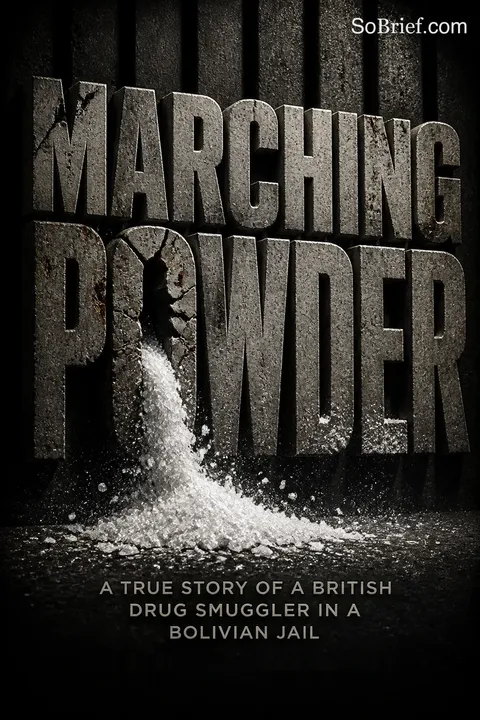
Marching Powder is a true-crime narrative built around a striking contradiction: Thomas McFadden is both a convicted trafficker and a witness to a prison system where corruption, commerce, and family life coexist behind one set of gates. Rusty Young frames the account through his own risky decision to enter San Pedro and record Thomas’s story. The result moves from airport arrest to survival, entrepreneurial success, addiction, bereavement, a second prosecution, and release. Its momentum comes less from a single mystery than from repeated reversals: a prison that first appears almost comfortable becomes dangerous; a corrupt arrangement that enables survival can also expose a prisoner to betrayal.
The book’s central achievement is to make institutional failure tangible. Entry fees, cell titles, bribes, private businesses, and family households show how the prison’s residents fill gaps left by the state. These adaptations are not simply admirable improvisation. They reproduce inequality, reward criminal networks, and make basic protection dependent on money and influence. Thomas’s trajectory illustrates how competence can be morally ambiguous: the skills that help him earn a place and protect visitors also keep him embedded in the drug economy.
The narrative also resists a clean division between decent people and criminals. Ricardo, Sylvia, Jerome, and the tourists show that generosity can emerge inside a deeply compromised environment. Thomas’s own conduct remains mixed: he traffics, uses cocaine, profits from prison tourism, and later makes a choice to return a stolen wallet. That complexity makes his gradual desire to change more credible than a simple redemption story.
Readers should remember the limits of the account. The events are presented through Thomas’s retrospective testimony, shaped by Rusty’s narrative reconstruction. The book includes severe allegations about officials and prisoners, but this text alone does not independently verify each one. Its vividness is not equivalent to comprehensive documentation. Even so, the larger portrait is coherent: San Pedro did not merely contain criminal life. It organized daily survival around the same markets, hierarchies, and compromised loyalties that had helped produce the crisis in the first place. Personal freedom arrives, but systemic repair does not.
Review Summary
Marching Powder receives mixed reviews, with an overall rating of 4.31/5. Many readers find the story of Thomas McFadden's experiences in Bolivia's San Pedro prison fascinating and unbelievable. They praise the book's insight into prison corruption and drug culture. However, some criticize the writing quality and question the narrator's reliability. Critics note McFadden's lack of remorse for drug trafficking and express skepticism about some of his claims. Despite these concerns, most readers find the book captivating and eye-opening.
People Also Read









Glossary
el Ingreso
prison entry feeThe payment required of a new prisoner to enter San Pedro. Thomas is first told that he must pay the police, and later learns that the charge is a standard fee rather than a one-time demand aimed only at him. It was only the first of several payments required to secure a place in the prison.
Law 1008
Bolivian drug lawThe Bolivian law under which Thomas is charged for cocaine trafficking. In the book, inmates describe it as a major driver of prison overcrowding, arguing that it brings many people accused of drug offenses into San Pedro. The account also presents drug cases as vulnerable to long delays, weak protections, and corruption.
Extra Muro
sentence reduction lawA Bolivian law introduced during Thomas’s imprisonment that halved the sentences of many prisoners in the overcrowded penitentiary system. It made some inmates eligible for early or immediate release. Thomas had served enough time to benefit from it, but new charges kept him in prison while his second case proceeded.
requisa
police prison searchA search of prisoners’ rooms conducted by police, sometimes without warning. In San Pedro, inmates feared that officers might plant drugs or demand money during a requisa. Searches also served as public displays of enforcement, even though contraband could later return through the same corrupt system.
La Grulla
solitary punishment sectionSan Pedro’s solitary confinement section, used to punish prisoners and hold people considered difficult or dangerous to control. Inmates spent most of each day locked in small, dark cells and faced severe limits on food, communication, and contact. Thomas describes its conditions as physically punishing and psychologically isolating.
International University of Cocaine
prison’s criminal training groundThomas’s metaphor for San Pedro as a place where experienced traffickers could continue criminal work, exchange knowledge, and use prison networks. It points to the contradiction between incarceration and ongoing criminal activity. The phrase captures the book’s argument that the prison could preserve and develop criminal expertise rather than interrupt it.
Posta
wealthiest prison sectionSan Pedro’s most privileged section, described as a separate, highly protected area where wealthy inmates and politicians lived in unusually comfortable rooms. Access to better facilities, police favors, and outside contact depended on money and influence. Posta stands in sharp contrast to poorer sections where inmates endured overcrowding and unsafe conditions.
FAQ
What is Marching Powder by Rusty Young about?
- True story of imprisonment: The book tells the real-life story of Thomas McFadden, a British drug trafficker imprisoned in Bolivia’s notorious San Pedro prison.
- Inside San Pedro prison: It explores the bizarre, corrupt, and self-governing world inside the prison, where inmates buy their own cells, run businesses, and even host tourists.
- Themes of survival and humanity: The narrative delves into themes of survival, corruption, friendship, and the drug trade, highlighting the resilience and dignity of inmates in harsh conditions.
- Author’s immersive approach: Rusty Young, the author, voluntarily lived inside the prison for months to document Thomas’s story, blending firsthand observation with Thomas’s personal account.
Why should I read Marching Powder by Rusty Young?
- Unprecedented prison insight: The book offers a unique, insider’s look at one of the world’s most unusual prisons, challenging common perceptions of incarceration.
- Gripping true narrative: Thomas McFadden’s journey is filled with danger, humor, and humanity, making the story both educational and entertaining.
- Broader social commentary: It provides critical insights into the global drug trade, US anti-drug policies, and their impact on Bolivia, appealing to readers interested in social justice and Latin American culture.
- Authentic storytelling: Rusty Young’s immersive research and close relationship with Thomas add depth and authenticity to the narrative.
What are the key takeaways from Marching Powder by Rusty Young?
- Prison as a microcosm: San Pedro prison operates like a small city, with its own economy, social classes, and political systems, reflecting broader societal issues.
- Corruption and survival: Corruption is rampant at every level, and survival depends on navigating bribes, alliances, and the prison’s unique rules.
- Human resilience: Despite harsh conditions, inmates display remarkable resilience, forming friendships and adapting to their environment.
- Complex justice system: The book exposes the flaws and complexities of Bolivia’s legal and penal systems, showing how justice, crime, and survival intertwine.
How does the San Pedro prison system work according to Marching Powder by Rusty Young?
- Buying cells and property: Inmates must pay an entrance fee and purchase legal title to their cells, creating a real estate market within the prison.
- Economic microcosm: The prison functions as a self-contained city, with inmates running shops, restaurants, and even cocaine labs.
- Family life inside: Women and children often live with inmates, creating a unique social environment with schools and markets inside the prison.
- Corruption and hierarchy: Guards and officials are deeply corrupt, and powerful gangs enforce order, often violently.
How is cocaine produced and distributed inside San Pedro prison in Marching Powder by Rusty Young?
- In-prison cocaine labs: Inmates manufacture cocaine using basic equipment in their cells, with production typically happening at night to avoid detection.
- Distribution networks: Cocaine is smuggled in and out of the prison, often by wives, children, or mules, and sold both inside and outside the prison.
- Police involvement: Corrupt police facilitate the drug trade, taking bribes and sometimes participating directly in trafficking.
- Addiction and impact: The widespread availability of drugs leads to addiction, violence, and social decay among inmates.
How does Thomas McFadden become a tour guide in San Pedro prison in Marching Powder by Rusty Young?
- Origin of the tours: Thomas’s first tour was inspired by Israeli backpackers brought by his girlfriend, leading him to start showing tourists around the prison.
- Navigating rules and bribes: He used humor, bribes, and invented stories to get foreign visitors admitted, becoming known as "Thomas the tour guide."
- Business and protection: By partnering with gang leaders and bribing police, Thomas ran tours safely, earning money and influence.
- Unique attraction: The tours became a popular and bizarre tourist attraction, offering outsiders a rare glimpse into prison life.
What challenges and dangers does Thomas McFadden face during his trial and imprisonment in Marching Powder by Rusty Young?
- Corrupt legal system: Thomas’s trial is repeatedly delayed, and bribery is common among judges and officials, resulting in a harsh sentence despite his efforts.
- Betrayal and violence: He is betrayed by fellow inmates, endures solitary confinement, and faces threats from gangs and corrupt authorities.
- Harsh living conditions: Thomas suffers from cold, hunger, disease, and lack of medical care, especially during his time in solitary confinement.
- Emotional struggles: He battles loneliness, addiction, and the loss of friends, with his relationship with Yasheeda strained by prison life.
Who are Ricardo and other key figures in Marching Powder by Rusty Young, and what roles do they play?
- Ricardo as mentor: Ricardo, a Bolivian inmate, befriends and protects Thomas, teaching him the prison’s social rules and helping him survive.
- Rusty Young’s involvement: The author becomes Thomas’s confidant and ghostwriter, living inside the prison to document his story.
- Fat Joe and the Mormon Church: Fat Joe, a Mormon missionary, tries to convert Thomas and establish a church inside the prison, but the effort fails.
- Other inmates and officials: Figures like Abregon, Samir, and the governor (Colonel Montesinos) play crucial roles in Thomas’s survival, business ventures, and navigation of prison politics.
How does Marching Powder by Rusty Young portray the relationship between inmates and the police in San Pedro prison?
- Systemic corruption: Police officers are deeply involved in the prison economy, taking bribes from inmates and tourists and facilitating illegal activities.
- Power struggles: Guards and officials compete for control and profit, leading to frequent reshuffles and instability.
- Violence and intimidation: Police use torture, beatings, and solitary confinement to maintain order and punish inmates.
- Manipulation of justice: Police manipulate trials and investigations to serve their own interests, making justice elusive for inmates.
What is the significance of the San Pedro prison tours in Marching Powder by Rusty Young?
- Unique tourist attraction: The tours offer outsiders a rare and shocking glimpse into a functioning prison society, becoming a major draw for adventurous travelers.
- Economic impact: Tours bring much-needed money into the prison economy, benefiting guards, inmates, and local businesses.
- Cultural exchange: The tours foster friendships and connections between inmates and foreigners, providing companionship and hope for prisoners.
- Exposure of contradictions: The tours highlight the bizarre contradictions of prison life, where crime, commerce, and tourism coexist.
How does Marching Powder by Rusty Young end, and what happens to Thomas McFadden after his release?
- Acquittal and release: After a lengthy trial and multiple bribery attempts, Thomas is found innocent of new charges and released after nearly five years.
- Emotional farewell: He says goodbye to friends like Ricardo and Rusty, feeling both relief and sadness as he leaves San Pedro.
- Vow for a new life: Thomas promises to quit trafficking and start anew, reflecting on the lessons learned during his imprisonment.
- Ongoing legacy: The prison tours continue under new leadership, and the book leaves a lasting impact by highlighting the complexities of justice and survival in Bolivia.
What are the best quotes from Marching Powder by Rusty Young and what do they mean?
- On prison society: “San Pedro is a society within a society, a city within a city.” This quote captures the self-contained, complex world of the prison.
- On corruption: “In San Pedro, everything has a price.” This highlights the pervasive corruption and the role of money in survival.
- On resilience: “You have to learn to live with the madness, or it will eat you alive.” This reflects the psychological challenges inmates face.
- On friendship: “Ricardo was more than a friend; he was my family.” This underscores the importance of human connection in the harshest environments.
Download PDF
Download EPUB
.epub digital book format is ideal for reading ebooks on phones, tablets, and e-readers.








