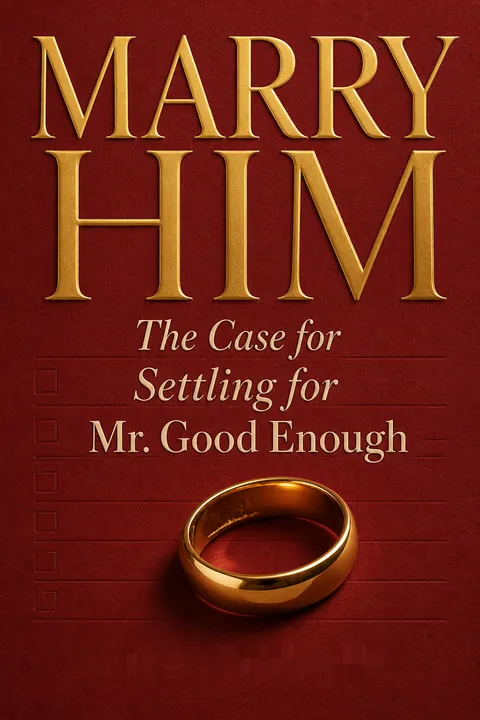


Key Takeaways
Choose a life-building partner, not a flawless résumé
A list can become a trap. The book opens with a joke about a store where every floor offers a more qualified husband, until the final floor is empty. The author recognizes herself in the shopper: her imagined partner must be funny, successful, kind, handsome, emotionally steady, and dozens of other things. Each disappointing relationship adds another requirement. At 39, a single mother, she sees that the married friends whose spouses seemed less than ideal were often happy with the life they built together.
Good enough is not resigned. The argument is not to marry someone unsafe, unkind, or fundamentally incompatible. It is to stop confusing compromise on preferences with surrendering core needs. The book asks readers to judge a potential partner by the daily life they could create together, not by how closely he resembles a fantasy assembled from romance stories and past disappointments.
What's striking is how the shopping metaphor turns attention back on the chooser. A partner is not a product whose quality can be assessed independently of the relationship; the same person may bring out patience, humor, or friction depending on the pairing. The useful correction is not simply to lower standards, but to ask which standards predict a livable shared life. That distinction protects the argument from becoming a defense of tolerating neglect or incompatibility. The store joke is memorable because the problem is not wanting a good partner. It is treating the search as if every desirable quality can be added without narrowing the pool or creating trade-offs.
Separate genuine deal-breakers from details that merely decorate your fantasy
Preferences accumulate quietly. The author describes rejecting men for traits as small as red hair, a favorite word, or an unfamiliar movie reference. Friends she interviews recall passing on men for baldness, awkward clothes, or a lack of flowers, then realizing those men had been kind, dependable, and loving. The list often expands by accretion: one boyfriend lacked a quality, so the next must have it, while retaining every old requirement.
Prioritize character and fit. Matchmaker Rachel Greenwald distinguishes visible, measurable traits, such as height or job, from qualities that shape a relationship, such as maturity, kindness, and capacity to commit. A workable screen protects essentials while leaving room for variation. The book's examples do not make appearance, religion, children, or money irrelevant. They ask whether each criterion is truly necessary for the life someone wants, or simply familiar from an old image of an ideal partner.
This distinction resembles a useful form of decision hygiene: separate evidence about likely behavior from signals that are easy to notice but weakly connected to the outcome. A polished profile or impressive title can feel predictive while revealing little about how someone handles conflict or responsibility. Still, a preference is not automatically shallow because it is hard to justify on paper. Attraction and cultural fit matter to some people, and no outsider can rank those priorities for them. The strongest use of the framework is therefore diagnostic, not prescriptive: scrutinize a rejection reason, then decide whether it protects a genuine need or merely preserves a familiar fantasy.
Ask why you want a trait before turning it into a requirement
Translate traits into needs. Social psychologist Eli Finkel's example in the book is that someone may say they want a lawyer, when what they actually value is intellectual curiosity or financial stability. Those underlying qualities might appear in someone with a different occupation. The author and dating coach Evan Marc Katz test her own long list by estimating how many men fit all her requirements. Their rough calculation leaves about 0.1 percent of local men as possible matches. It is an illustration of how filters multiply, not a scientific estimate.
Profiles invite false certainty. Behavioral economist Dan Ariely argues that detailed dating profiles can make compatibility seem measurable before two people meet. More listed traits create more opportunities to find a mismatch, while juggling many online conversations can leave little attention for any one person. Looking for the reason behind a preference makes the search less dependent on proxies and helps distinguish useful information from an appealing-looking checklist.
The what-versus-why distinction is a general tool for escaping proxy measures. A job title, shared hobby, or school may stand in for security, curiosity, or common values, but the proxy can be wrong. The reverse is also possible: a shared hobby can be meaningful in its own right, not merely a symbol of deeper compatibility. The book's arithmetic makes the cost of accumulated filters vivid, though its percentage estimates are deliberately rough and cannot forecast any individual's prospects. Its sharper lesson is to test assumptions through conversation and experience instead of treating profile categories as a complete picture of a person.
Treat early dates as introductions, not final exams
First impressions are thin evidence. The author once ruled men out because they seemed boring, lacked immediate chemistry, or did not match her type. But stories in the book show how little an awkward first meeting can reveal. Julie initially ignored a nurse who called to ask her out. When they later spent time together with colleagues, conversation flowed, and they eventually married. Another couple, Tracey and Phil, found each other unremarkable at first, then developed attraction through phone calls and repeated visits.
Give neutral a second look. Relationship researcher Diane Holmberg found that couples' accounts of how they met changed as their marriages changed: happier couples recalled the beginning more positively, while less happy couples did the opposite. A first date is not a reliable verdict on a future marriage. If the interaction is neutral and there is basic respect, another date can reveal more. A strong negative signal, such as cruelty or alarming behavior, is different from ordinary nerves or a quiet conversation.
The key is to distinguish uncertainty from evidence of danger. A low-key date may reflect nerves, unfamiliarity, or simply a slow start; it does not establish incompatibility. At the same time, repeated meetings should not become a duty imposed on someone who feels no attraction or does not feel safe. The book's case for patience is strongest when it concerns weak signals, not clear violations of boundaries. Its examples also highlight a broader problem with snap judgments: people are often better at evaluating a developing interaction than predicting a whole relationship from a brief performance.
Stop maximizing the dating pool and start noticing good-enough fit
More options can deepen doubt. Psychologist Barry Schwartz calls people who keep searching for the best possible option maximizers, while satisficers choose once an option meets their important criteria. The book illustrates the difference with sweater shopping: one shopper finds a sweater that fits her needs and buys it; another keeps searching for a marginal improvement and may end up with nothing, or with a purchase she cannot enjoy because she is still comparing.
A partner is not a perfect score. In dating, a maximizer may keep asking whether someone better will appear, even when the current relationship is kind and compatible. The author connects this habit to regret and second-guessing. The alternative is not to accept anyone available. It is to define the conditions that matter, notice when they are met, and stop treating every unchosen possibility as proof that the choice was wrong.
The framework helps explain why abundance can feel less like freedom than permanent audition. When every choice is compared with an imagined alternative, attention shifts from the actual relationship to its opportunity cost. Yet choosing early is not automatically wise: staying with a poor match to avoid uncertainty can be as damaging as endlessly searching. The practical question is whether additional information could change a decision, or whether comparison has become a way to avoid making one. That question keeps satisficing from collapsing into passivity and keeps high standards compatible with a stopping point.
Let steady connection count, even when the first rush is absent
Chemistry can distort judgment. The book describes intense early infatuation as activating the brain's reward system, with dopamine associated with longing and preoccupation. Anthropologist Helen Fisher's research, as presented here, suggests that this anxious high often changes over time, while long-lasting love can involve greater calm. The author recognizes that her strongest rushes often came with uncertainty, obsessive checking, and partners who were unreliable or unavailable.
Look for attraction and compatibility. Dating coach Evan Katz offers a memorable rule of thumb: seek substantial compatibility with a meaningful, but not necessarily overwhelming, level of chemistry. The author experiences this with Sheldon2, a man she initially overlooked because he was shorter, balding, and wore a bow tie. She feels relaxed and interested in seeing him again. The point is not that passion is irrelevant, but that calm interest can grow into attraction, and anxiety is not proof of a good match.
This reframes intensity as one kind of signal, not a certificate of destiny. The distinction matters because anxious anticipation can feel like profound connection while actually reflecting uncertainty about whether the other person will reciprocate. Conversely, early calm may allow people to notice character without the noise of constant reassurance-seeking. The book's neuroscience offers a plausible lens, but brain activity cannot by itself tell someone whether a particular relationship is right. The practical test remains relational: Is there mutual interest, respect, and enough attraction to keep learning about each other?
Choose a teammate by shared goals and repair, not shared hobbies alone
Marriage is a shared project. The author learns to ask what kind of daily life a couple wants, not only whether they enjoy the same films or music. The practical questions include children, money, religion, where to live, and how each person approaches responsibility. Matchmaker Lisa Clampitt ranks relationship goals and values ahead of shared interests because hobbies can be enjoyed separately, while life plans shape the household both people must manage.
Watch how disagreement works. Researcher Jayamala Madathil found similar reported satisfaction among people in arranged marriages and marriages of choice in her study. She describes choosing her husband partly because their values and expectations aligned, then growing to love him as they handled disagreements. The book presents this as a reminder that compatibility can be built through respect and negotiation. Love is not only a feeling that arrives; it is also the repeated practice of care, cooperation, and repair.
The teammate model makes practical compatibility visible before a couple is overwhelmed by shared responsibilities. Agreement on parenting or finances may matter more to a household than matching tastes in books. But treating marriage as a project should not reduce affection to a contract or imply that different life plans can always be negotiated away. The arranged-marriage study, as described, is one comparison in a particular context, not evidence that every arranged union is satisfying. Its useful contribution is narrower: courtship can make values and expectations discussable, rather than leaving them to be discovered through costly conflict.
Widen your filter without pretending age and circumstance do not matter
Timing changes the options. At a speed-dating event for people in their forties and fifties, the author finds fewer men than women, and several participants are outside the advertised age range. The experience makes concrete what she had previously treated as abstract: dating pools and family circumstances change over time. The book cites historical Census figures showing 107 single men per 100 single women among people aged 30 to 44, compared with 72 men per 100 women among those aged 45 to 65. These are population counts from the period discussed, not a forecast for any individual.
Act without panic. The author regrets rejecting potential partners over superficial details, but she does not conclude that anyone should marry under pressure. Her practical advice is to meet people more deliberately, seek help from friends or matchmakers if useful, and focus on people whose goals align. Biological timelines, children, and past relationships can shape dating; they do not determine a person's worth or guarantee a particular outcome.
This is where the book's urgency is both clarifying and risky. Its account of time and limited opportunities encourages readers to stop assuming that every option can be revisited indefinitely. Yet describing dating as a market can turn demographic patterns into personal judgments, especially when women's age and men's preferences are framed as fixed prices. Those numbers also describe a specific time and population. A sound application is to plan actively around real constraints without treating people as depreciating assets or treating marriage as the only respectable life. Urgency can sharpen priorities, but panic usually narrows them.
A better dating process improves your choices, not guarantees your ending
Openness created a real connection. The author eventually dates Sheldon2, the widowed father she almost rejected over his appearance, job, and bow tie. They share humor, values, and an ease she had not expected. The relationship lasts two months, then ends when he decides to move to Chicago to support his son, who had recently lost his mother, and to be closer to family. The author is disappointed, but the experience shows her that she can feel attraction and comfort with someone outside her old template.
A changed filter is not a magic ending. The book's final lesson is practical rather than triumphant: changing how she dates gives her more chances to recognize a promising person, but cannot control timing, family needs, or another person's decision. Her story makes the argument more credible because the new approach does not produce an effortless marriage. It produces a better-informed choice and a genuine relationship, even though that relationship ends.
The ending resists the comforting bargain that better behavior guarantees a partner. A more flexible search can improve the quality of attention and reduce avoidable rejection, but romance remains reciprocal and contingent. Sheldon2's choice places his child's needs ahead of a new relationship, a reminder that compatibility exists inside real obligations, not a fantasy of two people with unlimited time. This nuance strengthens the book's practical claim while limiting its promise: readers can revise their habits, not command outcomes. The meaningful success is learning to recognize a connection without insisting that it prove itself by matching a prefabricated story.
Analysis
The book's central intervention is a shift from evaluating candidates against an imagined ideal to asking what kind of relationship the two people can actually sustain. Its strongest distinction is between a preference and a need. That distinction turns dating advice into a method of inquiry: identify the underlying value behind a desired trait, then test whether the trait is essential or merely one possible route to that value. The narrative makes the method memorable because Gottlieb repeatedly catches herself violating it, especially when a promising man fails a superficial test. The book also corrects a cultural imbalance in the stories people tell about romance. Popular courtship narratives celebrate instant certainty and end at the kiss, leaving the routine work of marriage offstage. Gottlieb redirects attention toward parenting, money, values, domestic labor, and the way partners handle disappointment. Her account of Sheldon2 is especially important: changing her filter leads to connection, but not to a guaranteed marriage. His decision to move for his son's welfare shows that a good match is not an outcome one person can secure by choosing perfectly.
Its limits are equally important. The book centers heterosexual women seeking marriage and often children, and treats dating through gendered assumptions about age, attractiveness, and men's preferences. Its statistics and online dating examples belong to the period in which it was written; they should not be mistaken for universal rules. The market language can clarify that choices have constraints, but it can also imply that people's worth is measurable or that singlehood is a failure to optimize. The most durable reading preserves the book's practical challenge while rejecting that implication: examine your filters, distinguish core compatibility from cosmetic preference, and stay open to surprise, without surrendering autonomy, safety, or the possibility of a meaningful life outside marriage.
Review Summary
Marry Him: The Case for Settling for Mr. Good Enough receives mixed reviews. Some readers find it insightful, challenging unrealistic expectations in relationships and encouraging focus on important qualities. Others criticize it as repetitive, sexist, and promoting settling. The book explores why some women remain single into their 40s, suggesting they're too picky. It advises women to prioritize compatibility over superficial traits and to consider "good enough" partners. While some appreciate its candid approach, others find it frustrating and outdated. The book's controversial title and premise spark debate among readers.
People Also Read






Glossary
good enough marriage
A workable, imperfect marriageA marriage that is neither ideal nor deeply unhappy, but offers companionship, cooperation, and a shared life. Sociologist Paul Amato uses the term for relationships that may seem satisfactory while still containing limitations. The book argues that such marriages can be strengthened through effort and commitment, and that dissatisfaction alone does not prove a partner is wrong.
maximizers and satisficers
Two ways of choosingBarry Schwartz's terms for different decision styles. Maximizers keep searching for the best possible option and may remain dissatisfied or regretful even after choosing. Satisficers set meaningful criteria and stop searching when an option meets them. In the book, the distinction helps explain how endless comparison can make dating choices feel inadequate.
the less is more effect
Fewer details invite opennessDan Ariely's term for the idea that providing less specific information about a potential partner can leave more room for perceived similarity and discovery. A long list of traits gives readers more chances to identify differences before meeting. The book uses the concept to question the assumption that more profile information always improves dating decisions.
positive illusions
Seeing a partner favorablyGian Gonzaga's term for the tendency of happily married people to view their partners as unusually good, even though everyone has flaws. This does not mean couples never disagree or notice shortcomings. Rather, the overall positive view helps them appreciate a partner's strengths instead of treating every imperfection as evidence that the relationship is inferior.
Frog Princes
Unexpectedly promising partnersPsychotherapist Helena Rosenberg's term for people who do not initially seem like likely romantic partners but become appealing as their less visible qualities emerge. The book uses the idea to challenge snap judgments based on first impressions and familiar preferences. It does not mean every unlikely match will become a good one; it means early impressions may be incomplete.
sunk costs
Investments already unrecoverableIn economics, sunk costs are time, money, or effort already spent that cannot be recovered by changing course. The book applies the concept to repeated dating and breakups, where each new search can consume resources without building a shared life. The term is not an argument to stay in a harmful relationship simply because time has been invested.
FAQ
1. What is Marry Him: The Case for Settling for Mr. Good Enough by Lori Gottlieb about?
- Modern dating challenges: The book explores why many women struggle to find a suitable partner, focusing on the gap between idealistic expectations and realistic choices in today’s dating world.
- Personal and expert insights: Lori Gottlieb shares her own experiences alongside research and interviews with therapists, sociologists, matchmakers, and dating coaches.
- Rethinking "The One": It challenges the cultural obsession with finding a flawless soulmate, advocating for embracing a "good enough" partner who offers stability and fulfillment.
- From fantasy to reality: The narrative examines how media, feminism, and cultural myths shape romantic ideals, and offers practical advice for navigating dating more wisely.
2. Why should I read Marry Him by Lori Gottlieb?
- Candid perspective on dating: The book provides an honest, relatable look at why many women remain single despite high standards, helping readers understand the social and psychological factors at play.
- Expert and real-life stories: Gottlieb integrates advice from professionals and real singles, offering a comprehensive view of modern relationships.
- Guidance on expectations: Readers learn to distinguish between "settling" and "compromising," promoting a healthier, more realistic approach to finding a life partner.
- Empowerment through knowledge: By revealing the realities of the dating market and the importance of acceptance, the book empowers readers to make smarter choices for lasting happiness.
3. What are the key takeaways from Marry Him by Lori Gottlieb?
- High standards can backfire: Extensive checklists and idealized expectations often reduce the pool of potential partners, leading to loneliness or regret.
- Wants vs. needs: The book emphasizes narrowing down essential qualities to a few non-negotiables, rather than maintaining an exhaustive list of requirements.
- Chemistry vs. compatibility: Intense initial chemistry is often misleading; moderate chemistry combined with strong compatibility leads to more successful, lasting relationships.
- Marriage as partnership: Marriage is framed as a practical, cooperative partnership built on shared values and kindness, not just passion or perfection.
4. How does Lori Gottlieb define "settling" versus "compromising" in Marry Him?
- Settling means losing essentials: Accepting a partner who lacks qualities truly important to one’s happiness and well-being is considered settling.
- Compromising is healthy flexibility: Adjusting expectations on less critical traits allows for real-life complexities and increases the chance of finding a compatible partner.
- Compromise is necessary: The book stresses that no one is perfect, and successful relationships require acceptance and negotiation rather than rigid idealism.
- Identify non-negotiables: Readers are encouraged to clarify their core needs and be open to partners who meet them, even if they don’t check every box.
5. What is the "good enough marriage" concept in Marry Him by Lori Gottlieb?
- Definition from research: Coined by sociologist Paul Amato, a "good enough marriage" is stable, cooperative, and satisfying, even if not perfect or passionate at all times.
- Realistic expectations: The book argues that seeking a perfect marriage or soulmate sets unrealistic standards, often leading to dissatisfaction or divorce.
- Long-term happiness: Accepting "good enough" is presented as a practical strategy for lasting happiness and relationship stability.
- Impact on families: The book notes that children from "good enough" marriages that end in divorce may struggle with trust and commitment, highlighting the value of stability.
6. How does Marry Him by Lori Gottlieb address the influence of media and romantic fantasies on dating?
- Media shapes ideals: Romantic comedies, TV shows, and wedding culture promote the myth of a perfect soulmate and everlasting passion.
- Fantasy vs. reality: Gottlieb discusses how these portrayals led her and others to reject good partners in pursuit of elusive "fireworks" that rarely last.
- Unrealistic expectations: The book cites psychologists who argue that fairy-tale love stories fuel expectations that don’t prepare people for real relationships.
- Redefining romance: Readers are encouraged to value stable, loving partnerships as the true love story, beyond initial excitement.
7. What does Lori Gottlieb say about the dating market and the availability of "good men" in Marry Him?
- Scarcity increases with age: Census data and expert interviews show that as women age, the ratio of available men decreases, especially for those with specific criteria.
- Men’s preferences matter: Many men prefer younger women, which further reduces options for older single women.
- High standards narrow the pool: Women’s strict criteria, combined with men’s preferences, make finding a compatible partner more challenging.
- Acceptance of complexity: Gottlieb stresses the importance of embracing the reality that many available men have histories, such as divorces or children.
8. How does Marry Him by Lori Gottlieb differentiate between wants and needs in a partner?
- Needs are core essentials: Gottlieb’s dating coach advises narrowing essential qualities to about three non-negotiables, such as intellectual curiosity, being kid-friendly, or financial stability.
- Wants are negotiable: Desirable but non-essential traits can be compromised on without jeopardizing relationship success.
- Practical screening: Distinguishing needs from wants helps avoid dismissing good matches for minor reasons and streamlines the dating process.
- Avoiding the "no one qualifies" trap: Having too many "needs" can mean no one meets all criteria, leading to missed opportunities.
9. What does Marry Him by Lori Gottlieb say about the role of assumptions and first impressions in dating?
- Assumptions are misleading: Snap judgments based on profiles, appearances, or stereotypes often cause people to overlook compatible partners.
- Profiles are incomplete: Online dating profiles rarely capture a person’s true qualities, and first dates are unreliable predictors of long-term compatibility.
- Openness is key: Gottlieb encourages giving more people a chance beyond initial impressions, emphasizing that dating is a process of discovery.
- Challenge your biases: The book warns against relying too heavily on assumptions, which can lead to missed connections.
10. How does Marry Him by Lori Gottlieb address the psychological and cultural factors affecting dating and marriage?
- Cultural expectations: Modern Western culture’s emphasis on romantic love and personal fulfillment has raised expectations for marriage, sometimes unrealistically.
- Psychological baggage: Childhood experiences and emotional patterns influence attraction and partner choice, sometimes leading to repeated mistakes.
- Feminism’s mixed impact: While feminism has empowered women, it has also contributed to higher standards and confusion about balancing independence with relationship desires.
- Arranged marriage as contrast: The book explores how arranged marriages, which focus on shared values and practical compatibility, can lead to satisfying relationships.
11. What practical advice does Lori Gottlieb offer in Marry Him for finding a compatible partner?
- Broaden your criteria: Let go of rigid checklists, especially for objective traits like height or hair, and focus on subjective qualities like kindness and compatibility.
- Be proactive and realistic: Understand the dating market and adjust expectations accordingly, as advised by matchmakers and dating coaches.
- Focus on acceptance: Instead of nitpicking, look for reasons to say "yes" and appreciate potential partners’ positive traits.
- Dating is a process: Chemistry and connection often develop over time, so give relationships a chance to grow beyond initial impressions.
12. What are the best quotes from Marry Him by Lori Gottlieb and what do they mean?
- "The perfect is the enemy of the good." — Quoted from Voltaire, this encapsulates the book’s central message that seeking perfection can prevent us from embracing good, fulfilling relationships.
- "If you require that someone fulfill your perfect picture, you’re in for a long-term relationship with your fantasies." — From Judith Sills, warning against unrealistic expectations that hinder real love.
- "Every eight becomes a six over time." — Barry Schwartz’s insight on adaptation, explaining that initial excitement fades, so expecting constant fireworks is unrealistic.
- "There’s the way it was supposed to go and the way it really goes . . . It’s up to you whether you choose to go through that process." — Advice from dating coach Evan Marc Katz, emphasizing the importance of embracing the real journey of finding love.
- "You know you’re in love when you can’t fall asleep because reality is finally better than your dreams." — Attributed to Dr. Seuss, this sets the tone for the book’s exploration of love beyond fantasy.
About the Author
Other books by Lori Gottlieb
Download PDF
Download EPUB
.epub digital book format is ideal for reading ebooks on phones, tablets, and e-readers.








