

Key Takeaways
Shape a melody through pattern, repetition, and a rising-and-falling emotional arc
Three parts work together. The PRA Method organizes melody writing around Pattern, Repetition, and Arc. Pattern gives notes, rhythms, or chords a recognizable shape. Repetition gives listeners something to anticipate. Arc guides the song through changes in melodic and emotional intensity, so it feels like a journey rather than a flat sequence of sounds.
Build expectation, then move. A song can use very few chords and still feel dynamic if its melodies and rhythms change across sections. One-chord songs such as Aretha Franklin’s Chain of Fools show how phrasing and pitch can create tension and release without changing harmony. PRA is a practical way to hear and shape these parts, not a demand for complicated music theory.
What's useful about PRA is that it turns an elusive craft into three questions a writer can actually ask: What pattern can the listener recognize? Where should it return? How should the song's energy change? This resembles predictive perception, in which familiarity helps people anticipate what comes next, while variation keeps attention engaged. The framework is strongest as a diagnostic, not a formula. A melody may be compelling because of timbre, performance, or cultural associations that the three-part model does not fully capture.
Build a three-part rhythmic tag to make a melodic line easier to remember
Give the line a signature. Line+ is a way of organizing a melodic phrase into a longer line and a short repeated unit, often three notes, beats, or syllables. In the common Line+3 version, that three-part unit follows the line; in 3+Line, it comes first. The short unit can use matching rhythm, melody, and rhyme, which gives the ear several cues to recognize.
Make the ending count. The book points to this pattern in classical music and popular songs, including Yesterday and Rick Astley’s Never Gonna Give You Up. The pattern can also use two or four parts, and it need not always sit at the line’s end. Writers are advised to use it selectively, so the listener does not tire of the same rhythmic stamp.
The technique makes a useful distinction between melody as pitch and melody as timed shape. That matters because listeners often remember a rhythmic contour before they can name the notes. Grouping sounds into short units also gives performers a manageable phrase to deliver clearly. Three is a strong convention in many kinds of music and storytelling, but it is not a universal law of attention. The practical test is whether the grouping feels natural in the song’s genre and lyric, rather than inserted to satisfy a pattern.
Repeat the hook, then vary it before familiarity turns into fatigue
Let the listener learn it. Repetition can apply to melody, rhythm, chords, words, syllable stress, rhymes, instrumental riffs, and production details. In the chorus of Don’t Think I Don’t Think About It, a recurring melodic and rhythmic phrase gives the audience a quick way into the song, while the changing line endings continue its story. The audience could join in early because the central phrase returned consistently.
Keep the pattern alive. A repeated rhythmic figure is also called an ostinato. Repeating a pattern two or three times, then adding a small change or a new phrase, can preserve recognition without making a section feel mechanical. Shape Shifting is one variation: repeat a melodic shape starting on a different scale note. Beethoven’s Fifth Symphony offers a familiar example of a motif returning with changes.
Repetition is not merely a memory aid. It creates participation: a listener who can predict the next phrase can sing, move, or respond along with the performer. The balance between exact return and variation also resembles learning, where retrieval strengthens familiarity but novelty sustains interest. The book's suggested frequency is a useful starting point, not a fixed limit. Genre, tempo, and performance all change how much repetition feels satisfying, so writers should test the pattern over repeated listens, not only during the first draft.
Put strong words where rhyme, pitch, and attention naturally meet
Find the Hotspots. A Hotspot is a place in a melody that naturally attracts attention, such as a line ending, a rhyme, a high note, or a chorus title. Give these positions important words rather than filler. Rhyming words can share a melodic note or rhythm, and an internal rhyme can create a memorable point inside a line, not just at its end.
Make sound serve sense. Word Painting means shaping music to mirror a lyric’s meaning, action, or sound. A melody might descend on a word about going down, or scoop upward to suggest a roar. The reverse can also work: cheerful music under a dark lyric can create an unsettling contrast, as in Foster the People’s Pumped Up Kicks. The musical choice should deepen the intended feeling.
This approach connects songwriting to prosody, the study of how sound, stress, and meaning interact in speech and poetry. A word becomes more vivid when its musical treatment reinforces its emotional role, and a mismatch can be just as expressive when deliberate. The caution is that highlighting every meaningful word makes nothing stand out. A listener needs hierarchy: a few carefully chosen peaks, supported by quieter material. The craft lies in deciding which words deserve the spotlight and which should carry the line unobtrusively.
Make the chorus feel bigger by giving every section a different shape
Design the song’s Arc. Arc is the rise and fall of melodic intensity across a song. A verse often stays within a small range, creating a conversational feel; the chorus can open into longer notes, higher pitches, or a wider range. In Live Like You Were Dying, the verses sit lower, the choruses rise, and the bridge builds toward the final chorus.
Signal each turn. A pre-chorus can stretch a note to build anticipation. A post-chorus can extend the hook, while a quieter breakdown can make the return of a full chorus more powerful. Contrast can also come from line length, rhythm, or the beat on which the vocal begins. The book’s Right Margin Test uses lyric line lengths as a quick visual clue: uniform lines may signal sections that need more contrast.
A song arc works much like pacing in a story: tension and release help the audience sense where they are and what deserves attention. Contrasting sections can make a chorus feel larger without requiring a new chord progression or elaborate arrangement. The useful nuance is that higher pitch does not automatically mean greater emotion. A restrained chorus can be powerful when the performance, lyric, or harmony carries the lift. The aim is legible contrast, not a mechanical rule that every chorus must soar.
Treat early melodies as drafts and change the angle when stuck
Make room for alternatives. The book urges writers not to become attached to the first melody that arrives. Try changing its rhythm, note range, line length, or starting beat. Sing the same lyric over a different groove, switch instruments, or step away and return with fresh ears. The Angle Tool is this general practice of approaching a stuck song from a new direction.
Change the setting, not just the notes. Songwriter Mike Reid and co-writer Alan Shamblin reportedly transformed a long-stalled upbeat bluegrass idea by trying it as a ballad. The result became I Can’t Make You Love Me. That story illustrates how a groove can change the emotional meaning of existing words and melody. Experimenting is not wasted effort: rejected versions teach the writer what the song needs.
Creative work benefits from both exploration and selection. Generating several versions reduces the risk that the first plausible idea will be mistaken for the best one; changing tempo or instrument can also disrupt habitual associations. This is a form of deliberate variation, not random tinkering, because each attempt tests a specific possibility. Still, endless revision can blur a strong instinct. A useful discipline is to preserve earlier recordings, compare versions against the song’s emotional aim, and stop when additional changes no longer improve the listener’s experience.
Train your ear by listening analytically, then singing without overthinking
Listen to learn, not dismiss. Inspired Listening means noticing what works in songs across genres and storing those techniques for future use, rather than reacting with blanket approval or dislike. The Talk/Sing Method builds a quick bridge from speech to melody: hear a spoken phrase and sing it immediately, without judging the result. Clay Mills describes learning this from songwriter Rory Bourke, who turned a phrase Mills spoke in a writing session into a melody.
Let the ear lead. Auralect is the ability to follow the ear while composing instead of trying to reason out every note. Spitballing supports it by recording improvised vocal sounds over a loop before settling on lyrics. Repeated listening, singing, and learning songs from different styles expands the writer’s store of musical possibilities.
The method combines two modes that are often separated: close analysis and embodied practice. Analytical listening helps a writer notice timing, contour, and arrangement; singing makes those patterns physical and easier to recall. The shift from deliberate attention to fluent performance is familiar in skill learning. Yet analysis can become imitation if the writer copies surface features without understanding their function. The strongest use of a musical reference is to identify the problem it solves, then find a personal solution to the same problem.
Cut what delays the hook, and judge the song from the audience’s seat
Edit for momentum. The book’s Hand Saw metaphor means removing entire sections that repeat information or delay the chorus. In She Thinks She Needs Me, the writers shortened the second verse and reduced a longer bridge to one central thought, bringing the song back to its main idea sooner. The X-Acto Knife metaphor covers smaller edits, such as removing extra words or notes so repeated lines scan and sing more cleanly.
Check the give-a-hoot factor. The Level is a deliberate pause to ask whether a listener will care: Is the idea fresh? Does the chorus have an emotional lift? Are the hooks clear, and do the chords support the lyric? This test asks the writer to hear the song as a first-time audience member, not as someone attached to every line.
Editing is partly an attention problem. Every extra section asks the listener to wait, and every unnecessary syllable competes with the phrase meant to stay in memory. Cutting can feel like losing work, but the audience encounters the finished song, not the writer’s history of drafts. At the same time, brevity is not a virtue by itself. A long verse or unusual structure can earn its place if it develops the story or deepens the payoff. The useful criterion is function, not length.
Grow your musical vocabulary through collaborators, grooves, and unfamiliar genres
Acquire new tools. A track person creates a groove or instrumental track; a top-liner writes melody and lyrics over it. Drum loops can prompt rhythms a writer might not find at an instrument. Mills describes Beautiful Mess beginning with a loop and improvised phrasing before the team shaped it into a country song. Collaboration can also expose a writer to stronger approaches in lyric, melody, or arrangement.
Stay curious and keep working. The book encourages writers to study music beyond their preferred genre, borrow techniques without copying whole songs, and write regularly rather than chase yesterday’s trend. Genre blending has produced striking combinations, from Run-DMC with Aerosmith to Lil Nas X with Billy Ray Cyrus. Even short, consistent writing sessions help keep skills ready for inspiration.
A creative vocabulary grows through exposure, practice, and social exchange. Collaborators make tacit knowledge visible: a writer can observe how someone else solves a melodic or lyrical problem, then adapt the underlying method. Genre mixing can create productive tension because familiar conventions meet unfamiliar ones. But novelty alone does not guarantee coherence, and a borrowed device may not fit every voice or audience. The durable lesson is to collect options broadly, understand what each option does, and choose according to the song rather than the trend.
Analysis
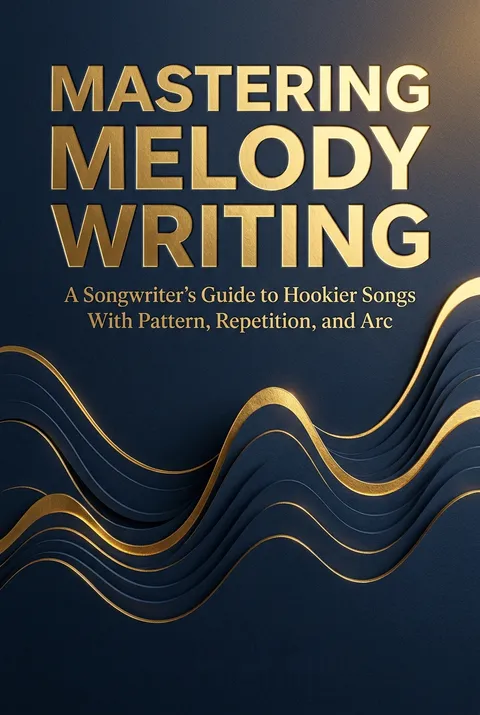
Mastering Melody Writing is a practical craft manual organized around a memorable sequence: create patterns, repeat the patterns worth keeping, and shape them into an emotional arc. Its most valuable move is translating ideas that can sound mysterious, such as hookiness or melodic instinct, into actions a writer can test: tap a rhythm, repeat a phrase, move a motif to a new pitch, alter the groove, or shorten a section. The case studies make the advice concrete, while the exercises turn listening into rehearsal rather than passive consumption.
The framework is particularly useful for writers who have strong ideas but lack a vocabulary for revising them. PRA helps diagnose whether a song lacks a recognizable motif, enough return, or contrast between sections. The smaller techniques, including Line+, Hotspots, and Word Painting, offer specific ways to make words and melody reinforce one another. The insistence on editing also counters a common creative trap: treating effort spent on a line as proof that the line must stay.
The book’s commercial orientation is also its main limitation. It largely studies successful popular songs and aims at accessible hooks, so its rules are best understood as tools for that goal, not universal laws of composition. Atonal, through-composed, or deliberately disorienting music may reject predictable returns for expressive reasons. Similarly, the preference for a higher, larger chorus is a familiar convention, not a requirement. The writers acknowledge exceptions and encourage experimentation, which keeps the method from becoming a rigid recipe.
The deeper lesson is that technique and instinct are partners. Named methods make choices visible and repeatable; listening, singing, collaboration, and revision help those choices become intuitive. A songwriter can use the framework to build an audience’s expectations, then decide when to honor them, bend them, or break them. The goal is not pattern for its own sake, but musical form that makes a feeling easier to hear and remember.
People Also Read








Glossary
The PRA Method
Three-part melody frameworkAn approach to melody composition based on Pattern, Repetition, and Arc. Pattern creates recognizable musical shapes, Repetition returns to selected shapes, and Arc arranges them into a changing emotional and melodic journey. The elements work together to help a song feel both memorable and varied.
Line+
Line with rhythmic tagA melodic patterning approach that divides a phrase into a longer line and a short repeated unit. The unit often contains three notes, beats, or syllables, but other lengths and placements are possible. Rhythm, melody, and sometimes rhyme can reinforce one another to make the phrase easier to recognize.
Arc
Song’s emotional trajectoryThe musical and emotional journey of a song, shaped by changing melodic intensity from beginning to end. Pitch, rhythm, note length, dynamics, silence, chords, and song structure can all contribute. A clear arc gives sections distinct roles and helps the listener sense movement and resolution.
Hotspot
Attention-catching melodic positionA part of a melodic line that naturally draws attention. Common Hotspots include line endings, rhyming words, high notes, and the opening or closing lines of a chorus. Writers can strengthen them by placing meaningful words and distinctive musical patterns in those positions.
Inspired Listening
Curious listening for craftA listening practice focused on identifying what works in songs and why, rather than judging them broadly. The listener notices choices such as rhythmic hooks, vocal entrances, melodic shape, or section contrast, then keeps those observations as possible tools for original writing.
Talk/Sing Method
Turn speech into melodyAn exercise in which a writer hears an ordinary spoken phrase and immediately sings it, without first deciding how it should sound. Repeating the exercise develops quick reflexes for connecting words, rhythm, and emotion, and can generate melodic ideas from everyday speech.
Auralect
Ear-led melodic composingThe ability to follow the ear while composing rather than intellectually calculating each note. It describes a listening state in which a writer hears a melodic direction and responds to it instinctively. Repeated singing, listening, and learning melodies can help make this process more familiar.
Spitballing
Improvised melody recordingA technique for improvising vocal melodies over a chord pattern or musical loop without planning the words in advance. A writer may hum, use nonsense syllables, or sing fragments of language, then listen back for memorable phrases that can guide a finished melody or lyric.
Shape Shifting
Repeat a shape at new pitchesA melodic technique that repeats a note pattern while starting it on a different note higher or lower in the scale. The interval relationships generally remain similar, allowing the listener to recognize the shape while hearing it in a new pitch position.
Word Painting
Music mirrors lyrical meaningA technique in which melody, harmony, rhythm, or other musical elements reflect the emotion, action, or sound described by the lyric. A descending melody might reinforce a word about falling. The musical relationship can also work through contrast, when a deliberate mismatch creates a specific effect.
Conversational Verse Melody
Small-range, speechlike verseA verse melody that uses a limited range, often two to four notes, to create the impression of speaking directly to the listener. It can establish a restrained or intimate mood and leave room for a chorus with greater pitch range or emotional intensity.
Angle Tool
A fresh approach when stuckA general songwriting practice of approaching a stalled idea from another direction. A writer might change the tempo, groove, instrument, or melodic rhythm, take a break, or return to the song from its beginning. The purpose is to interrupt habitual choices and uncover new options.
The Level
Audience-focused song checkA reflective review of whether a song is likely to matter to someone beyond its writer. It examines the freshness of the idea, the clarity and emotional force of the chorus, the usefulness of the hooks, and whether melody, chords, and groove support the lyric.
Top-liner
Melody and lyric writerA songwriter who adds vocal melody and lyrics over an existing musical track or groove. A top-liner may work alone or with other writers and track creators, and may contribute both melody and words or focus on one part of the song.
Track Person
Creates a song’s backing trackA writer or producer who builds the musical track or groove beneath a song’s melody and lyrics, often using recording software, loops, and live instruments. The track can give collaborators a rhythmic and harmonic starting point for writing.
Download PDF
Download EPUB
.epub digital book format is ideal for reading ebooks on phones, tablets, and e-readers.








