

Key Takeaways
Build valuable skills before expecting work to feel like a calling
Passion can be cultivated. Cal Newport challenges the idea that a person can simply discover an existing passion and match it to a job. Many people have no clear career passion, and loving an activity as a hobby does not guarantee loving its commercial version. Bill McKibben became a prominent environmental writer only after developing deep journalistic skill, first at Harvard's student newspaper, then at The New Yorker. His example suggests that the satisfying part of work often comes from broader qualities such as autonomy and impact, not a particular job title.
Skill creates leverage. Valuable abilities give workers more power to shape how and where they work. Instead of asking only which job sounds exciting, consider what skills could earn greater responsibility, independence, and influence. Passion can grow from that foundation.
The argument connects career satisfaction to competence and autonomy, two needs emphasized in self-determination theory, which studies how people sustain motivation. It replaces the pressure to identify a single calling with a more workable sequence: become capable, then use that capability to shape working conditions. The limitation is that skill does not automatically buy freedom. Hiring practices, caregiving duties, discrimination, and economic necessity affect who can convert expertise into autonomy. The principle is strongest when treated as a source of leverage, not a guarantee that effort alone controls a career.
Run your career like a venture, not a ladder
Plan, then stay adjustable. The book describes the modern career as a changing landscape rather than a predictable climb. In the interview, Fast Company editor Robert Safian cites an average job tenure of 4.4 years for American workers at the time, and argues that learning new skills is a career skill in itself. Ben Casnocha recommends thinking like an entrepreneur: build a distinctive combination of abilities and relationships, and maintain flexible plans. His shorthand is Plan A for the current direction, Plan B for a related pivot, and Plan Z for a worst-case fallback.
Follow a mission, not a title. A job title may disappear, while a problem you want to solve can guide you across roles. Stay curious about new tools, volunteer for useful challenges, and keep asking what should come next. Openness and initiative increase the chances of noticing unexpected opportunities.
This model resembles portfolio thinking: a career is a collection of skills, relationships, and experiments, rather than a single bet on one employer. That can make change less disorienting because identity attaches to a durable mission instead of a temporary title. There is a real tension, though. Constant adaptation can become exhausting if workers must endlessly retrain without security or support. The entrepreneurial stance is most useful when paired with boundaries and an honest assessment of resources, not when it becomes a demand to treat every employment problem as an individual failure.
Choose work where interest, ability, and opportunity overlap
Find the working intersection. Scott Belsky calls the overlap of genuine interests, skills, and available opportunities the ISO intersection. Interest supplies energy, skill makes a contribution credible, and opportunity gives that contribution somewhere to matter. A strong interest without the necessary ability may remain a hobby; skill without interest can become draining; and both can languish without a route to use them.
Treat opportunity as a stream. Belsky argues that opportunities need not be dramatic leaps. Conversations, introductions, conferences, and small projects can create steady movement toward work that fits. This makes exploration practical: test a project that uses a skill you enjoy, talk with people already working in that area, and notice which problems attract both your attention and someone else's demand. Managers can use the same lens to create roles where employees' strengths meet real organizational needs.
The framework is useful because it makes career fit an interaction among personal motivation, competence, and the surrounding market. It also discourages the false choice between passion and practicality. A useful extension is to treat the three circles as moving targets: skills change through practice, interests can deepen, and markets shift. The model should not imply that everyone begins with equal access to opportunity. Networks and resources are unevenly distributed, so deliberate outreach and experimentation matter, but structural barriers cannot always be solved by personal initiative.
Trade proving your talent for measurable improvement
Protect learning from judgment. Heidi Grant Halvorson contrasts the Be Good mind-set, which aims to prove existing ability, with the Get Better mind-set, which aims to develop ability. In a study by Claudia Mueller and Carol Dweck, fifth graders praised for being smart performed about 25 percent worse on a later easy task after struggling with a hard one. Children praised for effort performed about 25 percent better. The difference was how they interpreted difficulty: as evidence of fixed ability, or as a reason to keep working.
Make progress observable. Compare present performance with past performance, ask for help, and treat mistakes as information about what to practice. Joshua Foer's account of skill acquisition adds a related warning: the OK Plateau arrives when a task becomes automatic and improvement stalls. Experts deliberately work on difficult parts and seek feedback rather than repeating what already feels comfortable.
The shift from status to learning is more than positive thinking. It changes which evidence a person attends to: peer ranking emphasizes threat, while a progress record makes improvement visible. This has a close connection to formative assessment in education, where feedback is designed to guide the next attempt rather than label the learner. The nuance is that effort is not always the right diagnosis. Poor strategy, inadequate instruction, or inaccessible conditions can also block progress. A growth orientation works best when it invites adjustment, not endless effort in a broken system.
Practice hard things in focused bursts, then recover completely
Make practice deliberate. In the violinist study described by Tony Schwartz, the most accomplished musicians practiced around four hours a day, often in sessions of roughly ninety minutes, with breaks between them. The piece argues that mastery comes not from long hours alone, but from focused work on challenging skills, followed by recovery. The top musicians also slept about 8.5 hours in a day, including short naps, while the least skilled group slept less.
Give effort a rhythm. Schwartz recommends setting a protected practice period, beginning with an hour if necessary, and expanding only as concentration allows. Joshua Foer reinforces the point: musicians and athletes improve by working on difficult sections, not simply replaying their strongest performances. Track the results and use immediate feedback, from a coach, a colleague, or a record of your own attempts, to decide what to work on next.
The section's strongest insight is that recovery belongs inside a performance system, rather than being treated as a reward after work is finished. This aligns with research on learning and memory consolidation, where sleep supports retention and fatigue can impair attention. The precise ninety-minute rhythm should not be mistaken for a biological rule that fits every person or task. Different work, health conditions, and schedules require different intervals. The durable lesson is to protect focused effort, notice declining quality, and build recovery into the plan.
Automate one career-building habit before adding another
Spend willpower carefully. Scott H. Young argues that trying to change several routines at once often overloads the effort required to maintain them. His principle of focus is to work on one habit at a time, giving it a month before adding another. He also recommends consistency: repeating a behavior in similar conditions makes it easier to perform automatically. One example is practicing a skill at the same time after work instead of fitting it in at unpredictable moments.
Keep a record of progress. Teresa Amabile, Steven Kramer, and Ela Ben-Ur describe diaries as tools for capturing small wins, obstacles, ideas, and plans. Their research on creative workers found that progress in meaningful work strongly supported motivation and engagement. A brief daily note can preserve evidence of improvement that memory might lose, while periodic reviews can reveal recurring sources of energy or friction. Start with a few minutes rather than a grand journaling project.
Small routines reduce the number of decisions needed to begin, and a diary can serve as both a memory aid and a lightweight feedback system. Together, they turn vague intentions into observable behavior. Habit research also cautions against treating a month as a magic deadline: the book itself notes that habit formation varies, with one cited study finding a median of 66 days. The more useful measure is whether the behavior is becoming easier to resume after interruption. A missed day is data, not proof that the system has failed.
Treat relationships as infrastructure, not a favor bank
Make collaboration discussable. Steffen Landauer describes a storytelling group that kept meeting for twenty years, helping members shape projects through honest feedback, encouragement, and accountability. Michael Bungay Stanier offers social contracting: talk at the start of a working relationship about expectations, likely friction, and how both people behave when things go wrong. These conversations make later disagreements easier to address.
Mix trust with fresh perspectives. Research on Broadway musicals and scientific laboratories suggests that creative teams benefit from both familiar collaborators and people with different experience. Too much familiarity can produce groupthink; too little can make communication clumsy. Networking, in this view, is not collecting contacts for future transactions. It is building generous, varied relationships, including weaker ties beyond one's close circle, and asking clearly for help when needed. Strong collaboration also means building on others' contributions instead of competing for sole credit.
Relationships here are not ornamental. They provide feedback, access to knowledge, and the trust required to share unfinished work. The team's balance of familiar and unfamiliar members echoes a broader design principle: coordination needs shared expectations, while innovation needs difference. Neither ingredient is sufficient on its own. Social contracting can also feel awkward or overly formal, especially where power is unequal. Its value comes from making implicit expectations negotiable, not from scripting every interaction. Generosity works best when paired with clear boundaries and reciprocal respect.
Make failure cheaper, more informative, and easier to survive
Fear exaggerates the cost. Michael Schwalbe uses Jerry Seinfeld's first stand-up performance, a roughly ninety-second stumble, to show how a public failure can be followed by improvement. Research discussed in the book suggests that people often overestimate the pain and duration of failure, and how closely others will scrutinize it. The text calls this impact bias. It also notes that later-life regrets more often concern actions not taken than attempts that failed.
Use small experiments. Frans Johansson argues that success is hard to predict, so creators should make many small bets rather than risk everything on one untested idea. Palm Computing's failed Zoomer cost far less than Apple's failed Newton, leaving Palm resources for a second attempt that became the successful PalmPilot. Tina Seelig adds that failure can be treated as data. Choose risks with recoverable costs, learn from the outcome, and use persistence and agency to improve the odds.
This is a practical synthesis of behavioral economics and experimentation: anticipated losses can loom larger than actual experience, while small tests limit the price of being wrong. It shifts courage away from dramatic leaps and toward repeatable action. Still, not every failure is recoverable, and not every person has spare money, time, or reputation to spend on experiments. Good risk-taking therefore requires defining the downside in advance. Small bets are not merely smaller versions of big bets; they are tests designed to produce information before commitment grows.
Analysis
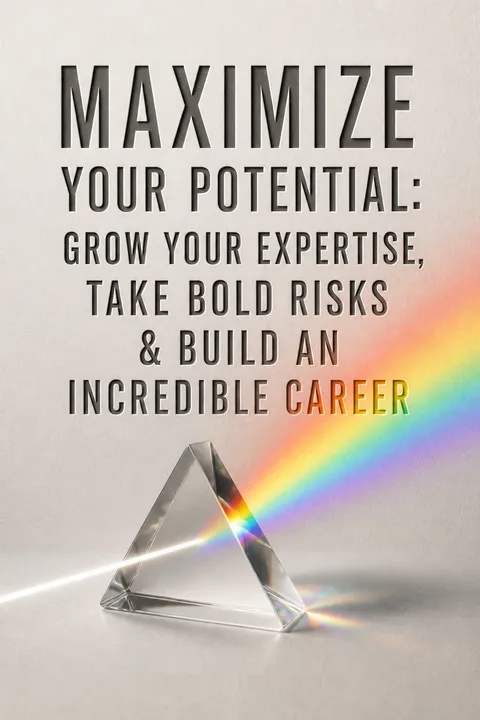
Maximize Your Potential is a multi-author career guide organized around creating opportunities, building expertise, cultivating relationships, and taking risks. Its central claim is that a fulfilling creative career is built through repeated action, not discovered as a ready-made calling. Across its essays, the same pattern recurs: develop an ability, use it in real work, learn from feedback, and adjust the direction as circumstances change.
The book's strength is its practical range. Newport questions passion-first career advice; Halvorson reframes setbacks as learning; Schwartz ties performance to recovery; Amabile and colleagues show how recording small progress can support creative motivation; and Johansson argues for experiments instead of confident predictions. These perspectives complement one another without pretending that career development is a single technique. The career is at once a craft, a learning system, a network, and a series of bets.
The most useful tension is between personal agency and structural constraint. The book encourages people to act like entrepreneurs, create opportunities, and build rare skills. That stance can be energizing, especially when old career ladders no longer offer reliable direction. But initiative cannot erase unequal access to time, money, mentorship, or influential networks. The advice is therefore most credible when read as a set of ways to increase options, not as proof that outcomes are fully self-made.
A second tension concerns measurement. Practice schedules, habit tracking, and progress diaries make development concrete, but creative work cannot be reduced to metrics without remainder. The book's better insights avoid that trap by using measurement as feedback, not as the definition of value. Taken together, its strongest lesson is to design a career that can learn: build skills, find collaborators, test ideas at manageable cost, and revise plans without mistaking a detour for failure.
Review Summary
Maximize Your Potential received mixed reviews, with an overall positive reception. Many readers found it insightful and practical, offering valuable advice on career development and personal growth. The book's format of short essays by various experts was appreciated for its diverse perspectives. Some readers felt it lacked depth or contained repetitive content. Key themes include adapting to change, cultivating skills before passion, and taking calculated risks. Despite some criticism, many readers found the book inspiring and worth revisiting for its actionable tips.
People Also Read





Glossary
Free Radicals
Self-directed creative workersA name Scott Belsky gives to people who take active responsibility for their work and career. They seek learning, meaningful impact, flexibility, and room to experiment, whether working independently or inside an organization. The term describes an attitude of initiative and adaptability, not a requirement to start a company or work alone.
permanent beta
Ongoing self-improvementBen Casnocha's term for treating a person or career as continually developing rather than finished. Borrowed from software that remains open to improvement after release, the idea encourages regular learning, testing, and adaptation. It frames change as an ordinary part of professional life rather than evidence that a previous choice was necessarily wrong.
ISO
Interest, skills, opportunityScott Belsky's shorthand for the overlap among genuine interests, skills, and opportunities. Interest supplies motivation, skill enables a useful contribution, and opportunity provides a context where that contribution can be applied. The framework is used to assess career choices and projects, with the greatest potential for impact where all three factors meet.
Be Good mind-set
Proving existing abilityHeidi Grant Halvorson's label for approaching a task mainly to demonstrate competence and earn validation. Because performance becomes evidence of fixed talent, difficulty can feel threatening and encourage anxiety or withdrawal. The contrasting Get Better mind-set focuses on learning, practice, and improvement rather than proving that ability is already complete.
OK Plateau
Improvement stops on autopilotJoshua Foer's term for the point at which a skill becomes familiar enough to perform automatically, but further improvement slows because practice no longer demands conscious attention. To move beyond it, learners need to focus on difficult parts of a task, seek useful feedback, and practice just outside their current comfort zone.
deliberate practice
Focused skill-building practiceA form of practice aimed specifically at improving performance, rather than simply repeating a familiar activity. In the book's discussion, it involves sustained concentration, challenging work, and feedback that helps identify what to correct. Tony Schwartz emphasizes short, focused sessions and recovery as part of a sustainable routine for this kind of training.
social contracting
Agreeing how to work togetherA practice Michael Bungay Stanier discusses for building resilient work relationships. Before focusing only on the task, collaborators discuss what each wants, where each may need help, how problems tend to arise, and how they will address friction. The aim is not a rigid legal contract, but shared permission to discuss the working relationship when difficulties appear.
Uncertainty Curve
Creative work's changing uncertaintyJonathan Fields's model of a creative project's movement from broad possibilities and high uncertainty toward constraints, decisions, and a finished result. Experiments can reveal new information and reopen possibilities. Moving too slowly can stall a project, while rushing toward certainty can close off better options before they have been explored.
little bets
Low-cost experimentsA term used in the book for small, limited experiments that test an idea before substantial resources are committed. Because success is difficult to predict, small bets allow a person or organization to try more approaches, learn from outcomes, and retain the capacity to try again if an early attempt fails.
impact bias
Overestimating emotional consequencesA psychological concept discussed in the book: people often overestimate how intense and long-lasting their emotional reaction to a future event will be. When considering failure, this can magnify fear and encourage avoidance. The book connects the bias to overlooking people's capacity to adapt and the ordinary experiences that continue after a setback.
FAQ
What's "Maximize Your Potential" about?
- Focus on Career Growth: "Maximize Your Potential" by Jocelyn K. Glei is about empowering individuals to grow their expertise, take bold risks, and build an incredible career.
- Four Key Areas: The book is structured around four key areas essential for long-term career success: creating opportunities, building expertise, cultivating relationships, and taking risks.
- Practical Insights: It provides pragmatic, action-oriented insights from leading researchers and visionary creatives to help readers navigate the modern career landscape.
- Empowerment and Action: The book emphasizes the importance of being proactive, experimenting, and learning from failures to realize one's full potential.
Why should I read "Maximize Your Potential"?
- Actionable Advice: The book offers practical advice and strategies for career development that can be immediately applied.
- Diverse Perspectives: It includes insights from a variety of experts, providing a well-rounded view of what it takes to succeed in today's work environment.
- Empowerment Focus: It encourages readers to take control of their career paths and make deliberate choices to maximize their potential.
- Adaptability and Growth: The book is particularly useful for those looking to adapt to changing job markets and continuously grow their skills.
What are the key takeaways of "Maximize Your Potential"?
- Craft Before Passion: Focus on developing rare and valuable skills before pursuing passion.
- Plan to Adapt: Be ready to pivot in your career with flexible planning and multiple backup plans.
- Networking and Relationships: Build a network with a spirit of generosity and seek out diverse collaborations.
- Embrace Risk and Failure: View mistakes as learning opportunities and take calculated risks to drive innovation.
How does "Maximize Your Potential" suggest creating opportunities?
- Cultivate Skills: Develop rare and valuable skills that set you apart in the marketplace.
- Be Proactive: Take initiative in your career by seeking out new challenges and responsibilities.
- Mission-Driven Work: Focus on a larger mission rather than specific job titles to guide your career path.
- Stay Open to Luck: Be open-minded and alert to unexpected opportunities that may arise.
What does "Maximize Your Potential" say about building expertise?
- Deliberate Practice: Engage in focused, time-limited practice sessions to develop mastery in your field.
- Feedback and Growth: Seek constant feedback and use it to improve your skills and performance.
- Avoid the OK Plateau: Continuously challenge yourself by practicing the difficult aspects of your work.
- Habit Formation: Change one key habit at a time to make excellence a natural part of your routine.
How does "Maximize Your Potential" address cultivating relationships?
- Seek Help: Don't hesitate to ask for help and build a network of accountability partners.
- Social Contracts: Establish clear expectations and address potential conflicts upfront in professional relationships.
- Generosity in Networking: Approach networking with a mindset of generosity rather than obligation.
- Diverse Teams: Create teams with a mix of familiar and new collaborators to enhance creativity.
What does "Maximize Your Potential" say about taking risks?
- Fear of Failure: Understand that fear of failure is often exaggerated and that setbacks are temporary.
- Small Bets: Make small, calculated bets to test ideas and limit exposure to risk.
- Learning from Mistakes: Use failures as valuable data to refine your approach and improve.
- Embrace Uncertainty: Accept that uncertainty is a part of the creative process and can lead to innovation.
What are the best quotes from "Maximize Your Potential" and what do they mean?
- "Craft comes before passion." This quote emphasizes the importance of developing skills before pursuing passion, as skills provide the foundation for a fulfilling career.
- "Luck is a state of mind." It suggests that being open and proactive can increase your chances of encountering opportunities.
- "The enemy of creation is not uncertainty, it’s inertia." This highlights the importance of taking action despite uncertainty to drive innovation and creativity.
- "Work with intention." Encourages focusing on meaningful work that aligns with your skills, interests, and opportunities for maximum impact.
How does "Maximize Your Potential" suggest dealing with failure?
- Reframe Failure: View failures as experiments that provide valuable data for future success.
- Resilience and Recovery: Develop resilience by bouncing back quickly from setbacks and using them as learning experiences.
- Failure Résumé: Create a résumé of failures to reflect on what you learned and how you grew from each experience.
- Prepare for Failure: Anticipate potential failures and have strategies in place to recover and adapt.
What is the "Free Radical" concept in "Maximize Your Potential"?
- Self-Reliance: Free Radicals are individuals who take their careers into their own hands and work on their own terms.
- Flexibility and Experimentation: They thrive on flexibility, engage in multiple projects, and are open to experimentation.
- Intrinsic Motivation: Free Radicals do work that is intrinsically rewarding and aim to make a lasting impact.
- Meritocracy and Networks: They believe in meritocracy and leverage online networks and peer communities for growth.
How does "Maximize Your Potential" suggest reprogramming daily habits?
- Focus on One Habit: Change one habit at a time, dedicating at least a month to each new habit.
- Consistency is Key: Make the habit consistent by doing it the same way each time to speed up the process of making it automatic.
- Classical Conditioning: Use triggers to associate new habits with existing routines, making them easier to adopt.
- Track Progress: Keep a journal to track your progress and identify patterns that help or hinder habit formation.
What role does deliberate practice play in "Maximize Your Potential"?
- Structured Practice: Engage in time-limited, focused practice sessions to improve specific skills.
- Rest and Renewal: Balance intense practice with rest to sustain high performance and avoid burnout.
- Feedback Loop: Use feedback to refine your practice and focus on areas that need improvement.
- Mastery Over Time: Understand that achieving mastery requires persistence and thousands of hours of deliberate practice.
99u Series

About the Author

Download PDF
Download EPUB
.epub digital book format is ideal for reading ebooks on phones, tablets, and e-readers.








