

Key Takeaways
A frightening thought is not a confession of what you want to do.
Thoughts are not intentions. Morris first calls her constant inner narrator the Voiceover, then gives it the character name Brain. As a teenager, she hears thoughts about swerving off a cliff, kissing a lecturer, and dropping a baby. She fears that noticing these thoughts means she might act on them. When she finally tells a friend, the friend describes having similarly disturbing thoughts, and Morris discovers that intrusive thoughts are common. Their content can be violent, sexual, self-critical, or absurd. In her account, they often reflect the mind imagining danger, not a person’s wishes or plans.
Notice, then assess. A thought appearing in the mind is not the same as choosing an action. If such thoughts feel overwhelming, impair daily life, or seem difficult to resist, professional support is appropriate.
The distinction between thought and intention resembles cognitive defusion, a technique used in acceptance-based therapies: a person learns to notice a thought as a mental event rather than obeying it or treating it as identity. This can reduce shame and the panic that gives intrusive thoughts more power. The reassurance still needs limits. Thought content alone does not establish risk, but neither does a humorous framing settle every clinical question. Frequency, distress, compulsive responses, and actual intent matter, which is why persistent or frightening symptoms deserve careful assessment.
Ask for evidence before turning a text into a breakup.
Ambiguity invites a story. In one exchange, Morris’s boyfriend sends a simple morning greeting. Brain interprets the missing exclamation mark, then a full stop, as proof that he is angry and preparing to end the relationship. Morris apologizes, asks repeatedly whether everything is fine, and eventually confronts him about his punctuation. A phone call reveals that he was not angry at all. The message had little emotional information, so anxiety supplied a dramatic explanation.
Check the interpretation. Before reacting to a short or oddly punctuated message, separate what is observable from what is guessed. A direct, proportionate question can clarify more than rereading, testing, and escalating. The point is not to dismiss genuine relationship concerns, but to avoid treating a guess as evidence.
Text strips away tone, facial expression, and timing cues, leaving readers to infer meaning from sparse signals. Under stress, negative interpretations can feel more certain than the evidence supports. Morris’s exchange also shows how repeated reassurance-seeking can prolong anxiety: each answer becomes another clue to analyze. A useful counterbalance is to identify the observation, name the interpretation, and seek clarification once. That method is not a guarantee of honesty, but it prevents punctuation from carrying more weight than the relationship itself.
Build identity by trying roles, not buying someone else's aesthetic.
Identity changes in practice. Morris’s wardrobe becomes a record of borrowed online styles, each promising a more interesting version of herself. Her larger experiments are more revealing: she leaves dance, studies broadcast journalism, works in London, takes a farm job in Australia, pours drinks at Disney World, and eventually makes comedy videos. Some paths end; others teach her what she enjoys. During the pandemic, she starts creating sketches and discovers that comedy can become her work.
Follow the live spark. The story does not suggest that every interest must become a career or that a leap abroad is right for everyone. It shows that identity is often discovered through doing, not through choosing the perfect look or making one permanent declaration. Morris ends up granting herself permission to wear a simple outfit while still becoming someone new.
This account treats identity less as a hidden essence waiting to be uncovered and more as a pattern built through experiments, feedback, and commitments. That view fits developmental research on exploration: trying roles can reveal preferences that introspection alone cannot. The story’s dramatic moves are also shaped by circumstances and opportunity, so they should not be mistaken for a universal recipe. Smaller experiments can serve the same purpose. The useful question is not whether a choice looks like a finished identity, but whether the experience provides information worth acting on.
Stop treating your body as a public performance you must pass.
Shame magnifies ordinary bodies. As a young teenager, Morris lies about having started her period because her friends have reached puberty first. She uses fake blood to support the story, then wears pads for years while waiting for her own period. Later, from ages 14 to 27, acne consumes her attention. She checks every bump, layers on make-up, and spends money on supposed cures. Bullying and beauty standards make skin and body differences feel like evidence of personal failure.
Care is not punishment. Morris says her acne eased alongside changes in stress, diet, and skincare, but she does not offer a miracle cure or claim one cause. Her larger lesson is that a body is not a fashion accessory or a measure of worth. Practical care can help, without turning every blemish or bodily function into a verdict on the person.
The book’s comedy makes private embarrassment easier to recognize, while its body image stories expose how peer judgment and polished media teach people to monitor themselves. Body neutrality can be more attainable than forced self-love: a person can respect a body without liking every feature. The account also wisely avoids presenting one acne routine as a cure. Skin conditions vary, and attributing them too neatly to stress or food can create fresh blame. Self-acceptance and appropriate medical care are compatible, not competing, responses.
Track the cycle before blaming yourself for a week of emotional chaos.
Patterns can explain the timing. Morris describes a day when a misplaced tin of chickpeas feels like proof that her boyfriend hates her, followed by an urge to cry, criticize herself, and delete social media. She blames the moon until her period-tracking app shows that menstruation is due within days. She had not understood how much her own premenstrual period could affect mood, appetite, sleep, and comfort.
Use tracking as information. Recording symptoms and cycle timing can help reveal patterns that are otherwise easy to misread as a sudden personality change. Morris’s account is personal, not a diagnosis or a claim that hormones explain every bad feeling. Severe, persistent, or disruptive symptoms deserve medical discussion, rather than being dismissed as inevitable or blamed on character.
Tracking turns a vague experience into a pattern that can be discussed with a clinician and helps distinguish recurring symptoms from one-off events. It can also reduce self-blame by showing that mood and physical comfort fluctuate. The caution is equally important: a cycle pattern does not make a person’s concerns unreal, and hormonal explanations should not be used to invalidate anger or distress. Monitoring works best as a tool for understanding and care, not as a reason to distrust every feeling that occurs before a period.
When chest symptoms feel fatal, seek assessment, not a search-engine verdict.
Anxiety can feel physical. At university, a hungover Morris develops chest tightness, dizziness, and a racing pulse. Brain consults a symptom website and declares a heart attack. Friends take her to the emergency department, where testing finds nothing abnormal and a clinician asks whether she may have had a panic attack. Later, her doctor connects similar episodes, poor sleep, restlessness, and nausea with generalised anxiety disorder, then recommends therapy.
Do not diagnose alone. A panic attack can feel like a medical emergency, but that does not mean every chest symptom is anxiety. Morris’s experience includes medical assessment before the explanation becomes clear. New, severe, or concerning symptoms warrant appropriate medical care. The story’s lesson is not to ignore the body, but to avoid letting a search result substitute for a clinician.
Panic can produce bodily sensations that resemble illness, and fear of those sensations can intensify them. Morris captures that feedback loop without claiming that it is safe to self-diagnose. Her visit to emergency care and later discussion with a GP are essential parts of the story, not incidental details. This distinction protects against two opposite errors: treating every anxious sensation as catastrophe, and dismissing a real medical problem as anxiety. A clinician can assess both the symptoms and the pattern over time.
Grief follows your own calendar, not a tidy five-step script.
Loss does not unfold neatly. Morris’s father develops Pick’s disease at 60 and dies five years later. His dementia means she begins mourning changes in his personality while he is alive, then faces another kind of loss when he dies. She describes taking charge, anger, exhaustion, laughter, envy of people with living fathers, and a powerful wave of recognition almost a year after the funeral.
Her sequence is HAYLEY. It stands for Hardy, Anger, Yawning, Laughter, Envy, and Yes, this has happened. Morris contrasts it with the SARAH model she finds online, which lists shock, anger, rejection, acceptance, and healing. Neither sequence becomes a rule for everyone. Her point is that grief can change pace, return unexpectedly, and coexist with moments of humor.
Morris’s improvised sequence challenges the assumption that grief is a fixed staircase with a correct final step. Contemporary bereavement models often describe people moving between confronting loss and managing the demands of ordinary life, rather than advancing through a uniform sequence. Her account also shows how humor can preserve connection to the deceased without erasing pain. The memoir cannot prescribe a timetable, and it should not be used to measure another person’s grief. Its value lies in widening the range of reactions readers may recognize as human.
Treat intuition as a prompt to check reality, not proof.
A feeling can start an inquiry. During a long-distance relationship, Morris becomes uneasy about her boyfriend’s reduced replies and online activity. She initially tries to explain the feeling away, then secretly accesses his account and discovers messages showing that he is seeing a coworker. The discovery confirms her suspicion, but her way of finding it crosses a privacy boundary and damages trust in its own right.
Signals need verification. Morris also recalls a psychic saying something unsettling about her parents, which prompts her to call her mother and learn that her father is ill. These events feel meaningful to her, but they do not establish that intuition is supernatural or always accurate. A gut feeling can justify pausing, noticing patterns, and asking questions. It should not be treated as a verdict without evidence.
Intuition can reflect subtle cues that have not yet been consciously assembled, but it is also vulnerable to confirmation bias, fear, and wishful thinking. The distinction matters: a feeling may be useful as a prompt to investigate, while still being insufficient evidence for an accusation. Morris’s discovery of betrayal validates her concern, not the ethics of covert account access. Open questions, boundaries, and observable behavior offer a sounder path than either suppressing a concern or treating unease as certainty.
Practice choosing well while your anxious Brain keeps talking.
Silence is not the goal. Before therapy, Morris expects judgment, punishment, or a cold clinician who will expose her as unstable. In her first session with Marie, she initially lies on the intake form and offers only vague answers. Then she describes her father’s illness, grief, self-doubt, and Brain’s relentless commentary. The therapist listens, draws connections on a board, and gives her worksheets to complete before their next meeting.
Make space for the voice. Morris comes to see Brain as part of her, but not the whole of her. She cannot permanently remove the thoughts, and she no longer sees silence as the only kind of progress. Therapy helps her relate to them differently, sometimes listening, often questioning, and choosing what to do without treating every warning as an order.
Personifying the inner critic creates distance without requiring denial. This resembles cognitive defusion: thoughts can be acknowledged without being treated as facts or commands. The therapy scene also counters the idea that treatment means being judged or repaired; it presents the therapeutic relationship as a structured place to notice patterns. A memoir can show what helped one person, but it cannot guarantee the same fit for every reader. Finding a suitable clinician and seeking more support when needed remain practical parts of care.
Let awkwardness be the price of showing up, not a reason to leave.
Anxiety predicts humiliation. After months of messaging a man she likes, Morris admits that her dating profile gives the wrong location and arranges to meet him anyway. On arrival, she sees him, panics, and stays in the taxi as it drives around to the front of the pub. She nearly calls off the date, but goes in. The evening is pleasant, and the two begin a relationship. In another story, an office presentation goes badly after colleagues deliver far more polished talks than she expected.
Showing up is not a guarantee. These stories do not promise that every risk leads to romance or success. They show that embarrassment is not reliable evidence that an attempt is doomed. Morris’s father’s advice, as she remembers it, is to pursue what feels fun without making other people’s imagined judgments the deciding vote.
This is close to exposure-based practice, where someone approaches a feared situation instead of relying on avoidance to feel safe. The date illustrates a useful result, while the failed presentation keeps the lesson honest: courage does not control the audience or guarantee a win. The distinction is between choosing a meaningful action and forcing oneself through every discomfort. Anxiety may signal a real boundary, but anticipated embarrassment alone is a poor measure of whether an experience matters.
Analysis
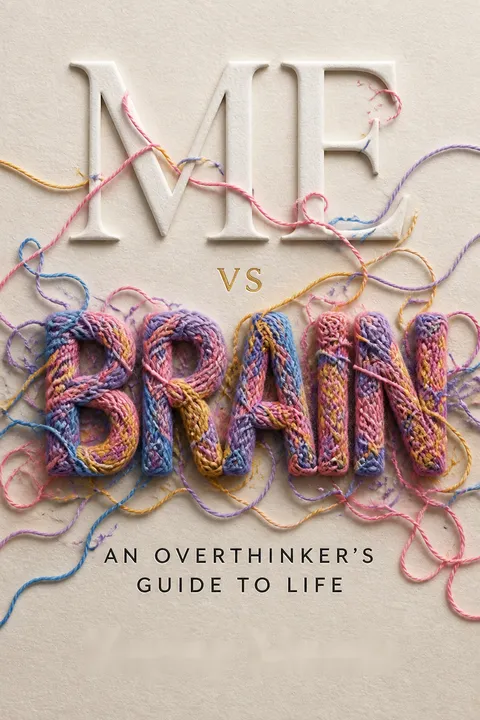
Me vs Brain is a memoir assembled from comic set pieces, not a clinical manual or a step-by-step anxiety program. Its central device is also its central argument: by turning anxious thought into a character, Morris makes it possible to observe the mind without confusing every prediction with fact. The joke creates distance, while the repeated scenes of shame, panic, and grief keep that distance from becoming detachment.
The book’s range is broader than its title suggests. Text-message overanalysis, puberty, acne, sex, medical fear, work, dating, and bodily embarrassment all show how a watchful mind can turn ordinary uncertainty into a public trial. The comic voice lowers the threshold for discussing experiences many people conceal. That is a genuine strength: recognition can reduce isolation before a reader is ready to seek formal help. The account of her father’s dementia and death deepens the argument. Mental noise is not merely an inconvenience to defeat; it accompanies a life that includes love, uncertainty, and irreversible loss.
The method has limits. A funny anecdote can normalize intrusive thoughts, but cannot determine whether a particular person needs clinical care. Personal improvements in acne, anxiety, or grief should not be mistaken for controlled evidence or universal prescriptions. Nor should the book’s trust in intuition be read as proof that feelings reliably reveal hidden facts. Its strongest practical insight is more modest: notice the thought, examine the evidence, and seek help when distress becomes difficult to manage. The result is not a promise of a quiet mind. It is a more humane relationship with a noisy one.
Review Summary
Me vs Brain receives mixed reviews, with an average rating of 3.89 out of 5. Many readers find it relatable and humorous, appreciating Morris's candid approach to mental health and overthinking. Some praise the audiobook narrated by the author herself. However, critics argue it lacks substantial advice and relies too heavily on anecdotes. The book's tone and humor divide readers, with some finding it insufferable or trivializing important topics. Several reviewers note the content's similarity to Morris's social media posts, which may appeal to existing fans but disappoint those seeking more depth.
People Also Read






Glossary
Brain
Personified inner commentaryMorris’s comic personification of her stream of anxious thoughts, predictions, self-criticism, and distractions. Brain speaks as though she were a separate, often irritating companion. The device helps Morris distinguish mental events from her whole identity, while recognizing that some thoughts may still contain useful information.
The Voiceover
Name for intrusive thoughtsMorris’s childhood name for the persistent inner narration that supplied commentary, alarming scenarios, and commands. She later understands many of these experiences as intrusive thoughts and personifies the voice as Brain. The term describes her experience, not an external voice or a formal diagnosis.
HAYLEY
Morris’s grief sequenceA humorous acrostic Morris creates to describe her own response to her father’s death: Hardy, Anger, Yawning, Laughter, Envy, and Yes, this has happened. It reflects the order and texture of her personal experience, including delayed recognition of the loss. It is not presented as a universal model or a required sequence.
SARAH
Online grief-stage modelAn acrostic Morris encounters while searching online for guidance about grief. Its letters stand for Shock, Anger, Rejection, Acceptance, and Healing. She finds that the sequence does not match her own experience, using that mismatch to emphasize that grief varies and need not follow a standardized order.
Download PDF
Download EPUB
.epub digital book format is ideal for reading ebooks on phones, tablets, and e-readers.








