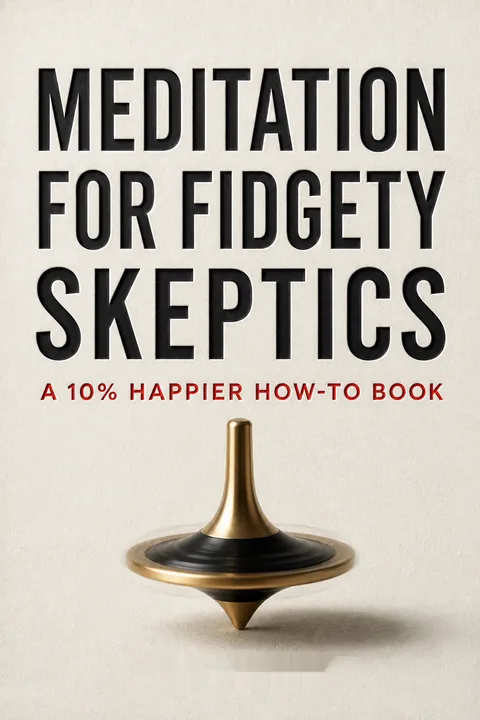


Key Takeaways
Treat every distraction as the moment meditation actually begins
The real exercise. Dan Harris once dismissed meditation as mystical nonsense. After depression, drug use, and a panic attack on live television, he began looking for practical ways to understand his mind. The basic exercise is simple: sit comfortably, notice the sensations of breathing, and return when attention wanders. The return is not a mistake. It is the repetition that builds the skill. Mindfulness, as the book uses the term, is noticing what is happening in the mind without automatically being swept along by it.
Evidence, not miracles. Research discussed in the book links meditation with possible benefits for stress, attention, anxiety, and other aspects of health. One eight-week study found measurable changes in a brain area associated with stress. The authors stress that this research is developing, not proof that meditation cures everything.
The distinction between attention and attention returning is pedagogically powerful. It converts a common source of shame, mind-wandering, into the very event the learner is practicing to notice. That resembles skill learning in music or sport: errors provide feedback, provided the learner can use them without quitting. The research claims deserve the caution the book gives them. Brain changes are interesting, but they do not by themselves establish meaningful benefits for every person or condition. The strongest case here is experiential and modest: a brief, repeatable exercise can train awareness of distraction.
Notice the inner narrator before it turns a feeling into behavior
A little room to choose. The book describes the mind as an internal narrator that replays the past, rehearses the future, and keeps returning attention to the self. It can be useful for planning, but its stories can also make an impulse seem like an instruction. Harris connects this lack of awareness to his own history: anxiety and depression went unrecognized, and he tried to manage them with drugs before his televised panic attack.
From reflex to response. Mindfulness does not erase anger when another driver cuts in or anxiety when a difficult email arrives. It can help someone notice the body’s early signals and the thoughts gathering around them. That pause creates the possibility of choosing what to do, rather than acting out the first reaction. The goal is not passivity, but a more deliberate response.
This is a practical account of metacognition: the capacity to observe thoughts as mental events, rather than confuse them with facts or commands. Emotion research also suggests that identifying a feeling can make it easier to regulate, especially when the label is specific enough to interrupt vague alarm. Still, noticing is not the same as resolving. A person can accurately observe a harmful situation and still need boundaries, support, or material change. The useful promise is not control over every feeling, but a wider interval in which judgment can operate.
Start with one minute; a repeatable practice beats heroic intentions
Lower the entry fee. The authors recommend beginning with five to ten minutes, but insist that even one minute counts when more feels unrealistic. The difficult step is often beginning, not sustaining a long session. A brief practice can become longer once someone is already seated, but it does not have to. Their practical priority is regular contact with the exercise, not an impressive duration.
Give the habit a foothold. Attach meditation to a reliable moment, such as after waking or before bed, and notice a reward that matters personally. One aspiring meditator recognized that anxiety relief motivated her more than abstract ideas about inner peace. The book also recommends accountability through a friend or group, and a flexible standard such as practicing most days rather than treating one missed day as failure.
The advice reflects a basic principle of behavior design: reduce the effort required to start, then let immediate feedback support repetition. A tiny action can establish a cue and identity without requiring an unrealistic burst of discipline. The risk is that a minimum dose can become a token that substitutes for deeper practice when someone needs more support. The authors avoid that trap by treating one minute as an entry point, not a universal therapeutic dose. Sustainable routines should fit both a person’s needs and their actual constraints.
Design meditation around your real life, not an ideal schedule
Adapt before you abandon. During the road trip, Harris’s wife, Bianca, resisted meditation partly because she was exhausted from work and caregiving, and partly because it felt like another duty imposed by her meditation-advocating husband. Jeff Warren reframed the practice as a short, restful pause that could fit into her existing evening routine. She later meditated while settling their child to sleep, paying attention to her breath, the child’s breath, and whatever else arose.
Keep the plan flexible. The book offers an “Accordion Principle”: expand or shrink the length of practice to match the day, including a one-minute version when time is tight. A regular place, a familiar cue, guided audio, or a sitting group can help. But a missed session is information about the plan, not evidence that someone lacks character.
Bianca’s story makes an important point about motivation: advice can become counterproductive when it feels like surveillance, especially inside an unequal distribution of care work. Adapting a new behavior to an existing routine respects the person’s context rather than demanding that context disappear. Flexibility is not an excuse for vagueness, though. A useful plan still needs a clear occasion for practice and a way to notice whether it helps. The most humane habit is not necessarily the most convenient one, but it should be one the person can genuinely own.
Meet difficult emotions with curiosity, acceptance, and a safe exit
A structured way in. RAIN is a method for working with emotions: recognize what is present, accept that it is happening, investigate its sensations and patterns, and practice non-identification, or not treating the feeling as the whole self. A person might notice anger as tension in the jaw, allow it without feeding the argument around it, and observe how its intensity changes.
Pace the exposure. Warren recommends beginning with a grounding sensation, such as the breath, and returning to it when emotion becomes too strong. The authors describe this as careful exploration, not a demand to confront every painful memory alone. They advise people with trauma, mental illness, or significant psychological difficulty to consult a mental health professional. Meditation may help alongside other care, but it is not a universal substitute for it.
RAIN combines emotional awareness with a crucial safeguard: the practitioner can shift attention back to a stable anchor or stop. That flexibility makes the method more responsible than simplistic instructions to endure distress. It also resembles exposure-based therapies, where contact with difficult material is paced and supported rather than forced. The analogy has limits. Meditation is not psychotherapy, and difficult feelings can intensify rather than settle. The section is strongest when it treats curiosity as an option guided by capacity, not as a test of courage.
Self-care is maintenance for service, not a rival to it
The cost of neglect. On the road trip, the production team’s director, Eddie, was losing sleep while trying to keep an overloaded schedule running. The group eventually stopped, discussed the strain, and changed the plan. The incident exposed a contradiction: people promoting mental care had created conditions that made care difficult. Harris’s wife described a related pattern, putting everyone else first and then using her remaining time to multitask rather than rest.
Avoid the second wound. The book uses the Buddhist image of a second arrow: the first is pain or disappointment; the second is the extra suffering created by self-blame and rumination. Self-compassion means acknowledging difficulty and wishing for relief, without insisting on a particular emotional result. The authors argue that caring for oneself can make it easier to care for others, while recognizing that meditation should not become another source of guilt.
The airline-mask analogy is useful, but the team’s exhaustion reveals a larger issue: self-care cannot repair an organization that persistently overworks people. Individual practices may improve coping while leaving the source of strain untouched. The more compelling claim is relational. Rest and self-compassion can reduce the spillover of distress onto colleagues, family, and patients. That is not selfishness, and it is not a complete solution to burnout. Personal maintenance works best when paired with realistic workloads, shared responsibilities, and permission to set limits.
Use mindfulness to sharpen judgment, not smother ambition
Calm is not surrender. Tempe police officers worried that meditation might dull the speed and alertness their work demands. Some already used controlled breathing before dangerous calls, a technique their department framed as tactical training. Officers described wanting a better reset between a violent incident and a routine call, or between work and home. Their concern was not to become less capable, but to avoid carrying one emergency into the next.
Interrupt the impulse. SURF is a brief method for handling an urge: stop, understand what is happening, relax rather than immediately act, and notice the freedom of having paused. Harris also uses a practical test for worry: is this thought helping solve something, or merely repeating distress? Meditation, in this account, does not remove ambition or emotion. It can help separate useful concern from compulsive agitation.
The officers’ example makes the performance argument concrete: a pause can improve readiness by preventing stress from one event from distorting the next. This is compatible with high-stakes training, where practiced breathing and attention can support decision-making under pressure. But the claim should remain contextual. Slowing an impulsive reaction can help in many situations, while immediate action is necessary in others. Mindfulness is not a command to deliberate endlessly. Its value depends on learning which signals require action and which are amplified by habit.
Turn ordinary activities into practice only when attention is deliberate
The activity is not enough. Running, gardening, prayer, yoga, or walking may support well-being, but the authors do not treat them automatically as mindfulness meditation. The key is deliberate attention to what is happening, followed by returning when the mind wanders. A runner can notice the feet, breath, and wind, then begin again after drifting into a rehearsal of an argument. The same activity can also be done on autopilot.
There are other routes. At InsideOUT Writers, formerly incarcerated young people used writing and group discussion to examine worry and support one another. Their work cultivated attention, perspective, and compassion without being formal meditation. The book calls this broader idea a practice: an intentional activity that trains useful qualities and carries them into life. Seated meditation is a foundation, not the only valuable way to develop them.
This distinction avoids turning meditation into a label for any pleasant or absorbing activity. It also leaves room for pluralism: writing, sports, communal support, and service can train capacities that overlap with meditation. That is a richer account of human development than insisting on one technique. At the same time, the activities are not interchangeable in every respect. A group discussion may offer social connection that solitary practice does not, while focused meditation may train attentional control more directly. The practical question is which qualities a person wants to cultivate.
Measure meditation by how you live, not how each sit feels
A rough session can count. The authors warn against grading meditation by calmness, concentration, or a dramatic breakthrough. Harris found that striving to meditate perfectly could turn distraction into self-criticism, while a difficult session could still train the ability to notice and return. The more useful measures are changes outside the session: listening better, losing one’s temper less often, or recovering from anger sooner.
Small gains are the point. “10% happier” captures the book’s modest promise: meditation may improve how someone experiences both good and bad events without making life flawless. Harris says the practice helped him savor positive moments and spend less time trapped in unproductive rumination. The effect is uneven, and setbacks remain normal. When a routine breaks, the invitation is to revise it and begin again, rather than declare the experiment over.
This is a stronger outcome measure than chasing a serene feeling on demand. It directs attention toward functioning, relationships, and recovery, where the practice is meant to matter. It also resembles the distinction between a training metric and a real-world result: minutes sat are easy to count, but they are not the ultimate purpose. Still, self-reports of being less reactive can be biased by expectation. A grounded assessment includes both personal observation and practical outcomes, without turning ordinary fluctuations into proof that meditation works or fails.
Analysis
This book is both a meditation manual and a travel narrative about the problem of getting people to use a tool they already suspect might help. Its central craft decision is to make resistance the plot. Harris begins as a skeptical journalist whose panic attack exposed how poorly he understood his own mind. The cross-country tour then tests meditation against specific lives: an anxious performer, an overworked caregiver, police officers, military cadets, and formerly incarcerated writers. The result is more persuasive than a string of abstract claims because the practice is repeatedly adapted to real constraints.
The most important conceptual shift is from meditation as a special state to meditation as a trainable relationship with experience. Distraction, anger, pain, and doubt are not disqualifications. They are material for practicing attention, perspective, and choice. This reframing also gives the book a practical behavioral theory: make the practice small enough to begin, connect it to a meaningful reward, adjust the routine, and treat lapses as occasions to revise rather than quit.
Its skepticism is valuable but not complete. The book acknowledges that research is preliminary and that meditation can surface difficult material, yet its personal stories and reported findings do not establish equal effects for everyone. The explicit advice to seek professional support when mental health concerns arise is therefore essential, not incidental. There is also a tension between promoting individual coping and recognizing structural causes of stress. The crew’s exhaustion shows that mindfulness cannot compensate for impossible workloads or unfair care burdens. The strongest reading is neither miracle cure nor wellness obligation: meditation is one adaptable skill, useful when it supports a person’s life and appropriate care, not a replacement for either.
Review Summary
Meditation for Fidgety Skeptics receives mostly positive reviews, with readers appreciating its accessible approach to meditation. Many find Dan Harris's humor and relatability engaging, while Jeff Warren's meditation instructions are praised for their simplicity. Some readers note the book's repetitiveness and length, but overall, it's seen as helpful for beginners and skeptics. Critics argue it lacks depth for experienced meditators. The book's casual tone and practical advice resonate with many, making meditation seem achievable for busy, fidgety individuals.
People Also Read







Glossary
mindfulness
noticing present experienceThe ability to recognize what is happening in the mind and body without automatically being carried into reaction. In the book, it includes noticing thoughts, emotions, urges, and sensations as they arise, then choosing whether to act on them. It is presented as a practical capacity that can be trained through repeated attention.
equanimity
allowing experience without struggleA learned ability to let sensations, thoughts, and emotions be present without compulsively pushing them away or grasping at them. Equanimity does not mean indifference or passivity. It means meeting experience with less inner friction, so discomfort or excitement is less likely to dictate behavior.
RAIN
a method for emotional awarenessA four-part approach to difficult experience: recognize what is present, accept that it is happening, investigate its qualities with care, and practice non-identification, or avoid treating the emotion as the whole self. The method includes grounding in a comfortable sensation and backing away or stopping if the experience becomes too intense.
SURF
a pause for urgesA brief practice for responding to an impulse: stop, understand the urge and where it appears, relax rather than immediately acting, and notice the freedom created by pausing. It is intended for everyday moments when someone might react automatically, such as an argument, a tempting habit, or an impulsive comment.
the hindrances
common meditation obstaclesA traditional set of difficulties that can interfere with meditation: sluggishness or sleepiness, desire, aversion, restlessness or worry, and doubt. The book treats them as recognizable patterns rather than personal defects. Naming what is happening can help a practitioner respond skillfully, such as moving when sleepy or returning to a grounding sensation when agitated.
prapañca
runaway mental elaborationA term used in the book for the mind’s habit of expanding a present event into an elaborate chain of imagined consequences. A small uncertainty can become a prediction of professional failure or catastrophe. Recognizing this escalation can help distinguish practical planning from repetitive, unhelpful worry.
free-range meditation
mindfulness in daily activitiesInformal meditation practiced during ordinary activities rather than only in a formal seated session. A person deliberately attends to sensations while walking, showering, or brushing teeth, and returns attention when it wanders. The activity becomes meditation through the quality of attention, not through the activity itself.
Accordion Principle
flexible session lengthA way to preserve a meditation habit by allowing its duration to expand or contract with circumstances. Someone might practice for several minutes on an ordinary day and briefly on a difficult one. The aim is continuity without turning an ambitious target into an all-or-nothing rule.
FAQ
What's Meditation for Fidgety Skeptics about?
- Practical Meditation Guide: The book offers a practical approach to meditation, targeting skeptics and those who struggle with traditional practices.
- Personal Journey: Dan Harris shares his experiences, including how meditation helped him manage stress and anxiety.
- Collaborative Insights: Co-authors Jeff Warren and Carlye Adler provide additional techniques and advice, enriching the reader's understanding of mindfulness.
Why should I read Meditation for Fidgety Skeptics?
- Relatable for Beginners: It demystifies meditation, making it accessible for those who find it daunting or unnecessary.
- Real-Life Applications: Offers actionable tips and relatable stories to integrate meditation into busy lives.
- Humor and Honesty: Dan Harris's candid and humorous style keeps readers engaged and motivated.
What are the key takeaways of Meditation for Fidgety Skeptics?
- Meditation is for Everyone: Emphasizes that meditation benefits anyone, regardless of background or beliefs.
- Start Small: Recommends beginning with short sessions to build a sustainable practice.
- Mindfulness is a Skill: Highlights that mindfulness can be developed over time, enhancing emotional resilience and well-being.
What are the best quotes from Meditation for Fidgety Skeptics and what do they mean?
- “The untrained mind is stupid.”: Stresses the importance of training the mind to cultivate awareness.
- “Getting lost and starting over is not failing at meditation, it is succeeding.”: Emphasizes that returning to focus is the essence of meditation.
- “Happiness is a skill.”: Encourages readers to actively cultivate happiness through practice.
How does Meditation for Fidgety Skeptics address common misconceptions about meditation?
- Not Self-Indulgent: Challenges the myth that meditation is selfish, highlighting its role in self-care.
- Enjoyable Practice: Frames meditation as a pleasurable experience rather than a chore.
- No Perfection Needed: Reassures readers that struggling with meditation is normal and perfection is not the goal.
What meditation techniques are discussed in Meditation for Fidgety Skeptics?
- Mindfulness Meditation: Focuses on the breath and observing thoughts without attachment.
- Noting Technique: Involves labeling distractions to create awareness and return to focus.
- RAIN Method: Recognize, Accept, Investigate, and Non-identification to work through emotions.
How can I start meditating according to Meditation for Fidgety Skeptics?
- Find a Comfortable Position: Sit with a straight spine, eyes closed or slightly open.
- Focus on Your Breath: Notice the sensation of breathing, using mental notes like “in” and “out.”
- Acknowledge Distractions: Notice distractions without judgment and return focus to the breath.
How does Meditation for Fidgety Skeptics suggest incorporating meditation into daily life?
- Start with Short Sessions: Begin with just a minute or two each day to build a habit.
- Attach to Existing Habits: Link meditation to routines like brushing teeth or bedtime.
- Use Micro-Hits of Mindfulness: Take brief moments throughout the day to check in with your breath.
What is the significance of self-compassion in Meditation for Fidgety Skeptics?
- Foundation for Growth: Self-compassion is crucial for personal growth and resilience.
- Encourages Consistency: Helps readers return to meditation after setbacks.
- Promotes Emotional Well-Being: Leads to greater emotional stability and understanding.
How does Meditation for Fidgety Skeptics suggest dealing with distractions during meditation?
- Welcome Distractions: Adopt a mindset of acceptance towards distractions.
- Return to the Breath: Gently redirect attention back to the breath.
- Practice Self-Compassion: Recognize that distractions are normal and not a sign of failure.
What are the benefits of meditation mentioned in Meditation for Fidgety Skeptics?
- Reduced Anxiety and Stress: Meditation can lower anxiety and stress levels.
- Improved Focus and Clarity: Enhances concentration and mental clarity.
- Greater Emotional Resilience: Develops a balanced emotional state for better responses to challenges.
How does Meditation for Fidgety Skeptics suggest overcoming the fear of meditation?
- Normalize the Experience: Understand that distractions and discomfort are normal.
- Start with Short Sessions: Begin with just one minute to avoid feeling overwhelmed.
- Focus on Curiosity: Approach meditation with curiosity rather than judgment.

Download PDF
Download EPUB
.epub digital book format is ideal for reading ebooks on phones, tablets, and e-readers.








