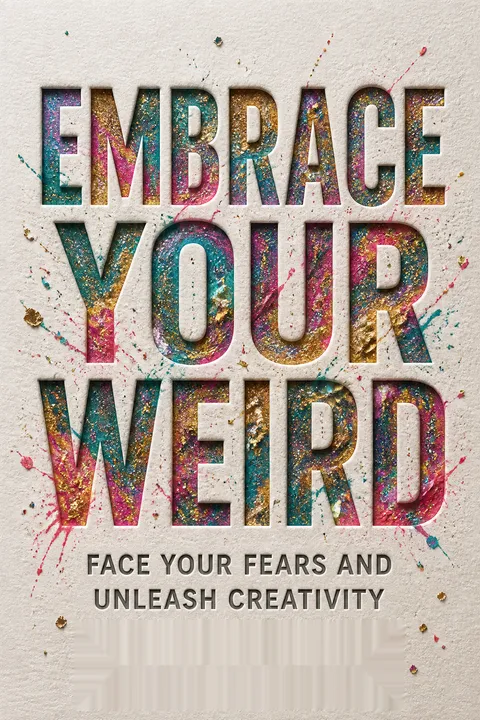


Key Takeaways
Let your odd combinations become the point, not the problem.
Weirdness is usable material. Day argues that creativity is not limited to painting or writing. The way someone dresses, chooses a meal, or notices a detail carries a personal point of view. She calls the evolving sense of who someone is as a creator the Hero-Self. Its distinctiveness comes from a person’s particular mix of interests and experience, not from being unlike everyone in every way.
Combine what already interests you. Day brought gaming and filmmaking together in The Guild, a web series that changed her career. Neither interest belonged to her alone; her specific combination and perspective made the project hers. Readers who told her they had started projects of their own, from a ferret rescue to a comic, showed how one person’s expression can give others permission to try.
What's compelling is the shift from originality as invention from nothing to originality as personal recombination. That resembles how creativity is often understood in fields such as design: familiar elements gain new force when someone connects them in an unexpected way. The book also makes a useful distinction between being unusual and being authentic. Still, uniqueness alone does not guarantee that an idea will work for an audience. Its value here is more immediate: a distinctive starting point makes creation feel personally meaningful, which is often enough to begin.
Create badly and privately before asking whether the work is good.
Lower the stakes first. Day recommends writing quickly, speaking answers aloud, or doodling when words feel stuck. Her exercises invite readers to draw an intentionally terrible horse, scribble without stopping, and mark up the book itself. The point is to make expression possible before the internal editor gets to grade it. A first attempt can be rough and still do its job: getting an idea out of hiding.
Protect the early draft. Day also suggests keeping the process private and stepping back from social media while working. Other people’s attention can make an emerging idea feel like a performance before it has had room to develop. The aim is not to produce an impressive object every time. It is to experience concentration and discover what comes out when judgment is temporarily suspended.
Separating invention from evaluation is a practical way to reduce the threat attached to starting. It echoes a broad principle in creative work: generate possibilities first, then assess and revise them. Private practice can also provide psychological safety, allowing experimentation without immediate social comparison. The limit is that privacy should be a temporary shelter, not a permanent test of worth. Sharing is part of many creative ambitions, and gentle, well-chosen feedback can help a draft improve. The useful sequence is protection first, judgment later.
Use self-knowledge to find material only your life can supply.
Look for emotional patterns. Day uses the Hero-Self exercises to examine childhood, present habits, and future dreams. Readers revisit old interests, memories, and the feelings attached to them. A childhood memory of vomiting at a circus, while wearing a treasured pink dress, helped Day notice how strongly embarrassment shaped her reactions. The point is not to dwell on the incident, but to understand what it reveals about her creative fears.
Recover forgotten pleasures. Looking through childhood photographs reminded Day that baking had once been a refuge. During writer’s block, she made an elaborate chocolate cake and found that the hands-on activity helped shift her mood and return her to writing. The old hobby did not dictate a career. It offered a route back to enjoyment, sensory attention, and a part of herself she had overlooked.
This approach treats identity as something to investigate rather than accept as a fixed label. That connects with narrative psychology, where people make sense of themselves by interpreting memories and recurring themes. The method is especially useful because it searches for both pain and pleasure, not just a polished personal brand. Memory, however, is selective and can be reshaped by the present. A remembered pattern is a clue, not a diagnosis. The strongest use of self-inquiry is to generate experiments, such as revisiting baking, rather than to confine a person to a story about who they used to be.
Choose creative processes you can enjoy, not outcomes others control.
Separate the work from the prize. A dream such as becoming famous depends heavily on other people’s decisions. A dream built around the work itself, such as studying acting or performing with friends, gives the creator actions they can take directly. Day admits that she once hoped Hollywood would recognize her specialness. When that did not happen as she expected, she reconsidered what she actually enjoyed.
Reclaim the part you control. She joined comedy classes, wrote material for herself, and kept training. Those choices did not guarantee acclaim, but they made acting a practice she could pursue without waiting for permission. Day applies the same test to any creative ambition: imagine its ordinary daily work, not just its celebrated result. If the process sounds miserable, the dream may be someone else’s idea of success rather than a life worth choosing.
This is a strong application of intrinsic motivation: sustained effort is easier to justify when the activity itself has value, not merely a hoped-for reward. It also distinguishes controllable actions from external outcomes, a useful principle in careers where selection and recognition are uncertain. Yet external aims are not inherently shallow. Income, status, or an audience can matter, especially when creative work supports a livelihood. The practical question is whether those rewards supplement a process worth doing or are the only reason to endure one that feels empty.
Make the first step small enough to start before confidence arrives.
Avoidance often hides overwhelm. Day describes procrastination not simply as laziness, but as a response to tasks that feel too large, unclear, or dependent on luck. A goal such as winning an acting award cannot be completed by effort alone. Studying, auditioning, and practicing are actions a person can actually take.
Build a controllable path. Break the goal into steps so concrete that the next move feels manageable. If the jump between two steps still feels stressful, add another. Day uses this approach to shrink ambitious plans into actions someone could begin immediately. She also recommends listing neglected tasks, choosing a few easy ones to clear, and deciding whether some can be dropped altogether. Progress comes from movement, not from waiting until the whole route feels comfortable.
The method resembles behavioral design: vague intentions become easier to act on when translated into observable, manageable steps. It also shifts attention away from outcomes governed by gatekeepers or chance. That can build self-efficacy, the belief that one’s actions can make a difference. The necessary nuance is that not every delay is psychological avoidance. Lack of time, money, health, or support can create real barriers. Breaking a task down helps with friction, but it cannot substitute for resources or make an impossible schedule fair.
Separate anxiety from identity, then use a tool that fits.
Treat anxiety as an experience, not a definition. Day describes anxiety as something that can interrupt starting, working, or sharing, while insisting it does not represent a person’s whole self. She offers six possible responses, named Fool, Dump, Protect, Baby, Robot, and Chicken. They include reframing anxious anticipation as excitement, writing out possible solutions, taking a brief break, imagining a loving audience, repeating the worry until it loses force, or deliberately inviting the physical sensation.
Experiment with care. These techniques are options, not a universal cure. Day says different tools work for different people and explicitly treats professional help and medication as valid. Her own experience includes using ongoing support, rather than expecting one exercise to eliminate anxiety. The practical lesson is to notice what is happening, try a fitting response, and seek more help when the problem calls for it.
The separation between a person and an anxious state resembles cognitive defusion, a therapeutic idea in which thoughts are noticed without being treated as the self or as facts. Reframing, writing worries down, and taking a short pause can also make a situation feel more manageable. The advice is strongest when presented as experimentation, not prescription. In particular, deliberately intensifying anxiety may not suit everyone, especially during severe panic or trauma-related symptoms. The book’s acknowledgment of professional care is important: self-help techniques can complement treatment, but should not be mistaken for a replacement.
Let feedback guide revision without turning it into a verdict on worth.
Name the actual fear. Day links procrastination and perfectionism to fear of failure, often rooted in a worry about rejection or lost love. She recommends asking what would happen if the feared failure occurred, then continuing the chain of questions until a next step appears. Naming the fear can make it less vague and allow a person to prepare a reassuring phrase for the moment it returns.
Sort lessons from punishment. Shame can keep a mistake alive long after it has taught anything useful. Regret imagines an unknowable alternate past, while jealousy treats another person’s success as evidence of scarcity. Criticism, by contrast, may contain information about a piece of work, but hostile people do not deserve unlimited access to its creator. Day’s account of a painful acting failure shows how an incident can feel larger than it is and how support can help put it in perspective.
The section is useful because it distinguishes a flawed product from a defective person. In psychology, shame often involves global self-condemnation, while guilt can focus more narrowly on a specific action; that distinction helps explain why shame can paralyze revision. The advice to learn from criticism also needs discernment. A comment can be inaccurate, biased, or simply cruel, and the creator is not obliged to treat every response as expertise. Feedback becomes valuable when it identifies something actionable without claiming authority over the maker’s identity.
Make play and boredom part of the work, not a reward afterward.
Play makes experimentation safer. Day asks readers to invent games, find unusual uses for ordinary objects, and work within playful constraints. She argues that creation need not be grim to be serious. A comic’s limited page count, for example, can prompt invention rather than restrict it. She also recommends periods without phone scrolling, leaving space for attention to wander and for unexpected associations to appear.
Borrow a starting point. Existing work can function as practice rather than a template to copy. Day studied cheerful dance videos before making her own gaming-themed music video, “Do You Want to Date My Avatar.” She reports that it drew almost 30 million YouTube views. The result was not predictable in advance. The useful starting question is not whether an idea will succeed, but whether the process makes someone curious enough to keep going.
Play supports exploration because it lowers the cost of trying an idea and makes repetition less tedious. Constraints can serve a similar role: they reduce the number of choices while inviting clever solutions. Unstructured downtime may also help ideas recombine, though it does not guarantee inspiration, and constant novelty can become another form of distraction. The book’s most practical distinction is between passive consumption and active engagement. A game, remix, or playful exercise becomes creative practice when it asks the participant to make choices and produce something.
Build a small creative circle that expects you to show up.
Find people who make effort visible. Day recommends role models for inspiration, mentors for practical guidance, and peers for encouragement and accountability. Her own weekly group of women in show business helped members share progress. The group’s regular meetings, held over pancakes, made creative intentions harder to ignore. Day credits that accountability with helping her write The Guild instead of leaving the idea undeveloped.
Start close to the work. A class, local group, online community, or thoughtful message to a creator can open a path to useful connection. Support need not come from someone with the same job. A person with a different skill may offer relevant knowledge or ask a question that clarifies the project. The essential feature is a relationship that makes the work feel less isolated and helps the creator return to it.
Creative work can be solitary, but persistence is social too. A group supplies attention, encouragement, and a recurring moment when intentions become visible. This resembles accountability structures used in education and behavior change, where a commitment gains force through being shared. The group’s tone matters: pressure can help, but shame-based monitoring can make experimentation riskier. The best circle combines reliable follow-through with room for unfinished work, changing goals, and honest disagreement.
Reserve time, then finish one project before chasing the next.
Make room in a crowded life. Day asks readers to examine what absorbs their time and prune commitments that do not serve their priorities. Even a short daily interval can keep a creative goal alive. A small, repeatable practice, such as writing or making one photograph, helps gather ideas instead of losing them to distraction.
Finish to learn. New ideas often look easier because the creator imagines them already complete. Day urges readers to choose one project, map its steps, make a personal commitment, and see it through before switching to the next bright possibility. Her closing challenge is not to produce a masterpiece on demand. It is to begin, continue through the awkward middle, and finish something. Completion gives a creator evidence of what the process actually required and makes the next project less abstract.
The emphasis on finishing counters a common bias: beginnings feel rewarding because possibility is still unlimited, while completion requires trade-offs and revision. A modest recurring practice can make creative work more accessible, but consistency is not a moral test. People with caregiving duties, unstable work, or limited resources may have little discretionary time to protect. The useful principle is proportionality: make a realistic space, define a finish line appropriate to the project, and treat interruptions as conditions to plan around rather than proof of personal failure.
Analysis
Embrace Your Weird is less a manual for producing a particular kind of art than a guided argument for reclaiming the right to make things. Its structure follows a persuasive arc: permit imperfect expression, investigate the self, identify internal and external obstacles, restore play, then make a concrete commitment. Day’s autobiographical stories keep that arc human. Her early embarrassment, anxiety, career disappointments, and eventual web projects show creativity as a practice built amid uncertainty, not a talent that appears fully formed.
The book’s distinctive strength is its refusal to reserve creativity for professionals. Choosing food, describing a cat, recovering a childhood hobby, or making a deliberately bad drawing all count as evidence that a person already has a point of view. This lowers the threshold for entry without pretending that ambitious work requires no effort. Day repeatedly returns to the harder truth: projects demand work, and a creator must tolerate poor drafts, unwanted feedback, and stretches when progress feels slow.
Its exercises are deliberately physical and playful. Writing, drawing, tearing pages, collecting images, and changing a room turn abstract encouragement into action. The humor is not decoration alone; it helps puncture the solemn idea that creative work must be painful to be legitimate. The book’s invitation to protect vulnerable work also recognizes that openness is not always virtuous. Some people are unsafe audiences, and boundaries can preserve the conditions needed to continue.
The main limitation is that agency can sound more available than it is. A tiny first step may help with overwhelm, but it cannot erase financial constraints, discrimination, disability, or a lack of time. Nor can a personal exercise address every form of anxiety or shame. Day is most convincing when she presents her tactics as experiments and acknowledges professional support, rather than as universal cures.
The lasting value is a practical change in orientation: stop waiting to feel like a legitimate creator. Use personal oddities as raw material, make a low-stakes first attempt, find people who support the work, and keep enough time to finish. The result may be a career, a hobby, or simply a more expressive life. The point is to let the process belong to the person doing it.
Review Summary
Embrace Your Weird is a creativity workbook by Felicia Day that combines humor, personal anecdotes, and interactive exercises designed to help readers unlock their creative potential. Reviewers praise Day's witty, relatable writing style and encouraging tone, though many note the book works best in physical format rather than audiobook due to its interactive nature. Reactions are mixed: fans appreciate her quirky personality and practical advice on overcoming creative blocks, perfectionism, and anxiety, while critics find her perkiness excessive or the content too general. Most agree the exercises are valuable if readers commit to completing them.
People Also Read







Glossary
Hero-Self
Creative self-understandingDay’s term for a person’s developing understanding of who they are as a creator. It is built by examining childhood interests, present-day habits and emotions, personal quirks, and future ambitions. The Hero-Self is not a fixed role or a polished public identity. It is a working picture of the experiences and preferences someone can draw on when making and sharing creative work.
Fool, Dump, Protect, Baby, Robot, Chicken
Anxiety-management exercisesSix techniques Day proposes for responding to anxiety. Fool reframes anxious anticipation as excitement. Dump lists possible solutions to the worry. Protect means taking a break or otherwise advocating for oneself. Baby imagines a loving, nonjudgmental audience. Robot repeats the worry until it feels less charged. Chicken deliberately invites or exaggerates anxious sensations. Day presents them as options, not universal treatments.
Flowchart of Fear
A feared-outcome sequenceA writing exercise for making a vague fear more concrete. The person states the feared outcome, asks what would happen if it came true, and continues asking what comes next. Following the consequences can reveal that there is a next action or a way to cope, even in an unwanted scenario. The exercise aims to reduce the power of uncertainty, not promise that failure will be painless.
Counterspell
A reassuring fear-responseDay’s name for a personal sentence or phrase designed to answer the root belief beneath a fear of failure. The creator first identifies what failure seems to threaten, such as being loved or accepted, then forms a response that feels emotionally credible. Repeating that response can provide reassurance before or during a vulnerable creative task.
Trash file
Unedited pre-work writingA private document or journal used to write freely before beginning a more demanding creative task. Day recommends setting aside a short period to record worries, jokes, observations, or anything else that comes to mind, without editing. The material does not need to be saved or used. Its purpose is to loosen self-censorship and make starting the main work easier.

Download PDF
Download EPUB
.epub digital book format is ideal for reading ebooks on phones, tablets, and e-readers.








