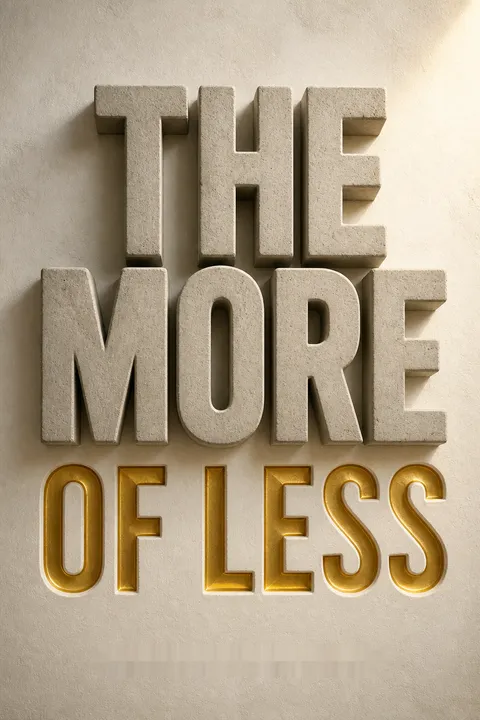


Key Takeaways
Use minimalism to reclaim the life your possessions are quietly consuming
The garage revealed the cost. On a spring-cleaning Saturday, Joshua Becker spent hours clearing his crowded garage while his five-year-old son, Salem, waited to play. A neighbor mentioned that her daughter owned less. Becker looked from the pile of belongings in the driveway to his lonely son and saw the real problem: possessions were taking time away from what mattered. His family removed about half their belongings within six months.
Minimalism, as Becker defines it, means deliberately making room for what matters by removing distractions. The payoff is not an empty house. It is more time and energy, less financial pressure, and greater freedom to invest in family, interests, and service.
The garage story makes an abstract cost visible: possessions require attention even when nobody is using them. This resembles the idea of cognitive load, where unfinished tasks and visible clutter compete for mental bandwidth. The more important question is not how many objects a person owns, but what those objects demand in upkeep, money, and attention. Still, possessions are not inherently burdensome. Tools, books, or equipment can make valued activities possible. The useful test is whether ownership supports a chosen life or quietly displaces it.
Build minimalism around your purpose, not someone else's rules
There is no universal quota. Some minimalists in Becker's circle lived with only a backpack, while others kept a family home and the belongings needed for their work and relationships. Becker and his wife kept a large dining table because hosting guests mattered to them, even though they rarely used all its seats for themselves. Their golf clubs, which served no important purpose, went.
The book distinguishes minimalism from extreme deprivation: the aim is to remove what obstructs your priorities, not to own the fewest possible things. People may need different possessions because they have different families, work, interests, and obligations. If your purpose is unclear, start reducing obvious excess anyway. The decisions can help reveal what you value, while those values guide what stays.
This purpose-first approach helps keep minimalism from becoming another status contest, this time over who owns the least. In design, a tool is judged by whether it serves its user and task, not by its appearance in isolation. The same logic makes a dining table valuable in one household and unnecessary in another. The approach also allows goals to emerge through action rather than demanding a perfect life plan before beginning. Its limit is that people can rationalize almost any purchase as useful, so purpose needs to be tested against actual use and trade-offs.
Question what your purchases are supposed to make you feel
Buying often answers an emotional need. Becker describes consumer culture as an environment that links products to happiness, status, security, and belonging. Its influence is reinforced by advertising and store tactics that encourage hurried decisions, such as false urgency, sale labels, and rewards for spending. But external pressure is only part of the story. People may also shop to soothe themselves or to feel secure, accepted, or finally content.
A couple in the book discovered that frequent online orders of relatively inexpensive items had added up to more than $10,000 over four years. The purchases had felt minor, but together they crowded out a trip they wanted to take. Reviewing what buying is meant to provide can expose the real need and point toward a better way to meet it.
The story of the online orders captures a behavioral-economics problem: small, immediate rewards can obscure their cumulative cost. A transaction can feel trivial in isolation while repeated frictionless purchases reshape a budget. Naming the emotional job of a purchase also helps distinguish genuine need from a marketing promise. Yet the book's emphasis on personal responsibility should not erase structural pressures, including targeted advertising and economic insecurity. Self-examination is most useful when it builds agency, not when it turns every purchase into a moral failure.
Start with easy, visible clutter, not your hardest memories
Small wins create momentum. Becker recommends writing down why you want to simplify, then beginning in a frequently used place where unwanted items are easy to spot. His own first step took about fifteen minutes: he cleared unnecessary objects from his car and immediately noticed the calm of a space with fewer distractions. He then worked through the home room by room, sorting items to keep, relocate, or remove.
For belongings to remove, he suggests deciding whether to donate, sell, recycle, or discard them, rather than letting the pile linger. He also recommends handling items individually instead of scanning past them. Starting with a garage full of keepsakes or a partner's belongings risks turning the first step into a fight. Start somewhere achievable, then build skill and confidence.
A visible result can make a change feel real in a way that good intentions cannot. Small, bounded tasks also lower the effort required to begin, a principle used in behavioral design. Choosing an everyday space has an added advantage: the improvement is repeatedly experienced, making the new standard easier to notice. Still, small wins can become a form of avoidance if the difficult areas are never addressed. Their value lies in building capacity for harder decisions, not in polishing one drawer forever.
Test uncertain possessions instead of trusting your imagined future
Use a reversible trial. Becker's living-with-less experiment asks a person to set aside an item or category for a defined period, then decide whether to keep it based on experience. He often used twenty-nine days, not because the number is special, but because a clear end date makes a trial manageable. Courtney Carver's Project 333 tested dressing with a limited wardrobe for three months. Becker's family also tried becoming a one-car household, but after four months they decided two cars better fit their jobs and schedules.
For possessions that feel too difficult to release, Becker calls temporary boxed storage leveling. Label and store the items, then review them after some time away. The point is not to force a yes or no in advance, but to learn what daily life actually requires.
These trials turn vague fears into observations. Reversible choices are useful because people often overestimate how much they will miss a possession, or underestimate the inconvenience of doing without it. A trial also makes room for context: one car may work for a remote household and fail for a family with separate commutes. The evidence is personal rather than scientific, so the trial needs sensible boundaries. Essential medication, safety equipment, and other high-stakes items are poor candidates for casual experimentation.
Make a clear home easier to maintain than a cluttered one
Replace the old routines. Removing excess is different from repeatedly organizing it. Once a household has reduced its belongings, Becker recommends habits that stop clutter from returning: deal with dishes and mail promptly, keep flat surfaces clear, put clothes away, and return misplaced items each evening. Small tasks are easier when every object has a proper place and there are fewer objects to manage.
He also suggests interrupting the buying cycle with a temporary shopping ban, watching less television, and changing expectations around gifts. Gratitude is another practice: paying attention to what is already useful and appreciated can weaken the reflex to seek satisfaction in the next purchase. These habits protect the space created by decluttering and make restraint part of ordinary life, rather than a one-time cleanout.
Maintenance depends less on heroic effort than on defaults. A recycling bin near incoming mail, or a clear home for frequently used items, makes the desired behavior easier and reduces repeated decisions. Shopping bans can similarly interrupt automatic habits long enough for preferences to reset. Gratitude may help redirect attention toward what is already present, but it should not be treated as a cure for financial strain or compulsive shopping. Practical supports, including budgets and limits on easy purchasing, can complement reflection.
Model less, set boundaries, and never rank possessions above family
Invite the family, do not impose. Becker advises discussing the benefits of owning less in a calm moment, listening to a partner's concerns, and beginning with one's own belongings. In one early mistake, he discarded sports-shaped gelatin molds his wife planned to use for their son's birthday. The disagreement taught him not to treat shared or other people's possessions as his to remove.
With children, parents can explain the reasons for reducing clutter and agree on concrete limits. Becker's daughter could keep toys that fit in her closet and artwork that fit in a designated bin, then choose what to remove when space ran out. With teenagers, he recommends modeling, asking them to pay for some expensive wants, and helping them question advertising. Patience matters more than enforcing a perfectly minimalist household.
The advice respects a distinction that many lifestyle programs miss: one person's desired simplicity can become another person's loss of control. Shared decisions preserve trust, and concrete boundaries give children a way to practice choice without turning every item into a negotiation. The gelatin molds make the point with welcome humility. A minimalist goal should not be used to override a partner's autonomy or diagnose ordinary attachment as pathology. Where hoarding or distress is severe, professional support may be more appropriate than household rules.
Turn surplus money, belongings, and time into help others can use
Giving can make decluttering useful. Becker and his wife initially tried a garage sale, spending a day to earn $135. They found greater satisfaction by contacting local charities that needed baby supplies, linens, and cookware. The shift changed the question from how much money an unwanted item might earn to who could use it now.
The book extends generosity beyond donations. Reduced spending can free money for causes, while less time spent earning and maintaining possessions can create room to volunteer. Becker tells of Ali Eastburn, who sold her wedding ring to help fund clean-water wells; friends followed her example, and the effort grew into an organization. Giving is not a requirement for minimalism, but it offers a concrete use for resources released by owning less.
The donation story turns excess into a relationship between a giver and an actual need, rather than a private exercise in tidiness. Research across psychology and public health has associated prosocial behavior with well-being, although effects vary and do not make generosity a guaranteed route to happiness. The strongest version of this idea centers recipients' needs and dignity, not the giver's emotional reward. Selling may also be sensible for valuable items or when money is urgently needed. The principle is to choose a useful destination, not to romanticize giving everything away.
Apply the same subtraction to calendars, not to human worth
Intentionality extends beyond objects. Becker argues that the same question used to evaluate possessions can help with schedules: does this activity support a priority, or does it displace one? He recommends creating quiet space, reducing digital distractions, declining lower-priority commitments, and protecting time for rest. For physical health, he reframes care as keeping the body capable of serving one's chosen work and relationships, rather than chasing appearance alone.
Relationships require a different standard. Becker says that abusive or persistently harmful relationships may need firm limits or an end, but people should not be sorted like possessions by whether they provide immediate benefit. His friendship with John, a man facing addiction and instability, gives him opportunities to offer patience and care even when the relationship is not reciprocal.
The contrast between calendar choices and relationships is ethically important. Activities can often be removed with limited moral consequence, while people have needs and dignity that resist a simple efficiency test. The book's distinction also challenges a self-help tendency to label every demanding relationship as toxic. At the same time, compassion does not require unlimited access: boundaries can protect safety and preserve a person's capacity to care. The useful question is not whether someone is profitable to know, but what form of connection is humane and sustainable.
Spend your recovered freedom on a purpose larger than shopping
The point is what comes next. Becker closes with a story about a merchant who gives up lesser possessions to obtain a pearl he values more. The comparison is not a demand to pursue one prescribed goal; it asks readers to identify what matters enough to justify the trade. For Becker and his wife, that purpose included creating The Hope Effect, a nonprofit seeking family-style care for children without parents.
Minimalism can release time, money, and attention, but those resources do not automatically become meaningful. They need to be directed. A person might pursue travel, art, family life, or community work. Becker especially urges readers to include service to others, arguing that ordinary interactions already carry influence. The final measure is not a bare house, but what the freed resources make possible.
This ending gives the book a moral destination without making decluttering the destination itself. Purpose can organize choices more strongly than an abstract desire to own less, and service can connect private changes to public benefit. The proposal is persuasive partly because it links restraint to concrete action, such as family-based care. Still, the book's preference for other-directed goals should not imply that recreation, rest, or personal ambition is selfish by definition. Sustainable contribution often depends on caring for oneself, too. The deeper test is whether a chosen life reflects considered values rather than inherited consumer scripts.
Analysis
The book's most important move is to recast decluttering as a question of allocation. Objects consume resources beyond their purchase price: money, storage, maintenance, attention, and sometimes the labor of family members. Removing them can return those resources, but the return is only potential. The book's argument is strongest when it asks what a person intends to do with the recovered capacity, not when it treats a sparse room as proof of virtue.
Its practical wisdom comes from lowering the stakes of change. Start with an easy area, try living without uncertain items, and make decisions from experience. These methods replace imagined regret with evidence and allow minimalism to vary by household. The emphasis on family consent is equally important. A home is shared infrastructure, and one person's tidy ideal can become another person's imposed loss. The book is unusually clear that relationships outrank the project.
Its account of consumerism usefully combines external influence and internal desire. Advertising can attach belonging or security to products, while buying may serve as a quick response to anxiety or dissatisfaction. Yet the framework risks sounding too individual when it treats overconsumption mainly as a personal choice. Housing costs, economic volatility, disability, caregiving, and unequal access to durable goods shape what people keep and buy. Ownership can be a rational form of resilience, not merely excess.
The book also makes a moral case for generosity, drawing a line from reduced consumption to service. That connection is inspiring, but not automatic: savings can be spent, time can be filled with new obligations, and giving can be poorly directed. The lasting lesson is therefore less about owning a prescribed number of objects than about repeatedly comparing actual commitments with stated values. Minimalism becomes useful when it functions as a decision practice: identify the life worth protecting, remove costs that obstruct it, and reassess as circumstances change.
Review Summary
The More of Less received mixed reviews. Many readers found it inspiring and practical for decluttering, appreciating Becker's Christian perspective and emphasis on purposeful living. However, some felt it was repetitive or too religious. The book's strengths include practical tips, personal stories, and a focus on the benefits of minimalism beyond just owning less. Critics noted that experienced minimalists may not find new information. Overall, readers praised Becker's approach to minimalism as a tool for living intentionally and generously.
People Also Read


Glossary
Minimalism
Purposeful ownership reductionBecker uses minimalism to mean intentionally emphasizing what a person values and removing possessions that distract from it. It is not a demand to own almost nothing, follow a universal quota, or make a home look bare. The appropriate level of ownership depends on the person's purposes, relationships, and circumstances.
heuristical process
Learning by simplifyingA learning-as-you-go approach in which reducing possessions helps clarify goals and values, while those goals guide further decisions about what to keep. The process moves in both directions: people do not need a fully formed life plan before beginning, because practical decisions can help them discover what matters.
Leveling
Temporary storage for decisionsBecker's term for setting uncertain possessions aside, usually in labeled boxes stored out of sight, rather than deciding immediately whether to keep or remove them. After a defined period, the owner reviews the items with some distance from them. It is an intermediate step toward a final decision, not permanent decluttering.
Project 333
A limited wardrobe trialA clothing experiment created by Courtney Carver. For three months, participants dress using thirty-three clothing-related items, including shoes and jewelry, with certain categories such as underwear, sleepwear, and workout clothes excluded. The aim is to test whether a smaller wardrobe can simplify dressing and reduce the stress of excess clothing.
Packing Party
Unpack only what you useAn experiment in which Ryan Nicodemus and a friend packed nearly all the possessions in his home into boxes. Nicodemus unpacked items only when he needed them, making unused belongings visible as unused rather than merely stored. The exercise helped him test assumptions about what his home and daily life actually required.
Only the best
Keep the most meaningful itemsBecker's approach to sentimental possessions: keep a small selection that is especially meaningful or representative, rather than preserving every object connected to a person or memory. He recommends displaying chosen keepsakes so they remain part of daily life. Photographs or donation to someone who can use an item may help with letting the rest go.
financial dividend
Money freed by owning lessBecker's name for the money that may become available when people stop buying unnecessary goods and reduce the costs of maintaining possessions. He suggests using this money for debt reduction, saving, better-quality necessities, or charitable giving. It is a possible result of changed spending, not a guaranteed financial gain.
FAQ
What's "The More of Less" about?
- Core Concept: "The More of Less" by Joshua Becker is about embracing minimalism to find a more meaningful and fulfilling life. It encourages readers to reduce their possessions to focus on what truly matters.
- Personal Journey: The book shares Becker's personal journey from clutter to minimalism, highlighting how owning less can lead to more freedom and joy.
- Practical Advice: It provides practical steps and strategies for decluttering and simplifying life, making it accessible for anyone interested in minimalism.
- Broader Impact: Beyond personal benefits, the book discusses how minimalism can lead to greater generosity and positive societal impact.
Why should I read "The More of Less"?
- Life Transformation: The book offers a pathway to transform your life by reducing clutter and focusing on what truly matters, leading to increased happiness and fulfillment.
- Practical Guidance: It provides actionable steps and strategies for decluttering, making it easier for readers to start their minimalist journey.
- Inspiration and Motivation: Through personal stories and testimonials, the book inspires readers to embrace minimalism and the benefits it brings.
- Broader Perspective: It encourages readers to consider the impact of their consumption on the environment and society, promoting a more sustainable lifestyle.
What are the key takeaways of "The More of Less"?
- Minimalism Definition: Minimalism is about promoting the things we most value and removing anything that distracts us from them.
- Benefits of Owning Less: Owning less can lead to more time, money, freedom, and less stress, allowing for a more intentional and fulfilling life.
- Generosity and Impact: Minimalism can lead to greater generosity, as it frees up resources to help others and make a positive impact on the world.
- Personalized Approach: Minimalism is not one-size-fits-all; it should be tailored to individual goals and lifestyles.
How does Joshua Becker define minimalism in "The More of Less"?
- Intentional Promotion: Becker defines minimalism as the intentional promotion of the things we most value.
- Removal of Distractions: It involves removing anything that distracts us from our values and goals.
- Personalized Practice: Minimalism is unique to each person and should be practiced in a way that aligns with individual purposes and lifestyles.
- Focus on Benefits: The focus is on the benefits of owning less, such as increased freedom, time, and resources for meaningful pursuits.
What practical advice does "The More of Less" offer for decluttering?
- Start Small: Begin with easy areas like a drawer or a car to build momentum and experience quick wins.
- Room-by-Room Approach: Tackle one room at a time, sorting items into keep, relocate, and remove piles.
- Eliminate Duplicates: Reduce clutter by getting rid of duplicate items, keeping only what is necessary.
- Experimentation: Try living without certain items for a set period to determine if they are truly needed.
How does "The More of Less" suggest dealing with sentimental items?
- Keep Only the Best: Retain only the most meaningful and high-quality sentimental items.
- Photograph Items: Take photos of items before discarding them to preserve memories without physical clutter.
- Give Items New Life: Donate sentimental items that others can use, allowing them to create new memories.
- Set Boundaries: Limit the amount of space or number of items you keep to maintain control over sentimental clutter.
What role does generosity play in "The More of Less"?
- Outcome of Minimalism: Generosity is a natural outcome of minimalism, as owning less frees up resources to help others.
- Motivation for Minimalism: The desire to be more generous can also motivate individuals to embrace minimalism.
- Practical Steps: The book encourages donating unneeded items to charities and using financial savings from minimalism to support causes.
- Personal Fulfillment: Generosity leads to personal fulfillment and happiness, as it aligns with living a life of purpose and impact.
How does "The More of Less" address family involvement in minimalism?
- Communication is Key: Discuss minimalism with family members, explaining its benefits and addressing concerns.
- Model Behavior: Lead by example, showing the positive effects of minimalism in your own life.
- Set Boundaries: Establish clear guidelines for possessions and involve family members in the decluttering process.
- Celebrate Progress: Reward family participation with experiences that highlight the benefits of minimalism.
What are some of the best quotes from "The More of Less" and what do they mean?
- "The more stuff you own, the more your stuff owns you." This quote highlights how possessions can control our time, energy, and focus, detracting from what truly matters.
- "Minimalism is the intentional promotion of the things we most value and the removal of anything that distracts us from them." It defines minimalism as a purposeful lifestyle choice focused on values.
- "Our excessive possessions are not making us happy. Even worse, they are taking us away from the things that do." This emphasizes the negative impact of clutter on our happiness and priorities.
- "Once we let go of the things that don’t matter, we are free to pursue all the things that really do matter." It encourages readers to embrace minimalism to focus on meaningful pursuits.
How does "The More of Less" suggest maintaining a minimalist lifestyle?
- Daily Routines: Incorporate daily habits like making the bed and clearing flat surfaces to prevent clutter.
- Shopping Bans: Implement temporary bans on shopping to break the cycle of unnecessary consumption.
- Limit Media Consumption: Reduce television and media exposure to decrease consumerist influences.
- Practice Gratitude: Cultivate gratitude to appreciate what you have and reduce the desire for more.
What challenges does "The More of Less" address in adopting minimalism?
- Family Resistance: The book offers strategies for involving family members and addressing their concerns about minimalism.
- Sentimental Attachments: It provides guidance on dealing with sentimental items and the emotional challenges of letting go.
- Consumer Culture: The book discusses the pervasive influence of consumerism and how to resist its pull.
- Personal Habits: It addresses the difficulty of changing long-standing habits and offers practical steps for doing so.
How does "The More of Less" encourage readers to pursue their dreams?
- Freedom from Clutter: Minimalism frees up time, money, and energy to focus on personal passions and goals.
- Intentional Living: The book emphasizes living intentionally, making choices that align with long-term dreams and values.
- Service to Others: It encourages using the resources gained from minimalism to help others and make a positive impact.
- Pursue Big Dreams: Readers are urged to take action on their dreams, using the freedom and clarity gained from minimalism to live a more fulfilling life.
About the Author
Download PDF
Download EPUB
.epub digital book format is ideal for reading ebooks on phones, tablets, and e-readers.








