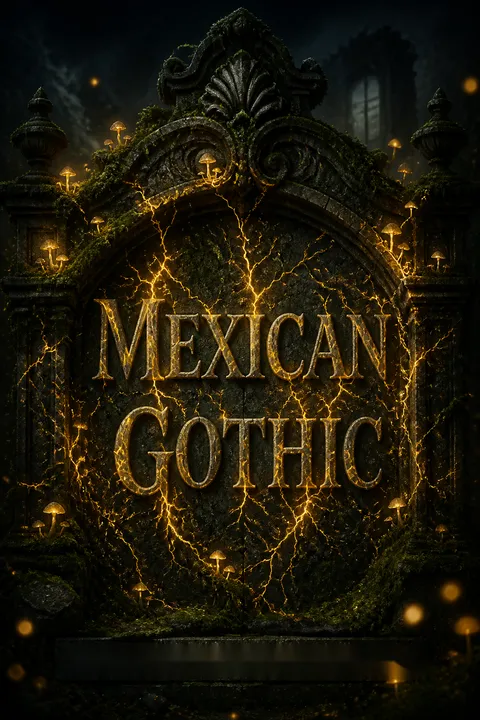


Plot Summary
A Letter From High Place
At a Mexico City costume party, Noemí Taboada is called home by her father, Leocadio. Her cousin Catalina has written from High Place, the isolated Doyle estate where she lives with her husband, Virgil. The letter claims Virgil is poisoning her and that the house harbors ghosts, but its disordered handwriting makes the family fear Catalina is seriously ill.
Leocadio distrusts Virgil and worries that Catalina may be trapped far from proper medical care. He sends Noemí to assess her condition and persuade the Doyles to bring her back to the city. Noemí agrees partly to help her cousin and partly because Leocadio promises to let her pursue graduate study if she succeeds. On Monday, she boards the train for El Triunfo.
The story begins with a conflict over who gets to define a woman’s distress. Leocadio recognizes the possibility of danger, yet his authority over Noemí remains transactional: her freedom to study becomes payment for entering another family’s private crisis. Noemí accepts the assignment as a test of competence, not yet understanding that the journey will challenge her confidence in reason as well as her social freedoms. Catalina’s letter is both a plea and an unreliable-looking document, establishing the novel’s central problem: the evidence of suffering can be dismissed as illness precisely when it most needs to be believed.
The House Above El Triunfo
Francis Doyle, a pale, hesitant cousin, collects Noemí at the mountain station and drives her through fog to High Place, a decaying Victorian mansion far above the fading mining town. Florence, his severe mother, lays down restrictions: Noemí must keep quiet, avoid wandering, and seek permission before going to town.
Noemí sees Catalina briefly in her bedroom. Catalina looks familiar but subdued, says she has tuberculosis, and cannot explain the alarming letter. At dinner, the ancient patriarch Howard Doyle arrives and questions Noemí about her Mexican and Indigenous heritage, framing his curiosity through racial hierarchy and eugenics.
Virgil, Catalina’s handsome husband, offers little warmth. Surrounded by silence, tarnished silver, and portraits of pale Doyles, Noemí begins to understand that this household’s rules are not ordinary hospitality.
High Place makes power tangible through routine. Florence controls movement and access; the family’s silence turns ordinary conversation into an act of defiance. Howard’s racial theories are not an eccentric dinner topic but the language through which he ranks people and imagines inheritance. Noemí’s polished social confidence helps her resist his scrutiny, yet her authority as a visitor is limited by the household’s control of rooms, transport, and medical information. The house’s faded grandeur mirrors a family that clings to status after losing its wealth, preserving hierarchy even as the material world that supported it decays.
Silver Behind the Fog
The next day, Noemí explores High Place and finds its library stocked with mold-damaged books and eugenics journals. The serpent eating its tail appears on a rug, then again on the iron gates leading to the family cemetery.
Francis walks her among the neglected graves and explains that many English workers died after Howard reopened the mine in the 1880s. The Mexican workers are largely absent from this memorial ground. Francis speaks wistfully about the train station and the world he has never been allowed to see, while Noemí describes her own studies and city life.
His candor contrasts with the family’s practiced reserve. The cemetery’s missing names and the house’s collected silver leave Noemí with a sharper sense of what the Doyles preserve, and whose lives their history excludes.
The cemetery makes the family’s nostalgia selective: English graves receive a designated resting place, while local laborers remain largely unmarked. The contrast between the silver locked inside High Place and the town’s poverty turns historical wealth into present evidence of extraction. Noemí’s interest in anthropology gives her tools for noticing how memory is organized, though she has not yet grasped the supernatural machinery behind the house. Francis’s longing for travel also introduces a quieter form of confinement. His limits are not only geographical; obedience has taught him to treat a life beyond the estate as almost unimaginable.
Marta's History of Ruth
Wanting a second medical opinion, Noemí drives into El Triunfo and meets Dr. Julio Camarillo, the young public-clinic physician. He has never been invited to High Place and recounts repeated epidemics tied to the mine, including deaths among local workers.
He hesitates to challenge the Doyles, whose money still carries weight in the impoverished town. Noemí also finds Marta Duval, a local healer whom Catalina had secretly visited. Marta promises to prepare another sleeping remedy and tells Noemí the town’s account of Ruth Doyle: before a planned marriage to her cousin, Ruth’s lover Benito disappeared, and Ruth later attacked members of her family.
Marta connects this history to an earlier miners’ strike led by Benito’s uncle, Aurelio. Her stories make High Place’s troubles look older and more deliberate than a single illness.
Noemí’s investigation exposes two competing systems of authority. Camarillo offers institutional medicine but is constrained by local economics and the Doyles’ influence; Marta offers community memory that official accounts have neglected. Neither source gives Noemí a complete explanation, and her own preference for rational evidence keeps her wary of talk of curses. Yet Marta’s account connects domestic violence to labor exploitation: the same family that disciplines women also withholds workers’ wages and treats local lives as expendable. The novel makes folklore a form of historical record, especially where the powerful have controlled what gets written down.
Catalina Hears the Walls
When Camarillo visits High Place, Catalina first jokes with him, then grows agitated and says that dead people speak from inside the walls. The doctor concludes that she needs psychiatric attention, though he cannot arrange it himself.
Virgil dismisses the assessment and insists that Catalina remain under the care of the family’s physician, Arthur Cummins. In the greenhouse, he tells Noemí that his family has a history of violence and argues that people cannot escape their inherent nature. Noemí challenges him, but he will not move Catalina.
Meanwhile, her own nights grow unsettled: she dreams of a golden woman and later wakes after wandering the corridors, where Virgil finds her and escorts her back. The house’s symbols and Catalina’s warnings are no longer merely decorations and strange talk.
Catalina’s brief return to humor makes her subsequent terror harder to dismiss as a fixed identity. Camarillo observes a change in her behavior, but Virgil converts his wife’s distress into a matter he alone can manage. His fatalism about inherited nature echoes Howard’s eugenics, revealing a family ideology that treats people as predictable material rather than autonomous selves. Noemí’s sleepwalking begins to erode the boundary between observer and patient. She still seeks explanations from medicine and chemistry, but the house has started to affect her directly, turning the investigation into a test of her own perception.
The Tincture Turns Dangerous
Noemí returns with the bottle Marta prepared, believing Catalina asked for it to help her sleep. Catalina takes several spoonfuls, then collapses into a violent seizure. Noemí tries to protect her cousin and calls for help, but Florence bars her from the room.
Dr. Cummins blames an opium tincture and Florence accuses Noemí of poisoning Catalina. Virgil privately berates her for interfering, and Noemí accepts that her attempt to help may have made matters worse.
The next day, Francis finds her in the cemetery and tells her Catalina had reacted badly to the same remedy before. He also says Catalina is miserable at High Place. Noemí cannot bring herself to leave, and Francis agrees to take her back to town to investigate what was actually in the bottle.
The seizure gives Noemí a painful lesson in the difference between good intention and competent care. The Doyles exploit that mistake to discredit her concern, while withholding the fact that Catalina has had a similar reaction before. Francis’s disclosure complicates the family’s accusation without absolving Noemí of responsibility. Her guilt makes her more vulnerable to control, but it also deepens her commitment to Catalina: leaving now would feel like abandoning someone she has already failed. This is a crucial emotional turn from confident envoy to implicated relative, driven by a concrete consequence rather than a sudden change of temperament.
Ruth's Hidden Page
During a supervised visit with Catalina, Noemí finds an old page hidden inside her cousin’s poetry book. The unsigned fragment describes voices in the house, a powerful patriarch, and Ruth’s resolve to resist him.
Noemí brings it to Francis and proposes that a chemical exposure, like the mercury associated with old hat-making, might explain the family’s altered behavior. Francis urges her to leave, insisting that a house can haunt people without ghosts, but he will not yet explain more. Their conversation reveals his fear of Howard and his own sense of captivity.
Soon afterward, Noemí sees mold shift on her wallpaper and nearly touches it before a cigarette burns her hand. She asks to leave, but rain and the Doyles’ control keep her at High Place, while her waking perceptions grow less reliable.
Ruth’s fragment gives Noemí an object she can test, but not a clean solution. The page joins the present crisis to an earlier woman’s resistance, suggesting that Catalina’s account belongs to a repeated pattern rather than private instability. Noemí’s chemical hypothesis demonstrates her characteristic method: she tries to translate the uncanny into material causes. Yet the moving mold unsettles the very observer who trusts observation. The episode also sharpens the story’s account of coercion: Noemí is not simply persuaded to stay. Isolation, weather, and restricted transport combine to make departure increasingly difficult.
Howard's Corrupted Communion
Before Noemí can leave, the Doyles summon her to Howard’s room. His body is covered in dark growths, yet he is alive. Virgil and Florence hold Noemí in place while Howard forces foul fluid into her mouth.
The contact plunges her into visions of the Doyle past, including an Englishman who discovers a life-extending fungus and bends it to his own ambitions. After she wakes violently ill, Francis explains that the fungus spreads through High Place and creates the gloom, a network that stores fragments of memory.
It harms outsiders but can bond with the Doyle bloodline, allowing Howard to take new bodies across generations. Noemí understands that Catalina’s visions have a physical source and that she has been infected. Francis reveals that Howard wants her money and children, then offers to help her escape.
The revelation turns the Gothic house from metaphor into organism. Its walls do not merely symbolize family history; they carry a biological network that makes memory, coercion, and inheritance materially entangled. Howard’s so-called communion is violence disguised as sacred custom, forcing Noemí’s body into the system he controls. The distinction between outsider and bloodline explains why the Doyles preserve racial purity while seeking a compatible newcomer when their lineage falters. Francis’s disclosure is both an act of trust and an admission of complicity: he has known enough to fear the system, but not enough courage to oppose it until Noemí arrives.
A Wedding Without Consent
Locked in her room, Noemí learns from Francis how to use small doses of Marta’s tincture to weaken the fungus’s influence without triggering another seizure. He agrees to help her escape with Catalina, though he fears the house will not release him.
Virgil demands that Noemí write to her father claiming she will stay until Christmas, then announces that she will marry Francis. The ceremony is staged in Howard’s room, with an old dress and a piece of fungus offered as ritual food.
Afterward, Virgil enters Noemí’s room while the others are occupied and uses the house’s influence to stir desire and confusion. Noemí recognizes the manipulation, shoves him down, takes the tincture from his pocket, and drinks enough to clear her mind. She then rushes to Catalina’s room to begin the escape.
The imposed wedding makes the Doyles’ strategy explicit: they want control to appear as consent, using ceremony to convert coercion into family legitimacy. Noemí’s agreement is tactical rather than submissive, and the tincture gives her a narrow interval in which to act. Virgil’s manipulation targets the gap between desire and agency, exploiting Noemí’s genuine curiosity about danger to make imposed impulses feel like her own. Her resistance depends not on denying her complexity but on recognizing that complexity can be weaponized. The episode marks a shift from investigating the family’s power to resisting it with information and timing.
The Ritual Breaks Apart
Noemí finds Catalina dazed beside Mary, whose body has been overtaken by the house’s influence. Mary attacks Noemí, and Noemí kills her with Francis’s straight razor when Francis pulls the maid away.
Florence captures the three and takes them to Howard’s bedside, where Cummins is preparing a transmigration into Francis. Catalina suddenly seizes the doctor’s scalpel and stabs Howard in the eye and neck, disrupting the ritual and making the family convulse. Noemí reaches Francis, but Howard’s command still draws him toward the bed.
As the old man raises his ring to complete the transfer, Noemí takes Florence’s gun and shoots Howard twice. The shots weaken his hold long enough for Noemí to pull Francis away. Catalina follows as they flee toward a concealed passage.
The ritual exposes the family’s deepest moral arithmetic: a person counts as a body available for use, while obedience is treated as proof of devotion. Catalina’s sudden violence matters because it reverses her imposed image as passive, fragile, and dependent. Noemí’s killing of Mary is not framed as triumph; it is a desperate act in a structure that has already stripped away safe alternatives. Francis remains subject to Howard’s command even as he resists, showing how family attachment and biological control reinforce one another. The gun buys time, not victory, and sends the survivors into the house’s hidden center.
Agnes Beneath the Crypt
Francis leads Noemí and Catalina through a pantry passage into tunnels beneath the family crypt. Glowing mushrooms guide them to a chamber where Noemí recognizes the golden figure from her visions: Agnes, Howard’s first wife, buried alive and transformed into the living core of the gloom.
Her trapped mind sustains the fungus’s network and the Doyles’ control. Virgil arrives through the crypt and reveals that he let Noemí escape the fungus’s hold so she could injure Howard and weaken his own father.
He now claims authority over the gloom and orders Noemí to submit. The fungus’s influence begins to overcome her again. Francis resists Virgil long enough for Noemí to grasp what Agnes’s buzzing means: not a threat, but a cry of suffering that has never ended.
Agnes’s discovery changes the meaning of the house’s haunting. The supernatural presence is neither a free-floating ghost nor an abstract curse; it is the remnant of a woman’s violated body, converted into infrastructure for male power. The Doyles have made one victim’s suffering the medium through which they dominate descendants, servants, and newcomers. Virgil’s apparent assistance is revealed as strategic, but his plan depends on the same instrumental logic that shaped Howard’s rule. Noemí’s most important insight is ethical as well as tactical: the entity must be understood as a suffering person, not merely an obstacle to escape.
Fire Eats High Place
As Virgil tries to force Noemí back under the fungus’s influence, she recognizes that Agnes’s trapped presence is crying out to be released. Noemí hurls her oil lamp at Agnes’s fungal growth, setting the chamber ablaze and breaking the network’s hold.
Virgil collapses, as does Francis, whose body is bound to the house. Catalina takes the ceremonial knife and kills Virgil while Noemí frees her. Francis is too weak to walk, but the women drag him up through the crypt as the fire spreads through the tunnels and High Place.
They find the cemetery gates and emerge into the mist, carrying Francis between them. Behind them, the mansion burns, consuming the silver, portraits, and fungal web that sustained the Doyle family’s rule. The three leave the mountain together, though they do not yet know what the fungus has left inside them.
The climax requires two distinct acts of violence: Noemí destroys the structure that contains Agnes, while Catalina ends Virgil’s immediate threat. Fire is both a practical weapon and a refusal of preservation; the Doyles’ silver, portraits, and inherited rituals cannot survive the destruction of their living foundation. Yet escape does not equal uncomplicated healing. Francis’s dependence on the house makes the rescue physically costly, and the possibility of fungal remnants prevents the burning from becoming a neat cure. The women leave with agency restored, but the novel preserves uncertainty about what has been passed through their bodies.
A Future Beyond the Mountain
In El Triunfo, Dr. Camarillo treats the survivors and helps them prepare a version of events for the authorities. Noemí stays beside Francis while he sleeps for two days, afraid he may never wake or may carry the fungus beyond High Place.
Catalina urges her to rest, but Noemí keeps watch until Francis opens his eyes. He worries that the house may have survived in him; Noemí cannot promise otherwise. Instead, she tells him they will leave together for Mexico City, where her father is coming to collect them.
She imagines a life among bright, changing streets rather than the closed rooms of the Doyles. Noemí kisses Francis, turning their new attachment into a choice neither family arranged. The ending offers no proof that the danger is gone, only companionship and a future they can attempt to shape.
The resolution answers the opening’s family obligation with a different kind of promise. Noemí began by traveling as Leocadio’s representative; she now chooses a shared future with Francis and accepts that certainty is unavailable. Her optimism is not simple denial: she knows the fungus may persist, and the burned house cannot erase what they experienced. But the final emphasis falls on relationship as a practice of care rather than inheritance or possession. Catalina’s return to companionship and Noemí’s vigil beside Francis suggest recovery will be social and gradual, not a magical restoration of the lives they had before.
Analysis
Mexican Gothic turns the familiar haunted mansion into a system that feeds on bodies, memory, and social obedience. High Place’s failing mine and tarnished silver are not merely signs of a family past its prime. They reveal an elite household trying to preserve its authority after the economic world that sustained it has collapsed. Howard’s eugenics gives this project a vocabulary of fitness and inheritance, while his rituals make domination appear sacred. The novel’s horror therefore joins racial hierarchy, class exploitation, and patriarchal control in one material structure.
Noemí’s investigation asks whose account of suffering gets believed. Catalina’s illness is repeatedly treated as exaggeration or weakness, even when her behavior changes in front of a doctor. Local stories dismissed as superstition preserve facts that the Doyles’ portraits and physicians omit. Noemí’s own scientific reasoning is valuable, but it does not make her immune to manipulation. The fungus can distort desire and perception, turning the confidence to choose into another instrument of control. Her resistance depends on combining evidence, inherited knowledge, and attention to other people.
The story’s most disturbing image is Agnes, whose violated body has become the network supporting the family’s apparent immortality. The Doyles do not defeat death; they relocate its cost onto women, workers, and descendants. Their circular emblem captures that arrangement, but the ending refuses to suggest that destruction erases everything. High Place burns, yet Francis fears what might remain in him. Against that uncertainty, Noemí’s care for Catalina and Francis offers a less grand but more ethical alternative to inherited power: chosen attachment, shared risk, and the possibility of building a life without pretending the past has vanished.
Review Summary
Mexican Gothic is a atmospheric and creepy gothic horror novel set in 1950s Mexico. Many readers praised its vivid imagery, slow-burn tension, and complex themes of colonialism and patriarchy. The story follows Noemí as she investigates her cousin's strange letter from a remote mansion. While some found the pacing slow at first, most were gripped by the eerie atmosphere and shocking revelations in the latter half. A few disliked the body horror elements, but overall it was lauded as an innovative take on classic gothic tropes.
Characters
Noemí Taboada
The restless investigatorA young Mexico City socialite and university student, Noemí is quick-witted, stylish, flirtatious, and more intellectually serious than her family’s expectations allow. She enjoys parties and attention, but these are also skills: she reads a room, turns charm into leverage, and knows when to provoke or retreat. Her shifting academic interests reflect genuine curiosity, not simply flightiness. She is drawn to anthropology because she wants to understand how people live and what they believe, yet she initially trusts her own explanations more than other people’s testimony. Her devotion to Catalina forces her to combine skepticism with attention, and her courage grows through acts of responsibility rather than through a sudden loss of fear.
Catalina Taboada Doyle
The endangered dreamerNoemí’s older cousin, Catalina once cared for the younger children in the family and shared stories, books, and imaginative games with them. Her romantic temperament makes her susceptible to the promise of a beautiful, dramatic life, and she marries Virgil quickly, hoping for a new beginning. At High Place, isolation and illness leave her dependent on people who control her access to family and medical help. She remains perceptive even when her thoughts become difficult to follow, and she tries to communicate what she knows through indirect clues. Her bond with Noemí rests on affection and shared history, not merely on the rescuer-and-patient roles others impose on them.
Francis Doyle
The sheltered naturalistVirgil’s younger cousin, Francis is a shy botanist who collects mushrooms, makes spore prints, and paints careful botanical studies. His gentleness is partly temperament and partly adaptation: raised in a household ruled by Howard and Florence, he has learned to minimize his needs and obey. He envies the world beyond High Place but doubts he could survive outside the only life he knows. His friendship with Noemí gives him a rare audience for his interests and a reason to question his resignation. Francis is not a conventional rescuer; his knowledge matters, but fear and family loyalty complicate his ability to act.
Virgil Doyle
The polished heirCatalina’s husband and Howard’s adult son, Virgil is handsome, self-possessed, and accustomed to being obeyed. He presents himself as a capable host and occasionally offers Noemí moments of warmth, but his courtesy never removes the imbalance of power between them. He is shaped by a household that prizes lineage, wealth, and control, and he speaks of human nature as if people cannot change their essential character. His ambitions are bound to the Doyles’ declining fortunes and the future of the family. His appeal is part of his danger: he can make coercion look like intimacy and make domination sound like a reasonable bargain.
Howard Doyle
The dynastic patriarchThe ancient head of the Doyle family, Howard presides over High Place through rules, rituals, and an obsessive concern with the family line. His interest in eugenics and racial hierarchy gives ideological shape to his possessiveness: he treats bodies as instruments of inheritance and judges people by their supposed fitness. His age and physical frailty do not make him harmless. The family organizes its routines around his preferences, and even adults struggle to oppose him. Howard represents a form of authority that survives the wealth and industry that first supported it, maintained through dependence, fear, and the belief that the family’s past must dictate its future.
Florence Doyle
High Place's strict keeperFrancis’s mother and Howard’s niece, Florence manages High Place and enforces its rules with clipped efficiency. Her reserve can resemble pure cruelty, but her own life has also been shaped by expectations of duty, family, and place. She distrusts Noemí’s influence over Francis and sees the younger woman’s independence as destabilizing. Florence’s orderliness helps keep the household functioning, yet it also protects the family’s power by restricting movement, conversation, and access to information.
Leocadio Taboada
Noemí's calculating fatherNoemí’s father is a successful businessman who has built a fortune in dyes and pigments. He worries that his daughter’s changing interests and social life will keep her from settling into a respectable path, yet he recognizes her intelligence and sends her to investigate Catalina’s condition. His promise to support her graduate studies makes the mission both an act of family care and a negotiation over Noemí’s independence.
Dr. Julio Camarillo
The cautious town doctorThe young physician at El Triunfo’s public clinic, Camarillo wants to help the town but has little institutional power. The Doyles’ private physician and local influence make him wary of entering High Place uninvited. He takes Noemí’s concerns seriously enough to examine Catalina and later treat the survivors, even though he cannot explain the full danger surrounding the family.
Dr. Arthur Cummins
The family's physicianCummins is the Doyle family’s trusted doctor, continuing a relationship begun by his father. He defends the family’s routines and dismisses Noemí’s challenges, presenting himself as a medical authority while remaining deeply entangled with the household he serves. His position shows how professional expertise can be used to reinforce private power rather than question it.
Marta Duval
The healer and storytellerA village healer, Marta prepares plant-based remedies and carries local stories about the Doyles that the family would rather keep private. She is practical about earning a living and sharp about the difference between treating symptoms and solving a deeper problem. Her knowledge comes from community memory as much as from herbs, giving Noemí access to histories absent from High Place’s portraits and formal records.
Ruth Doyle
The defiant family daughterA daughter of Howard Doyle from an earlier generation, Ruth appears in family photographs and town stories as a young woman whose choices unsettled the household. Her interest in plants and remedies connects her to the estate’s greenhouse and its concealed histories. A fragment attributed to her reveals an effort to hold onto her own judgment, making her an important predecessor to Noemí and Catalina.
Richard Doyle
Francis's absent fatherFlorence’s husband and Francis’s father, Richard came from outside the closed Doyle household and once experienced life beyond High Place. His knowledge of languages and his connection to Francis survive in the son’s memories and a small portrait. His history helps explain why Francis imagines escape and fears what the house can do to those who resist it.
Hugo Duarte
Noemí's city suitorA young architect who accompanies Noemí to a costume party, Hugo is attractive and pleasant company, though Noemí is unsure whether she wants a serious attachment. He represents the social world she leaves behind, where flirtation and romance are often treated as games she can end at will.
Mary
A silent household maidOne of High Place’s longtime servants, Mary works quietly under Florence’s direction and is rarely permitted a voice in the household. Her presence reflects the Doyles’ reliance on people whose labor sustains the mansion while their individuality is overlooked.
Agnes Doyle
Howard's first wifeHoward’s first wife, Agnes, is remembered through a portrait, a statue in the cemetery, and the family’s sparse accounts of the past. Her place in the Doyle household is surrounded by ritual and silence. The contrast between her public memorial and the little known about her life makes her a haunting figure in Noemí’s investigation.
Aurelio
The miners' organizerA local miner who challenges Howard Doyle’s decision to withhold the workers’ share of silver, Aurelio becomes a figure in Marta’s account of labor resistance. His story connects the estate’s private history to the exploitation that sustained its wealth.
Benito
Ruth's forbidden belovedAurelio’s nephew, Benito works in the Doyle household and becomes close to Ruth. His presence links a worker’s family to the private world of the Doyles, challenging the class and racial boundaries Howard tries to preserve.
Plot Devices
The Ouroboros
A sign of endless inheritanceThe serpent consuming its own tail appears on the cemetery gates, library rug, greenhouse glass, furniture, and underground chamber. At first it seems to be a family emblem, an old symbol that gives High Place a unified visual language. Its repetition gradually acquires a more literal force: it evokes a lineage that reproduces itself by turning bodies and memories back into the family’s own material. The symbol links the Doyles’ obsession with ancestry to the novel’s recurring cycles of control, violence, and return.
The Gloom
A network that stores mindsThe fungus beneath High Place spreads through walls, foundations, cemetery, and the surrounding air. In symbiosis with the Doyle bloodline, it preserves fragments of memory and allows Howard’s consciousness to persist through descendants. For other people, exposure can produce illness, disorientation, visions, and loss of agency. It makes the house more than a setting: the building becomes a biological system that shapes what its inhabitants can remember, feel, and do. Its origins and effects are gradually explained through Noemí’s experiences and Francis’s knowledge.
Marta's Tincture
A brief breach in controlThe sleeping remedy Marta prepares for Catalina becomes an accidental means of weakening the fungus’s influence. Taken in small amounts, it loosens the house’s hold long enough for a person to think or act more freely; too much can provoke a dangerous seizure. The bottle’s role changes from a secret comfort for Catalina to a tool in Noemí and Francis’s escape plan. Its limited duration and risks prevent it from serving as a simple cure, making timing and restraint essential.
Ruth's Diary Fragment
A clue across generationsA torn page hidden in Catalina’s poetry book connects her warnings to Ruth Doyle’s earlier resistance. Its references to voices, the patriarch, and a plan to resist provide material evidence that the family’s present crisis has precedents. The page does not explain the supernatural mechanism, but it gives Noemí a way to compare women’s accounts across time and question the household’s official version of events. It also shows how written notes can preserve intention when a person’s memory or freedom is under threat.
The Dream Visions
Memory disguised as hauntingNoemí’s dreams and episodes of sleepwalking carry fragments of the house’s stored memories. They arrive as distorted scenes, golden figures, bodily transformations, and recurring instructions, leaving her uncertain whether she is hallucinating or witnessing the past. The visions foreshadow the fungus’s connection to human memory without explaining it too soon. As Noemí learns to interpret them, they become a form of evidence, though never a perfectly clear one. Their ambiguity keeps the reader close to her changing perceptions.
FAQ
Synopsis & Basic Details
What is Mexican Gothic about?
- Socialite investigates family secrets: In 1950s Mexico, socialite Noemí Taboada investigates her cousin Catalina's disturbing claims of poisoning and hauntings at her remote mansion, High Place.
- Unraveling a sinister mystery: Noemí uncovers a dark family history, a controlling patriarch, and a sinister force that binds the Doyle family to the mansion.
- Fighting for liberation: Noemí must confront the oppressive atmosphere and supernatural elements of High Place to save her cousin and break free from the family's curse.
Why should I read Mexican Gothic?
- Atmospheric gothic horror: Experience a chilling and suspenseful tale set in a decaying mansion with a rich and unsettling atmosphere.
- Strong female protagonist: Follow Noemí Taboada, a vibrant and determined socialite who challenges societal expectations and fights for her cousin's freedom.
- Exploration of social themes: Delve into themes of power, identity, race, and colonialism through a gothic lens, offering a thought-provoking and engaging reading experience.
What is the background of Mexican Gothic?
- Post-Revolution Mexico: The novel is set against the backdrop of 1950s Mexico, a period of modernization and social change following the Mexican Revolution, contrasting with the Doyles' clinging to outdated traditions.
- Eugenics movement: The novel references the eugenics movement, reflecting historical attitudes towards race and social hierarchy, particularly the Doyles' obsession with bloodlines and racial purity.
- Mining history in Mexico: The story incorporates the history of silver mining in Mexico, highlighting the exploitation of local labor and the economic influence of foreign families like the Doyles.
What are the most memorable quotes in Mexican Gothic?
- "This house is sick with rot, stinks of decay, brims with every single evil and cruel sentiment.": This quote from Catalina's letter encapsulates the oppressive and sinister atmosphere of High Place and foreshadows the horrors Noemí will uncover.
- "You are much darker than your cousin, Miss Taboada... I imagine they reflect your Indian heritage rather than the French.": Howard Doyle's unsettling observation reveals his racist and eugenicist views, highlighting the novel's exploration of race and social hierarchy.
- "It's the house. The house takes most of my time.": This quote from Catalina emphasizes the oppressive power of High Place and its ability to consume and control its inhabitants, foreshadowing the extent of its influence on her mental and physical state.
What writing style, narrative choices, and literary techniques does Silvia Moreno-Garcia use?
- Atmospheric and descriptive prose: Moreno-Garcia uses vivid descriptions to create a chilling and immersive gothic atmosphere, emphasizing the decay and isolation of High Place.
- Third-person limited perspective: The story is primarily told from Noemí's point of view, allowing readers to experience the mystery and horror alongside her, while also creating suspense and uncertainty.
- Foreshadowing and symbolism: The novel employs subtle foreshadowing and recurring symbols, such as the ouroboros and the mushrooms, to hint at the dark secrets and themes at play, adding layers of meaning to the narrative.
Hidden Details & Subtle Connections
What are some minor details that add significant meaning?
- The state of the cars: The luxurious but dated car Francis uses to pick up Noemí symbolizes the Doyles' faded grandeur and their inability to adapt to modern times.
- The recurring ouroboros motif: The image of the snake eating its tail, found in the library, cemetery gates, and greenhouse roof, represents the Doyles' cyclical history of incest, violence, and decay, as well as their obsession with immortality.
- The lack of mirrors: The absence of mirrors in certain areas of the house, and the distorted reflections in others, symbolizes the characters' fractured identities and the Doyles' desire to control their image and perception.
What are some subtle foreshadowing and callbacks?
- Howard's interest in aesthetics: Howard's unsettling questions about beauty and race foreshadow his eugenicist beliefs and the Doyles' obsession with maintaining a "pure" bloodline.
- Catalina's love for gothic novels: Catalina's fondness for stories like Wuthering Heights foreshadows her entrapment in a gothic setting and the themes of isolation, madness, and forbidden love that she experiences.
- The description of the Paris green wallpaper: Noemí's knowledge of the arsenic-laced green wallpaper foreshadows the insidious and unseen dangers lurking within High Place, mirroring the slow poisoning of Catalina.
What are some unexpected character connections?
- The connection between Ruth and Francis: The revelation that Francis's father was driven to suicide after being driven mad by High Place creates a parallel between his fate and Ruth's, highlighting the cyclical nature of the Doyles' destructive influence.
- The link between Dr. Cummins and the Doyles: The fact that Dr. Cummins's father was also the family's physician and that he was intended to marry Virgil reveals the Doyles' insular nature and their reliance on those who are complicit in their traditions.
- The shared Mazatec heritage: Noemí's Mazatec heritage connects her to the indigenous people exploited by the Doyles, positioning her as a figure who can challenge their colonial legacy and bring about change.
Who are the most significant supporting characters?
- Francis Doyle: Francis, despite his timidity, becomes a crucial ally to Noemí, providing her with information and ultimately helping her escape High Place, demonstrating his hidden strength and desire to break free from his family's control.
- Dr. Julio Eusebio Camarillo: Dr. Camarillo, the local physician, offers Noemí a second opinion on Catalina's condition and provides her with information about the town's history and Marta Duval, highlighting the contrast between the Doyles' insular world and the broader Mexican community.
- Marta Duval: Marta Duval, the local healer, provides Noemí with the sleeping tonic and shares stories about the Doyle family's past, revealing the dark history and the curse that has plagued them for generations.
Psychological, Emotional, & Relational Analysis
What are some unspoken motivations of the characters?
- Howard's desire for immortality: Howard's obsession with eugenics and control stems from a deep-seated fear of death and a desire to perpetuate his legacy through his descendants, driving his manipulative and controlling behavior.
- Florence's need for control: Florence's strict adherence to tradition and her domineering personality stem from a need to maintain order and control in a chaotic and decaying environment, seeking to preserve the Doyles' status and legacy.
- Francis's yearning for freedom: Francis's timidity and compliance mask a deep-seated desire for freedom from his family's oppressive traditions and a yearning for connection and purpose beyond High Place, motivating his eventual alliance with Noemí.
What psychological complexities do the characters exhibit?
- Noemí's internal conflict: Noemí grapples with her desire for independence and intellectual pursuits versus the societal expectations of marriage and domesticity, creating internal tension and driving her to prove herself.
- Virgil's repressed emotions: Virgil's cold and detached demeanor masks a deep-seated resentment towards his father and a struggle to reconcile his family's legacy with his own desires, leading to his manipulative and controlling behavior.
- Catalina's fragile mental state: Catalina's history of loss and her isolation at High Place contribute to her fragile mental state, making her vulnerable to the Doyles' influence and blurring the line between reality and delusion.
What are the major emotional turning points?
- Noemí's realization of Catalina's true state: Noemí's growing awareness of Catalina's mental and physical decline fuels her determination to uncover the truth and save her cousin, shifting her from a curious observer to an active participant in the conflict.
- Francis's decision to help Noemí: Francis's decision to defy his family and help Noemí escape marks a turning point in his character arc, as he embraces his own agency and chooses to break free from the Doyles' control.
- The discovery of Agnes's fate: The revelation of Agnes's mummified remains and the truth about the gloom intensifies the horror and underscores the Doyles' depravity, solidifying Noemí's resolve to destroy High Place and end their reign of terror.
How do relationship dynamics evolve?
- Noemí and Francis's evolving bond: Noemí and Francis's relationship evolves from initial distrust to a genuine connection based on shared empathy and a desire for freedom, culminating in their alliance against the Doyles and their shared escape from High Place.
- Noemí and Virgil's power struggle: Noemí and Virgil's relationship is characterized by a power struggle, with Virgil attempting to control and manipulate her while Noemí resists his influence and challenges his authority, ultimately leading to their violent confrontation.
- Catalina's dependence on Noemí: Catalina's dependence on Noemí highlights the importance of female solidarity in the face of oppression, as Noemí provides her cousin with support and strength, ultimately helping her break free from the Doyles' control.
Interpretation & Debate
Which parts of the story remain ambiguous or open-ended?
- The extent of the fungus's influence: The exact nature and extent of the fungus's influence on the characters' minds and actions remain somewhat ambiguous, leaving room for interpretation about the balance between free will and external control.
- The future of Francis and Noemí: The ending leaves the future of Francis and Noemí open-ended, suggesting the possibility of a new relationship but also acknowledging the challenges they face in overcoming their trauma and building a life outside of High Place.
- The nature of the gloom: The exact nature of the gloom and its connection to Agnes's consciousness remains open to interpretation, blurring the line between psychological horror and supernatural elements.
What are some debatable, controversial scenes or moments in Mexican Gothic?
- The attempted rape scene: The attempted rape scene between Virgil and Noemí is a controversial moment that raises questions about the use of sexual violence in gothic literature and its potential to be exploitative or empowering.
- The ending violence: The graphic violence at the end of the novel, particularly Catalina's murder of Virgil, may be seen as either a cathartic release of pent-up rage or a disturbing descent into brutality.
- The portrayal of the indigenous population: The novel's limited portrayal of the indigenous population and their relationship to the Doyles' exploitation of the land may be seen as a missed opportunity to explore themes of colonialism and social justice in greater depth.
Mexican Gothic Ending Explained: How It Ends & What It Means
- The destruction of High Place: The fiery destruction of High Place symbolizes the end of the Doyle family's oppressive legacy and the liberation of Noemí, Catalina, and Francis from their control.
- Breaking the cycle of violence: The ending suggests the possibility of breaking the cycle of violence and oppression, as Noemí and her companions escape High Place and seek to build a new life free from the influence of the Doyles.
- Uncertain future with lingering trauma: While the ending offers a glimmer of hope, it also acknowledges the lingering trauma and challenges the characters face in rebuilding their lives and forging a new identity, leaving their future uncertain.
About the Author




Download PDF
Download EPUB
.epub digital book format is ideal for reading ebooks on phones, tablets, and e-readers.








